
Field notes from 24 conversations at the 20th annual CDOIQ Symposium
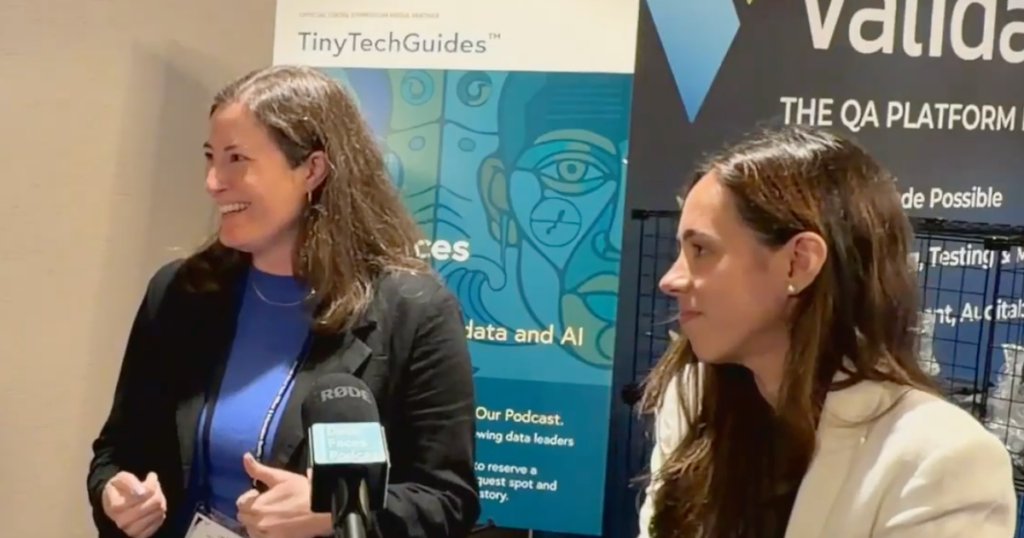
In late July, I had the good fortune to spend three days at the 20th annual CDOIQ Symposium at the Hyatt Regency in Cambridge, Massachusetts. TinyTechGuides was the official media partner this year, so I set up at booth 21 with a camera and a couple of chairs and spoke to some of the greatest minds in data, analytics, and AI. I pulled data and AI leaders aside between sessions and asked them what they were actually seeing. The people who sat down included data leaders from Capital One, ADP, Apple, Intuit Credit Karma, and H-E-B, alongside the analysts, authors, and educators who built this field over the last two decades.
Twenty-four conversations later, one concern kept surfacing in different words. Nobody at the event was afraid of the LLMs themselves. They kept coming back to what happens when you point a confident, tireless system at a data foundation that is built on a house of cards. Stacie Christensen of H-E-B said it as plainly as anyone. “AI is a multiplier and a scaler, not a fixer,” she told me. “If the foundation underneath it is broken, there’s nothing positive to scale.” That is the fear underneath the fear, that AI will faithfully amplify whatever mess it inherits and do it faster than anyone can catch.
Three themes ran through most of the conversations. Below is the whole roster with a key point from each, and a link into the full write-up for each theme. Every leader shared real-world, practical insights, so use this as your map and follow the ones that speak to your own work.
Agentic AI and the context problem
Agentic AI was the pervasive topic on the floor this year. Everyone wants agents, and almost nobody has the data plumbing to feed them. And you know what they say about plumbing? Sh** runs downhill. So what exactly are all these agents supposed to run on?
- Stewart Bond, IDC: Latency is the enemy of agentic AI, and the centralized data lake may already be obsolete.
- Kevin Petrie, BARC US: In BARC’s survey, 70 percent of companies say less than half of their unstructured data is usable for AI.
- Capital One (Amy Lenander and Christina Egea): Treating data like a product launches use cases three times faster and cuts maintenance cost by 30 percent.
- Amin Venjara, ADP: Value equals data plus capabilities, so run the internal data platform like a product people choose to use.
- Douglas Laney, Infonomics: The first billion dollar business run by a handful of people and a swarm of agents is coming.
- Terry Dorsey, Denodo: Perfect data quality is a myth, and quality really sits in the eye of the consumer.
- Steven Moskowitz, Industry Forward: Manufacturing runs on wide data, and cognitive KPIs measure how AI changes thinking, not just usage.
Check out the full recap in Agentic AI is only as good as the data you feed it.
The CDO role at 20 years
Thanks to Richard Wang and Stuart Madnick, along with many others, CDOIQ is where the chief data officer role was born, so the 20th anniversary put the job itself on the table. If the job description changes every single year, how do you know when you have the right person in the seat?
- Randy Bean, Data & AI Leadership Exchange: If you are not getting measurable business value from AI, go back to the office and shut it down this afternoon.
- Richard Wang, MIT CDOIQ: The role went from one researcher’s dream to more than 2,000 CDOs, and data archaeology is the tax you pay when you lose the people who hold the knowledge.
- Stuart Madnick, MIT: By every measure he has seen, attackers are using AI more aggressively and efficiently than defenders.
- Peter Aiken, Virginia Commonwealth University: The best CDOs have been fired three times, and data belongs in the business rather than in IT.
- Mark Ramsey, Ramsey International: A shadow pit crew forms when the CDO does not own data access, and half of CDOs do not survive three years.
- John Ladley, author and advisor: ChatGPT built the rudiments of a data model in 38 seconds, and a 40-year-old profession still has not figured out its 1.0.
- Leigh Felton, AI for Job Security Foundation: You cannot de-bias a system built to recognize historical patterns, so govern AI like an environment.
Read the whole conversation in 20 years in, the chief data officer’s job is being rewritten.
Data quality and trust as the AI foundation
Agentic AI drew the crowds and the CDO role got personal, but data quality was the theme nobody could avoid. Well, it was the CDO IQ (Information Quality) event, so what did you expect. How can you trust what AI tells you when you cannot trust the data underneath it?
- Tom Redman, the Data Doc: Only 3 percent of companies he tested met basic data quality standards, and the follow-up work suggests no improvement since.
- Fern Halper, AI Foundations Group: AI will expose every weakness your company has, and trust in unstructured data trails structured data by roughly 20 points.
- Stacie Christensen, H-E-B: AI is a multiplier with nothing positive to scale when the foundation is missing, so govern at the moment of data creation.
- Leticia Naqvi, Apple: Data maturity is the AI readiness pillar everyone forgets, and it sits under every AI output you will ever trust.
- Danette McGilvray, Granite Falls Consulting: Most data cleanup is a crime scene where nobody investigates, so start by asking whether anyone actually cares about the problem.
- Jonathan Agee, Validatar: The state of data quality earns a C, and prevention belongs in development the way QA does in software.
- Kelley Kassa, BARC US: Only 9 percent of finance AI in North America is in production, because the agent does not go to jail when the number is wrong.
- Gwen Thomas, The Data Governance Institute: Organizations govern for the same reason cars have brakes, so they dare to go fast.
- Dan Everett, Insightful Research: AI adoption is really change management, and claimed productivity gains shrink once experts validate the output.
- Intuit Credit Karma (Veenit Shah and Puneet Singh): An AI remediation agent cut root cause investigations from 30 to 40 minutes to a few, across 40,000 columns.
See what these data leaders had to say in AI will expose every weakness in your data.
What I heard across three days
Twenty-four conversations, and one common thread ran through all of them. The leaders getting real value from AI had done the unglamorous work first, the governance, the ownership, and the data quality that lets an agent act on something true. Tom Redman put a number on how rare that still is. Kevin Petrie showed how much unstructured data is not ready. Randy Bean gave everyone permission to kill what is not working, and Stacie Christensen named why it matters, because AI multiplies whatever you hand it.
What it came down to was this, handing a fast, confident system a shoddy data foundation nobody trusts, then watching it scale the mess while the whole thing circles the drain. Every leader in that room already knew what to do about it, and most of them have been building toward it for 20 years. AI just raised the stakes on finishing the job.
All 24 conversations are live on the Data Faces Podcast on-location hub. New interviews and studio episodes drop every couple of weeks, and I would rather you hear these leaders in their own words than take my summary for it.
Frequently asked questions
What is the CDOIQ Symposium?
The CDOIQ Symposium is the flagship annual event for chief data officers and data leaders, founded out of the data quality research programs at MIT and held in 2026 for the 20th time at the Hyatt Regency in Cambridge, Massachusetts. It gathers data and AI executives, academics, and practitioners for sessions and working conversations on data quality, governance, and the evolving role of the chief data officer. TinyTechGuides attended as the official media partner and recorded 24 on-location interviews for the Data Faces Podcast.
What are data and AI leaders most worried about with AI right now?
Based on 24 conversations at CDOIQ 2026, the dominant worry is about the foundation underneath the models rather than the models themselves. Leaders repeatedly described AI as a multiplier that faithfully scales whatever data quality, governance, and context it inherits, which means weak foundations produce fast, confident, and wrong results. Data quality, unstructured data readiness, and ungoverned agents were the three fears that came up most.
What were the three themes from CDOIQ 2026?
The 24 interviews grouped into three themes. The first is agentic AI and the context problem, meaning agents cannot act without real-time, governed data where it lives. The second is the chief data officer role at 20 years, and how AI is rewriting the job in real time. The third is data quality and trust as the foundation every AI output depends on. Each theme has its own detailed write-up linked from this page.
About David Sweenor
David Sweenor is the founder and host of the Data Faces podcast, where he talks with the people who are making data, analytics, AI, and marketing work in the real world. He is also the founder of TinyTechGuides and a recognized top 25 analytics thought leader and international speaker who specializes in practical business applications of artificial intelligence and advanced analytics.
With over 25 years of hands-on experience implementing AI and analytics solutions, David has supported organizations including Alation, Alteryx, TIBCO, SAS, IBM, Dell, and Quest. His work spans marketing leadership, analytics implementation, and specialized expertise in AI, machine learning, data science, IoT, and business intelligence. David holds several patents and consistently delivers insights that bridge technical capabilities with business value.
Books
- Artificial Intelligence: An Executive Guide to Make AI Work for Your Business
- Generative AI Business Applications: An Executive Guide with Real-Life Examples and Case Studies
- The Generative AI Practitioner’s Guide: How to Apply LLM Patterns for Enterprise Applications
- The CIO’s Guide to Adopting Generative AI: Five Keys to Success
- Modern B2B Marketing: A Practitioner’s Guide to Marketing Excellence
- The PMM’s Prompt Playbook: Mastering Generative AI for B2B Marketing Success
Follow David on Twitter @DavidSweenor and connect with him on LinkedIn.
Related Posts
Build data products for the hundredth use case
Your AI stack will be wrong in 12 months