

Data Faces Podcast — On Location · CDOIQ Symposium 2026
Dan Everett, owner of Insightful Research, on the psychology of AI resistance, what productivity studies actually show, and his data parody songs.
Listen: YouTube · Spotify · Apple Podcasts · Amazon Music
About Dan Everett

Dan Everett is the owner of Insightful Research, where he brings more than 25 years in data and analytics together with behavioral psychology to help organizations align data and AI initiatives with how people actually work. His path into brain science began when his son was diagnosed with autism, and he moonlights as the writer of data parody songs, including a free EP recorded for CDOIQ 2026.
In this interview
- How human psychology, social threats, and cognitive biases shape resistance to AI and data initiatives
- Why claimed productivity gains shrink when output still needs domain experts to validate it
- Why the urgency around AI agents is forcing organizations back to data quality fundamentals
- How Dan turns data topics into parody songs, from an AC/DC rewrite to a rockabilly governance track
→ Browse all on-location interviews: Data Faces Podcast — On Location
Full transcript
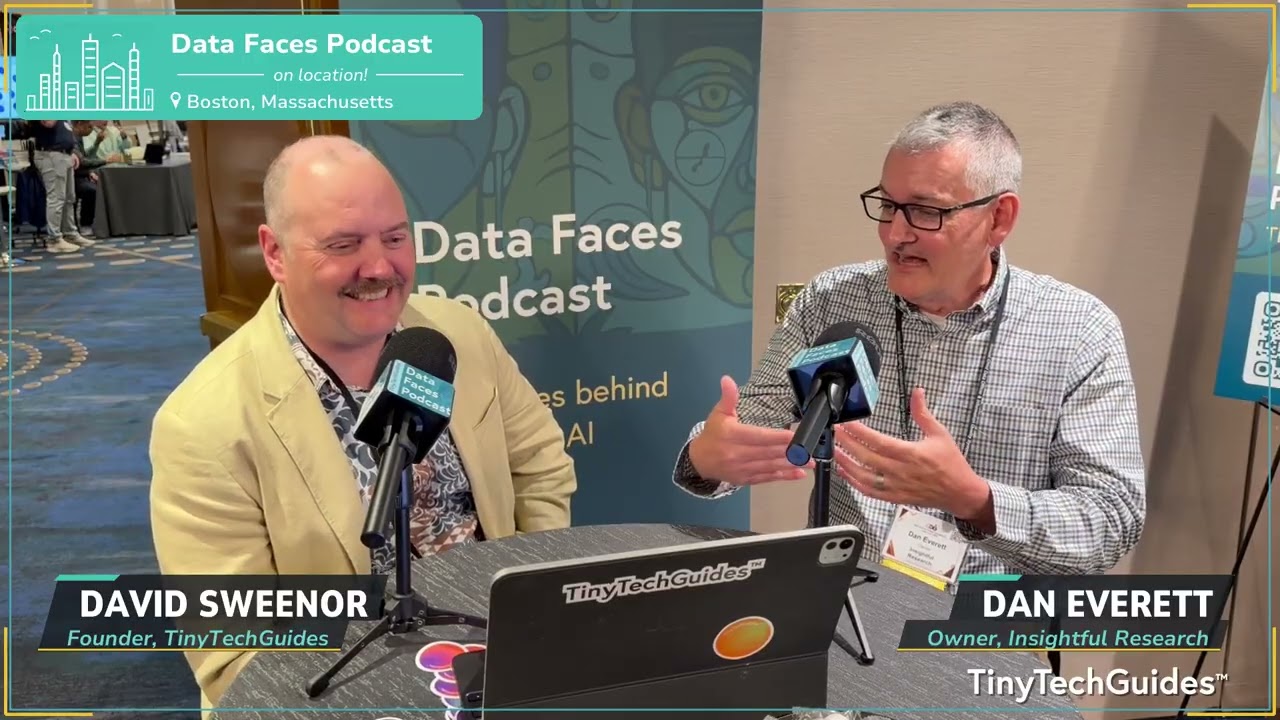
David Sweenor 0:02 All right. Hello, and welcome to the Data Faces podcast. On location, we are coming to you live from the CDOIQ event in Cambridge, Massachusetts, right next to MIT. Right now, I am joined by Dan Everett of Insightful Research. He is the owner of that. And Dan, welcome to the Data Faces podcast. Well, thanks for having me on. Hey, can you tell us a little bit about yourself, company, what you do?
Dan Everett 0:28 Yeah, so I’ve been in the data and analytics space for about 25 years. And for about that long, when my first child was diagnosed with autism, I started down a path of understanding how the brain processes information and makes decisions. And so over the years, what I’ve come to realize is that the things that I was learning to help my son can actually help data and analytics and AI companies trying to do that. Because if you think about it, it’s all change management. Okay. Right? I’m serious. People the way that people respond to that there’s often social threats right that stand in the way Okay, you know so sure we keep saying data or keep seeing people is the biggest problem in Data governance and data management just in general right forget to take away that people are just the biggest problem, okay, you know But we keep focusing on technology right right, but if you think about it So we’re going to move to a data products approach to analytics. Okay. So I come to you. You’ve been writing reports for your boss for 10 years, and you’re like the subject matter expert. You get lots of praise. You know all that work you were doing for your boss? You don’t have to do that anymore. AI’s done it for me. And instead of like, that’s not a good thing, now you’re threatening my sense of worth and importance to the company. As opposed to an approach of like, hey, we’re going to move to this data products approach. and we really need your help and your understanding based on what you do to make this successful and we’d like to move you to become part of this team that we’re building around this. So the whole understanding human psychology and threats and rewards and cognitive biases Right, can help us shape how we talk about these things and mitigate some of the resistance that we run into.
David Sweenor 2:30 All right, we’re going to dive into that in just a second. The name of the show is Data Faces. Yes. And so I like to get behind people in their professional careers. So, icebreaker, what did you want to be when you grew up?
Dan Everett 2:49 You know, I wasn’t one of those kids that had, like, I want to be this. I sort of, like, stumbled along, and then, you know, all of a sudden relational databases became popular, and that’s where all the jobs were. That was when you looked through the newspaper, you would circle the jobs, right? Sure. And so then I downloaded Oracle in 2015, pieces and put it together on my computer and I taught myself sequel. And then that’s how I got into dating.
David Sweenor 3:30 You didn’t know what kind of what you wanted? I didn’t know what I wanted to be when I grew up. I had no idea. People ask me like, what did you want to do? I’m like, I don’t know. I do stuff. I probably should be on my business card. I just do stuff. What do you do? Well, whatever I want to do. All right, so you talked a little bit about the psychology and trying to move organizations from point A to B because change is hard, right? We’ll look at Spencer Johnson’s, who moved my cheese? We got Hemingway. And so how does a leader approach this? Because to your point, AI is coming for my job. There’s a fear. Do I want to train it? Do I want to even be helpful? And so how should a leader think about this?
Dan Everett 4:14 Well, I think you have to be honest. So if your perspective is really, we’re going to automate everything and get rid of people?
David Sweenor 4:25 Well, don’t you think that’s what a lot of people… I think process productivity is what I hear about, right?
Dan Everett 4:31 You’re not hiring more people, for sure. I think that there is a lot of that, right? So, I mean, if that’s your message, you’re going to get pushback. Sure. I’m sorry. But, you know, if you look, there’s been several studies recently where… the productivity gains that are being claimed are much lower because there’s productivity up front, but the productivity, the workload gets shifted to the back end because people still need to, unless you want AI work slop, you still need to. Yeah, yeah, you’re right. Yeah, you still need to validate the output. And so the work is just shifting. I’ve talked to several people in different, marketing, in software development, in data engineering, they’re all saying the same thing. The work efficiency is much smaller than what people are claiming, and the workload is getting pushed, but the output is better.
David Sweenor 5:25 Okay, the output is better.
Dan Everett 5:27 Yeah. After it’s been vetted and reviewed and claimed. But you have to vet it, right?
David Sweenor 5:31 Yeah, you still have to do all that stuff.
Dan Everett 5:33 And you have to have the domain knowledge to validate it, right? So it’s not so much… There is some small efficiency, but it’s small efficiency but better output if you have the right people in place to validate the output.
David Sweenor 5:51 Right. You know what’s interesting? So this reminds me, I used to be way back when, like a business analyst, and this was when… say outsourcing to lower wage countries was still out there, but it was running hot and furious. And so as a business analyst, I had to do like three times as much work because I had to write the requirements. You send it off. Maybe my requirements weren’t that great. That’s fine. They wouldn’t ever question them. They would implement them exactly as specified and not tell you you’re going to run off a cliff. Right. You come back, so there’s an iteration there, and then you’ve got to go fix it and validate it. So I think that’s what you’re saying. It’s essentially the same parallel. I see it in marketing today. So, you know, doing marketing, people are like, oh, here’s the output. I’m like, this is clearly AI slop. Go redo it. Don’t even send this to me anymore. That’s what’s going on today.
Dan Everett 6:45 I think that that’s what’s going on. That’s my opinion. yeah yeah okay so what else is going on over at insightful research hmm well I have a very kind of quirky mind okay and so I like to make music parody songs, data parody songs. That’s very niche.
David Sweenor 7:17 Yes, it’s very niche. Data music parody.
Dan Everett 7:20 Yeah, and then I put them to music.
David Sweenor 7:25 So I’ve got three on my YouTube channel right now. I’ll have to check that out.
Dan Everett 7:29 The Pain of Silos. You know? Yeah. AI is swell. And context. Okay. Because everybody’s talking about context.
David Sweenor 7:40 We’ll have to get the links to those and put them in the show notes. That’s super fun. And are you a musician or using AI to do all the music?
Dan Everett 7:46 So originally it started, I saw somebody. Yeah. I saw somebody on LinkedIn and I thought, oh, that looks really fun, because it’s things that I like to do. So, I, so like, ACDC Highway to Hell. So, I took that and then I wrote the lyrics of Generative AI’s Swell. And then I got the karaoke version on YouTube, and I sang it, and then I put all the video together.
David Sweenor 8:14 Okay.
Dan Everett 8:14 Okay, but now, those are on LinkedIn. But now on the YouTube channel, I’ve got Suno. Sure, yeah, I’ve tried that out, yeah. I give it my lyrics, then it will put it in any, like, you want hip-hop, you want rock. Country, whatever you want. Any genre you want. Super good, too. Yeah, I just did governance is hot in the rockabilly style.
Speaker 3 8:35 Ha!
Dan Everett 8:36 I did an EP for the CDO IQ 2026. Okay. Yeah, I made it free for everybody to download.
David Sweenor 8:43 Do you think it’s Grammy worthy? No, but it’s entertaining as hell. You’ve got to get the golden record, baby. You never know. That’s one of the songs I’m working on.
Dan Everett 8:52 Golden years, bop, bop, bop.
David Sweenor 8:55 That’s awesome. And what’s been the YouTube reception? Lots of likes and views and comments?
Dan Everett 8:59 You know, I mean, there’s some, you know, but I mean, it’s not, as you said, it’s very niche.
David Sweenor 9:04 Well, there’s a need for that. There’s a couple other people that have been on my podcast. People that…
Dan Everett 9:11 They like it. People want to laugh. Right. Exactly.
David Sweenor 9:14 We’ve got a lot of gloom and doom in the world. I’ll tell you that right now. So, yeah. Okay. All right. Who knew where this was going to go? Well, you never know. This is the Data Faces podcast, so we can talk about… whatever whatever we want so what has been your perspective have you been this is my first time at the event okay first time and what’s your sort of read of the room what are people thinking about what are they concerned about really worried about their fears their stuff
Dan Everett 9:48 I think what’s really interesting is that the AI and agentic AI is like that’s all everybody’s talking about but if you actually talk to people it’s still the basic blocking and tackling of like how do we clean up our data right right and and how do we you know catalog everything and all these other for lack of a better term basic there i mean you know the fundamental things right and that hasn’t changed it’s like we’re still All it’s done is said, oh, shit, now we actually need to do something. Because before, we need to get something out. Speed was the metric. And so data quality came second. And now, if you want the speed of AI agents without getting into big trouble, you need to go fix the data now.
David Sweenor 10:44 Do you think data quality… Are people… still thinking about when they talk about data quality rows and columns and numbers because there’s the whole unstructured side of thing but most of the vendor solutions I see and everybody’s like it’s sort of the traditional perspective of data quality not a lot of people say I got 18 PDFs as an example of unstructured All with different names, like the same PDF, V1 through V whatever, final, final, final. And so just when people say data quality, what’s in their mind? Are they thinking unstructured or are they just mostly centered on the sort of the transactional things we’ve always been focused on?
Dan Everett 11:32 I think both. I think, you know, you come here. And it’s more traditional data management. Sure. Right. And so that’s that’s the first thing. But I think organizations realize that, you know, they’ve got all of these documents and everything that they need to take care of. And I mean, there are some if you look around, there are some vendors now, right, that are addressing that unstructured piece. I just I don’t know, maybe a week or so ago wrote an article in my newsletter on LinkedIn on from critical data elements to critical documents and records and using that same methodology of how do you ensure provenance by maintaining metadata throughout the RAG pipeline so that it doesn’t get stripped out. It was super popular. A few people asked me, can you put that in a PDF and share it with me?
David Sweenor 12:25 Because I want to share it around the…
Dan Everett 12:28 I think that people are thinking about it, but they’ve been in different worlds and we need to I don’t know, maybe we’ll still have, it’ll be the data management people, it’ll be the content management people, and it’ll be the, I don’t know, but at some point, they have to come together. They have to come together. I feel like it’s still, I feel like it’s separate. I don’t know organizationally how we’re going to make that happen, but yeah, they have to come together.
David Sweenor 12:53 Yeah, okay. Earlier, we spoke a little bit about, actually, let me switch gears. You just mentioned metadata.
Dan Everett 13:01 Yeah.
David Sweenor 13:02 And there’s, you know. A million times more metadata than data. I asked Stuart this question, but I’m gonna ask you too. Okay. We have to be worried about metadata quality. since that’s providing the context for all of your models. So is that going to be a whole new discipline? Metadata governance. Okay. How are we going to even ascertain the metadata quality? We can’t even get regular data quality right.
Dan Everett 13:29 You’re going to create a canonical metadata schema.
David Sweenor 13:34 Okay. Oh, my gosh.
Dan Everett 13:37 No, no, no. Look, look.
David Sweenor 13:41 Data governance?
Dan Everett 13:42 Model governance? We can have metadata governance. We’ll have decision governance and orchestration governance and security governance. But what do you think about the term governance? Like, nobody wakes up in the morning and says, I want to be governed today.
David Sweenor 13:54 Like, it gets a bad rap. It’s just necessary. People hate the term. People don’t want to buy it unless they’re forced to buy it.
Dan Everett 14:03 No, nobody wants governance because that’s a threat to their autonomy. Can we have both? Can we have both? Autonomy and governance? Yeah. Oh, you want data mess. I mean mesh. Data mess. Oh, oh. Can I not say that? You can say whatever you want.
David Sweenor 14:20 We’re on the pod.
Dan Everett 14:21 All right, all right. All right.
David Sweenor 14:23 The data’s a mess, and it’ll always be a mess.
Dan Everett 14:25 The data’s a mess, and it’ll always be a mess. How long have you been in the data and analytics?
David Sweenor 14:34 A long time, especially by my lack of hair.
Dan Everett 14:36 Okay, yeah, you got it all pulled out.
David Sweenor 14:38 That’s right, she pulled out my hair.
Dan Everett 14:40 And we haven’t fixed the problem. No. We’re not going to fix the underlying problem. What we’ll fix is, for a particular use case, can we get the right data with the right quality and the right unstructured data to go with it, right? And the rest, like…
David Sweenor 15:01 It’s not going to happen. Okay. All right. All right, Dan. So, Dan, where can people subscribe to your newsletter, find a little bit more about you and what you do if they’re interested?
Dan Everett 15:16 Sure.
David Sweenor 15:17 LinkedIn and then insightfulresearch.com. All right. Well, thank you for being a guest on the Data Faces podcast on location. Great. Thank you. It’s a pleasure. Nice. Music. I’m going to go find it. I’m going to put that in an overlay.