

Data Faces Podcast — On Location · CDOIQ Symposium 2026
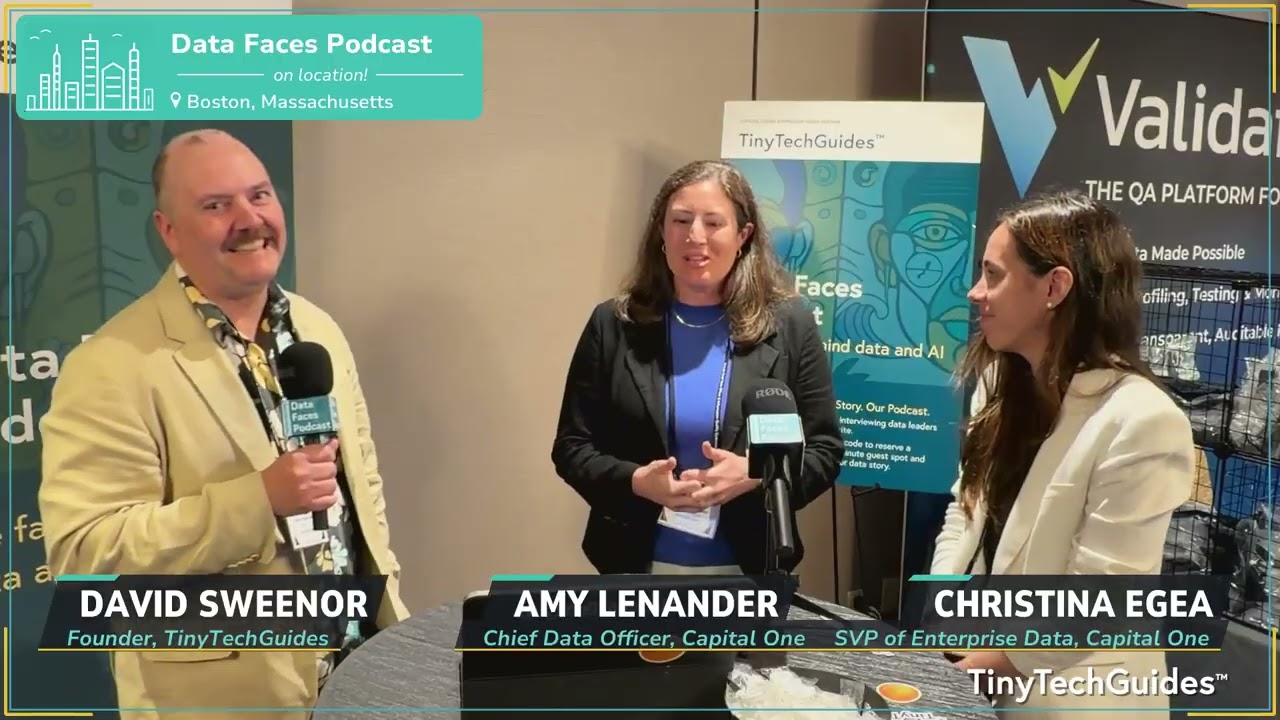
Amy Lenander and Christina Egea of Capital One on doubling down on data products, nine core data categories, single accountable owners, and use cases launching three times faster.
Listen: YouTube · Spotify · Apple Podcasts · Amazon Music
About Amy Lenander and Christina Egea
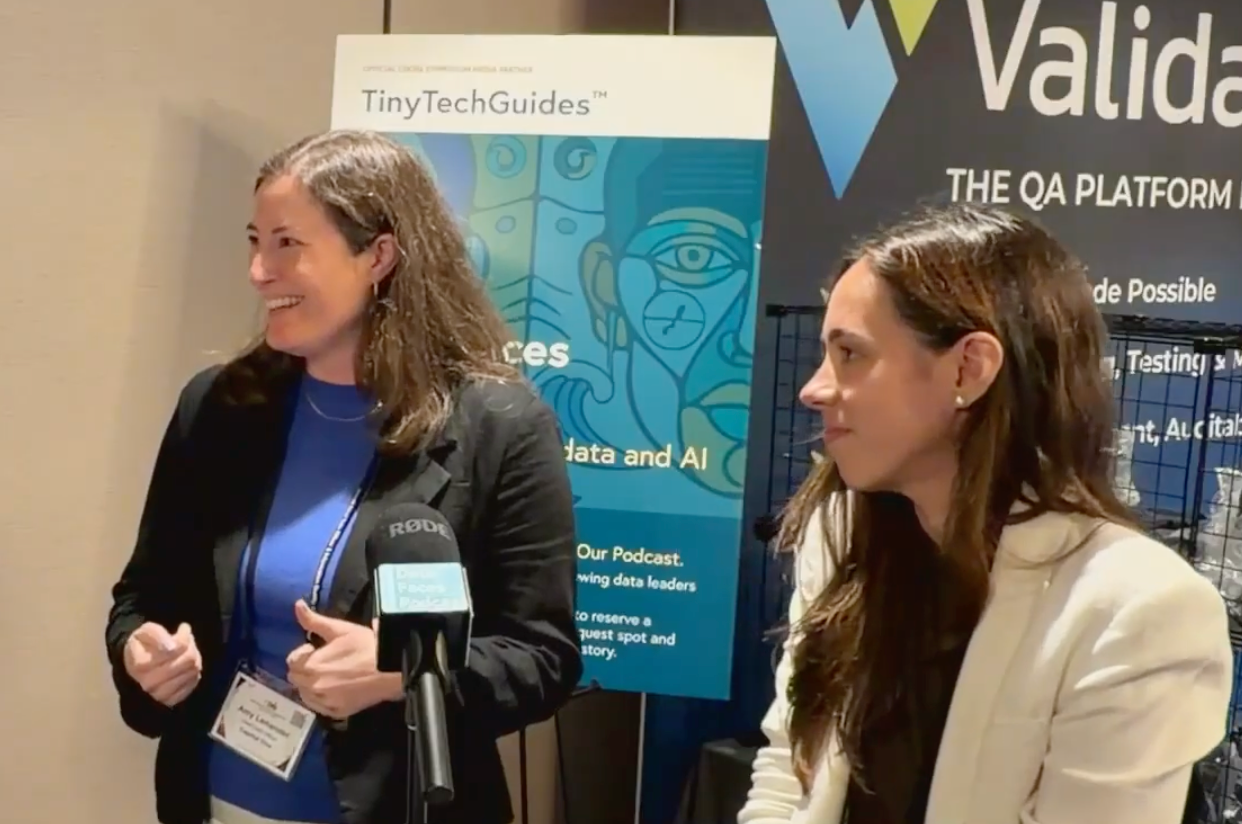
Amy Lenander is Chief Data Officer at Capital One, where she leads the data strategy for a business serving more than 100 million customers. Since joining in 2003 she has run the No Hassle Rewards program, served as Head of International and CEO of Capital One UK, and led the Navigator car-buying platform. Christina Egea is SVP of Enterprise Data at Capital One, leading the product and data teams that standardize, protect, and operationalize the company’s data so people across the business can easily find, understand, and trust it.
In this interview
- How a usage analysis revealed nine core data categories to build products around
- The lifecycle of a data product, from scoping and ownership to ontology modeling and data assets
- Why a business-first background helps a CDO prioritize the data that matters most
- How listening to customers drives adoption, from easier migration to closing the missing 30%
→ Browse all on-location interviews: Data Faces Podcast — On Location
Full transcript
Amy Lenander 0:00 Just about where the microphone is.
David Sweenor 0:02 And how do I pronounce your name? Amy.
Amy Lenander 0:03 I’m Amy Lenander.
David Sweenor 0:05 Lenander.
Amy Lenander 0:05 Christina Egea.
David Sweenor 0:07 Christina Egea.
Amy Lenander 0:08 Okay.
David Sweenor 0:09 And your titles are CDO and…
Amy Lenander 0:13 Senior Vice President.
David Sweenor 0:14 SVP, right?
Amy Lenander 0:15 Yep. You got it.
David Sweenor 0:18 All right. Are you ready? So I’ll do a quick intro. I’ll just ask you to introduce yourselves, what you do, capital one.
Amy Lenander 0:26 Sounds good.
David Sweenor 0:27 Jump in, and we’ll hit the 10, 15-minute mark, and we’ll be done.
Amy Lenander 0:30 Okay. Sounds great. All right.
David Sweenor 0:31 Ready? All right.
Amy Lenander 0:34 And you’ll let us know if the sound isn’t good, right?
David Sweenor 0:39 Hello and welcome to the Data Faces podcast. On location, we’re coming to you live from the CDO IQ event in Cambridge, Massachusetts, right next to MIT. Standing next to me is Amy Linander. She’s Chief Data Officer at Capital One and Christina Egea, SVP of Enterprise Data. Welcome to Data Faces podcast.
Amy Lenander 0:56 Thank you.
David Sweenor 0:57 So, Amy, can you tell us a little bit about what you do at Capital One? What’s your role? What do you do?
Amy Lenander 1:02 Sure. I mean, as you said, I’m the chief data officer at Capital One. That’s a tall order. Yeah. And it means, you know, different things in different places. So what it means at Capital One is that I’m accountable for setting and driving the data strategy across the company. And my team manages the data platforms that help ingest, move, store, govern data across the company.
David Sweenor 1:28 Okay, and how about yourself, Christina?
Christina Egea 1:31 Yeah, thanks for having us. I am on Amy’s team, and my team works on building and managing a bunch of the platforms Amy described, inclusive of our data product strategy and some of the work we’re doing to make trustworthy, curated data available to everyone in the company who needs it.
David Sweenor 1:49 Okay, and it’s a pretty large organization, right? So you have a gigantous data ecosystem, I would say, right?
Amy Lenander 1:56 Yeah, and getting bigger now that Discover is part of our world and Rex is part of our world. We’re getting more and more data.
David Sweenor 2:03 Okay, okay. And you guys had a talk today, so can you tell us just a little bit about what was the talk, what was the name of it, and what did you talk about?
Amy Lenander 2:11 Sure, I’ll start and you can jump in. So our talk was doubling down on data products to drive business value. And I had given a talk last year about our data transformation broadly at Capital One. And by far the thing people were most interested in was data products. So this time we doubled down. And we had a very interested audience. And we were mostly talking about how we do data products at Capital One and how some of the things that we do are different from other companies and their implementations of data products.
David Sweenor 2:42 Okay, okay. And you’ve got firsthand experience of all these data products, right?
Christina Egea 2:47 That’s right.
David Sweenor 2:48 And what sort of questions or key points were you making in the talk?
Christina Egea 2:54 There’s a couple of things I think we talked about. One being just in general, I think different companies are at different levels of data maturity and the importance of really strong kind of top-down buy-in on your data strategy and the investments you need to make. I always tell folks, like, I feel so lucky because you can’t find anyone at Capital One who doesn’t love data. I think not every other company has that benefit. So that has been a key part of our success. Then we spent a lot of time talking about what does it take to curate data that’s really usable? How do you build data product frameworks with the right ownership so that the right folks in the company are held accountable for their data and have the right both incentives and support to build great data that will work for everyone in the company who might need it. And so we talked about some of that and just the challenges we face, as Amy said, like, you know, we have a big history of a lot of data. We’ve acquired companies with complexity. So how do we take strategies that scale across that kind of growing footprint?
David Sweenor 3:49 Yeah, you know, it’s interesting. So you mentioned last year your session was, you know, a lot of interest in data products. I think there’s a lot of talk about data products, but I don’t think everybody quite gets it. Yeah, we’re pro data products, so. Okay, or they don’t know where to get started. So you take a little bit of a different approach to data products, right? And so maybe you could tell us a little bit about that.
Amy Lenander 4:14 Yeah, sure. So one of the things that we do that I think is most unique among companies I’ve talked to and what they do is being very intentional about curating the data that we want to manage as data products. So that means some of our most used data at the company because that’s really reused a lot across different lines of business. But it also means data that we think has a lot of value and maybe hasn’t been used much historically because it’s been hard to get at. So we’ve very intentionally started with the data products that we think have the most leverage to the company and really gotten the organizational support to build those data products, have one owner for each of them who’s making the calls and making sure that they all work together really well to get them going.
David Sweenor 5:03 That’s great. And then, you know, Christina, like data products, are they like, I always hear, well, it’s got to be specific to a use case. Are they more multipurpose than that? Because I can imagine you could have thousands and thousands of data products and we’ve got data sprawl all over again. We can’t find what we need to use.
Christina Egea 5:22 Yeah, it’s a great question. I think actually our starting point is We actually have a intentional, as Amy said, focus on having a smaller set, frankly, of the most important data products that are by nature reusable. And I think really making sure that we’re investing in a universe of data products that’s mutually exclusive, that the things don’t overlap, that they clearly link together but have boundaries is a place where my team spends a bunch of our time. And that… In most cases, I think we have use cases that help get them launched, but we focus a ton on making sure that the data product will scale, not just to a single use case, but to like the next, not just five or 20, but like 100 use cases and customers. And we’re really focused on building the core data at the company that everyone can broadly make use of and making sure it all connects together.
David Sweenor 6:12 Can you tell us a little bit about the process of how a data product comes to life?
Christina Egea 6:18 Yeah.
David Sweenor 6:18 So you mentioned there’s hundreds of use cases. You have a bunch of them now. And how does a new one come about?
Christina Egea 6:26 Yeah. There’s a bit of a top-down and bottoms-up perspective. We actually started on this journey by analyzing, as Amy said, all the data usage in the company and trying to understand, hey, all these people that are using all this data, what are the core categories of data or domains of data that are involved? And what we found was like, gosh, despite having a lot of breadth and depth, there were like nine categories of data that reflected most usage. And so we started by saying like, gosh, those are probably the first data products to go after. And so we started with that top down approach. We then over time have had each business unit evaluate their own data landscape and build more of a bottoms up view of like, what are all the data products they need? And then our team, centrally for the company, manages that overall framework and says, how do we make sure that this mosaic of data products is mutually exclusive, that we know how it links together, that we define the boundaries around it? And we manage the lifecycle from scoping those things and identifying owners to actually modeling the data, which we model into an ontology, to then building the data assets that support it, like APIs and streams and tables that ultimately bring it to life for use cases.
David Sweenor 7:32 Okay, that sounds like a very smart approach. And so, Amy, you led sort of the consumer business before your role here. So how does sort of this business-first mentality translate to your role as a CDO? Because a lot of CDOs are purely technical backgrounds, and so you’re maybe a little bit nontraditional to a lot of the CDOs I’ve spoken with.
Amy Lenander 7:55 Yes. So my background is working in the business as a business analyst who owns strategies related to marketing, to credit, to loyalty, and then eventually running whole businesses at Capital One. And I think that helps me in a few ways. One is that I know… where the leverage is in our businesses. So we want to prioritize the data that’s most important to the businesses and is going to have the most relevance across the company. And I come in sort of knowing that from the start, which helps us prioritize where we focus because So there’s so much you could do in data, it’s just endless, the things that you could make better, but knowing which are the things we’re gonna make better that are really important for the business is where that background comes in. The other place it comes in is really having empathy for our business partners. We have an interesting role in our enterprise team where the businesses are both our customers, we do things on their behalf to make them successful, But also, to drive the data strategy, I often need to get the business to do a thing, often that they don’t want to do, but it’s good for them, like eating their vegetables.
David Sweenor 9:09 Right, right.
Amy Lenander 9:10 So it’s really helpful for me to have the empathy and credibility to push them on, like, yes, you do need to do this right now, and the excuses you have aren’t really… We’re not buying them, but that’s right. Or like, yeah, I get that that thing you’re saying you have to do is really important for the company. I totally get it. Like, let’s find another way to get this thing done.
David Sweenor 9:32 Okay.
Amy Lenander 9:33 So it’s been very helpful from a partnership perspective as well.
David Sweenor 9:36 Yeah, to just have that background and empathy in some cases, for sure. So, Christina, what’s the hardest part about building data products and get them adopted at scale?
Christina Egea 9:51 I think there’s many things that are hard. I think the hardest We’re wearing dirty laundry here. I think the hardest part is probably getting started. And I think ultimately the biggest thing I felt in this role over the last three years is this tension between, gosh, how do we move faster? And why can’t we get to market faster and buildings more quickly to, oh my gosh, if you move that fast, how could you be doing it right? How could you be trucking all your customers? How could you be building something that’s reusable? And recognizing that tension of, like, the fastest thing to build is the thing for a single use case. The harder thing to build is the thing that will scale. And finding the balance between those things while getting better over time. Like, that tension is, I think, at the heart of the strategy that we’ve been driving. And I think getting started is hard. We have much more momentum on the other end of building this first set of data products, having people not just once but twice or five times or 20 times adopt them and getting that kind of flywheel going.
David Sweenor 10:53 Okay. You know, I mean, how, everything starts with good intentions. And maybe some things that you thought were going to be spectacular, maybe they’re slower to be adopted. So how do you drive adoption when you’re like, hey, I got the greatest data product ever. Why aren’t you guys using it?
Amy Lenander 11:15 Yeah.
David Sweenor 11:16 I’d love to hear that. Yeah.
Amy Lenander 11:18 Well, the first thing is to listen to the answer when you actually ask that question to stop pushing and start listening. Okay. To say, okay, customers, like, why?
David Sweenor 11:28 It’s not the right product.
Amy Lenander 11:29 Like, why aren’t you using this? And they might say, you know, it’s going to be really painful for me to change what I’m using today to using that. One of the things Christina was talking about in our talk earlier was how it’s a lot easier to get someone to adopt a data product when they have a brand new use case. than when they have to displace the data feed they normally have in their existing use case to then use the data product. Extra work. Yeah, even though they know the data product is better, they’re like, oh, but is it really worth the extra work? So, I mean, that would tell us, like, oh, well, we need to… There’s not a problem with the data product. There’s a problem with… The thing we can do is make it way easier to adopt. What tools can we create to make it easier for them to use the product that they know is better? I might also say, go look for those new use cases where you don’t have that incumbent debt, for example. But it might also be like, hey, actually, your data product covers 70% of the data I need. 70% isn’t enough because I’m not going to use that instead of my other thing that actually covers 100%. Then you need to listen, build in that 30%. And so much of data in general, but also data products in particular, is about really understanding your customers and talking to them. I mean, they don’t pay for your data, but they walk with their feet. So you need to really deeply understand them like a good product manager would.
David Sweenor 12:55 Sure. Okay. That’s, that’s, that’s really, that’s, that’s really interesting. So Christina, you know, what are just some of the benefits, you know, your organization has realized from, you know, just this data product approach versus maybe how you were doing it in the past?
Christina Egea 13:13 Well, I think I would start by saying I think our investments in data products stand on the shoulders of all our foundational investments. We benefit a ton from having built out a core set of platforms, catalogs, an integrated lake. I think we would not be in the starting point we’re in if we didn’t have that foundation and our data products built on top of that. The benefits that I think we then harness as a collective organization, we’re seeing stuff like three times faster time to market for use cases that launch on data products versus how it worked before. We’re seeing things like 30% less cost to maintain data once it’s in a standardized data product with our higher quality bar. So those benefits just like accrue and accrue and really are the outcome of a bunch of other ecosystem investments that Amy has been driving across kind of our data system overall.
David Sweenor 14:02 Okay. Well, this has been an amazing conversation. We could go on and on, but I want to be respectful of your time. So Amy, Christina, Capital One, thank you for joining the Data Faces podcast. I appreciate it.
Amy Lenander 14:13 Thank you. Thanks for having us. Cheers. It was fun. Yeah, thank you. Thank you.