

Data Faces Podcast — On Location · CDOIQ Symposium 2026
Randy Bean, founder and CEO of the Data & AI Leadership Exchange, on 12 years of CDO panels, where the role is heading, and his mid-year read on the AI bubble.

Listen: YouTube · Spotify · Apple Podcasts · Amazon Music
About Randy Bean
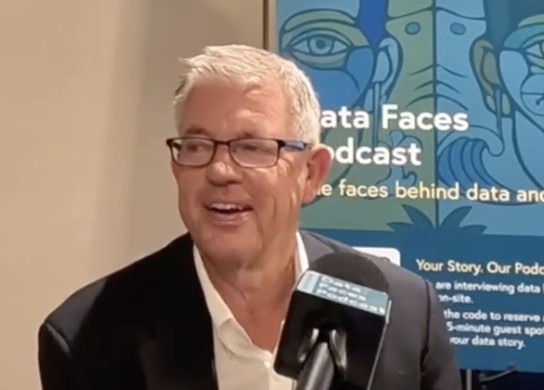
Randy Bean is the founder and CEO of the Data & AI Leadership Exchange and a longtime chronicler of data leadership. He founded the consultancy NewVantage Partners, wrote Fail Fast, Learn Faster, and has organized the CDOIQ Symposium’s Chief Data Officer panel for 12 years, giving him a front-row view of how the role has changed.
In this interview
- How the CDO role moved from risk and compliance to a business-value mandate
- Where CDOs report today, with 42% under technology and 33% under business leadership
- Why churn at the top of the panel signals a fight to control AI’s future in the enterprise
- Randy’s bubble call, AI is overestimated in the short term and underestimated in the long term
→ Browse all on-location interviews: Data Faces Podcast — On Location
Full transcript
David Sweenor 0:00 Roll with it. All right, you ready? And is this on visual too? Yeah, we’re recording.
Randy Bean 0:05 Yeah. OK. Good?
David Sweenor 0:07 Can I just put this here? Put what there? Oh, yeah. I’ll ensure. That’s fine. That’s on the site right now. OK. All right, ready? Hello and welcome to the Data Faces podcast on location. We’re coming to you live from the CDOIQ event in Cambridge, Massachusetts, right next to Boston. I am sitting next to Randy Bean. He is the founder and CEO of the Data and AI Leadership Exchange. And Randy, welcome back to the Data Faces podcast.
Randy Bean 0:36 It’s great to have you here. Nice to see you again.
David Sweenor 0:39 And as I like to ask many of my guests to get behind their professional profiles, what What did you want to be when you grew up?
Randy Bean 0:50 Oh, I know the answer to that easy, because I tell people that. Because it’s the opposite of what I am now. I said I wanted to be either a poet or a rock star, but I didn’t quite have the talent or commitment to do either. So I wound up where I am now just purely by, you know, I went into business, into industry, At the time, the skills that they were training people on were to work with technology and computers to manage their data. So I was trained as a COBOL and assembler programmer. But I was always more interested in the data and how it could be applied so that organizations could make better decisions. And that’s really led what I’ve done for the past four and a half decades now.
David Sweenor 1:39 So a reporter or a rock star? A poet or a rock star. Did you have a particular instrument or do you play?
Randy Bean 1:47 A little bit of everything, but nothing very well.
David Sweenor 1:50 Okay, yeah, I’m not very good. So you did a panel today at the CDO. You had some leaders from a couple of pretty notable companies. What was the key sort of theme and topic and what were people talking about? What are they interested in? What are their challenges?
Randy Bean 2:07 Yeah, so this is the 12th year that I’ve organized the Chief Data Officer panel for the CDOIQ program. And this year I had Chief Data Officers from Lowe’s, Ford, and Humana. And the Chief Data Officer from Humana just came over from Starbucks a couple months ago. Last year I had Chief Data Officers from JP Morgan, Vanguard, New York Life, and the U.S. Space Agency. We really talked about the evolving role of the Chief Data Officer, particularly since this is the 20th CDOIQ program and I’ve been doing these panels for a dozen years. But the roles really evolved from a largely defensive risk regulatory and compliance to offensive and business-focused role. And then with the emergence and adoption of AI, particularly over the last four years or so, it’s really completely changed. transform for many organizations, not only their focus on data, but structurally how they’re managing data as an asset and where AI fits in that whole picture.
David Sweenor 3:22 Okay, and from the data perspective, are companies getting a handle on this? We’ve been talking about data quality issues for quite a while. I don’t know if it’s gotten any better or worse. Um… I mean, if you were to give companies a letter grade in general, you know, A through F, where do you think the industry is as a whole?
Randy Bean 3:47 Companies are asking the same questions that they did when I started my career 40, 45 years ago. So, you know, it’s, I mean, for me, what I focus on is the business value that investments in data and analytics and AI deliver. So what I often say to organizations is, in part to force them to think and to provoke conversation. I say, if you’re not getting measurable business value or have a clear path to measurable business value from your data and AI investments, I suggest you go back to the office this afternoon and shut them down. So, you know, you can spend all the time in the world that you want to on data quality, but, you know, for me, it’s all about delivering business value.
David Sweenor 4:32 It always starts with that. And are companies, when they’re thinking about business value… are they still in this AI is going to make us super productive and efficiency, or are they leaning more towards we’re going to reinvent our whole business process and more on the innovation front, right? Because I always hear a lot about the cost and not the revenue side of things.
Randy Bean 4:57 Well, I think companies are all over the place in terms of where they are in AI adoption, but I think that… Companies really need to think about how they can use AI to reinvent their businesses from top to bottom. But they also need to think about it from a long-term perspective. I think I said in the session today that technology transformations take time because it involves change, organizational change, people change. um change in roles responsibilities processes etc and it was uh just a few years ago during the pandemic that i was speaking with the chief digital officer the nation’s largest insurance company and they said to me you know randy we’ve done more to execute on our digital transformation stretch in the past six months than we did in the previous 20 years right right so it’s often not until there’s an existential uh requirement to do something that organizations really fundamentally undergo the transformation that they need to do. Otherwise, it’s experimentation, lip service, carving off pieces that are low-hanging fruit. But it’s not a reinvention of how they operate.
David Sweenor 6:12 Okay, okay. And then you mentioned that you’ve been moderating this panel for quite some time. You’ve had some of the largest companies in the world are a part of these panels. And you said, well, they’re kind of arguing about the same thing, but what’s new kind of in terms of the debate that is top of mind?
Randy Bean 6:33 Well, it’s funny because you said largest companies. I used to say that on these panels I’ve had everyone from A to W. I mean, American Express to Walmart, but then a few years ago I had the… Pet supply company Zoetis, so it’s literally been A to Z. Okay. You know, data has gone from something over the decades that was hidden in the back office to something that’s now part of the C-suite. So last year on the panel I had Teresa Heitzenrethert, who was Chief Data and AI Officer at J.P. Morgan, and she was in a unique position and one that I thought was exemplary in terms of a model for what other organizations could do. She was part of the 14-person operating committee reporting to Jamie Dimon, the CEO of JP Morgan. But again, this is a role in flux, and she’ll be retiring at the end of this year, and data and AI will be moving back under the technology leadership function.
David Sweenor 7:38 Okay. Is that the right place to house that function? I’m just curious. There’s always this debate, business versus AI and it should be an IT or business. What’s the best practice? What are people doing, I guess?
Randy Bean 7:50 Well, I mean, I will just say a couple things. That’s actually a question that I ask in the survey each year in terms of where the chief data officer reports. And In this year’s survey, 33% reported into business leadership, 42% reported into technology leadership, and another 23% reported into other places. Okay. I’m personally, even though that’s not where most of the chief data officers report, I’m a huge proponent of business. In other words, I think that’s the reason why we’re here. And technology, data, all of these functions need to… serve the business, ultimately serve your customers, make your customer experience better, and if they’re not doing that, then why are we here? And it doesn’t mean that technology leaders can’t be business leaders, but from my experience, the closer you are to the end business and the end customer, the more value you can deliver when the day’s done.
David Sweenor 8:58 Yeah, I think I would tend to agree with you because, you know, putting, you know, IT in general is a very risk adverse and there’s processes and controls and for business, you want that innovation and experimentation and, you know, like with models and analytics and AI, they fail, that shouldn’t be seen as a problem. That’s part of the process. Yeah. So in the business, that’s okay. IT is like, oh, well, you failed, you know.
Randy Bean 9:21 Well, there’s a joke I’ve told to audiences a number of times where they said, you know, where do you think the chief data officer should report? And I said to the chief sales officer, what? You know, that’s like the stupidest person. I’m like, no, they’re not the stupidest person. They’re the person that has revenue accountability, customer responsibility, as I mentioned. Way back when I was trained as a COBOL and assembly programmer, and our clients were the businesses, and my colleagues often said, the business people, they can never articulate their requirements, they’re so stupid, et cetera. And I used to hear this over and over again, and then finally I said, just stop that. They’re the reasons why we’re here. If it wasn’t for the business people, if they weren’t serving their customers, the customers weren’t generating revenue, we wouldn’t be here at all. So we need to realize what’s important. This is a business, and we need to deliver business results that improve the customer experience.
David Sweenor 10:24 Okay, okay. And our last, I think we recorded our other one in the beginning of the year, December, January-ish timeframe, and you had advocated this notion of the CDAIO role. Yeah. and he had an HBR piece out. Are we seeing, how has that evolved? How is the debate coming along? I don’t know if we have any new data, but just curious, it’s kind of what you’re seeing, you know, since then. I know business moves slow. It’s only been six or seven months since we had that discussion, but any changes?
Randy Bean 10:56 Things are actually changing in real time, and I mentioned on the panel this morning that, you know, a year ago we had these four chief data officers, and As of the end of this year, none of them will be in those roles anymore. Three of them are gone already, and the fourth one from JP Morgan will be retiring at the end of the year. So things are moving really rapidly, and people ask me, well, what do you think will happen with the chief data officer role? And, you know, I’m not making any predictions right now, but there’s a battle, a fight going on to control AI and shape the AI future of organizations. And data is a component of that. So, you know, I think the next year to two years will be very interesting. And I think the role could look very different in a way that I don’t really imagine right now looking ahead.
David Sweenor 11:50 Okay, very interesting. And then we also talked a little bit about, I think we did some predictions and talked a little about, you know, is there a bubble, an AI bubble? Is there not? Kind of where are we mid-year? What’s our report card say kind of on the bubble front?
Randy Bean 12:07 Well, I mean, AI is real. AI is inevitable. Are the expectations overinflated? Are the values overinflated? Yeah. Well, the shortest answer I can give to all of that is I tell people that if they ask me, I say that my view is that AI is overestimated in the short term but underestimated in the long term. long-term transformational effect of AI on society, on jobs, how the world operates will be beyond what most people can assimilate and imagine today.
David Sweenor 12:53 Yeah, I probably agree with you, because we had all this oh it’s gonna you’re gonna be 100x more productive and i feel like you’re just shifting we’re shifting the work uh here’s some content can you go review that and it’s ai slop in general and so now you got to do the work instead of me and i think we’re just sort of deferring that i don’t think we’re getting that productivity uh and broad strokes that we thought we would yeah it’s more been a lot on the personal level too versus like the company level
Randy Bean 13:21 Yeah, I think that there will be, like with any technology, there will be, and technology is fundamentally a tool, so there will be things that are disruptive in both positive and negative ways. I like to think in terms of health care and human longevity and things of that kind that AI can add tremendous value in terms of social media and kids glued to AI and iPhones and things like that. I think that’s not especially healthy. But it’s like any transformational technology change throughout history. mankind adapts for better or for worse. And, you know, it’s interesting because, you know, I have often talked about that the benefits outweigh the downside. But, you know, just last year there was the movie Oppenheimer, so no nuclear weapons. You know, the jury’s probably still out. But, you know, a lot of these technologies now have the power to, you know, they can maybe protect parts of the world, but they can also destroy mankind. All right. All right. Well, there we go.
David Sweenor 14:36 Well, with that, Randy Bean, founder and CEO of Data and AI Leadership Exchange. Thank you for joining the Data Faces podcast once again on location. My pleasure.
Randy Bean 14:46 Thank you, sir. Absolutely.