

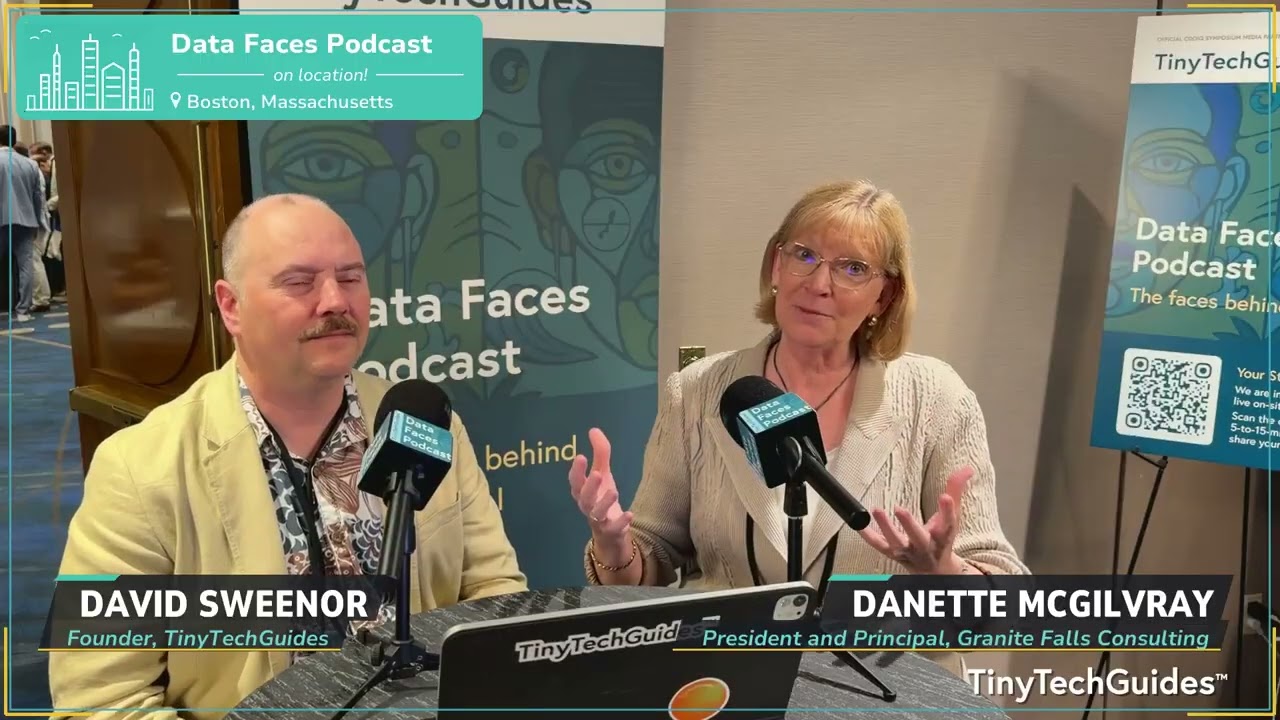
Data Faces Podcast — On Location · CDOIQ Symposium 2026
Danette McGilvray, president and principal at Granite Falls Consulting, on the Ten Steps methodology, the data quality crime scene, and the context AI depends on.
Listen: YouTube · Spotify · Apple Podcasts · Amazon Music
About Danette McGilvray

Danette McGilvray is president and principal of Granite Falls Consulting and an internationally respected data quality and governance expert. She is the author of Executing Data Quality Projects: Ten Steps to Quality Data and Trusted Information, the methodology data teams around the world use to tie data quality work to business value.
In this interview
- Why step one is confirming a data problem matters to something the business cares about
- How the information environment, including lifecycle, metadata, and ontologies, provides the context AI needs
- Why correcting data without root cause analysis guarantees repeat problems
- How the human element of communicating, managing, and engaging runs underneath every step
→ Browse all on-location interviews: Data Faces Podcast — On Location
Full transcript
David Sweenor 0:01 All right, here we go.
Danette McGilvray 0:03 Now, should I be looking at you? Should I look at the camera?
David Sweenor 0:06 We can do both. If you’re going to look at a camera, that’s the main one. This one is just a test camera.
Danette McGilvray 0:11 Here we go.
David Sweenor 0:14 Hello, and welcome to the Data Faces podcast on location. We are coming to you live from the CDO IQ event in Cambridge, Massachusetts, right next to MIT. I am joined right now by… with Danette McGilvray of Granite Falls Consulting. She is president and principal. Welcome to the Data Faces podcast.
Danette McGilvray 0:33 Hey, I’m excited to be here.
David Sweenor 0:35 You know, part of the name of this show is Data Faces, and it’s to get back behind the people and before their professional career.
Danette McGilvray 0:43 Okay.
David Sweenor 0:44 So I always like to ask an icebreaker question. What did you want to be when you grew up?
Danette McGilvray 0:49 Wow. I actually didn’t think so much about it. I got good grades. I was just going to go to the university and then I was going to figure it out. Okay. And I was actually a re-entry student. I had two kids, went back to school.
David Sweenor 1:03 Okay.
Danette McGilvray 1:03 And fell into data and it was really a perfect fit.
David Sweenor 1:07 Okay, and what is it about data that has you so fixated on it? It’s been sort of a career. We were just talking before we started this recording, and you’ve written a book, and so we’ll get to the book, but kind of what sort of attracted you to just data in general?
Danette McGilvray 1:22 I think I like the idea that data is in between technology. I was a programmer in a previous life, so I get the technology piece and the business who uses it. But I somehow have found this niche being an in-betweener. And I feel like the data is kind of like that in-betweener and the bridge. And there is something really satisfying about filling in a picture because people haven’t historically paid as much attention to the data. So I like filling in the rest of it.
David Sweenor 1:58 Have you seen a shift with the advent of generative AI, specifically in agentic and people’s willingness to want to pay attention and give a crap about it?
Danette McGilvray 2:11 Well, I’m going to say I’ve seen it in a couple of different ways.
David Sweenor 2:15 Okay.
Danette McGilvray 2:16 So the people who actually understand what is behind AI, they care about the data. But there’s a large audience of people who think it’s just magic, and I’m going to type in this question, and I trust everything that comes out of it. Sure. And that’s a problem. So I’ve seen both ends of it.
David Sweenor 2:37 Okay, okay. And so, you know, a big focus of this conference is data quality, information quality. It’s built into the name. And you’ve written a book about it. And can you tell us the name of the book?
Danette McGilvray 2:53 Yeah, so the book is called Executing Data Quality Projects. The subtitle is the name of my methodology, 10 Steps to Quality Data and Trusted Information.
David Sweenor 3:03 Okay, so 10 steps. Now, before we get to those steps… We don’t need to go through all the 10 steps. We have been talking… about poor data quality since we were chiseling things on Sumerian tablets or what have you. Yes. And are we ever going to fix it? And why is it so hard to fix?
Danette McGilvray 3:26 Okay, I don’t know if we’re going to, I’m going to do air quotes here. You’re going to air quote it? Hey, well, we’re on video. You’re going to fix it. Sure. However, we know that data quality is a problem. AI is all about data. AI has the potential of doing good, but it also has that potential of doing so much harm.
David Sweenor 3:47 Right.
Danette McGilvray 3:47 Therefore, we do need to care about the data behind it and the data that gets produced by it.
David Sweenor 3:54 Okay.
Danette McGilvray 3:54 So we have to manage all of that. So preventing the problems is a big deal. So data quality is not, oh, I’m just going to go in and correct some data. That’s part of it. That’s not all of it. Or, oh, let’s just do data entry. Well, that’s good. That’s part of it. That’s not all of it. So it’s a bigger picture. And data also, we have to care about people. So my methodology, if it’s not the first, it’s one of the first data methodologies that actually builds in that human element into it. And showing people how it needs to be taken care of. People know that, but to have it be able to give examples and build into it so people say, ah, that’s what I need to do.
David Sweenor 4:45 Okay, so 10 steps. We’re not going to cover all 10 steps, but beginning steps.
Danette McGilvray 4:51 Okay. Where do we start? Yeah, the very most important thing is what do you care about? Okay. Okay, so sometimes people just, oh, I have this data problem. Oh, I see this. Oh, I can fix that. I get excited about it. However… Does anybody care about that particular problem? And if you don’t know that that actually matters to something that your business cares about, it could be the enterprise, it could be a team, geographical area, whatever piece of the organization. Unless you can see that there’s a reason to pay attention to that, We have too many problems. Let’s make sure we spend our time on what’s important. So that is actually a number one.
David Sweenor 5:33 This seems like this, and we always have this chasm between, say, data engineers, data professionals, data janitors, whatever term you want to use. They want to just go fix all the data or whatever piece of the data they’re working on. And there’s always this chasm between the business, what you’re talking about, that’s got to have a business impact. How do we get these two groups to even communicate? Because they sort of speak different languages, don’t they?
Danette McGilvray 6:00 Yeah, that’s what a good data quality professional will do. So it’s a broad view of data quality. It’s not just this piece or this piece or this piece. It’s like there’s a number of pieces that have to work together. And yet, we know how we can get them to work together. We don’t have to get overwhelmed. We get to make some good decisions. But I always think people make better decisions about their data if they see the big picture. And then they say, we’re going to do this now versus doing something else later. So so that’s where that whole human element now, we’re not going through all the ten steps, but there’s nine steps but Bar underneath all of them says communicate manage and engage with people throughout Okay, you got to do something with the people every single step of the way change management Communication what whatever that whatever it is. So part of the art of data quality is I give you some steps I give you examples and advice, and then you get to go out and do it, and that’s the art.
David Sweenor 7:11 Okay, so what’s the middle part of the set? You talked about the beginning, so the middle-ish steps, and then I’ll ask you about sort of the end-ish steps, if there is an end.
Danette McGilvray 7:20 Actually, I want to jump into the second step, because it really ties in. Step two is called… Analyze your information environment. Okay. And the reason I want to just mention that is in AI they talk a lot about context. Right. That’s where you learn all the things that you need to know about the context for AI. It’s your information lifecycle, it’s your metadata, it’s your ontologies, it’s all the things that give your data structure context and meaning. And so we don’t want to skip that. Although people want to.
David Sweenor 7:54 But it’s not easy though, right? These data ecosystems are gigantous, right? That’s right. They’re intergalactic in scope.
Danette McGilvray 7:59 They are, which is why you still always have to make some good decisions about what do we do now versus what do we do later.
David Sweenor 8:06 Okay.
Danette McGilvray 8:07 But we give you guidelines. But by the time you get through, you assess your data quality. We give you helps. I call them business impact techniques. Like, oh, nobody wants to do the work. Nobody wants to invest. What do I deal with it? Oh, great. I’ve got some techniques to help people be able to show how do I build a business.
David Sweenor 8:26 That’s what people need is they need the real stuff. They don’t like date. Hey, recognize date is important. Well, duh. No crap.
Danette McGilvray 8:33 Well, yeah, but people always say that, right? But we don’t know how to do it. Yeah, garbage in, garbage out. Everybody says that, but it doesn’t mean they’re going to invest in it. In fact, one of my favorite sayings most recently is, people will spend… can’t millions and tens of millions of dollars on tools but they won’t spend tens of thousands and hundreds of thousands on all the stuff that is around that that makes the tool work most effectively to get the best investment out of it and so that’s part of what we are this wraparound that you will actually get a better investment out of your tools okay do the things around it all right it always existed But people want to ignore it.
David Sweenor 9:17 Okay. So we’ve analyzed your data. What’s the next step?
Danette McGilvray 9:21 What’s the next set of steps? Identify root causes. So it’s so easy for people to say, oh, I found this problem. Well, let’s just go correct it. You know, we don’t want to do that. So I kind of use this analogy. That’s sort of our natural instinct, though. It is a natural instinct.
David Sweenor 9:37 I just want to go fix it right now. It’s a natural instinct. Put my finger in the dam, it’s not going to leak anymore, right?
Danette McGilvray 9:42 Exactly. But if you think about it, I just mentioned the information environment. think about there’s been a murder there’s a body it’s lying in the park okay okay if the police are doing their job they come they coordinate off they look for witnesses they they interview people what time of day where was the person coming from why are they there right right okay so you would expect them to do that but we have all kinds of data quality crime scenes so what do we do We just go in, we swoop in, we correct the data, and we go right. And then we wonder why there’s all… We keep having data quality crime scenes because all we do is go in. And that would be like there’s a murder, body’s lying in the park, and what happens? Somebody comes in, they pick up the body, take it to the coroner’s office. They don’t investigate. They don’t do anything. There’s going to be more murders in the park.
David Sweenor 10:33 Okay.
Danette McGilvray 10:33 So…
David Sweenor 10:35 Getting to root causes and things you know Sounds like you know we can get a board game out of this it could be like a little side Okay, we got time maybe for a couple more steps, so we’re taking a rigorous approach to this We’re going to take this, kind of identify what we need to do.
Danette McGilvray 11:03 And we can do it against small things. Like one person can apply this methodology in four weeks. Or you can have a big team taking several months. Flexible, scalable. That’s the point. So we do root causes. We develop our improvement plans. Like this is not really totally rocket science. But when you bring it together and apply it against data, that is what people have not been able to do as well. And what it does is it gives you a roadmap. So we find out about a lot of things when we do, when we start getting into our data. Sure. And all of a sudden, you’re wandering through the trees, and all of a sudden you’re 100 miles from your destination. This is the map that keeps you on the trail. You reach out here, you get this detail. You go over here, you learn more about that concept. But you keep going because you know why you’re doing it, and you know where you want to go. Right, right.
David Sweenor 12:03 Okay. Well, this sounds like a fascinating read. Where can our listeners and viewers find this book?
Danette McGilvray 12:10 You can get it anywhere. Books are sold. Amazon, anywhere else. It’s available in Kindle, in a Kindle version, any kind of an e-book version. Executing Data Quality Projects, 10 Steps to Quality Data and Trusting Information. Also available in Japanese, Chinese, and Spanish will be out this year.
David Sweenor 12:30 That’s amazing. So where can people find more about you and your company, what you do if they want to learn more, go beyond sort of what’s in the book?
Danette McGilvray 12:39 Yeah, yeah. So gfalls.com. Falls as in waterfalls, gfalls.com, Granite Falls Consulting, Rock Solid Data Solutions. And give me a call. I’d love to talk about data quality.
David Sweenor 12:54 There we go. Well, Danette McGilvery, Granite Falls Consulting, President and Principal, thank you for joining the Data Faces Podcast.
Danette McGilvray 13:01 Thank you so much for inviting me.
David Sweenor 13:03 All right. Cheers.