

Data Faces Podcast — On Location · CDOIQ Symposium 2026
Steven Moskowitz, founder of Industry Forward, on wide data versus big data in manufacturing, the AIMS framework, and cognitive KPIs for the factory floor.

Listen: YouTube · Spotify · Apple Podcasts · Amazon Music
About Steven Moskowitz
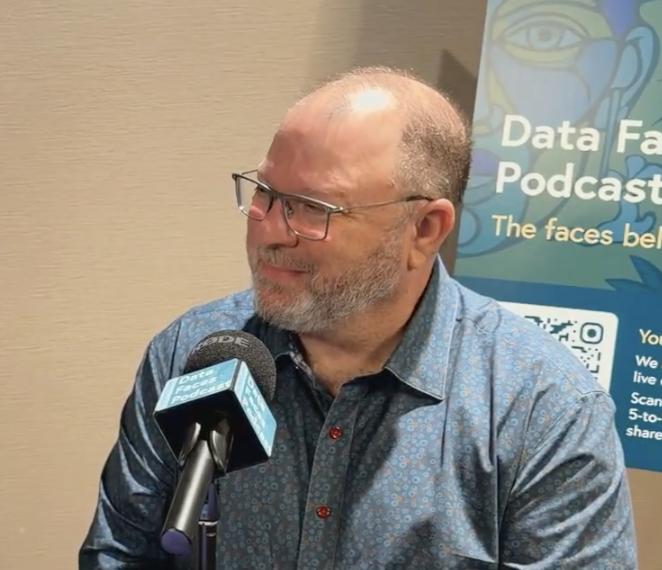
Steven Moskowitz is the founder of Industry Forward, where he helps manufacturers turn AI investments into results. A veteran of the semiconductor industry, he developed AIMS, an AI management system for manufacturing, and champions the ideas of wide data and cognitive KPIs for the factory floor.
In this interview
- Why manufacturing’s wide data creates challenges and opportunities that big data industries never see
- How AIMS sequences alignment, assessment, and picking the right team before any scaling
- Why 90 days should end with positive stories at every level, and why augmented intelligence lands better than artificial intelligence
- What cognitive KPIs like mean time to root cause measure that usage and token metrics miss
→ Browse all on-location interviews: Data Faces Podcast — On Location
Full transcript
David Sweenor 0:01 All right. Hello, and welcome to the Data Faces podcast. On location, we’re coming to you live from the CDO IQ event in Cambridge, Massachusetts. Seated next to me is Stephen Moskowitz, founder of Industry Forward. Stephen, welcome to the Data Faces podcast. Thank you.
Steven Moskowitz 0:21 Thank you very much, Dave. Nice to be here.
David Sweenor 0:23 Can you tell us a little bit about yourself and what your company does?
Steven Moskowitz 0:26 Sure. So kind of the quick background, I started a PhD in chemistry, started in the semiconductor industry doing R&D and kind of moving through that process into the manufacturing operations, learned about lean manufacturing, Six Sigma, and quickly learned about transformation and how you drive change in companies. When I left the semiconductor world, I moved to the chemical world, doing innovation management, how you do new product development, portfolio management, moved from there into digital transformation. Through that process, I also was part of a couple of trade associations, both on the innovation side and the manufacturing side. learn that the problems that we think we have, every industry thinks that they’re unique. None of us are unique. The problems are often the same. It’s how do you solve problems? I thought I was special. How do you solve problems? How do you tackle organizational challenges? How do you do innovation? How do you collaborate? How do you partner? Those are common things that we all see. In the AI world, we’re seeing the same thing. So when I left my most recent role, I decided to kind of step out of my own, did some work to get some certifications, really around AI and manufacturing. And helping manufacturing companies now think about, you’ve invested in AI, you have the technology, but you’re not getting the value. You’re not really doing everything you want or you’re stuck in the pilot mode. How do you start to scale it and really get the value you want from the investments? So we’re developing a process I call AIMS. It’s an AI management system for manufacturing and really focusing on not the technology, but how do you manage it within your company to get the most value across the industry? And it’s really, my focus is in manufacturing, but as we heard, through the last couple of days. The problems around AI adoption, which are people-focused and organizational-focused, leadership-focused, are common. There are some uniquenesses in manufacturing, but it’s an exciting time.
David Sweenor 2:38 Okay, well it sounds like you have a well-rounded background, lots of great experience. Before we jump into the topic du jour, the name of the show is Data Faces, so I’d like to explore a little bit behind your professional career. So always ask an icebreaker. What did you want to be when you grew up?
Steven Moskowitz 2:59 It’s a good question. I’ll say actually when I was a sophomore in high school and we were taking the PSAT and you had to kind of click off on the boxes. What do you want to do? I clicked off the box, chemistry, PhD, professor. And I think I was just too lazy to change once I wrote it down once. So I went in that direction. I always assumed I’d be a professor. Went in a different direction. But a lot of what I’ve done in my career has been around education. Learning at the professional level, helping people across organizations and industries learn, learn how to solve problems, learn how to collaborate. So although I never went to the professor route, I think education at a high level is still where I’ve ended up.
David Sweenor 3:45 Okay. Oh, that’s great. And so let’s talk a little bit about data and AI in the manufacturing setting. As we both know, both grew up in a semiconductor world. There’s a wealth of data like so much like beyond imagination. And do you think that’s unique? Is there more data, is there more different kinds of data than say a finance or healthcare organization? Or do you think it’s the same?
Steven Moskowitz 4:12 So I think what we’re seeing in manufacturing is what I call wide data versus big data.
David Sweenor 4:18 Okay.
Steven Moskowitz 4:18 So in a lot of industries, and even in manufacturing, the back office, you have huge amounts of data that all look the same, right? In the finance industry, everything kind of looks and feels the same.
David Sweenor 4:28 You’ve got transactions, and yeah.
Steven Moskowitz 4:30 In manufacturing, we have a lot of different types of data. You have timestamp data, you have graphs, you have images, you have pictures. You have a lot more manufacturing equipment data, right, from your PLC. the types of data we see are very different, which causes some unique challenges, and I think also some unique opportunities for manufacturers. So although at a high level, it’s still data, we see a lot more unstructured data in unique ways. It’s not just documents. When we hear conversations, hear people talk about unstructured data, it’s all your documents. Well, it’s not just documents. It’s CAD drawings. It’s equipment data. It’s image data. Pictures of defects. It’s pictures of defects. It’s three-dimensional images. It’s people working on the factory floor and collecting things like ergonomic data of how people are moving to prevent injuries. So a lot richer data, which gives us some unique opportunities.
David Sweenor 5:39 Okay. Okay. And what would you say the state of sort of data quality is in manufacturing compared to maybe other industries? Like you think they’re head behind right in the middle?
Steven Moskowitz 5:58 I think the regulated industries are further ahead because they had to. So the finance industry, healthcare industry had to because of auditability. I think manufacturing where you have kind of that auditability trace has forced some of that to be there. But we see a lot of variability. And one of the challenges is, there is no standards. There’s not really good standards on data consistency and data standardization across equipment or across supply chain. And so while I might have in my factory really good managed data, my suppliers, my customers are totally different. So how do we start to share across? And I think one of the unique things we’re seeing in manufacturing is the need not just to manage our data, but to manage our data at an ecosystem level. and to be able to share data much better. Right, right. From raw material suppliers, equipment suppliers, to customers. And so that’s, I think, a little uniqueness in manufacturing that we’re seeing. Sure.
David Sweenor 7:03 And you mentioned Ames earlier. Tell us about AIMS and sort of what’s it all about.
Steven Moskowitz 7:09 So it’s again, AI management system is what it stands for. And it started with a group out of its headquarter in Singapore. It’s a global non-for-profit called Insight, I-N-C-I-T, which is the International Center for Industrial Transformation. and they developed some maturity models around smart manufacturing and sustainability that are working with the World Economic Forum, and they’ve recently developed their AI model. And the model looks at kind of a people process technology view and aligning it to your corporate strategy, your investment numbers, to figure out, well, what really matters to you, to your unique company and your industry? Sure, sure. And so the model’s great, I’ve gotten certified, and it’s a really nice way to help companies, but it’s a little short. It doesn’t give you a full picture of what do I do now? And so I’ve built the model to kind of take a little bit broader picture, and it starts with alignment. So a lot of the conversations we’ve had this week have been around how do we align value? How do we get the organization aligned on strategy? And so that’s where I start, is that alignment of language, of strategy. One of the things we’re seeing, for example, is when you talk to the C-suite, they are talking to their board and the news, which it’s AI equals generative AI and agentic AI. Well, you talk to a factory leadership team, and they don’t want that. They want machine learning, predictive analytics, dashboards, you know, that type of view. But you get people on the factory floor, well… They want vision systems, they want edge AI, they want robotics. So it’s how do you figure out what are the right tools for the company and actually get everybody aligned. So before you even go into an assessment, let’s actually figure out what we’re talking about. Get that consistency of language and understanding. And then you go into the assessment and then after that you kind of figure out not only what are the right projects, but who are the right people to work with? One of the things we find, that I find at least, is you may have a critical program that you think is the right place to start, but they’re busy, they have a lot going on. They’re probably not the right people to start with always. And so finding that right group in the company is part of that early assessment as well. The ones that are ready and willing and want to try and combining that with the assessment. At the end of the day, you kind of then do some projects and you start to build it up. And the ultimate goal at the end of a 90 day period is to be able to tell stories. So it’s not to say what’s my ROI, what’s my new OEE numbers, it’s can I tell positive stories at different levels in the company about what AI does for me. And that allows you to then really build momentum and then start to think about how do you scale and go from there. The other part I’ve been working on is what are the metrics? How do you actually measure AI?
David Sweenor 10:07 It’s like core of lean, right? If you can’t measure it, you can’t improve it.
Steven Moskowitz 10:12 And one of the things I’ve talked about earlier was the idea that AI, people think about artificial intelligence and they panic, right? The language kind of scares them. I started using the word augmented intelligence.
David Sweenor 10:25 Sure.
Steven Moskowitz 10:26 And just the idea of in manufacturing, we’ve done augmentation for years. Right. From the Henry Ford with the conveyor belts at a factory, which was all about augmented coordination. to vision systems and cameras to augment our eyes and what we can see. Right. Robots and load lifters to augment our strength and drones to augment the ability to move things.
David Sweenor 10:47 So it’s sort of safer because it’s not going to like cognitively safer. It’s not taking my job. It’s helping me do something, whether give me super strength or super knowledge or whatever.
Steven Moskowitz 10:59 And so the idea I like to think about is cognitive intelligence, right? It’s cognitive augmentation. So how am I… augmenting my ability to think. And so when we think about metrics now, what we typically measure is say OEE, or tool availability, or first pass yield, and then you measure it with and without AI, and that theoretically will give you the value. Okay, well that’s one way to look at it. The other big thing obviously nowadays is usage. And so a lot of people started with, well, how many people are using the tools? How many models are out there? How often is it being accessed? And then we all realized, tokens cost a lot of money. So now there’s a cost element of that. But those are all still kind of after the fact and tell you, well, how we’re using it, not how it’s changing us. And so I’ve started to develop the idea of cognitive KPIs. And how do you think about that? So in manufacturing, one of the things we often talk about is mean time to detect. How quickly can I detect a problem on the factory floor? I can use vision systems to detect it faster. And then we talk about mean time to repair, which is how quickly can I get it back up and running the equipment? Well, between those two, there’s things we have to do. We have to go from identifying the problem to understanding root cause. And then from root cause to saying, well, I have different paths to fix it, how do I close that gap and figure out what the right path is?
David Sweenor 12:18 Right, right, right.
Steven Moskowitz 12:19 So those are two metrics you can start to measure which are cognitive. Can I actually shorten the time to get to root cause by leveraging AI? Sure. Can I shorten the time to evaluate options on what the path to take is? to shorten the time to figure out mean time to action plan. And those are things we don’t measure today. And those are new metrics I think are going to be valuable in manufacturing and maybe other places to really reinforce the goal of AI isn’t to replace, but it’s to help us do our job better. And part of our job, right? If we really want to value our people is we want them to be thinkers, right? We want them to be decision makers. We want them to innovate. And so it’s, how do you measure that? And so that’s, that’s one of the things I’m working on now and trying to get out there.
David Sweenor 13:06 You know, I like this notion of value alignment and, I guess what’s standing in people’s way and is there just different perspectives on what value is or is there just trying to understand like what’s preventing companies from getting there faster, I would say, I guess.
Steven Moskowitz 13:33 It’s a good question. I think understanding of value is critical. I think in most companies today, we’ve built our silos for certain reasons. You have different functions that do different things. Those different functions, because they have a different responsibility, often have different metrics. Different values.
David Sweenor 13:50 Different values. And get us into silos. Here’s my kingdom, your kingdom. That’s right. Different value pillars.
Steven Moskowitz 13:57 And often those value pillars were created because of information management. Right, I own maintenance, because I own the information around maintenance as well as the process, but I have to hand it off to the supply chain team and the procurement team and the engineer. And with AI, we’re moving to a path now where data flows more freely. Yeah. Information flows. You talk about that sharing across.
David Sweenor 14:20 Decision flows.
Steven Moskowitz 14:22 And so one of the things I think is happening, and we’re going to see over time, is that the organizational structures we have today We’re designed for the world that we’ve been living in, around how we manage information, how we manage decisions. That’s a barrier to AI. And I think one of our challenges is to start to think, how do we redesign our organizations? Not just a flatter organization at the senior, but how do we break down those silos to build more innovative, collaborative ecosystems, even within a company? And I think that is going to be a critical driver to change.
David Sweenor 14:59 You know, I love that. So collaborative, openness, sharing across the organization, best practices. I think a core tenet of both of our backgrounds. Agreed. Steven Moskowitz, founder of Industry Forward. Thank you for joining the Data Faces podcast. Where can people find out more about you, your work, if they have questions?
Steven Moskowitz 15:18 LinkedIn is always a great place. Industry Forward, number four. Forward.com is the website. And you can always schedule time to talk or reach out there on LinkedIn. All right, well thank you, sir. Thank you so much. Cheers. Cheers.