

Data Faces Podcast — On Location · CDOIQ Symposium 2026
Stacie Christensen, senior data leader at H-E-B, on why data initiatives fail before technology, grading industry data quality, and governing data at creation.
Listen: YouTube · Spotify · Apple Podcasts · Amazon Music
About Stacie Christensen
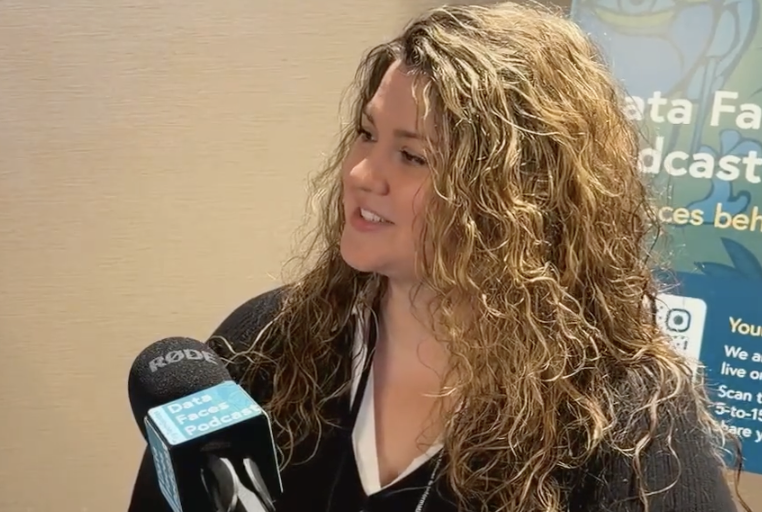
Stacie Christensen is a senior data leader at H-E-B with 22 years in the data industry. She is the author of the Built on Data series, including Built on Simplicity, and writes about the human and organizational side of data at dataisnotpersonal.com.
In this interview
- Why the foundation under the technology, including accountability, ownership, and governance, decides whether data initiatives succeed
- Why hoarding data creates noise, backlog, and risk without helping critical business decisions
- Why governing data at creation beats governing it downstream in analytics and reporting
- How to spot circular data flows and use them as a starting point for simplification
→ Browse all on-location interviews: Data Faces Podcast — On Location
Full transcript
David Sweenor 0:00 Are we on?
Stacie Christensen 0:01 We’re on. This one on?
Speaker 3 0:03 Yep.
David Sweenor 0:04 All right, you ready?
Stacie Christensen 0:05 Yes, I am.
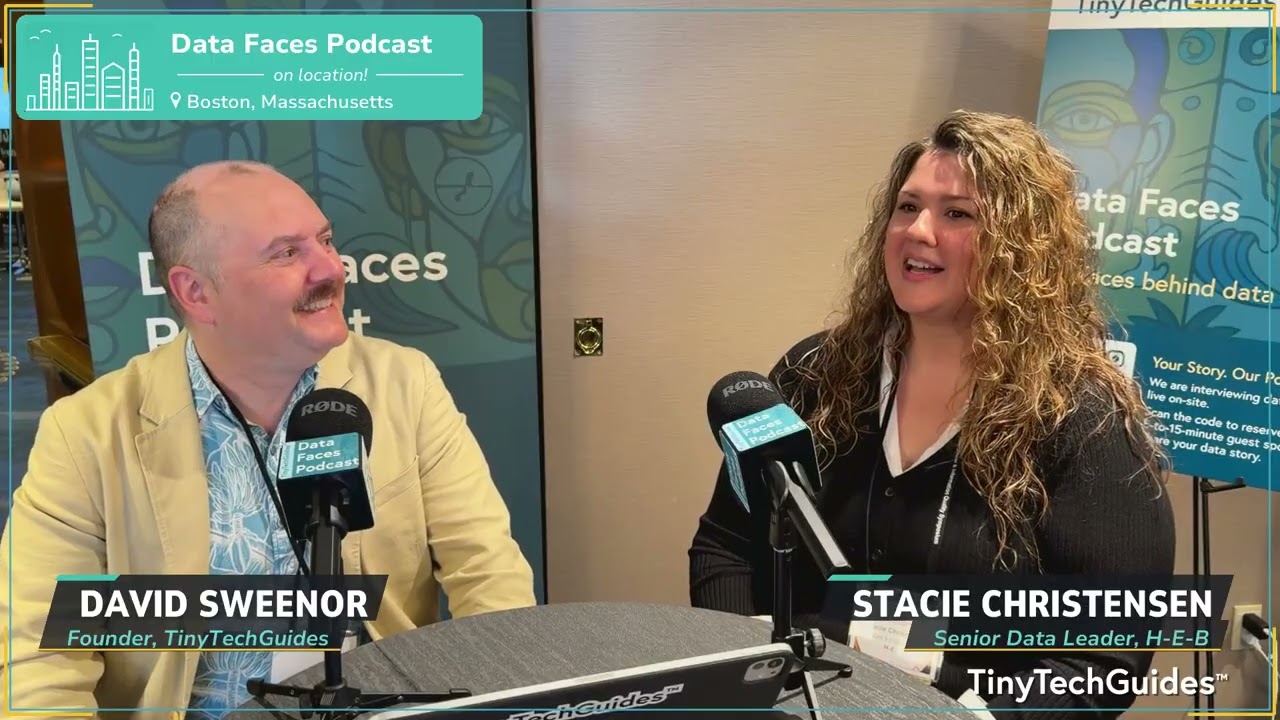
David Sweenor 0:06 All right, here we go. Hello and welcome to the Data Faces Podcast. On location, we’re coming to you live from the CDOIQ event in Cambridge, Massachusetts. We are on day three and I am joined sitting next to me is Stacey Christensen. She’s Senior Data Leader at H-E-B. Stacey, welcome to the Data Faces Podcast.
Stacie Christensen 0:29 Thank you so much. Thank you for having me.
David Sweenor 0:31 Can you just tell us a little bit about yourself and your background and your role at H-E-B?
Stacie Christensen 0:36 Sure. So I am a senior data leader currently at H-E-B. I actually have over 22 years in the data industry. So I kind of feel like when it comes to data, I’ve been there and experienced a lot of different things in practice. So my undergraduate is in computer science and mathematics. I went back and got my MBA, and now I’m deep into a doctorate, if you can believe it, specializing in data.
David Sweenor 0:57 Wow. That is fantastic. So the name of the show is Data Faces, and part of this is I like to get behind people in their professional careers before LinkedIn existed. Oh, I see. So I have a question for you. What did you want to be when you grew up?
Stacie Christensen 1:19 That’s a tough question. I don’t know if I had something particularly in mind.
David Sweenor 1:25 Okay.
Stacie Christensen 1:26 So I can tell you how I got into computer science.
David Sweenor 1:29 Tell us about that.
Stacie Christensen 1:30 So computer science was really competitive. And it was one of those classes that everyone had that they were like, oh, it’s the hardest class I’ve ever had. And they would come close to failing. And so I decided, well, that’s the class I’m going to take. And I’m going to get an A, and I’m going to show all of them. And then I ended up getting in it. And it was a wonderful experience. And so I feel like in that moment, I knew that technology was going to be my path. Now, what I wanted to do before that when I was a youngster, I’m not quite sure. Okay.
David Sweenor 1:58 Well, I didn’t know either, so I tell people, no, I just do stuff.
Stacie Christensen 2:01 So I still don’t know what I want to be when I grow up.
David Sweenor 2:05 So no worries there. So you have a session here at the CDOIQ event. Can you tell us a little bit about the session and what’s it about?
Stacie Christensen 2:14 Absolutely. So the session is around why data initiatives fail, and it’s usually long before technology is ever the problem. And so I wanted to talk to the group about a pattern that I’m seeing that I’ve seen over the last 22 years. Technology comes and goes. It’s changed over the years in so many ways. And so what I’m seeing is a continual pattern that regardless of the technology that comes in, What usually happens is we have initiatives and they start struggling, but tech is the first thing that we’re blaming. And it’s usually not the thing that’s actually at fault. What’s at fault is our foundation that’s under that technology. Our foundation is what kind of ensures the success of all of those lovely investments that we’re making or the potential failure. So that’s where I’m focusing in.
David Sweenor 2:56 And when you say foundation, are you talking about the people and processes? So people are the problem. This is what I’m hearing.
Stacie Christensen 3:05 Well, people-owned issues might be the problem. So it’s all of the dreaded words that you hear, the accountability, ownership, alignment, governance. Those are the things that we’ll be focusing in on.
David Sweenor 3:17 Why is it so hard for organizations to get this right?
Stacie Christensen 3:21 You know, I think everyone, including myself, we all want that easy button. And technology is the thing that we interact with our issues through. And so it’s easy for us to point the finger at technology and say, this is the problem. And if we had something different, it would fix that problem. And so I think that’s why we lean towards that direction. And sometimes it’s easier than having to address those people-owned issues.
David Sweenor 3:42 Well, and right now the easy button is just AI it, right? Let’s just AI it. It’s going to solve all of our ills. You would agree with that, right?
Stacie Christensen 3:50 No. No?
David Sweenor 3:51 Okay, good.
Stacie Christensen 3:52 I think there’s a big misconception about AI that it is a solution or the answer or a fixer. And in my opinion, it’s a multiplier and scaler. It is not the fixer. of our foundation. So if that foundation doesn’t exist, it won’t have anything positive to scale.
David Sweenor 4:08 Okay, makes sense. And so we were just talking before we started this, but you wrote a book called Built on Data.
Stacie Christensen 4:16 I did.
David Sweenor 4:16 Tell us about that book.
Stacie Christensen 4:18 So it’s the first book in a series called the Data Alignment Framework. So it’ll be three books. I might have silently released the second book in the series just for this conference. It’s also called Built on Simplicity. You’ll notice a pattern there. There’ll be a third one in the fall called Built on Alignment. But Built on Data specifically is talking about how discipline creates usable data and not technology.
David Sweenor 4:42 So let’s double click on that. Discipline is the core of this. So what does that mean? Is this personal discipline, organizational discipline, and how do you define this and what do people need to think about?
Stacie Christensen 4:57 For me, when I say discipline, I mean organizational discipline. So making sure that we have our foundational skill sets in place, that we have governance, that we’re watching our data, that we have data quality, that we understand what data is actually worth the investment in to be cleaning up and streamlining. And so for me, it’s more about that organizational, it’s the stuff that still need that human touch that AI cannot come in and answer for us today.
David Sweenor 5:23 Hmm. And so you mentioned data quality. It’s a huge, huge topic of this show, for sure. If you, you know, based on your conversations and, you know, the organizations you’re familiar with, where would you Pegas, if you were to give it a letter grade on how we’re doing with data quality as a whole, as an industry?
Stacie Christensen 5:49 I think data can be incredibly messy. And again, I think it’s really important to understand what data is worth the investment to have strong data quality. And I think that’s pending company, organization, industry. And so it gets like a little bit splitting hairs. But overall, I think we’re really messy with data quality because there are so many data points out there and all the random gathering of data. And sometimes I almost wonder, are we gathering too much data to where we have so much, we’re not using most of it for the critical business decisions we need to make. And it becomes noise. And it becomes a backlog of things that we think we need to clean up when really it’s nothing that we need to actually run our company.
David Sweenor 6:31 Well, people are hoarders. They don’t want to throw anything away. They are. Especially data. Like, well, I might need it sometime in the future, but it does introduce risk. But I’m not going to let you off the hook. You have to give it a letter grade. A, B, C, D, F. Just overall, in general. In general. Industry, where do you think we’re at?
Stacie Christensen 6:44 I don’t know. I think we’re actually below average. So I would actually go like C, D territory. All right. D plus, C, C minus. D plus, C minus. Somewhere in there. There we go. Just because I think there’s so much noise out there when it comes to data.
David Sweenor 6:57 There is. And do you think there’s enough focus on… the unstructured data. A lot of people, when they talk about data quality, where rows and columns and tabular data, and there’s some vendors that are focused on unstructured, but what’s your perspective on that?
Stacie Christensen 7:11 Unstructured is incredibly interesting, and again, I think it goes into what data actually makes sense for us to invest in. If we have an unstructured data set, I would start to question, what are we actually using that for, and how are we using it? And does it make sense for it to just exist out there unstructured? Maybe it does. And so, I don’t know. No, it would depend on the data set that’s sitting out there because some companies I think do have important data sitting unstructured because they haven’t invested in it. And then there’s others that leave it unstructured because it’s not worth the investment.
David Sweenor 7:42 Okay. Oh, that’s very interesting. And you mentioned earlier when you were describing your book Built on Data, The notion, you know, data quality. You also said the word data governance.
Stacie Christensen 7:52 I did. And people hate to be governed, number one.
David Sweenor 7:57 So how should organizations, you know, how are they doing with data governance these days?
Stacie Christensen 8:02 So, you know, I’ve actually worked for the extremes. So I’ve had experience with companies that have heavily invested in their data governance. And it’s been a great experience. It flows great. It’s helped data quality. They have trustworthy data that we can use throughout the data pipeline. But then I’ve worked at other extremes where even the term data governance was taboo. You didn’t talk about it. You surely did not bring it up in a meeting and say, what we’re missing is data governance. So it can be all over the map. of where companies are, because I feel like I’ve lived both extremes and somewhere in the middle.
David Sweenor 8:37 So you’ve seen the good and the bad. What does a good data governance program look like versus a bad program? What are their hallmarks? Because we want people to get it right. There’s a lot of people screwing it up. So if you were to compare and contrast, what do you see the leaders of this, what are they doing right?
Stacie Christensen 8:56 So for me, I know I am very passionate with data governance because I’ve seen what a success that it can be. And so for me, I strongly believe that data governance actually exists at the beginning of a data pipeline, at data creation. that data is governed before it enters the pipeline to prevent bad data from being entered. And so bad data becomes exponentially more expensive the further down a pipeline it’s sent. So I want to stop it before it starts. And then I think governance exists at a few points in between at critical transitions in that data. And so from there, That’s what I think is data governance is not a body that exists in one place. It can exist in many places at critical places where the data is actually being transformed.
David Sweenor 9:38 Okay.
Stacie Christensen 9:39 Now on the flip side of that, where I get very passionate is I don’t believe data governance should be in one place and I definitely don’t feel like it should be at the end of a pipeline. And I have seen data governance exist downstream in analytics and reporting, which to me, that’s far too late in the data process for governance to exist.
David Sweenor 9:58 Okay. And then, yeah, so that was my next question. So like organizationally, so I think you’re talking a little bit about shift left. We want to sort of stop everything before it gets in there. But for the best programs you’ve seen, is there like a central team that manages data governance with a hub-and-spoke model? Or kind of what do you see as best practices organizationally?
Stacie Christensen 10:22 So there’s two different flavors that I’ve seen work really well. One is a centralized governance team that’s deployed more upstream. And they own that governance in the multiple locations, regardless of where it is. But then I’ve also seen it deployed where other teams it’s broken up, depending on where it’s at in its journey, the data.
David Sweenor 10:44 All right, so both are equally effective.
Stacie Christensen 10:46 I am very much a go-with-the-flow kind of person. And so for me, when I work with organizations or companies, I want to see what works for them. What’s their current structure? What works? I’m very cautious to say there’s ever a one-size-fits-all. I think it’s very dependent on companies and how they function of what can work best for them.
David Sweenor 11:06 Okay, all right. So you mentioned you have a series of three books. Yes. Book number two, Silently Released, built on what?
Stacie Christensen 11:14 Built on simplicity.
David Sweenor 11:17 Tell us about that one.
Stacie Christensen 11:18 So it is all about removing complexity from your data systems. I am under the strong belief that simplicity is probably the most underrated skill in all of technology. So this deep dives into how do we start making our processes, our data flows, our data models more simplistic, to where it’s easy for us to describe them, to understand them, and then in return to govern and to scale them, especially when we’re all talking right now of turning all that over to AI’s hands.
David Sweenor 11:47 Sure. So can you maybe just give us a concrete example of simplifying the processes, something that may be complex, and how would you simplify it?
Stacie Christensen 11:59 Oh, that’s a tough one off the cuff there. But I know one thing I’m passionate about that I feel like keeps returning in my books as I talk about circular data flows. It’s something that just strikes a nerve for some reason. And that’s where you get to the end of a data pipeline, let’s say analytics and reporting. and you somehow end up with data that you’re changing or creating there and then you shove it back to the top of the data pipeline okay so that’s a circular data flow in my opinion and so that that’s because the data coming into it wasn’t what the consumer needed so they had to do extra additional transformations or whatever they wanted and now they want to send it now they got to go put it back in the warehouse or what have you and to me if we’re sending data upstream there’s something really wrong with our process And so for me, I like to kind of go in and be a little judgmental at first. Start identifying. A little judgy? A little judgy. I think that you have to do that when you’re looking for complexity. But understand, okay, what can’t we explain well? And so one of those things with circular data flows, when you get into why are we doing that? Sometimes it can’t be explained very well. Well, we just decided to do this down here. Okay, that’s a red flag. And so those are the things that I start identifying to where I say, all right, let’s start deep diving into those and start eliminating those outer edge cases first before we dig into the hard stuff, which is the data pipeline itself.
David Sweenor 13:23 And you mentioned that people… are the problem, or I mentioned that in the beginning.
Stacie Christensen 13:29 I don’t think those were my words.
David Sweenor 13:31 Those were my words, to be clear. But how do you get people on board? Because that’s just a constant challenge for organizations. People are doing their thing, whatever they’re doing, and you come along and be like, hey, maybe we should do it this way. And there may be resistance a lot of times. So how do you approach something like that?
Stacie Christensen 13:53 I think that’s where I say there’s not a one-size-fits-all solution. I think it’s important when you enter a company or an organization that you take the time to understand how they do things and why. Maybe some of their processes look ridiculous. As you’re walking in, you’re like, oh, that’s complicated. Why would you do it? It’s important not to approach it that way. Really start to dig in and understand. And I think when you spend time with people, you start to understand why they do things and partner with them to help lead them to a conclusion. it really helps them want to have ownership in that decision. Okay. And so I start there. I want to understand why we’ve done things this way because there’s a reason we’ve got to where we’ve gone.
David Sweenor 14:33 That’s true, and there’s a reason they’re resistant, so we definitely got to understand that. Sure. Well, Stacey Christensen, Senior Data Leader at HEB, where can people find more about you and get a hold of your books and ask you questions if they’re interested?
Stacie Christensen 14:47 So my books are all on Amazon. Easy. Everyone has Amazon Prime, right?
David Sweenor 14:52 I think so. Majority.
Stacie Christensen 14:53 Also, I have a website. It’s called dataisnotpersonal.com.
David Sweenor 14:57 Okay. Well, thank you for joining the Data Faces podcast.
Stacie Christensen 14:59 Absolutely. Thank you for having me.