

Data Faces Podcast — On Location · CDOIQ Symposium 2026
Terry Dorsey, Senior Data Architect at Denodo, on the hidden data problem blocking AI at scale, information delivery, and why data quality sits in the eye of the consumer.

Listen: YouTube · Spotify · Apple Podcasts · Amazon Music
About Terry Dorsey
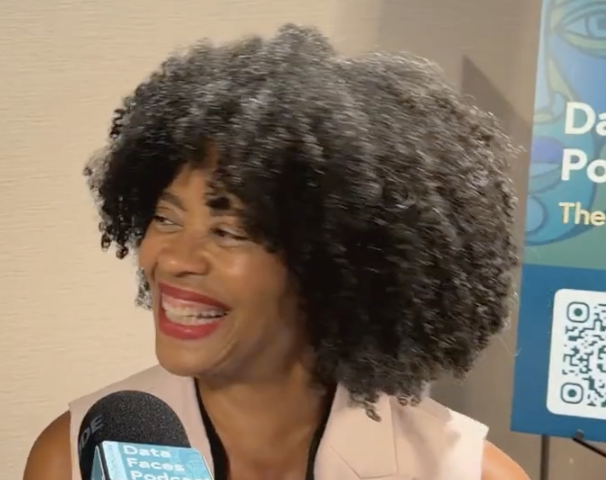
Terry Dorsey is a Senior Data Architect and North America evangelist at Denodo, the data management and virtualization company. After more than 40 years in the industry she retired, then came back because talking to people about data does not feel like work. She holds a PhD and focuses on turning raw data into information that both people and AI can use.
In this interview
- Why AI initiatives stall when one project team tries to own the models, the security, and the data all at once
- How adding semantics and context turns raw data into information that people and AI can understand
- Why perfect data quality is never achieved and why nitpicking it can paralyze an organization
- How abstraction and semantic models let development stay stable as systems and processes change
→ Browse all on-location interviews: Data Faces Podcast — On Location
Full transcript
David Sweenor 0:00 All right. It’s not really work. Can I ask you about that? Sure.
Terry Dorsey 0:04 I don’t care.
David Sweenor 0:06 All right. Are you ready to go? Yes. That’s good. Do you hear us? Are things going? Are we recording? All right.
Terry Dorsey 0:14 Here we go. Wait. How do I pronounce your name?
David Sweenor 0:18 Terry. Terry Dorsey? Yes. Okay. I thought so. Always good to ask. All right. All right.
Terry Dorsey 0:23 Here we go.
David Sweenor 0:25 Hello and welcome to the Data Faces podcast. On location, we’re coming to you live from the CDOIQ event in Cambridge, Massachusetts, right next to MIT. And so I am joined right now by Terry Dorsey. She works for Denodo, Senior Data Architect, and she’s also retired. Tell us about that, Terry. Hello.
Terry Dorsey 0:46 Well, I actually did retire. I’ve been in the industry for over 40 years. Way over 40 years. But I decided to retire, but this doesn’t really feel like a job. I’m doing something that I like to do. I like talking to people. I like helping people do things. So it’s not really like working. You’re back. Yes, I’m back.
David Sweenor 1:07 All right, all right. So the name of the show is Data Faces, and I like to get behind people and their professional careers. So I always ask an icebreaker. What was your first job?
Terry Dorsey 1:18 First job? Actually, my dad made me get it. He actually got the job for me. Okay. Well, that’s always helpful. I was 16. I was working for Burger King, and I was on the microphone. Oh, okay. You know, hold the pickles, hold the lettuce. Okay. It was a fun job. Yeah? Yeah.
David Sweenor 1:34 It’s one of those must-do. It must and must do. Everybody’s done those sorts of jobs. Yes.
Terry Dorsey 1:39 He also made me quit, but that’s a must.
David Sweenor 1:41 Okay. All right. Well, very good. And so can you just tell us a little bit about kind of what you do over at Denodo and what Denodo is all about?
Terry Dorsey 1:50 Right. So what I do at Denodo is I talk about – see, my job is pool. I don’t really sell. What I do is I talk about methodology, how to do things, how to approach data to support different efforts, AI being one of them. but other data consumption models as well. So it’s kind of fun. I also work with customers around their strategy for data as well, which is fun. What we do at Denodo is we are the AI data layer. We provide contextual information in support of AI, but also other initiatives for data consumption. And so we have a really broad outlook as to how people can leverage the information in their enterprises for a myriad of things. Okay.
David Sweenor 2:41 That sounds like a tall order there.
Terry Dorsey 2:43 Yeah.
David Sweenor 2:43 There’s a lot to it. And so you had a, I don’t know if you had a session or were having it, but it was called the Hidden Data Problem, Blocking AI at Scale. Tell us about that. What are the hidden data? Is it one problem or many?
Terry Dorsey 2:56 Well, I mean, nowadays there are many problems, but the way I try to focus on how you look at them is to separate those problems out, right? And so when we talk about the hidden problem, it’s more of an approach or methodology as to how you approach development objectives, whether it’s AI or other ones. And then this idea of no technology is an island. So a lot of times AI development, we look at it as this big encapsulated thing where everything has to happen within that project cycle. And if we think back on the way that we’ve done analytics, when we do applications, a lot of people do that soup to nuts, project focused. And so the advice or perspective that I like to give people is that When you look at initiatives like AI, it’s a culmination of many capabilities within the organization. And many of them scale and move at different paces. And if we look at AI as the understanding and the delivery of that technology, then many other things in the organization can move and scale and everything can scale up together.
David Sweenor 4:07 So it’s not just one thing. It’s like an amalgamation of a bunch of different… Correct. When you say that, it’s like analytics and machine learning, or is it a broader definition? Maybe data stuff?
Terry Dorsey 4:19 Right. So when we look at AI and other initiatives, most initiatives require information. I mean, just about anything you do in an enterprise or in a business, you have to do something with information or data. Right. Sure. Right. And the idea of it being specific to AI initiatives means that you kind of get blockage. And a lot of times you’ll stall because you have to do so much work in that space. So this idea that you leverage information delivery as a capability within the organization. You manage the AI, the development.
David Sweenor 4:52 I mean, the AI technology is moving very quickly.
Terry Dorsey 4:55 Can you imagine as a developer trying to do that as well as the security and the data for that? It’s just too much and you lose focus. And so the idea is that for AI as a capability, you focus on that capability. How do I do reasoning frameworks? What kind of technologies or models do I use? There’s a whole lot that goes into that activity or that capability. And let’s not contaminate it or burden it down with having to also include how I get data from the organization, how I secure it. And so there’s this idea of these capabilities working together. In my last job, when we implemented AI, that was the outlook. Interestingly enough, this was back in 2017, we were working with, it was then IBM Watson at the time, And it was a team. And everybody thought, oh, we bring them in and things are just going to happen, right? Because we’ve got this great big AI team, right? We’ve got this great AI team, right? These people are experts. Yeah, sure. Yeah, you’re there in case they need something or whatever. But the actual work… The bulk of that work was in the business, their processes, how they looked about data, how they positioned data, and IT, how do we actually bring it together so that these people that are outside can make sense of it. So there’s this merging of capabilities interacting and working together within the organization, and that’s really much how you scale. I mean, as a result, we completed in a year that effort, and that effort continues today. Okay. I’m working for it, so…
David Sweenor 6:29 that’s the idea yeah i get it all right so then you know it’s this ai it’s dependent on all these other capabilities why is do you think information delivery is the most important of those capabilities
Terry Dorsey 6:44 Right, sure. I mean, if we look at anything, again, that happens in organizations. And we look at some of the surveys and many of the articles that are out today, how we actually deliver and manage information is kind of like the whole genesis or the whole foundation of AI, right? So an AI can’t work without information, right? If you wanted to do something, it’s providing information or it’s understanding information to do that. And so data delivery, excuse me, and information delivery becomes a big component of that. With that, many companies also struggle with how do you put guardrails around what AI can do and use, and that is part of how do you actually protect the data that actually gets used for it, be it for traditional AI or even in generative AI when we’re actually bringing information to it. Right.
David Sweenor 7:34 You’re actually, I didn’t pick up on it until just now, but you’re using a very deliberate word. You’re using the word information delivery versus probably everybody else here would say data delivery. What’s the difference?
Terry Dorsey 7:49 Right. And so, I mean, there are certainly probably more formal definitions of that. But where I see, and for a long time, organizations I worked for were kind of guilty of it as well, is this idea of fixating on information where it sits, where it has some meaning but not enough meaning, but not quite enough meaning. And so the difference between this raw, the raw information and turning it into something purposeful that people and AI can understand, to me that provides information, core meaning.
David Sweenor 8:24 So we take data, we add definitions, semantics, context around it, and would you say that’s the beginning of information? Yes, I think it’s the core, right?
Terry Dorsey 8:35 And in many instances, you have to be careful not to over-architect because there’s different levels of information at different consumption. Like, for instance, a data scientist needs information at a certain level. Maybe a business user would need something at a more architected level or higher level. Right, right, right. So there’s this idea of what is something core that I can provide? And so you hear a lot of talk about semantic models and things like that. And from my perspective, that semantic starts with the beginning of the abstractions of the enterprise. So, for instance, if you’re a person in sales, you know what a sales order is. Sure. Right. It’s not table X, Y, Z. Right. Right. It’s a sales order. Right. Right. And that becomes informational or the core or the foundation of information to be used. Okay.
David Sweenor 9:26 So actually raises an interesting question for me. So, you know, this is CEO IQ. So information quality. A lot of people talking about data quality here. Would you say the state of data quality is across the organization? If you could give it a letter grade, what would you give it?
Terry Dorsey 9:45 Okay, so I hear a lot of conversations around quality. As a practitioner, I have probably, I don’t know, a different perspective. Okay. And not totally different because in the keynote yesterday they were talking about the different dimensions of equality with context being one of them. And so my perspective is this. First of all, you never achieve it.
David Sweenor 10:12 Okay. It’s a mirage.
Terry Dorsey 10:14 Well, it’s not that it’s not a mirage. Okay. It’s that it’s in the eye of the consumer. Right. So, for instance, you can have a system where all your fields are completed. Uh-huh. Right. But maybe then on the line, somebody went outside a business process and did something different. It doesn’t reflect the business process. Right. Your stats may say that. Oh, wow, that’s 100%. quality, but it’s not really reflective of a business process. It was reflective of a workaround. Is that quality or not? If I don’t need that piece of information, is what’s left quality enough for me to use? To get into these areas where we’re nitpicking quality, I think it’s paralyzing. The perspective I had and we had back in 2016, they came and said, we’re going to do AI and we’re going to start today. And so I think what’s more important than that is foundationally what is going to be your methodology or approach. And can you design it such that as the technology changes downstream, I can adapt to it. And this is where now you start to hear things more about semantic models and things like that. Abstraction is a design principle. It’s been around for years. Software engineers use it. And abstraction, in my estimation, in my experience, is key to that. Because if I abstract, if I create these core meanings and I leverage those, as the technology shifts or changes, I still work with core principles. Right, right. And anything I build on that core, it’s going to be dependent on the core. I just need to keep that core settled. I can evaluate or I can always iterate on the quality of information that flows through it because my business processes are changing. They vary throughout my organization. The other perspective I have on that is a lot of it from an implementation perspective. Today, when we think of quality, we’re talking downstream. We’re not talking implementation. So, for instance, there was one project I was working on. It was crisis management. And crisis management wants to know where you are in the building. Yeah, sure. Well, say your HR people in the building field put organizational information. Right, right. And so basically, if we’re not doing some type of governance of how we’re implementing, everybody has to eat that. right downstream right right and so to me it’s just it’s kind of holistic there’s a point of stopping the bleeding and you can do that through abstraction downstream and then fixing the bleeding by working on implementation in your system that’s kind of like that notion of your shift left right bring it closer you know one question that brings up to me is
David Sweenor 13:05 I think you hit the nail on the head there. The person that is doing the work, say the developer or data engineer, they have a certain view of their universe, but it’s not probably broad enough for, they don’t know about crisis management, maybe they never even heard of it. And so how do you bring that, I guess, expanded set of things they need to consider back to the people doing the work?
Terry Dorsey 13:28 How do you approach that?
David Sweenor 13:29 Because every data product or set of critical data elements you have
Terry Dorsey 13:35 It’s per use case.
David Sweenor 13:36 There’s no hundreds or thousands of use cases. How do you even think about that?
Terry Dorsey 13:41 Right, and again, the way I think about it is there’s core, right? And so I have customers. I have things as a business person that I talk about. So in our project, we talk about formulas. We talk about customers. We talk about materials. These things have attributes, and these attributes are fairly fixed. I can always adjust what flows through them, but from a developer standpoint, I just need to work with that abstraction. Okay. Because what happens is you have this huge shift that happens on the business side of your organization. Systems move out, in and out, people change their processes. But the core of what those things are remain the same. And so you can stabilize development. And that’s why we were successful. It would have cost us millions more if we had done it at a persistence level. Okay. All right.
David Sweenor 14:26 And maybe one other question. So this notion of information, and I know a lot of people, when they talk about data quality, We’re talking about tabular data still. I think, I don’t know, do you think organizations have an understanding of their unstructured data? Where it is, like we’re doing an okay job maybe. We’ve got databases, we kind of know where those are, the major ones. PDFs and that unstructured data, it seems like an intractable problem to me.
Terry Dorsey 15:01 I would agree. I mean, I would agree because I think organizations have struggled to date with structured data. Right. Let alone unstructured data, right?
David Sweenor 15:09 It seems straightforward and known. Exactly, but it’s not. We can do distributions and figure that out. I know there’s more to it than that, but unstructured. How do you know the quality of, say, a PDF as an example? The past forms you see was complete, but the content of it. Maybe it was written by AI. Maybe it’s just AI slop. How do you even know? How do you even ascertain some of that stuff?
Terry Dorsey 15:28 It could be people slop, right? Yeah. It could be people slop. But I mean, I agree. I think that when we start to, with any effort, what you use to source that, you know, to source information for that effort has to be appropriate for the consumption of that. And so you just don’t willy-nilly go off and just start, you know, feeding or creating things. Right, right. It has to be for purposes. It has to make sense. So if I’m trying to do something critical within my organization that it’s going to make or break me, I’m not going to necessarily use some emails that are laying around for that. So I think the use of it has to fit the application or the purpose.
David Sweenor 16:07 Well, very good. Well, Terry Dorsey, Senior Data Architect at Denodo, thank you for joining the Data Faces Podcast.
Terry Dorsey 16:14 Thanks for having me.
David Sweenor 16:15 Cheers.
Terry Dorsey 16:16 Have a good day. Thank you.