

Data Faces Podcast — On Location · CDOIQ Symposium 2026
Amin Venjara, chief data and product officer at ADP, on value equals data plus capabilities, the 2,100-person Data and AI Day, and data products that end repetitive stitching work.

Listen: YouTube · Spotify · Apple Podcasts · Amazon Music
About Amin Venjara
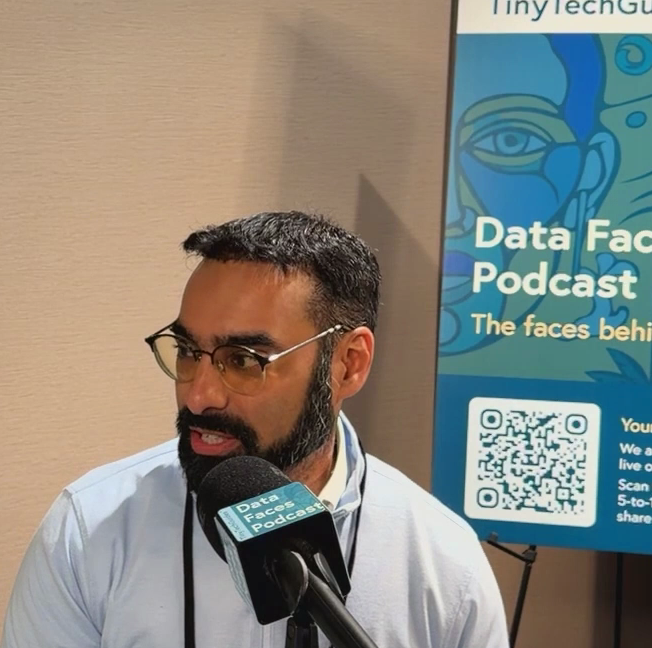
Amin Venjara is the chief data and product officer at ADP, where he oversees the product portfolio and data strategy for a company that operates in 140 countries, pays over 40 million people a month, and moves $3 trillion a year. He leads ADP’s internal data platform as a product that builder teams across the enterprise choose to adopt, and he built its Enterprise Graph from a single use case into an enterprise-scale capability.
In this interview
- Why data alone does not create value, and what capabilities like semantic layers and entity resolution add
- How treating the data platform as a product changes the relationship with internal customers
- How a hackathon and a 2,100-person Data and AI Day make foundational data work visible to executives
- What a real data product looks like, using normalized customer context to power chat and agent experiences
→ Browse all on-location interviews: Data Faces Podcast — On Location
Full transcript
David Sweenor 0:04 Hello, and welcome to the Data Faces Podcast on location. We are coming to you live from the CDOIQ event in Cambridge, Massachusetts, right next to MIT. I am joined by Amin Venjara. He’s the Chief Data and Product Officer at ADP. Welcome to the Data Faces Podcast.
Amin Venjara 0:22 Thank you very much. Happy to be here.
David Sweenor 0:24 So, I mean, part of the name of the show is Data Faces. And it’s really to get behind… the people before their LinkedIn profile and professional careers existed. So what did you want to be when you grew up?
Amin Venjara 0:41 Gosh, that changed a lot. As I was growing up, I loved, you know, I listened to a lot of baseball games on the radio growing up. Sure. So at a certain point in time, I loved, I was a New York Mets fan. Okay. And so being a sports broadcaster was a dream of mine at one point. All right, there you go. Yeah. You got the voice for it. I don’t know if I have the pipes for it. But things like this remind me of that. I played trumpet as a kid. So I had some interest in doing that. But I always had a love for math. And what’s interesting of how all these pieces come together is that there’s something really powerful about being able to tell stories with data. And that’s what I found really interesting of the ability to combine the technology. Doing data requires technology, people, and storytelling. And all of those are important. It’s not just the technology, it’s the people who are building it, it’s the people who are going to use it, and then it’s the storytelling that helps to inspire what all of this is about. Okay. And I guess that’s what helped me to fall in love a little bit with this area because I saw the combination of I like technology. The people side of it is fascinating because I think people often don’t pay attention to the engineers. And I’m like, these are super brilliant people. And we need to give them. And then if we can storytell around it, we can translate and connect the dots.
David Sweenor 2:09 I love that. So now we know your origin story. You are the Chief Data and Product Officer at ADP. What does that mean, and what do you do?
Amin Venjara 2:19 Yeah, so let me start with ADP. ADP is a global company. We’re in 140 countries. And we serve the human capital management needs of our clients. That’s everything from hiring and recruiting to paying. We pay almost 20% of the U.S. working population, over 40 million people per month across the globe, over a million clients. And we also, little known fact, we move $3 trillion of money. every year holy moly and so that’s not just the pay but the taxes and all the government so we’re plugged into the financial systems and the government systems okay so that’s what ADP does and helps to take that load off of what customers have to do right and in my role as the chief product and data officer it’s to look over the product portfolio of how we serve clients from the smallest clients From mom and pop shops, or nail salons, and tire centers, and doctor’s offices, all the way up to Fortune 500 global multinationals. And then also being able to connect how data drives differentiation to that client experience.
David Sweenor 3:26 Okay. I’ve had a few of my paychecks come from ADP. Can I get another zero on mine?
Amin Venjara 3:35 That is probably the most common question I get. The answer to that is that’s your job, not mine. Okay. Well, great.
David Sweenor 3:43 We got a chance to catch a little bit of your session earlier. It was called Value Equals Data and Capabilities, a field guide to product-led data platforms. Can you tell me a little bit about that talk and sort of what’s the premise? What was the premise of that?
Amin Venjara 3:58 Yeah, so the premise is really a lot of times when data organizations start, data’s a complex area to be able to drive value out of. And because it requires so many things, you have to do your data sources, you have to do your ingestion, you have to do ETL pipelines, you have to do data quality, you have to do lineage, there’s all these details. And when data practitioners come and talk to the business about it, they end up talking about all these details. And I liken it to somebody who is like a contractor and they come in and say, I’ve got wood, I’ve got concrete, I’ve got nails. It’s awesome. And the person on the other side is I want to entertain people in my backyard.
David Sweenor 4:40 Right, right.
Amin Venjara 4:41 And this guy’s like, I got the best wood. It’s amazing concrete. It can hold this many pounds. And the guy’s like, I just want people to have a good time. So should I build a deck? Do I want a patio scape? That’s the conversation I want to have. And data practitioners are talking about the wood, the nails, and the concrete. Now, these things are really important. but you got to think about the value that’s being created first. And so that’s where this framework of value equals data plus capabilities came from, is to start with the value, and really be able to articulate things there, but the other piece of that is, and everybody, you know, there’s a lot of discussion around creating value, getting executive buy-in, but the other piece is, Yeah, data’s important, but this whole other piece that often executives don’t understand is around capabilities. Just because you have the data, I mean, you guys ingested the data, it’s all in one place, or you’ve put it into some data lake, whatever, shouldn’t we be able to use it now?
David Sweenor 5:39 Right.
Amin Venjara 5:39 No. Not just because it’s in the same place can you extract the value. There’s a lot of work that has to happen, these capabilities. And that’s where we found an unlock in our organizations when we created that understanding of data and capabilities is how you create value. That’s where we start to have a better conversation because we were able to articulate the value that the business wanted and the business could understand that it wasn’t just the data but these capabilities we had to build. What do I mean by capability? Think about something like a semantic layer, something like entity resolution graph so that I can have a client 360. Just because I have sales data, service data, customer data, finance data, doesn’t mean I have a complete picture of a client. I have to do the stitching work. That stitching work is a capability. Just because I have the data across these things doesn’t mean I have a semantic definition of knowing how to get the right answer for revenue or customer count or head count. All the data might be there, but I don’t have the capability and I haven’t done the work to get the semantic layer in place. That’s a capability. Data plus capabilities equals the value.
David Sweenor 6:46 You know what is interesting? So I like that. I love the analogy of the deck and the hammer and nails. You know, I think we’ve all lived that. You know, one of the parts of your talk I caught was how do you get sort of people on the same page? And you had a couple of mechanisms, a hackathon, a day to day. Tell us a little bit about that and why is that so important for the organization?
Amin Venjara 7:10 Yeah, and so one of the things that we also embedded in the philosophy and culture of the data organization is to say we’re going to treat it like a product. We’re going to treat the data platform like a product. You don’t have to use us. we are going to make you want to use us. You’re going to choose to use us. Just like any of your favorite providers or enterprise, you know, hyperscalers, you can choose to use them, you can choose not to use them. We want to be the provider of choice for your data. And inside the organization.
David Sweenor 7:45 Right.
Amin Venjara 7:46 So when you take that orientation, what does that mean? That means you say, you look at everybody in the organization and they’re your customer. And you have to say, OK, they’re your customer. Now, what do they need? How do we serve them? Now, you have to build things so it’s easy to use. You have to understand what their needs are and be able to serve them. But also, you have to get the word out. And so this gets to your question is to say, OK, well, what is all this stuff that you guys have? What is all this data? What are these capabilities? How do we use it? Great. I want to, you know, I need to create this dashboard or I want to build this product or I want to have this, you know, chat capability, whatever it is. How do I make that happen? So what we found was that like any good product or platform, we needed a some kind of motivating event like a dev conference or a product conference. And that was where we said, you know, we’re going to have one day that we set out and it’s going to be like a developer’s conference where people will see, because we don’t build for the end users. We build for the builders. They leverage our data platform and they create the end capability. They build the end analytics or insights or product or whatever they’re going to be able to do. So we need to let those people who are builders understand what we have and help them get hands-on with it. So what we did is we just borrowed a page out of the playbook. You know, there’s, you know, AWS has their re-invents. Sure. Salesforce has their dream force.
David Sweenor 9:11 Everybody’s got some sort of hackathon or whatever going on.
Amin Venjara 9:13 So we said, all right, let’s do one of those. And we just built it internally. You know, so in June, every year now, we get together. And we put on a two-hour data and AI day. And what Data and AI Day is, is it features our ability to say what’s the vision of where we’re going with the platform. We highlight customer success stories, people who’ve used our platform, have built on top of it, and show the outcomes they’ve built with. We talk about the new releases of where we’re going with the roadmap. And we even feature a hackathon winner who’s built something new and innovative in just a couple days using our platform. So now that requires another double play. Where did you get this hackathon winner from? Three weeks ahead of time, we host a hackathon where we invite applications from across the company to say, we’ve got this data platform. We want you to build on top of it. Here’s the theme. This past year’s theme was agents. Surprise, surprise. I’ve not heard that term before. So we had people submit. We got over 60 applications. We only selected… five, because we want to be able to work with those teams. You have to do onboarding and permissions. You have to do access. There’s a lot of things that you have to do with those teams. And so we get them curated, give them a good experience, and then we select a panel of judges from different departments, leaders, who can then judge those different teams. And we had teams from across the enterprise and also judges from across the enterprise, and they selected the winner. And universally, you see the teams get a much deeper understanding of what they can do with our services. The judges get an understanding of what teams can do, and they are typically executive leaders across the organization. And then the winning team gets the ability to showcase the work that they’ve built in a large forum across the organization.
David Sweenor 11:13 That’s super smart, because a lot of times the foundational work that is data It goes unnoticed. We’ve been referred to ourselves over the years as data janitors or pick your term du jour. So now you’re getting the people creating these data products. They’re super excited. The executive leadership to see kind of how it manifests itself in the business and really spawn, you’re creating this innovation engine within the company. 100%.
Amin Venjara 11:40 And I think that is the… And it’s difficult. It’s difficult to get the engine working because they are different languages. There’s a business language and there’s a data language.
David Sweenor 11:54 I just want to entertain versus I want the best wood for my deck.
Amin Venjara 11:57 Exactly, right? And both of them have value and there is a translation mechanism that has to happen. Part of the response, what we took on as a data organization to say, translation is our job. If that is our customer, we have to explain what we do, why it’s important, and how you use it. And we have to get you to care.
David Sweenor 12:23 Right. Okay. I love that. And then this event, they weren’t small events. I mean, you had thousands, I forget the number, but thousands of people participating in this event.
Amin Venjara 12:34 Yeah, it was actually great. So we were on our second annual, this past June we did our second annual one, and we had about 2,100 people show up, both in person and live. Largely it was live cast, but we were tracking all the numbers, and 2,100 people tuned in. And so that’s a great, for us across the enterprise, that level of attention shows us there’s hunger, there’s interest, and there’s a real desire for people to want to know what’s happening. We’re also seeing great, we track our usage just like any product platform, we track our usage. We say how many users do we have? How many active users do we have? And we’re continuously tracking those metrics because that is how we measure success.
David Sweenor 13:15 The usage. The usage.
Amin Venjara 13:16 The usage of the platform and also the efficiency of how we’re generating value. So we track outcomes of the use cases that we provide. We track the users and the active users we have. And the efficiency in which we can deliver that value to the spoke teams. Let me double click on that last one because value is going to be specific to each use case you have. Is it revenue? Is it sales? Users, you can count users. Efficiency, what do you mean by efficiency? So efficiency, we said, look, we operate in a hub and a spoke model. Yep, sure. And the hub has to create the capabilities that’s needed, and the spokes are going to be able to then take it to the end value use case and then apply it. And so we said, all right, what’s the easy way for us to evaluate, like, what percentage of the value or of the effort that we’re putting in is going towards the hub versus the spoke?
David Sweenor 14:09 Okay.
Amin Venjara 14:10 So we created a simple metric. We said, okay, out of total cost, we can take the total compute and storage cost that we have, that we spend on the platform. Sure. take the amount that the spokes spend and put it over the total cost. That gives you the spoke percentage of the spend that we do. And that tells us that the more and more we can have spoke being a higher percentage of the total cost, it means we’re being more efficient with the hub.
David Sweenor 14:40 Okay.
Amin Venjara 14:41 And so we track that as well as a way to drive it.
David Sweenor 14:43 Okay. And then just to make this a little bit concrete, we talked about data products. Can you, like… and without giving away any trade secrets. Give us an example of a couple of the types of data products you have. What’s the overall number of data products? We need data products, but I don’t think people quite grok it. So I don’t know if you’re able to give an example. or two, and maybe do you have hundreds, thousands? How many of these things do you have?
Amin Venjara 15:11 I think it depends upon your organization. Because one thing you want to do is be able to calibrate the data products to, because it takes work.
David Sweenor 15:20 Fit for purpose. It’s got to have a specific use. So imagine it could get out of control. You could have too many. Too many. So there’s sort of a balance there.
Amin Venjara 15:28 I don’t know if there is a right number across organization. What I would say is I’ll give you an example of one that can kind of give you a sense of what a data product is that needs this level of curation and that multi-use. So think about this. If I’m creating a chat experience in my product, and I have my customer come in. Now, if they’re in a SaaS application, and that SaaS application has certain information about that customer. But I also have a CRM system that knows about that customer. I also have a financial system that knows about that customer. I also have a sales system, a service system, I have a ticketing system, I’ve called transcript systems. All of those systems know something about the customer. Well, when they’re interacting with me over here in this SaaS application, that SaaS application can provide some context to how that interaction should go. But imagine that when that customer engages, if that application could call a data product that had already normalized data across these different systems, so that it could call the appropriate context for that customer.
David Sweenor 16:42 Super valuable.
Amin Venjara 16:44 So that’s a data product that can now be consumed by your chat application, your agent over here. And it could get access to all these other data products and maybe even some kind of combined data product that puts these things together. And it’s pre-processing the data. It understands latency. The definitions are right. It’s resolved the customer IDs. If you leave all that work to be done by each individual system, you’re leaving a lot of work to be done repetitively. But if you can get that package into a data product, you have the right levels of lineage and frequency and refreshments that can then serve the customer better.
David Sweenor 17:25 I think you actually just articulated so perfectly, stop reinventing the wheel. That’s the whole idea, right? That’s right. All right, well, I’m Amin Venjara, the Chief Data and Product Officer at ADP. Thank you for joining us on the Data Faces Podcast.
Amin Venjara 17:43 Thank you for having me. Cheers. Thank you, sir. Thank you. That was awesome.