

Data Faces Podcast — On Location · CDOIQ Symposium 2026
Kelley Kassa, senior analyst at BARC US, on why data management outranks AI in finance, the shadow spreadsheet problem, and who’s accountable when AI gets a number wrong.

Listen: YouTube · Spotify · Apple Podcasts · Amazon Music
About Kelley Kassa
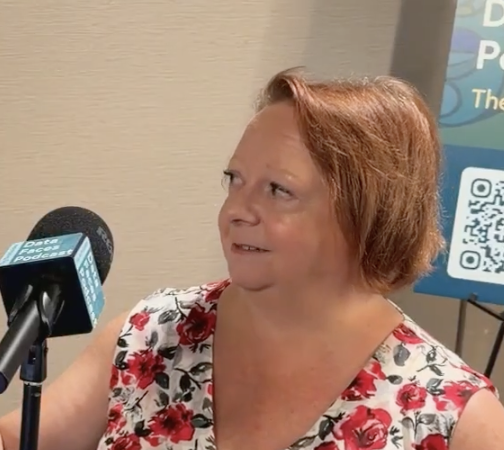
Kelley Kassa is a senior analyst at BARC US, where she researches corporate performance management, planning, and the office of finance. Her work focuses on how finance teams manage data and adopt AI, from shadow spreadsheets to agent-assisted monthly close.
In this interview
- Why data management outranks AI on the finance priority list
- How shadow spreadsheets undermine the planning system of record
- Where finance AI adoption really stands, with 9% in production in North America
- Why sign-off stays human, since you carry the liability when AI gets a number wrong
→ Browse all on-location interviews: Data Faces Podcast — On Location
Full transcript
David Sweenor 0:00 Perfect.
Kelley Kassa 0:01 Do you want me looking at you or the camera?
David Sweenor 0:04 We can do both. Are we all right?
Kelley Kassa 0:06 We’re good? We’re working. We’re going.
David Sweenor 0:09 All right.
Kelley Kassa 0:09 I’m going to hit go. All right. These are pretty good mics. I’ll just hit start.
David Sweenor 0:16 Hello, welcome to the Data Faces Podcast on location. We’re coming to you live from the CDOIQ event in Cambridge, Massachusetts, right next to MIT. I am joined, sitting next to me is Kelly Kasa. She is Senior Analyst at Bark US. Kelly, welcome to the Data Faces Podcast.
Kelley Kassa 0:32 Hi David, it’s great to see you again. I know we last met up at BARC’s US Retreat in lovely Colorado.
David Sweenor 0:40 That’s right. It was a great event there and so it’s a pleasure to see you again. And for those who may not be familiar with you or BARC, can you just tell us a little bit about
Kelley Kassa 0:52 you your role at bark and what bark does sure so i’ll start with what bark is bark is a global research firm we do primary research based on we get users to complete surveys my role is in the corporate performance management group i joined bark in october of 2025 as our north american
David Sweenor 1:17 person in the practice okay the rest of the practice my practice is in europe um i i like to say north america because i’ve got a few vendors in toronto so we’re not just us okay great and you know the name of the show is data faces so i like to get behind people’s professional um resume that that lives on linkedin so what was your first job
Kelley Kassa 1:41 My first job was down at the Jersey Shore, where I grew up, working at a 24-hour diner across from a commercial marina. So I learned how to juggle different things, how to manage different urgencies, how to deal with lots of different personalities, and how to keep cool when things are a little crazy.
David Sweenor 2:04 Yeah, well, we all had those jobs, so it’s always a great learning experience. So we’re here at the CDO IQ event, and information quality, data quality is a huge topic here. How does that relate to sort of what you do in corporate performance management? Because I feel like out of all the functions, they have their data the best. probably in the best shape a lot of the times. But maybe I have that wrong, so let’s dig in.
Kelley Kassa 2:36 Well, one would think that the Office of Finance has it in the best shape, but that’s not actually true. And in fact, it’s a high priority for corporate performance management people. In our 2025 CPM trends survey that we do with BPM partners and Craig Schiff and John Colbert, data management was the number one priority for CPM users. The issue is that they tend to have a lot of siloed data. And despite the fact that I think it was over 40% of people surveyed use dedicated planning, budgeting, forecasting software, there’s still a large amount of Excel.
David Sweenor 3:21 Yeah, I was going to say spreadsheet galore, right?
Kelley Kassa 3:23 Spreadsheets galore. And when you have spreadsheets, the data quality is questionable.
David Sweenor 3:29 Right. So what’s your recommendation for these organizations that have questionable data quality? How do they even think about getting a handle on this spreadsheet chaos, I’ll call it, and data management being a top priority? How are they going to address this?
Kelley Kassa 3:48 So there are a number of ways to address it. And I have to admit that data management, data quality, data transparency, they’re all wrapped together with data integrations. And that’s one of the bigger issues as well, is not having the data integrated. So the first step for many organizations is to go with a platform approach to corporate performance management. In that case, it’s sometimes called enterprise performance management. So people like OneStream, SAP, Oracle, IBM Planning Analytics, they all take a platform approach and have the ability to integrate with lots of different data systems.
David Sweenor 4:30 Okay. And… How do they think about it? Do you start one piece at a time? You mentioned there’s spreadsheets everywhere. Everybody’s got their own little system running. How do they approach getting on a platform?
Kelley Kassa 4:54 So the big thing is to figure out when you’ve essentially hit the wall with spreadsheets in Excel and realizing there’s a problem. And for a lot of companies, a lot of CFOs and FP&A people in the Office of Finance, they realize that they don’t have the agility in their data to make the right decisions. Maybe it’s, as somebody said, you might have, say, 10 databases connected into your system, but you actually have 12 data systems as well. And so you need to have everything connected in, Then the other issue is how fresh is your data? For some companies, the idea of batch processing or once a night works. For other companies, for example, say a coffee company, where they’re concerned about a product going stale on the shelves, they need much more close to real-time data.
David Sweenor 5:56 Okay, okay. And then the survey you mentioned, data management, and I think that It was quite a big population of financial leaders, 1,000 or more. And so you mentioned data management sort of at the top of the priority list. I think I recall at that Barco event, the AI was sort of at the bottom of the list, which seems to be opposite, completely opposite to other surveys I’ve seen and the topic of discussion here. Data management is at the top, and AI is at the top. They’re both at the top. Why is finance sort of opposite? Why is this?
Kelley Kassa 6:33 Well, I think it’s because finance recognizes that data management and data quality, data integration is vital. It’s a vital foundation for successful AI. Because if AI doesn’t have the right amount of data, the right types of data, data that’s auditable, you can get questionable results, questionable outcomes. So it’s really a matter of the CFOs, and I argue that the CFO is in the position to be the AI entrepreneur. They recognize that they need the foundation, they need a good foundation, in order to then get what they want out of AI.
David Sweenor 7:21 So we get that data quality is important and everybody’s pro data quality, but we’ve been talking about data quality forever. And so why is it so hard for the finance function, who you would think would have their act together, why is it so hard for them?
Kelley Kassa 7:44 I think it’s hard for them just as it’s hard for the data management practitioners that we’re talking to here at the show. There’s always a new system. There are always shadow systems. Shadow Excel sheets is a big problem in finance. Everybody will have their planning system. record but then they’ll have their own private spreadsheets on the side that they do their quote-unquote real planning in and so it’s a challenge and it’s always going to be a challenge you know for decades a lot of vendors said we’re going to enable you to not use Excel any longer that’s changed a bit because now these vendors recognize that Excel is not going to go away The issue is that how do we manage it? How do we deal with it? And nobody has solved that problem yet.
David Sweenor 8:39 Okay. So on the AI spectrum, is the finance function going to be… adopting AI anytime soon? Are they thinking about it? Are they testing it? Are they just like, no, we’re just going to focus on the data for now and AI will be sometime later?
Kelley Kassa 9:03 A lot of them are moving towards adopting AI. I refer to it as the messy middle. The big challenge is you might have your vendors sounding like everybody’s doing everything with AI and they’re working a four-day work week. And then you’ve got…
David Sweenor 9:19 I’m waiting for that one, by the way.
Kelley Kassa 9:20 Yes, yes. Then you’ve got users on the other end of the spectrum who, I joke, don’t even know how to spell AI. And the reality is somewhere in the middle. One of our surveys showed that globally, AI in production is at 6%. in production now and I questioned that data a little bit because it didn’t feel right for the North American market so I dug a little bit deeper and in North America the AI in production in adoption is 9% so in North America we’re a little bit ahead but there’s still so much more work to be done. And part of the reason why AI can really work in finance is especially if you look at maybe the closed function in accounting, it’s repeatable processes on a monthly, quarterly, annual basis. And so you can have AI agents doing all those tasks that a human could be doing better things with their time than the monthly checklist tasks.
David Sweenor 10:30 But a human would still need to sort of validate the results and make sure AI did things correctly, I’m assuming, right?
Kelley Kassa 10:39 Absolutely. Like you, I’ve been to a lot of events recently. When I was at the OneStream conference, Tom Shea, the CEO and founder of OneStream, said, you can go, you know, yes, go off and use agents for this, that, and the other thing, but understand that once you sign off on it, it’s not the agent that goes to jail, it’s you that goes to jail if AI makes a mistake. So yes, there always needs to be a human in the loop, and when it comes to financial consolidation, you know, you definitely need to sign off on that and be sure.
David Sweenor 11:14 assured that that data is correct and that brings us back to data quality transparency and good data management rules you know that’s really interesting to me because so let’s say ai does a lot of the tedium that that maybe humans can do but don’t want to for whatever reasons there’s too much too much work out there for sure and but you still are on the hook to verify and validate if those results are accurate. I don’t even know how to, how should someone think about that? So AI’s done all this stuff, and you get this package of numbers. So what do you do? It’s sort of, you know what I’m saying?
Kelley Kassa 11:56 Yeah, yeah. Well, you know, that brings up a slightly different angle that a lot of vendors are hearing is why can’t I just vibe code a solution or throw my clod at my spreadsheet?
David Sweenor 12:10 could possibly go wrong.
Kelley Kassa 12:11 Exactly, exactly. And so you really want that assurance that your data is correct and that you are willing to sign off on it. You know, if you think about balancing your own, I don’t think anybody uses checkbooks anymore. We used to though. But we used to. We used to, right. You know, you’d go back through your various documents and say, yes, this is good, or wait, this is wrong, where is there a problem? And so that’s sort of, if you think about it, with a large company, that’s the analogy, but then it becomes much more problematic as you grow.
David Sweenor 12:50 Right, right. Okay. And then I guess maybe my last question is what do you think the future holds for finance? I don’t even want to go long term. We’re here next year. You’re on the show again. What’s changed?
Kelley Kassa 13:19 I think… Maybe not what has changed, but what CFOs would like to change is the ability to have the right number at their fingertips. You’d be surprised at how many CFOs still struggle with that information, having that information. And when the CEO or the board asks you, what if we do X, what would the numbers look like? The CFO does not want to have to say, I’ll get back to you in a week, I’ll get back to you in three days. So what everybody would like to see is that the right data, auditable, high quality, they can get at that near instantaneously. So it’s a matter of a few clicks to answer that question, as opposed to come by and see me next week.
David Sweenor 14:05 Okay, that’s Nirvana. So here we have Kelly Costa, Senior Analyst at Bark. Where can people find more about the research that you do at Bark? And if they have questions, how do they get hold of you?
Kelley Kassa 14:16 Well, they can go to Bark.com. That’s B-A-R-C.com. They can reach out to me on LinkedIn. If you do try to reach out to me on LinkedIn, know that my first name, Kelly, is spelled with an E-Y, so that’s K-E-L-L-E-Y. And if people want to see me offline, I’ll just point over to the Charles River here outside our window. And three days a week, they can find me rowing on the Charles River.
David Sweenor 14:46 Oh, excellent. Well, Kelly, thank you for joining the Data Faces podcast.
Kelley Kassa 14:49 Thanks, David. Cheers.