

Data Faces Podcast — On Location · CDOIQ Symposium 2026
Douglas Laney, founder of infonomics, on the self-driving business, why data still is not a balance sheet asset, and the token economics reshaping AI decisions.

Listen: YouTube · Spotify · Apple Podcasts · Amazon Music
About Douglas Laney
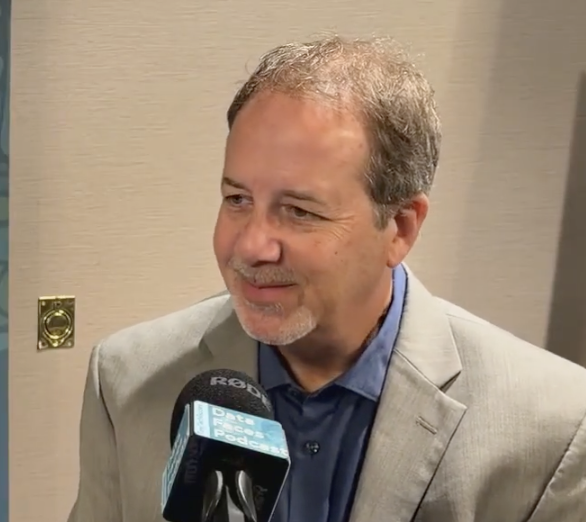
Douglas Laney is the founder of infonomics, the discipline of managing, measuring, and monetizing data as an actual corporate asset, and the author of the book Infonomics. He teaches infonomics in the MBA program at the University of Illinois and returned to Data Faces after his Episode 42 studio conversation. His research and books live at douglasblaney.com.
In this interview
- Why treating data as a corporate asset still stalls on accounting standards that keep it off the balance sheet
- Why traditional data quality dimensions do not translate to unstructured data and AI slop
- What a self-driving business looks like and why autonomy is becoming a competitive requirement
- How expensive token usage is forcing organizations to rethink swapping cheap labor for AI
→ Browse all on-location interviews: Data Faces Podcast — On Location
Full transcript
Doug Laney 0:01 All right.
David Sweenor 0:03 Hello, and welcome to the Data Faces podcast, live on location, coming to you from the CDOIQ event in Cambridge, Massachusetts, right next to MIT. I’m joined with a repeat guest, Mr. Douglas Laney. He is the founder of Infonomics and had a great, great show a couple weeks ago. Doug, thanks for joining us on the Data Faces podcast.
Doug Laney 0:26 Thanks, David. Thanks for having me.
David Sweenor 0:28 So… I want to say, the last time you were on a show, you opened up with a story about, did Tom Cruise play you in Risky Business? Yeah. That short.
Doug Laney 0:38 Yeah.
David Sweenor 0:39 It got a lot of hits. Did it? It’s on YouTube, so I hope the residuals come in.
Doug Laney 0:44 Clearly people searching for me, not Tom Cruise. No, no, no.
David Sweenor 0:48 So, you know, as always, what was your, my sort of icebreaker question is, what was your first job? Like, before your LinkedIn exists, what was your first job where you actually got a pay stub?
Doug Laney 1:02 A pay stub. Yeah, I was working in a tennis club. Okay. So I played competitive tennis, and so when I was a junior, I worked in a tennis club so I could get free court time. Okay. That’s a good way to do it. Cleaning up the locker room, folding towels. Yeah, and then in the summer at an outdoor club where I learned to maintain clay tennis courts. Oh, wow. So, yeah. And you still play today? I’m back to it now. Oh, okay. Since moving to Portugal. All right. Yeah.
David Sweenor 1:33 Well, very good. So, you know, thank you. Number one, you know, you introduced me to Rich Wang right after this. So now we’re here. Wonderful. Super excited. And so just you’ve been involved with this event quite a while. Oh, 20 years, I think. Yeah. What’s changed, you know, through that? You know, have things changed and how have things evolved?
Doug Laney 1:54 I think when I first started coming to this event, a lot of the ideas were really, really new. The concepts of big data was very new. The concepts of virtual data storage and access of analytic tools was all pretty new. A lot of the things, and maybe I’m just jaded, but a lot of the things kind of come full circle or pendulum back and forth. Right. I know there’s a lot of new technology leveraging AI, helping organizations build AI solutions. But from a kind of data perspective, I don’t know if I’m underwhelmed. I hear ya. Listen, I’m not a technologist, so I’m sure what’s happening underneath the covers from a data perspective is impressive. But yeah, I’m not feeling the overall excitement about changes in the industry other than AI. And maybe that’s, we’ve somewhat solved the data problem a bit. Folks are handling data governance and data quality fairly well, at least they know they need to be doing that. It’s not something new to the organization. I think where we’ve still fallen short is in pushing the idea of data as an actual corporate asset and treating it as an actual corporate asset, which is something I wrote about in Infonomics, that organizations should manage and monetize and measure data the same way that they do with their other assets. Maybe we blame the accounting profession for not recognizing data as a balance sheet asset, and someday maybe when they do, things will change, but I think it’s hard for organizations to get budget and resources to really manage data the way they should or the way they manage other assets because it’s still not a balance sheet asset according to arcane and antiquated accounting standards. There we go, there we go, there we go.
David Sweenor 3:43 So I want to talk about the self-driving business. Sure, yeah. Before we get there, you mentioned a bit underwhelmed, Yeah, I’ve talked to a lot of folks at the show. Data quality is still a problem. Data is crappy everywhere. But the biggest thing I’m sort of walking away with, I feel like there’s like an underinvestment in unstructured data and understanding the quality of that. You know, when you talk to many of the data quality vendors out there, it’s still tabular data, which is sort of known. And I think… I’m not saying easy, but it’s straightforward to understand the quality of that and unstructured.
Doug Laney 4:18 Maybe there’s more research needed. Do you have a thought? Well, when you look at the ways that data quality is measured typically, back from Rich Wang’s days and Danette McGovry and I have all posited various factors to measure. about data, it’s accuracy, timeliness, completeness, completeness of the record, completeness of the data set, integrity, scale, precision, et cetera. Those are not qualities that are readily applied to unstructured data. So we really haven’t come up with a great way to measure the quality of unstructured data. And one of the problems today is Now we’re seeing AI tools creating a lot of AI slop, and so how do you measure the quality of that? And I think a lot of it comes down to utility. How useful is that content to make decisions, to drive business efficiencies? So I don’t know if there’s really going to be a way to measure the quality of of unstructured data very well.
David Sweenor 5:20 Yeah, well, I think it’s really, really, there’s like, you know, if you have a form, is it complete? You can measure that, sure, but like, the content of it, if it’s AI slop, how would you even recognize that?
Doug Laney 5:31 Yeah, I mean, there are tools to recognize it, and in my, I teach an MBA class on infonomics at University of Illinois, and you know, when I see some student essays that look a little bit suspect, I’ll run them through an AI detector, but it’s not sanctioned by the university, so there’s really nothing punitive I can do other than take a shot across the bow.
David Sweenor 5:53 Just give them a little evil stare. All right, so the self-driving business. Tell us a little bit about your thoughts on that. I know you’ve been doing a lot of active research on this. Where are we? How close are we? What does it mean?
Doug Laney 6:04 Yeah, so this is a concept that we started talking about back when I was with Gartner almost a decade ago that at some point we’ll see big data and analytics and process integration and sensors and kind of the nexus of all of that combined to enable an organization to do what cars do today, self-driving. I was just in a car last night driving to a restaurant And the Uber driver didn’t have his hands on the wheel the whole time. Did you feel uncomfortable?
David Sweenor 6:29 I feel a little uncomfortable with that.
Doug Laney 6:30 No, I was more kind of thrilled by that. I wasn’t too uncomfortable. And then we started thinking about why can’t we apply that same kind of concept, that metaphor or that concept to a business itself. And I think it’s something that is coming. Organizations right now are automating certain parts of the business. They’re not really coordinating well across business functions yet, but I think if we start applying AI analytics, good data, maybe even external data as well, process integration, sensors, it’s highly probable that at some point we will see the first billion dollar business that’s run by just a handful of people and a bunch of AI agents or agent swarms.
David Sweenor 7:15 Well, so that sounds like, you know, nice in concept. And but there’s probably some challenges. Well, I don’t know if it’s nice in concept. I mean, I don’t know.
Doug Laney 7:25 It may be it may be important. I mean, I don’t know.
David Sweenor 7:30 We could. You can’t talk about the asymmetry of wealth and power. There’s a whole thing there.
Doug Laney 7:33 It’s critical for businesses to survive. Sure. Just as businesses, we were talking about this last night, just as businesses that didn’t get on, didn’t succeed with big data and analytics, they don’t exist today. Right. And so I think very soon organizations that are not automating, and automating and autonomy are a little bit different, but don’t have autonomous aspects of their business are going to fall behind competitively. Because right now our business processes are designed for the frailties and limitations of the human mind and body. And I don’t think that businesses that survive in the future will move beyond that.
David Sweenor 8:16 Yeah, and we’ve seen a little bit, you know, a little bit different, your point between, you know, automation and autonomy, but, you know, we’ve seen it with the automotive industry, the brewing industry, there’s these mammoth beer breweries that are run by just a couple people, Lego Factory, all that stuff.
Doug Laney 8:29 Now, why not apply that across the business, where different parts of the business, marketing, sales, finance, legal, you know, are all being coordinated, and with some awareness of external market factors and competitive factors and oil prices and all of that. So I think today we’re still running a lot of businesses based on spreadsheets. That’s true.
David Sweenor 8:53 So when we’re thinking about the self-driving business, we’re at the CDO acute conference. What do CDOs need to think about?
Doug Laney 8:59 Yeah, so the CDO needs to be the one who’s championing this concept. Right now it’s probably about establishing the vision and the roadmap. So that’s really what I’m focused on. The technology will change undoubtedly. Sure. Always does. Next time we come to this conference, there’ll be all sorts of new technologies. Right. But the roadmap is probably establishing that vision, establishing some processes that you want to put in place, that you want to automate, that you want to become autonomous, then figure out how to get them to coordinate collectively. Yeah, and then the big ethical problem and the labor problem is what do we do with people? Are we replacing them or are we upskilling them? So I’ve seen organizations today that have replaced half of their customer service people, but then they’ve moved them into new roles.
David Sweenor 9:55 That seems like a bit rare. I think people, like we talked a little bit last time, businesses aren’t really altruistic in any sense of the way. So I guess when that happens, I’m looking for the three R’s, which you mentioned last time.
Doug Laney 10:06 Retirement, relaxation, and reading. That’s right, that’s right. But yeah, they’re not altruistic, but they don’t want the reputational hit of firing boatloads of people.
David Sweenor 10:17 I mean, I think my hypothesis is they’re going to let people go. They’re going to be like six months, three months. Holy crap, what did we do? Our business is floundering for whatever reason.
Doug Laney 10:29 Well, there’s a lot of that. Token usage is expensive, and organizations are realizing that, yeah, we replaced this cheap labor with expensive AI token usage. And so they’re rethinking that strategy.
David Sweenor 10:42 Okay, all right. And then so I guess in terms of… You know, we talked about the challenges, you know, the rationale, the motivation. You know, how close do you think we are from this being a reality?
Doug Laney 10:56 Yeah. We used to say, and I worked in the early days of AI back in the late 80s and early 90s when it was called expert systems. Right. And we used to say, you know, AI is a journey, not really a destination. Okay. So… Yeah, I think people are all excited about super intelligence and general artificial intelligence, but I really think it’s about what can we make autonomous? What can we do better? How can we change our business models and the economics of our business using AI?
David Sweenor 11:32 All right, well, very good. Well, Doug Laney, you know, really the inventor of infonomics, all-around swell guy. So where can I find out more about kind of your latest research and things like that?
Doug Laney 11:43 Find me on LinkedIn. It’s a great place to find me. I’ve also got my own professional website, which is douglasblaney.com, or come to Portugal and come visit. I’ll take you out on the Portugal officer. Well, thank you very much for joining the Data Faces podcast on location.
David Sweenor 11:59 Take care.