

Data Faces Podcast — On Location · CDOIQ Symposium 2026
Leticia Naqvi, People Analytics Research Manager at Apple, on the four pillars of AI readiness and why data maturity is the one leaders forget.
Listen: YouTube · Spotify · Apple Podcasts · Amazon Music
About Leticia Naqvi
Leticia Naqvi is a People Analytics Research Manager at Apple, where she studies organizational AI readiness. Her research frames readiness around four pillars, leadership alignment, data maturity, innovation culture, and change management, drawn from over a year of study across organizations of every size.
In this interview
- The four pillars of organizational AI readiness, drawn from over a year of research across organizations of every size
- Why executive sponsorship and starting small with one function beat a company-wide big bang
- How standardizing a single data definition across partners shows where governance earns trust in AI
- Why data maturity is the forgotten pillar, and why AI readiness starts with the data foundation
→ Browse all on-location interviews: Data Faces Podcast — On Location
Full transcript
David Sweenor 0:00 Are we ready to go? Are you ready? I’m ready.
Leticia Naqvi 0:03 All right, here we go.
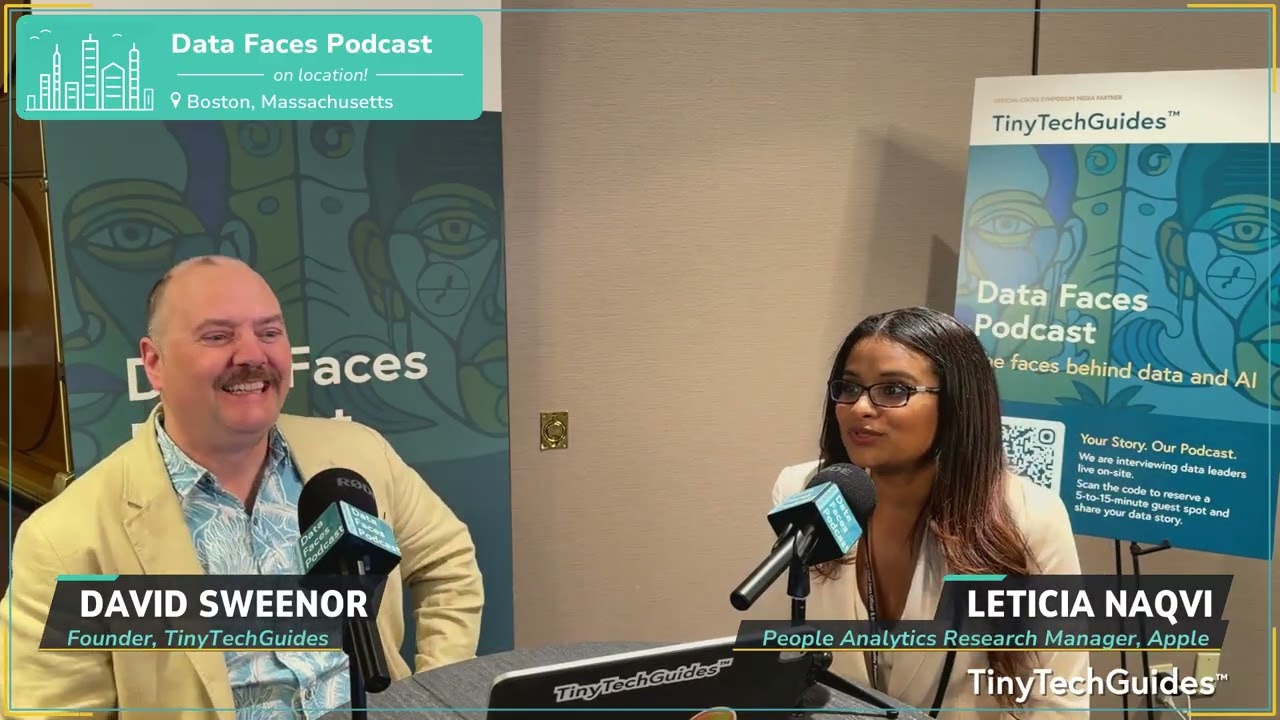
David Sweenor 0:08 Hello, and welcome to the Data Faces podcast. On location, we’re coming to you live from the CDO IQ event in Cambridge, Massachusetts. Sitting next to me is Leticia. How did I say your last name?
Leticia Naqvi 0:21 Nakvi.
David Sweenor 0:22 All right, hold on. Hello and welcome to the Data Faces Podcast. On location, we’re coming to you live from this CDOIQ event in Cambridge, Massachusetts. Sitting next to me is Leticia Nackvey. She is People Analytics Research Manager at Apple. Welcome to the Data Faces Podcast.
Leticia Naqvi 0:44 Thank you for having me.
David Sweenor 0:46 So, can you tell us a little bit about yourself, your work, and what you’re doing over at Apple?
Leticia Naqvi 0:52 Yes, so people analytics research manager at Apple, where my work focuses on people data analytics and business strategy, specifically within the domain of immigration analytics.
David Sweenor 1:07 Okay.
Leticia Naqvi 1:09 I also am working on research doctorate program where it also kind of stems from where I got this topic, organizational readiness for AI, but more on a people level okay since that’s where I kind of focus on but historically I have been in the immigration industry for over 14 years I’ve always worked on the vendor partner side but now I work on the client side so I understand both aspects of that but yeah that’s where kind of work stem from for as far as like data analytics and everything as far as business strategy as well.
David Sweenor 1:53 Well, there’s a big need for people who know how to do people analytics, right? So thank you for that. The name of this show is Data Phases, so I always like to get behind people before the LinkedIn profile existed. I always ask just a nice breaker question. So what did you want to be when you grew up?
Leticia Naqvi 2:11 Surprisingly, I did want to be an attorney. I wanted to be a lawyer. But then that kind of shifted. My previous history, I was working at immigration law firms.
David Sweenor 2:24 OK. You were almost there.
Leticia Naqvi 2:25 And I was almost there. I even went to my undergrad was kind of focused in criminal justice.
David Sweenor 2:33 Sure.
Leticia Naqvi 2:33 And then I pivoted for my master’s degree and went more on the business side. But I still have this always fondness of immigration, like attorney or law in the back of my mind. But yeah, I did surprisingly want to be an attorney.
David Sweenor 2:51 Okay, well, hey, that’s great. We need those. And so you had a session today. Can you tell us a little bit about the session here at CDOIQ and kind of what was the topic, the theme, and sort of what were some of the key points that you wanted people to walk away with?
Leticia Naqvi 3:07 Yes. So the topic was about bridging the gap from AI to insights to implementation. Okay. So also defining what organizational readiness actually means.
David Sweenor 3:21 Okay. I’m curious about this because I hear about we’ve got to be ready in life. Right. So you’re going to tell us, right? Right.
Leticia Naqvi 3:27 There’s a little, you know, there’s some frameworks, pillars that are involved, but essentially that’s what my discussion was today.
David Sweenor 3:34 Okay. So can we just double click on that sort of what is the framework and what does organizational sort of readiness mean?
Leticia Naqvi 3:41 So the framework is based on research and just also industry practical application stems from four pillars. Leadership, alignment, data maturity, innovation, culture, and Change management. Okay. So all of those four dimensions should work and not just one should dominate to make it successful to be able to implement AI successfully across an organizational level.
David Sweenor 4:14 And so there’s like frameworks are a dime a dozen out there, right? There’s a zillion frameworks, but this is based on research. Mm-hmm. And how do you, can you tell us just a little bit about the research process? How do you go about figuring out these are, out of all the dimensions that could possibly be there, these are sort of the four critical ones. How does that process work?
Leticia Naqvi 4:37 Yes, so based on my current research, because that’s where my research has stemmed from, it’s been over a year of just… Finding practical application frameworks that have been implemented across other organizations, whether it’s multinational organizations, mid-sized organizations, or even small startups. But some of the key components that stem from those four frameworks, four pillars, specifically the leadership alignment I think was what was one of the most that was because I think we need executive sponsorship to be able to align and get kind of like the resources and break the barriers I don’t know if your research has uncovered this but how do you go about
David Sweenor 5:28 getting alignment among these leaders. It seems like it’s probably the most difficult part of the whole process, I would imagine.
Leticia Naqvi 5:36 Right. And, you know, I think essentially it comes down to, like, do I need to get buy-in? Do I need to present with my research what we’re finding? And it also starts small, right? It can be departmental. So it doesn’t have to be like Big Bang.
David Sweenor 5:53 It can be like a functional or departmental area. Exactly. Not like, oh, the whole company’s got to do this now.
Leticia Naqvi 5:59 Right. And I think that’s where my experience, I kind of, like, realized that, okay, if we start small and then maybe it’s a word of mouth kind of thing. Where, oh, it worked for this function. Let’s see if it will work in this use case on a different function.
David Sweenor 6:16 Success breeds success, right? Right. Okay. Okay. And how about the other ones? You had data maturity, innovation culture, and change management. Mm-hmm.
Leticia Naqvi 6:25 kind of what are the other where do people get tripped up if you you know i mean probably all of them but kind of what are the any highlights you have from from any of those so i will say data maturity um because there’s a lot of facets that’s involved with that so you have the quality of the data right the infrastructure of the data there’s a lot of facets that are involved with making sure that that data is accessible, trustworthy, in order for it to even be able to provide great outputs for the users of that data, right? So I think that’s a major factor. And then going into innovation culture is, you know, how do we adopt that? have that culture not be fully embedded within an organization right but how do we make sure that that there is some sort of sustainable change and then change management sure I think that’s a hard one of the hard ones because it’s you’re kind of guiding and teaching how do you, how does the user, How do you tell somebody to do something they don’t want to do? do something they don’t want to do, right? So I think like, and it’s trying to operationalize it in their workflows and see like, maybe this will make it help you work better, and this, you know, I think kind of phrasing it in that way, incentivizing the people.
David Sweenor 7:48 Right, okay, that makes sense. And how do you like, this notion of, innovation culture is a bit fascinating to me. We wanna innovate, we wanna innovate. But how do you measure it? How do you think about it? And what is signs of a innovating culture versus one that may be stagnating?
Leticia Naqvi 8:12 That’s a really good question. I think, and it is very hard to measure, right? And I think it’s not like how many, and I think if we’re going to go into the AI discussion, but if not how many AI models are deployed or how many, because when you think innovative, what’s new, what’s, you know, what’s exciting for the business, um, I think with that is seeing how people operate that into their systems, like systematically.
David Sweenor 8:46 Okay, okay. And then, you know, I think you’ve mentioned maybe, you know, governance is super important and maybe it could be a catalyst for AI. Can you tell us a little bit about that? Because, you know, when you talk to lots of organizations, we’re like, pro-governance for sure, but we’re sort of lagging in maybe implementing it or getting going with it. So kind of what’s your experience in research, say, in that area?
Leticia Naqvi 9:14 It’s very difficult. I think in a data mindset, it’s necessary to have governance because you have standardization, especially because of this was based off my session, but a use case was working with several external partners and you’re trying to standardize just one data definition, like that. all four partners can have different meanings but then the business has a different meaning and it’s who sets that standard do we set it as the client or does the do we go off of like so there is i think like the alignment there but so what’s the answer what’s the answer And so then it goes into the governance part. We need to make sure that, and I think that’s also how it makes, how AI becomes more trustworthy when you have those guardrails in place.
David Sweenor 10:14 Yeah, you know what’s interesting? So you’re working in people analytics, so probably some of the most sensitive data an organization has, and you’ve got privacy and trust, and you have to treat this data So what can other sort of organizations learn from how you treat data, you know, because you got, you know, this is probably one of the marquee corporate assets that is the most guarded and held very tightly.
Leticia Naqvi 10:42 Yes, and I will say just working on the client side that we do have very heavily privacy, security, and, you know, because we deal with a lot of PII on people data specifically. And I think it’s just making sure that, if there’s a privacy, governance, security kind of function involved, and not just, there are privacy people, there are security, and there’s governance, and not just stemmed into one. I think that makes it easier, just based on my experience, because if you kinda put it under one umbrella, a lot of things can get lost in translation there.
David Sweenor 11:24 Okay, okay. And then, you know, for, you know, we’re at a CDO conference here. And so how does a CDO go about – they’re going to listen to this podcast. They’re going to say, how do I know if I am ready personally? And how do I know if my organization is ready? How should they think about this?
Leticia Naqvi 11:53 That’s a really great question. So I think they should think about it as – Not a technology project, more of an, okay, is this an organizational AI initiative, right? So it’s not how fast can we implement AI, it’s are we ready or can we? do it and so I think it’s making sure that you do assessments of their do a current state assessment of the organization and it has to be genuinely you know I think open eyes to understand that there are maybe faults, like what the current process is.
David Sweenor 12:38 Right.
Leticia Naqvi 12:39 Current processes may need to be changed. And how do we get there? And it may take a year, may take two years, five years, six months. You know, it depends on how large of a scale you’re trying to do it. And like I said earlier, I think start small, like maybe an org or function, just however that company operates. Because I think when you try to do too much at once, I think you’re not scaling effectively.
David Sweenor 13:07 I agree with you. So don’t try to boil the ocean. I think that’s a great, great message. And so I guess the one thing, based on your presentation today, what’s sort of the one key point you want all the data leaders and business leaders out there, what do you want them to walk away?
Leticia Naqvi 13:26 I think I would like them to walk away with making sure, because I know the four pillars I listed, leadership alignment, data maturity, innovation culture, and change management are all key dimensions. But I think what does get forgotten is the data maturity. Right. Because that’s the underlying, like one of the underlying root causes of AI-generated outputs that may not be, you know, and then that goes to executives, that goes to, you know, people that use it. And so I think that’s one takeaway that I would make sure that is highlighted.
David Sweenor 14:05 So there’s data maturity and readiness, and you didn’t mention it, but… Is that a prerequisite for being AI ready? And is AI ready to have a whole other set of probably dimensions associated with it?
Leticia Naqvi 14:18 Yeah, yes. So I would say that you need to have the foundation, the data foundation, like from the ground up.
David Sweenor 14:26 Without it, you’re building a house of cards, right?
Leticia Naqvi 14:27 Right, exactly.
David Sweenor 14:28 Okay. Well, Leticia Nackby, People Analytics Research Manager at Apple. Where can people find out more about you, your work, if they have questions?
Leticia Naqvi 14:40 So you can find me on LinkedIn. On my session earlier, there’s my LinkedIn information. And then also via email, I can provide that. Okay.
David Sweenor 14:52 Well, hit her up. Hit you up on LinkedIn.
Leticia Naqvi 14:54 Yeah, LinkedIn. All right.
David Sweenor 14:56 Well, thank you for joining the Data Faces Podcast.
Leticia Naqvi 14:57 Thank you for having me.