

Data Faces Podcast — On Location · CDOIQ Symposium 2026
John Ladley, data governance author and independent advisor, on why the field hasn’t hit 1.0, what a 38-second AI data model means for careers, and AI’s new governance duties.

Listen: YouTube · Spotify · Apple Podcasts · Amazon Music
About John Ladley
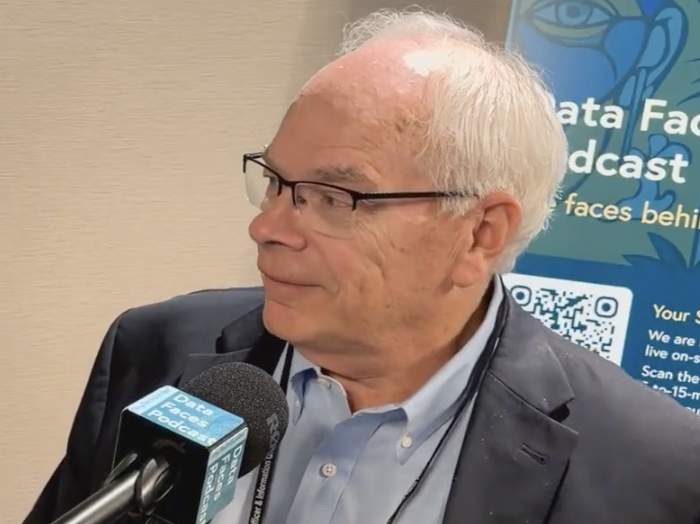
John Ladley is a data governance author, educator, and independent advisor with more than 40 years in information management. He has written multiple foundational books on data governance and enterprise information management, and he came out of semi-retirement to fold AI into a third edition of his data governance book.
In this interview
- Why a 40-year-old profession still hasn’t figured out its version 1.0
- What ChatGPT building a data model in 38 seconds means for governance careers
- The new duties AI adds to governance, from bias and ethics to overseeing automated work
- The two questions to ask leadership before starting any AI program
→ Browse all on-location interviews: Data Faces Podcast — On Location
Full transcript
John Ladley 0:00 That’s me. All right.
David Sweenor 0:01 We’re going to talk about this.
John Ladley 0:02 With the leather helmet and the scarf.
David Sweenor 0:05 All right. Well, you ready?
John Ladley 0:06 I’m ready.
David Sweenor 0:07 We’ll talk about something.
John Ladley 0:08 Okay.
David Sweenor 0:09 Here we go. Hello, and welcome to the Data Faces podcast. On location, we’re coming to you live from the CDOIQ event in Cambridge, Massachusetts, right next to Boston. I am seated next to John Landy. He is an author, independent advisor. John?
John Ladley 0:29 John Landly.
David Sweenor 0:30 Landly, is that what I said?
John Ladley 0:32 L-A-D-L-E-Y, yeah.
David Sweenor 0:37 I am seated next to John Ladley, independent advisor, data governance, and he’s an author. John, welcome to the Data Faces Podcast.
John Ladley 0:45 I’m just delighted to be here.
David Sweenor 0:47 So, John, the name of the show is Data Faces. Yes. And I’d like to get behind… Data Face. We have faces, but I’d like to get behind the people in their professional careers. Okay. And I noticed on your LinkedIn profile, you had a biplane.
John Ladley 1:03 Yes.
David Sweenor 1:04 What’s up with that? That’s an unusual LinkedIn.
John Ladley 1:08 Yeah. My publicity photo has me sitting in it too. I own a 1941 Boeing Stearman biplane, which was a trainer in World War II. They built over 8,000 of them in the early 40s, and they trained 80,000 to 100,000 men and women to fly airplanes. They were the primary trainer. Very cool. So the PT, the PT-17, like you see P-51, that’s a fighter, pursuit fighter. PT is primary trainer. And that’s where you went, and they would sit you in there, and at that point in history, they would put young men in there that had never even seen an airplane. Sure. And eight hours later, they were soloing it. Okay. Eight flight hours later, a few weeks later, they’re soloing it, and now they’re on the way to bigger and hopefully better, safer things. There’s a lot of them out there. I am a steward of history. Right. I’ve restored it to as originally as I can legally do it. Okay. And it’s an award winner. Oh, great. And it’s just an analog piece of my life. It’s the analog piece of my digital life where I can honor history, pursue my love of flying airplanes. I’ve been a pilot for 40 years, and I’m an instructor, commercial, multi-engine, certified, all that stuff. But I can pursue my hobby, but also I can honor the past. And that sounds lofty, but that’s exactly why I do it.
David Sweenor 2:51 You know, well, it’s probably a whole lot of fun, too. It looks super cool.
John Ladley 2:55 Oh, no, it’s not fun at all. I don’t have any fun at all.
David Sweenor 2:58 I had the opportunity when I was, I don’t know, probably in high school or something, but we went to Old Rhinebeck, New York.
John Ladley 3:06 Oh, that’s a wonderful place.
David Sweenor 3:07 And we flew, got to fly. It was like, at the time, pay 20 bucks and go up in the open cockpit by plane. Exactly, yeah.
John Ladley 3:13 So you know what it’s like. It’s noisy and there’s lots of bugs, but it’s an immense…
David Sweenor 3:17 It’s like driving my motorcycle.
John Ladley 3:19 Yeah, well, I tell people that it’s my motorcycle that flies. That’s right. And the funny thing is, if you’re a motorcycle person, if you hear a Stearman coming in the distance, it sounds like a Harley up in the air.
David Sweenor 3:33 Right, right. Okay, very good, cool. So you’ve written a few books, right? Yes I have, yes I have. Tell us on data governance.
John Ladley 3:41 Yes, yep. And data management, yes.
David Sweenor 3:44 What’s changing in the whole data governance and data management landscape?
John Ladley 3:50 It’s changing constantly. I’m a bit of, well, obviously like with the old airplane, I’m a bit of a historian.
David Sweenor 3:56 Okay.
John Ladley 3:57 And when you step back, our profession is what, 40 years old?
David Sweenor 4:02 Sure.
John Ladley 4:05 And people say, oh, it’s this generation, this generation, this generation. No, we’re just, we’re young, we’re new, and we’re just bumping into each other trying to figure out how to do things.
David Sweenor 4:16 Right.
John Ladley 4:17 So, by definition, things have to change a lot.
David Sweenor 4:20 Yeah.
John Ladley 4:20 Right? Okay. So, I’m like, I’m not, oh, it’s changing so much, I’m so surprised. No. We haven’t figured out the 1.0 yet, I think is the thing. So I wrote the first, my first book was in 2010, which was on enterprise information management. Second book, 2012, were the data governance chapters in that book, but it made the book too big. So we got a standalone book out of that, and everyone said, oh that’s great, and it had traditional stuff in it, methodology, tasks, things. And then I realized that we were accelerating past it, and data governance was not something that was The tasks and everything help people do stuff, but they treat it as a cookie recipe. And even though I said it in the text, no one’s thinking. So second edition, six years later, 95% rewrite, to emphasize, use your head, here’s how to use your head.
David Sweenor 5:24 Use your brain, right.
John Ladley 5:26 And refer to the tasks, refer to the first edition, but here’s what we’ve learned in the last six or eight years. Again, we say we’ve learned, it’s just we’re still figuring out the 1.0, okay?
David Sweenor 5:39 Right, right.
John Ladley 5:41 Now, I’m already working on a third edition just a few years later because this pesky thing called AI I mentioned AI in the second edition, but not enough. Not enough. And so now we’ve got to, now the book’s going to go from 240 pages to 300. Because we have got to put, interweave, First, you’re governing, you’re helping the governance of AI in that business, but there is using AI to do data governance too. So we have to address both, and we have to address them so that they’re separate. And it’s a lot of work. We’ve been working on the second edition for over a year now. We have another year before it’s out. You know what’s funny?
David Sweenor 6:27 You mentioned AI is sort of, you know, you got to update the book. And my first book I wrote, It’s called Artificial Intelligence, and it came out in April. I published it. It was a tiny tech guide. And in November, JetGPT came out that same year. And now, sort of instantly, not outdated, but it was missing the sort of foundational information on generative AI. I have yet to update it, though. I have not been so fortunate.
John Ladley 6:55 Well, we were noodling on this book. I’m getting help from my daughter who’s working her way into this business. And we’re working on the second edition in June of 24. And that’s when your ChatGPT license became available. You could send them in 60 bucks a month or whatever. And I did that. And the first thing I did was I did a data model. And I said, will this do a data model? 38 seconds later I had the rudimentary aspects of a data model. And at that point I said, this changes everything. This is job threatening, career altering. And I was on the verge of retiring. And I said, I’ve got to give this another year or two now. because this has got to be folded into this work. So that’s what we’re working on.
David Sweenor 7:58 So it sounds like it’s on two dimensions, I’m sort of hearing. One is AI. There’s probably maybe a whole set of things people need to… consider, because of AI and how fast it can consume and use data and all that stuff, governance, and then there’s probably how AI can actually help with the governance process.
John Ladley 8:19 Exactly, and that is, I’ve discovered, that’s a big problem. People just say AI. Well, AI is a tool. A hammer is a tool.
David Sweenor 8:31 And everything’s a nail.
John Ladley 8:32 It could be. And that’s a mistake, right?
David Sweenor 8:35 Right.
John Ladley 8:36 Okay. But it is a tool. What I teach classes, and I tell data people, don’t sell your tools as deliverables. The catalog. The catalog’s done. We’re done. Right. Oh, no, no. Not at all. I mean, you know, if you’re building a house and you go to this site and there you are with your lovely bride and there’s your dream home being built and some dude in coveralls comes up and says, hey, John, look, this is my hammer. isn’t this just the best thing ever? Right. I would say I had a creepy carpenter on the job site, okay? Right. And so, you know, this emphasis of the tool. Now, my first question is, what are you doing with that? If he said, I’m the electrician, I have a concern. Right, right, right, right. Okay? Sure. Yeah, but, so we need to back off and understand, I can use AI to do really, really cool things today. Policy writing, it’s a thing of the past. AI can do it. Okay. Just tweak a little bit, get the best policy ever, and you can get sample policies, get a data model out, you can get a data model started, you can do all kinds of good research and stuff. So, data provenance, you can do that too with AI. I just recently did a gig with a colleague of mine and we took all the code of a bank, millions of lines of code, and we self-documented all the systems because they didn’t have any documentation. AI did that in about a weekend. So you can do all that. Is that the AI we’re talking about that the robots are going to take control? No, no, not at all. It’s an entirely different thing. It’s an entirely different use of the tool. We have to bifurcate that.
David Sweenor 10:23 Right.
John Ladley 10:23 To start. I don’t, even at this conference, I don’t, sometimes I feel like it’s not sinking into people, you know?
David Sweenor 10:31 And so in relation to, you know, the work you’re doing on this, you know, updating your book, are you, I mean, how has AI changed the things you need to be concerned about from a governance perspective?
John Ladley 10:49 A lot. Okay. First of all, Data governance. Remember, governance is a discipline that helps organizations control complicated processes and systems. Governance has been around since the pyramids were built. Because you had some dude there with a stylus and some papyrus going. Hemetep, that’s crooked.
David Sweenor 11:16 That’s when data governance started. And capturing data on how many rows.
John Ladley 11:19 Yeah, qubits, what’s a qubit? Well now you just sounded like a comedian there. So anyway, so it’s been around a long time. People don’t understand that governance is governance is governance to a certain extent. Now so for the data stuff is what are those controls over data? For the AI governance is what are some of the specialized controls over data? and then we have to work on how do they merge together. So with data governance changing, it’s things like a lot of our mundane administrative work is now automated, or can be automated, so what do we do? We have to think about, well one, we have to add new capabilities to oversee the AI.
David Sweenor 12:01 Sure.
John Ladley 12:01 The data feeding in the AI. So that’s some new capabilities. We have to, we focus more on organization alignment. Business direction. Right. We have to focus on ethics. AIs are biased from day one because they’re biased by the data we give them. How do we make sure that the biases are not counter indicating the mission of the AI? All right. Those are new things that we’ve got to deal with.
David Sweenor 12:33 Wouldn’t have to worry about that before with just predictive models and data, or does AI magnify it at a scale?
John Ladley 12:41 Yeah, with a predictive model, you run some analysis, and if it says something that’s an outlier, you’re immediately… trained to dive into that and figure it out.
David Sweenor 12:57 Sure.
John Ladley 12:58 But if AI says something, it’s an outlier. You don’t know what an AI outlier looks like.
David Sweenor 13:02 That’s true. Most people don’t question it. Unless it’s absurd. They take the first answer, like, this is dogma. I’m like, this is one of an infinite number of possibilities that you can spit back to.
John Ladley 13:10 Yeah. Unless it’s absurd. I mean, I saw someone ran a model at LLM where they kept feeding. Besides, they took their built-in model, then they fed the results back in.
David Sweenor 13:20 Oh, yeah.
John Ladley 13:20 repeatedly, millions of times. And finally, the AI just, whatever you ask it, it said chicken.
David Sweenor 13:27 Yeah, early on I did that with a photo. I kept putting my photo back. Yeah, it goes insane. It went crazy.
John Ladley 13:32 Yeah, it goes insane. But unless it’s obvious like that, people are just going, oh, okay. As long as people are people, you and I will have lots of work to do.
David Sweenor 13:43 That’s true. That’s true, okay. And so for people, there’s a lot to consider with data and AI governance and technology’s changing so fast for the CDOs that will be listening to this or watching it. How do they get started? What’s your recommendation to them when they’re considering this?
John Ladley 14:12 This is an unusual scenario, but let me posit this. I’m a CDO. The boss says, go do AI. The first thing I’m going to ask the boss is, why? The boss will say, well, everyone else is doing it. I went to CEO camp and all the cool kids had AI. That’s right. All right. So then the second question is going to be, if we do this, what do you think it looks like when we’re done?
David Sweenor 14:40 Okay.
John Ladley 14:41 Please tell me what success is. Now, everyone says, oh, John, that’s genius. I was just telling a bunch of people before this, study the field of organization development and change management. The first primal concept you must lock into your brain if you’re going to change anything, move an organization from point A to point B, what does point B look like? Human beings can’t function without that vision. So the first thing I’m going to say is get your vision down, get your benefits down, and then move on.
David Sweenor 15:11 Okay. And so, John, where can people find out more about you, your work, and your books?
John Ladley 15:18 Books are on Amazon, just look for John Ladley. Put my first name in, because there’s another author out there that does heaving bosom novels. Some sort of distant relative. That’s the best way I can phrase that. The second thing is JohnLadley.com. And also I’m accessible through Dataversity. I do a lot of training for Dataversity, so I’m available through their website as well.
David Sweenor 15:48 All right. Well, fantastic. John Latterly, independent consultant, advisor, author, pilot, and instructor. Thank you for joining the Big Faces podcast.
John Ladley 15:57 Glad to be here. Cheers. Cheers.