

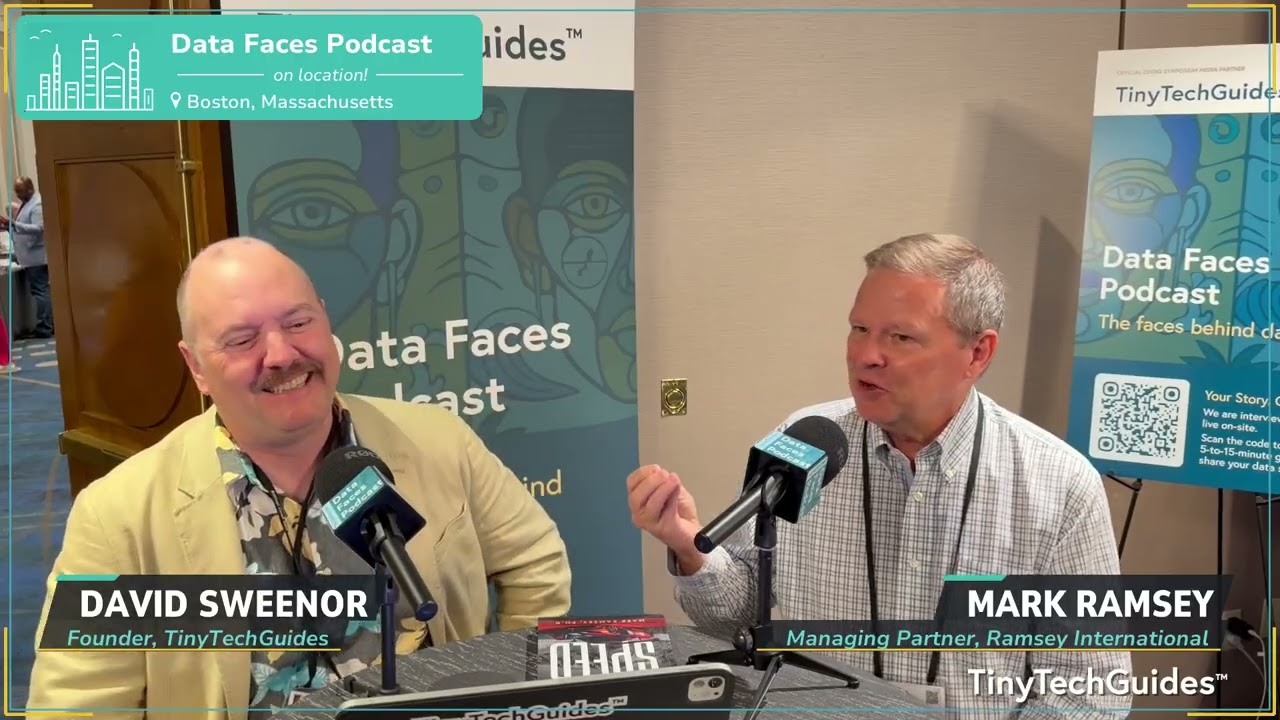
Data Faces Podcast — On Location · CDOIQ Symposium 2026
Mark Ramsey, managing partner at Ramsey International, on the shadow pit crew, why half of CDOs don’t last three years, and putting AI in the driver’s seat.
Listen: YouTube · Spotify · Apple Podcasts · Amazon Music
About Mark Ramsey
Mark Ramsey is managing partner at Ramsey International, a data strategy consultancy, and a former chief data officer. He entered professional motorsports in his 50s with a race team called Big Data in Action and turned the experience into Data at Speed, a book that maps the five crashes every chief data officer will face.
In this interview
- What the shadow pit crew is, and why it forms when the CDO doesn’t own data access
- Why blocking generative AI drives employees to free tools that expose company data
- Why 50% of CDOs don’t survive three years, and how owning the mandate changes that
- Why copilot-style AI caps you at 20 to 30% gains while AI as the driver reaches 100x
→ Browse all on-location interviews: Data Faces Podcast — On Location
Full transcript
David Sweenor 0:00 So I’ll just start. What I’ll do is a quick intro. We’re here to ask you to introduce yourself, your company, and then we’ll just jump in. Okay. All right.
Mark Ramsey 0:09 Sounds like a plan.
David Sweenor 0:10 We’ll go ahead around 15 minutes, whatever works. Very good. All right. Hello and welcome to the Data Faces podcast. On location, we’re coming to you live from CDOIQ in Cambridge, Massachusetts, right next to Boston. Sitting next to me is Mark Ramsey, managing partner at Ramsey International. Mark, welcome to the Data Faces podcast. Hey, thanks for having me. So can you tell us a little bit about yourself and your company? What do you do? Sure.
Mark Ramsey 0:38 Yeah, I mean, I’ve been in the data and analytics space for well over 35 years, and it’s always been a passion around helping companies figure out the strategic value of data. I was with IBM for almost 20 years and then became the first chief data officer for Samsung Mobile. And then after that I was the first chief data and analytics officer for a large pharmaceutical company, GSK, headquartered in the UK. And then for the last 10 years I’ve really transitioned back into my consulting roots and I have an advisory firm where we work with organizations on implementing large scale data and analytics. And of course, these days generative AI. Oh, yeah, we can’t forget about that.
David Sweenor 1:22 Yes. And you know, so the name of the show is data faces. And part of the motivation is to get, you know, behind people and their professional LinkedIn profiles and careers. So I understand that you were into motorsports. So I’m sure our guests would love to learn a little bit about what did you do in motorsports?
Mark Ramsey 1:43 Well, yeah. Back a number of years, I’ve always had a passion around cars and sports cars and things. And in the mid, probably it was on 2015, I started taking courses on driving fast on tracks.
David Sweenor 2:00 Okay.
Mark Ramsey 2:00 And it’s sort of an addiction that then when you start driving fast on a track, then you want to go faster.
David Sweenor 2:06 You get in trouble on the normal highway. Yeah, the normal highway, not so much.
Mark Ramsey 2:09 This is bad. Okay. But then I had this, I guess, flaky idea about actually starting to race. And I was well into my 50s. And so starting as, you know, getting into racing when you’re at that age, it’s a little unique. But it was something that I really wanted to do. And so I started doing racing in a purpose-built race car. Did that for a couple of years. And then, again, another crazy idea. I wanted to step it up. And racing, a lot of people don’t realize, or maybe they hadn’t realized, that racing, professional motorsports, is very data-driven. So a lot of folks have seen Drive to Survive on Netflix and have really gotten into F1 and they see how much data is really involved in racing. And so it kind of brought together my passion for data and my passion for driving fast. So I entered professional motorsports in 2018 and did a couple of years of racing at a lot of the major tracks in the U.S., Daytona and Watkinson.
David Sweenor 3:18 Wow, that’s great.
Mark Ramsey 3:19 And it was highly competitive and I learned a ton. And we actually built a race team. called Big Data in Action. And the idea was… That’s good for sponsorship for sure. Yeah, exactly. And again, with that level of racing, it requires sponsorship. So we had a couple dozen sponsors, all high-tech companies in the data space. The thing that was different is we didn’t just have sponsors, we actually built a data platform, we ingested the data, we analyzed the data, and really used that as a way to improve the performance of the racing. So it wasn’t just big data in action as a title of the team, we actually put together a solution I did that for a couple of years, and then, like a lot of things, I realized that it almost had become a second career. Yes. And I wanted to kind of step it down and be more into just racing for fun, which is what I do now. And so I still am involved with racing and still involved with using data to go quicker.
David Sweenor 4:20 Well, that’s great. And so this brings us to you have a book here called Data at Speed.
Mark Ramsey 4:27 Yes.
David Sweenor 4:28 Tell us about this book, and what was the motivation for writing this, and what are we going to get out of this?
Mark Ramsey 4:33 Well, a few years ago, actually, at the MIT Chief Data Officer event, I did a presentation on using data in organizations like professional motorsports teams do. So I showed up at the event in my full racing suit. It was a very well-attended session, a lot of engagement. I think people really got a lot out of it. And my wife started encouraging me to take the content from that presentation and turn it into a book. And so after a couple of years of encouragement, I finally broke down and did it. And so the book is really about sharing experiences in professional motor sports and the, you know, as they used to say on the ABC wide world of sports, it’s sort of the thrill of victory and the agony of defeat. And so I go into a lot of detail on crashes and trying to go faster and using the data to improve performance. And the real objective of the book is to help people understand how the things and how data is used in professional motorsports is very applicable to how data should be used within organizations. It’s making decisions faster and using the data faster. and so that’s really the purpose of the book and so it’s bringing together my two passions and the feedback has been great and a lot of people they learn a little bit about racing and they learn a little bit about how to deploy large-scale data programs and it’s all kind of interwoven so it’s a lot of fun that’s super cool you know a couple of the companies i have i’ve worked for in the past you know they’ve sponsored f1 teams and
David Sweenor 6:20 And, you know, one of the things that, you know, so there’s all the whole data element, you know, we’re exclusively for data and AI type companies and that’s fine. But one of the things that occasionally we struggled with was connecting the dots between all the things an F1 team does and like a pharmaceutical company or a whatever company. How do you make that connection for the CDOs and leaders and business and data leaders that you’re talking to? Because some of them are like, oh, well, you know, it’s a car. It’s not difficult to me. I may manufacture pharmaceuticals as an example.
Mark Ramsey 6:57 No, no, it’s a great example. That’s in the book. I mean, the thing that’s a little different for me is that having been a professional race car driver and using the data.
David Sweenor 7:07 And a professional professional.
Mark Ramsey 7:09 And a professional data person, you know, what I tried to do is weave that together succinctly. And so, for example, one of the things that I share is the five crashes that a CDO will experience. And it’s tied to the racing program. So it’s a direct connection. I mean, I agree with you, the sponsorship in Formula One. There’s so many things that are happening in Formula One that it can be difficult to make that connection. I try to take it from a perspective of having implemented a number of data programs and experienced the thrill of victory and the agony of defeat in the data program. It makes it much easier for me to connect that to the racing.
David Sweenor 7:54 Okay, so we don’t have time to cover all five crashes a CDO will encounter in their career. Pick one or two that maybe let’s just start with one. What’s your favorite one or the most that happens every time? Or maybe they always think of all five.
Mark Ramsey 8:13 Where are they going to crash and burn here? Yeah, the one that I think is kind of funny is the shadow pit crew, and I think we’ve all experienced this. I mean, you’ve certainly been in data, but it’s analogous to the shadow IT group, right? Sure. So if the CDO doesn’t step up and actually drive the access to data and build the program, somewhere in the business that shadow pit crew or the shadow IT is going to do it for themselves. And so that can be extremely detrimental to the organization if they don’t step up and really take charge. And so that’s one example of kind of this crossover between what can happen in data programs and what can happen in racing.
David Sweenor 8:55 So can I maybe just probe on that a little bit? Sure. I think all my listeners and viewers are certainly well aware of what shadow IT is. And I feel like with generative AI in particular, Everybody’s a creator. Some organizations have granted access to the service of their choice. Some are like, we haven’t figured it out yet. And pretty much everybody, every employee’s using it, whether it’s sanctioned or not.
Mark Ramsey 9:27 Correct.
David Sweenor 9:28 What kind of risks, or how does a CDO think about this? Because maybe their organization’s too slow because they’re mired in policies, so they’re like, we’re not going to do anything. They’re paralyzed. but their employees are still using it, I’m pretty sure.
Mark Ramsey 9:40 Right, no, for sure. I mean, unfortunately, what ends up happening is if the organization doesn’t authorize the use and actually promote the use, then the employees are using the free version. Whatever they want, yeah. And the free version is then exposing data to the outside world, so it’s actually detrimental They think they’re helping, but they’re not. I think with generative AI and the fact that you’re putting some very powerful tools in the hand of the business users, the upside can be tremendous. There are risks. In fact, I did my presentation yesterday at the event here, was specifically on that the CDO needs to own the mandate around the data. And if they don’t do that, then people are just going to go around them. And with generative AI, we’ve now turbocharged the ability to have these shadow IT, shadow development. And so, again, even if the organizations feel like they are protecting themselves, they’re actually causing more damage or having the huge potential to cause more damage.
David Sweenor 10:49 And there’s all sorts of excuses. Well, it’s too expensive. We don’t have the budget. I mean, I think as your message, go get it. You’re going to spend the money, right?
Mark Ramsey 10:59 It’s pay me now or pay me later, right? It’s kind of like you’re opening yourself up. And again, there’s always the media headlines about huge spend when they’ve opened up access to generative AI. In a lot of cases, that’s because what’s been opened up is a pay-by-the-drink approach.
David Sweenor 11:18 Yeah, sure.
Mark Ramsey 11:19 And most of the platforms offer a monthly fee that locks in at a certain level. Or you can maintain a certain budget to hit within. But thinking you’re protecting yourself by just avoiding it, the technology has advanced so rapidly that that’s actually a fast path to a crash.
David Sweenor 11:40 Yeah, okay. And so, you know, what is a CDO to do now? So we have these five crashes. You just mentioned own the mandate. How, like, they go to work tomorrow. after they watch this amazing podcast.
Mark Ramsey 11:59 Amazing podcast, yes.
David Sweenor 12:02 What should they do? What’s your advice? What’s your recommendation for them to get started? Because it’s a bit overwhelming. It can be. There’s security, there’s budget, there’s this, there’s that. Is there a normal job?
Mark Ramsey 12:13 no i mean i think the my recommendation is when you walk in on monday morning you have to walk in owning the data owning the mandate and and move away from from thinking that your role is just to govern the data because that’s we see a huge turnover in chief data officers right the the 50 of the chief data officers don’t survive past three years and part of that is because They’re not owning the data and helping the organization drive the strategic value of the data. They’re too focused on playing defense.
David Sweenor 12:47 But sort of in the name, right? There’s always been this debate. Chief data officer, chief analytics officer, now we’re talking about chief AI officer.
Mark Ramsey 12:58 AI, AIO officer. I mean, they’re adding up. I know, I know.
David Sweenor 13:02 Lots of acronyms, but I always thought, like, one was defense, CDO, you know, generally in IT, and CAO was more an offensive play. Is that sort of experience? I mean, it’s kind of what I’ve seen. I think part of it is. I’m not saying that’s how it should be.
Mark Ramsey 13:16 Right, I would say number one, that’s not how it should be. Number two, I would agree with you that unfortunately the reason that we’re seeing the attrition of CDOs is because of exactly that fact. They’re playing defense, right? They’re privacy, they’re governance, they’re protecting the data. That doesn’t drive value to the business. What drives value to the business is going on offense and saying this is a repository of information. I own that and I’m going to make sure that the business has access to it and you actually can take action and make decisions and drive value. There’s the sandbox you can play at. Right. And it’s going to be open it as much as possible. Exactly. Exactly. Because if you’re playing defense, that’s that’s a good path to your next job interview because you’re not driving any value.
David Sweenor 14:03 OK. And then I guess maybe the last thing I wanted to ask was in terms of the I guess other steps like is this. Should generative AI be feared? We’ve seen in the headlines, and I don’t know if that’s the right way to phrase it, but we’ve seen in the headlines it’s going to unlock Huge amounts of productivity. I’m not sure I’m seeing that among my clients. I saw it at the personal productivity level, but then I just shifted my work to you because I gave you AI slop. Now you’ve got to go review, validate, invent. Yeah, I get it. You know what I’m saying? Maybe it’s not. It shouldn’t be feared. Is it? the potential being realized that we were probably hearing about last year? Are we sort of in that trough of disillusionment coming up the other side of the hype? I’m curious what your read on this is.
Mark Ramsey 15:02 Yeah, I think my read is that we’re not getting the value out of it, and a good reason is because we are fearful of it. People are, I mean, again, with this, the economic conditions and the way the job market has been, people are always concerned about is AI going to take my job away, as opposed to looking at it if they can leverage AI to the fullest and get 100x productivity increase, then they’re making their role even more critical to the organization. And I think the reason that we’re not seeing the big benefits is because most folks are using it like an add-on to what they already do. They’re not looking at the fact that AI can replace a lot of the things that they used to do. And we work with clients that are seeing 100x productivity improvement, but you can’t do that through like a co-pilot mentality. If it’s a co-pilot, which means you’re driving and you have a co-pilot that’s helping you here and there, Yeah, you might see 20 or 30% improvement. If you’re a developer and the co-pilot is helping you craft a little bit of the code or it’s helping you revise your code, you’ll get a little benefit. Until you switch it around and AI is actually the driver and you’re supervising it and you let it go to the maximum, that’s where you see the huge benefit. And most organizations, most individuals aren’t there yet for a variety of reasons.
David Sweenor 16:26 Okay. Well, Mark Ramsey, managing partner at Ramsey International. Where can people go to find your book? More about you and your company.
Mark Ramsey 16:34 Yeah, probably the easiest is the website dataatspeed.com. The book’s available on Amazon in all the different formats. But, yeah, if you go to dataatspeed.com, you can watch some videos of crashes and fires and all kinds of fun stuff.
David Sweenor 16:50 All right. Well, thank you for joining the Data Faces podcast.
Mark Ramsey 16:52 Thanks for having me. Cheers.
David Sweenor 16:54 Cheers.