

Data Faces Podcast — On Location · CDOIQ Symposium 2026
Leigh Felton, president of the AI for Job Security Foundation, on why you can’t de-bias AI, governing AI as an environment, and not letting AI genericize you.
Listen: YouTube · Spotify · Apple Podcasts · Amazon Music
About Leigh Felton
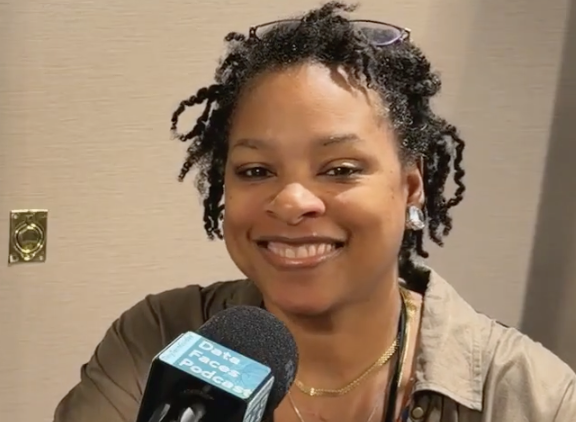
Leigh Felton is president of the AI for Job Security Foundation. A pregnant, homeless teenager and college dropout early in life, she went on to spend 20 years at Microsoft, where she headed the company’s first ethical AI enablement program, and she is the author of the two-volume series I Could Have Been CEO Yesterday.
In this interview
- Why de-biasing an AI system trained on historical patterns may be impossible
- How environmental-scale governance, in the spirit of OSHA, differs from governing AI as a tool
- Why collaborating with AI and pushing back on it beats publishing its first draft, even when the task takes longer
- Why junior employees and Gen Zers will question the things 30-year experts stopped questioning
→ Browse all on-location interviews: Data Faces Podcast — On Location
Full transcript
David Sweenor 0:00 President, AI for Job Security Foundation.
Leigh Felton 0:02 All right, we’re ready? I’m ready. We’ll go about 15 minutes. All right, here we go. If you can stop talking to me in 15 minutes, we’ll see.
David Sweenor 0:09 I got a timer here for that. I’m calling you. No, I’m not talking about me.
Leigh Felton 0:15 Oh. I’m not talking about me. I’ve had conversations and we tend to go long, but let’s see.
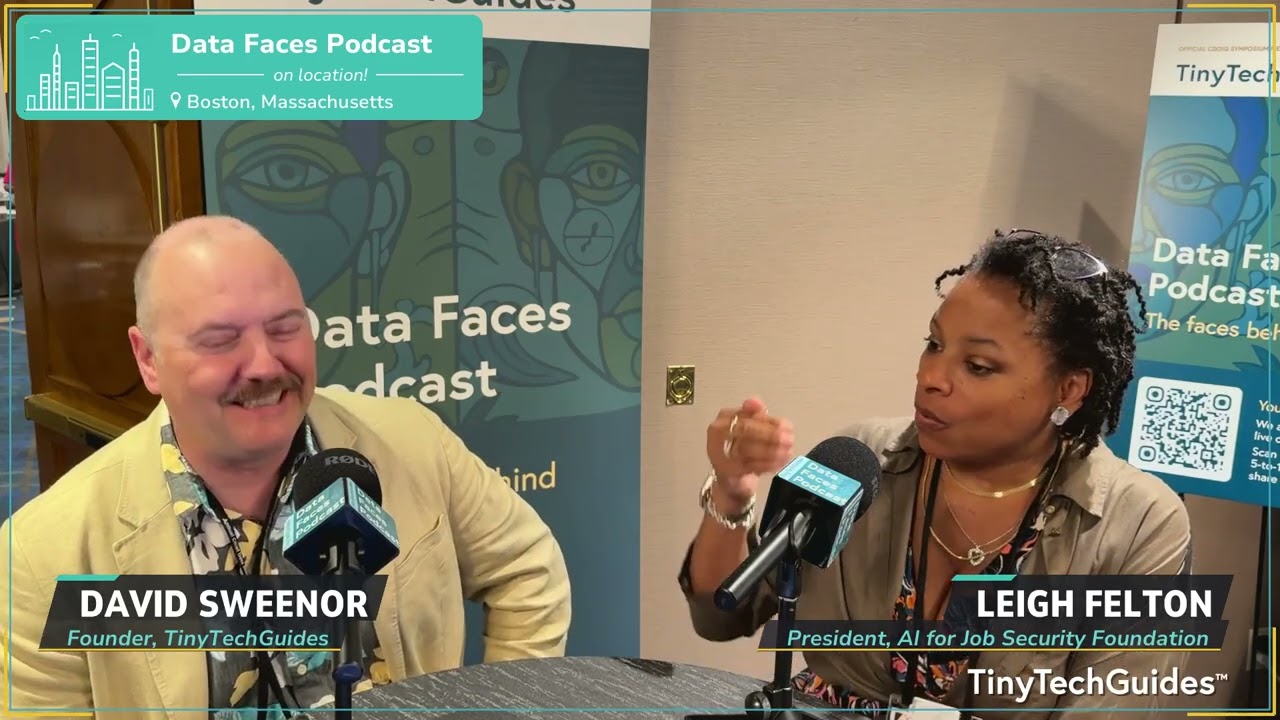
David Sweenor 0:19 Here we go. Hello and welcome to the Data Faces podcast. Our location, we’re coming to you live from the CDOIQ event in Cambridge, Massachusetts, right next to Boston. Next to me is Lee Felton. She is president for AI for Job Security Foundation. Lee, welcome to the Data Faces podcast.
Leigh Felton 0:38 Thank you so much for having me. I’ve been really looking forward to this conversation.
David Sweenor 0:42 I’m super excited, but before we get into this, the name of the show is Data Faces. I like to get behind the people before their professional careers existed. Okay. What did you want to be when you grew up?
Leigh Felton 0:56 I wanted to be the first black female president of the United States of America. Oh, so there’s time. No, there’s not. There’s too many skeletons. I was going to say there’s too many skeletons in my closet for that one, but…
David Sweenor 1:06 Okay, all right, all right.
Leigh Felton 1:08 I’ve moved beyond. I definitely have higher ambitions than that now.
David Sweenor 1:12 Well, now you’re president of the AI for Job Security Foundation. Tell us a little bit about that. And what do you, you’re president, so you sort of do everything, but just tell us about what’s the foundation about?
Leigh Felton 1:23 So the AI for Job Security Foundation is a 501c3 nonprofit organization that is focused on helping communities, students, faculty understand what AI actually is, understand how to embrace it, understand how to control it, and understand how to keep and create new jobs for the future workforce.
David Sweenor 1:46 Okay. Wow. That’s no small to tall order. It’s not. You have a couple of books here.
Leigh Felton 1:53 Show us these.
David Sweenor 1:54 We’ll be on video here.
Leigh Felton 1:56 What do we got here? So I have a two-volume series.
David Sweenor 1:59 Let’s put it right here. Okay.
Leigh Felton 2:00 I have a two-volume series. The first volume is, I could have been CEO yesterday, but AI algorithms say I’m a DEI risk today. This is about how the limits of historical data is being used to train everybody to predict what the future will be. As I tell people for this book, it is looking at the intricacies of what has happened through stories. through, I do comparisons of AI, different AI GPTs, asking questions that are completely irrelevant and that cannot be answered. And you will see these GPTs confidently answer questions because of the historical training and the historical biases. It is already built. So to de-bias an AI system is impossible since the system itself is built to be biased. It’s built to recognize patterns.
David Sweenor 2:55 You can’t erase history.
Leigh Felton 2:56 And you cannot erase history. You cannot. It throws out anomalies. So anyway, that is the first book. Volume one. Volume one, AI Algorithms. See, I’m a DEI risk today. So it’s truly about part of my story being, I mean, I’m a successful, I was 20 years at Microsoft. I headed the first ethical and AI enablement program at Microsoft. And I’ve done so much more since then. But AI, had it existed back then and it was telling who could do jobs, it would have thrown me out because I was a college dropout. I was a statistic, a pregnant, black, homeless teenager. Okay. AI would not have given me a chance because the pattern recognition does not heal to success in those situations.
David Sweenor 3:40 Oh yeah, and there’s been a lot of cases of different companies where that’s, you know, hiring bias. Exactly. Well documented.
Leigh Felton 3:46 So I’m just glad I’m able to sit here now being the president of a company, you know, having done so much in my career because AI didn’t exist and wasn’t choosing people for jobs back then. Right, right. So that is book one. It’s about the history. It’s about understanding how AI is trained and and the fact that those limitations are causing us to limit our own opportunities. The second book, I Could Have Been CEO Yesterday, does AI decide who will be CEO tomorrow? It takes it a step further and it says, okay, so if we’re using this historical data to tell us and predict what the future is going to be, what is the ultimate goal? The ultimate goal for a lot of organizations is autonomous AI. And autonomous AI is and should not be the ultimate goal because it’s taking away understanding, empowerment, and actual imagination of what the future can be. And so it shifts the focus to talking about AI as an environment, not a tool. Organizations are used to adopting and deploying tools, not environments that completely change cognitive behavior, completely change logic, and completely change the culture and opportunities for people.
David Sweenor 5:05 Let’s double click on that. So I think I’ve had a number of conversations here and talked about jobs a little bit and this and that. Yes. I think a lot of people see AI as a tool. Would you agree with that?
Leigh Felton 5:21 And you’re saying, don’t think of it that way. It’s an environment. Yes. That is the uphill battle that people need to understand.
David Sweenor 5:30 Let’s articulate a little bit. AI is an environment. Let’s define that.
Leigh Felton 5:38 Let’s define that. So if you think about a tool, and this is what organizations for centuries have done, You pick it up, you put it down. The human determines what it wants to do with that tool. The human determines did it, you know, if I have a hammer and I nailed something, did I miss the nail? Did it hit the nail? Did it go in or did it not? Okay. The hammer’s not going to remember my grip and tell me to move two inches over. The hammer’s not going to tell me, no, don’t nail that nail. Instead, go over to this nail and reinforce this nail. The hammer is not going to influence where I put in nails for the safety and security of my buildings, of my homes, of my vehicles. But yet, that’s up to the person. But yet, we’re having AI systems. that are telling us confidently, even with limited information.
David Sweenor 6:30 Confidently tell you wrong things all the time.
Leigh Felton 6:32 It will confidently tell you the wrong things. That’s right. We have AI systems that are literally shaping the way we think, shaping the culture, shaping… access and opportunity. That’s environmental scale. So if you think about environmental regulation, environmental governance, things like OSHA, safety around, that’s how you govern environments. We’re still governing AI as a tool, which means that we’re looking for the end result. Who did it hurt? How did it process? We’re not trying to get ahead of it and saying, what is it going to shape and adapt and change? And is that what we want the result to be?
David Sweenor 7:12 So how do you get these, you know, there’s many of them here, some very large companies that are… maniacally focused on profitability. The story right now, you’re talking about one side of the equation, efficiency, productivity, that’s costs, cutting costs, two point jobs. Nobody’s talking about the revenue side, innovation, new business models. So how do you get a CDO to care? And how should they think about this?
Leigh Felton 7:44 And this is the thing, you have to speak in the language that people speak in. And so if I go into, even to a CDO that understands data quality, understands data governance, understands all of those things that are required, data management, that are required to successfully take in, abstract, and even monetize your data, you have to speak in the language. If I just go in and say, hey, you need governance, you need rules, you need to understand what AI is, they’re going to be like, blah, blah, blah. Where do I check the box and say I did it just so if any regulators come across, I can say, hey, we did that. You have to speak the language that they’re speaking. So if you’re talking about productivity, you have to say, okay, so there’s been studies that say AI, for some engineers and developers, AI has reduced productivity by about 19% because now they’re using these AI and it’s actually taking them longer to do their jobs. That is the opposite of what we wanted.
David Sweenor 8:43 Yeah, I see that in the marketing side for sure. Like an AI put out something, like I could have wrote it faster. Or if you get sent something, like this is AI crap, works a lot. Yes. Or I could go fix it, just shifting the work.
Leigh Felton 8:56 But this is the thing that I push back on. And this is, when you talk about these large organizations, that’s exactly the default of what they’re thinking. And where I get their attention is by saying, actually there’s a different way of looking at that. If the engineer and the developer were putting in a prompt and the AI responded and they just took that response and then encoded it and moved it forward, That might be more productivity. That’s faster, not necessarily more productivity. But if it’s actually the engineer is pushing back on the AI and they’re collaborating, they’re adapting, they’re really building something new. That, even if it takes 19% longer for that task, they are actually being way more productive than if they just went into this node of what I call AI think, which is just taking out the slot that AI is producing and publishing that. That is not productivity, but that is the conscious, the subconscious thought that people are associating with AI, that it should just be able to make it faster.
David Sweenor 9:58 I agree with you 100%. I think that’s the number one mistake most people, even experienced users of AI, GPT systems, make is they accept the first output. I’m like, that’s one of an infinite number of possibilities that could come out of these things. And so people that have learned to use it, Effectively, that’s what they do. They iterate it. It’s a challenger. You can challenge it. Give me a thousand reasons why this is right. Another thousand why this is wrong. Let’s work through this.
Leigh Felton 10:26 And even more so than that, don’t ask the AI to give you the reasons. And so this is, so I’ve been in industry for 30 years. So I have experience. I have expertise. And so I know AI will never be able to write, strategize, decipher better than I can. Never. And some people can’t say that, but I believe it for them. Sure. And I know when I’m giving AI my voice and I stop it. I don’t let it genericize me. So if you think about all these articles and publications and LinkedIn posts, they’re starting to sound the same. The sea of sameness is well upon us. All the same. It’s this, it’s this, it’s this. I’m not trying to. It’s not, it’s not, it’s not. It is the same pattern. It’s not this, it’s that. Exactly. And it’s the same pattern. The result. Because individuals are allowing, even if they say, AI, give me a thousand. you know, or give me a thousand of this, they’re still allowing AI to tell you what the parameters are. Instead of saying, you know, this does not sound like me. I believe, and sometimes I will rant to my AI. I will rant to my AI because it is in that just like we used to do, if you remember the old movies, we used to, if an author was writing a book in a typewriter, I mean, I’m talking, I’m aging myself here, you see the, and then, oh, they make a mistake, they scroll it up, they throw it away, then they go, and then, you know, five minutes pass, and then you’d see this crumple of papers on the floor, but then what happens? They remember something. They go over to that piece of paper and something triggers. They go over to another and something triggers. And then they’re able to actually work through the problem. We’re getting to the point where people aren’t working through the problems. Instead, they’re giving AI prompts to say, give me a thousand reasons where they are not working through the problems. And so if you use AI to work through the problems and to say, okay, I see all of this, but what am I? missing what don’t I see that expands the scope of your AI and then that co-adaptation actually makes your AI stronger right so message number one don’t let me I replace your brain please don’t something up there please don’t right exactly remember this people can think people can imagine People can make judgments. AI cannot do any of those things. AI, and this is one of the things that if you’ve seen any of my work, you’ll know I’ll say this all the time. Had OpenAI, instead of coming out with ChatGPT as artificial intelligence, had OpenAI come out with ChatGPT, a probabilistic engine that is statistically guessing based on patterns that it recognizes, I don’t think that they would have had the same level of millions and millions of people signing up overnight. But that’s actually what it is. We think AI is this magic bullet, this magic pill, and it can be, but it’s not this thing that sees you, that can decipher things of the unknown that you’ve never created before. That’s what people are for.
David Sweenor 13:47 I hear you. So we have a couple minutes left. Let’s talk about… The future of work and jobs. Are we optimistic, pessimistic? And where are we on sort of this? Everything’s a curve. Are we on the front side of it? Is it doom and gloom? Is there a reason for hope?
Leigh Felton 14:09 So I honestly, truly believe. And this has been, and I told you I had a debate before this. You were riled up when you got here.
David Sweenor 14:17 I was riled up when I got here and ready for a conversation.
Leigh Felton 14:20 But I honestly, truly believe AI will never be as smart and intelligent as people. I like this.
David Sweenor 14:28 We have a scoop right here. I honestly, truly believe that. I do.
Leigh Felton 14:31 I honestly, truly believe that. But the thing is, it has to be more than Lee that believes that. It has to be contagious. It has to be delivered in schools, universities, the next generations of tomorrow. It has to be delivered in organizations. These leaders that think that they can replace all of their associate and junior positions. And this is what I say. You think you can replace all of your associate and junior positions and just have a few of the experts, the 20, 30-year experts like myself. We know what we’re doing. We come in. We can see what’s right. We can see what’s wrong. We can organize the hell out of just about anything. But you know what we also do? We cut the turkey in half. We cut the turkey in half, and then we put it in the oven and bake it. And a junior person would come in and say, okay, I see that we’re cutting the turkey in half. Maybe I shouldn’t say anything, but why the hell are we? Okay, I’m sorry. Why are we cutting the turkey in half? And then we will stop because we haven’t really even, we’ve just done it for so long. And then we say, well, because my mother and her mother and their grandmother and generations have cut the turkeys in half for generations. Yeah, because their ovens were smaller. Right. So it’s our junior people, especially Gen Zers, especially Gen Zers. If they don’t succumb to AI think, they will see things and imagine things that us experienced experts, things that we haven’t seen or we haven’t questioned because that’s the way it’s been. And it’s so super critical that we give them that opportunity to write their book, crumple up the paper, and continue to think.
David Sweenor 16:02 Well, that is a nice message to end on. So, Lee Felted, President, AI for Job Security Foundation. Where can people find your books, more about you, and where should people go if they want more information? Thank you.
Leigh Felton 16:13 So, on Amazon, I could have been CEO Yesterday series, Does AI Decide Who Will Be CEO Tomorrow? Definitely connect with me on LinkedIn. I have a newsletter. I have… a weekly video message that I put out every Friday. So just follow that and connect with me. And if I’m saying something that you disagree with, let’s have the conversation because it’s during those conversations that we continue to innovate and create.
David Sweenor 16:42 Thank you for joining the Data Faces podcast. Thank you for having me. I appreciate it.