

Data Faces Podcast — On Location · CDOIQ Symposium 2026
Fern Halper, founder of the AI Foundations Group and VP of research at TDWI, on why AI governance is not data governance, the 20-point trust deficit in unstructured data, and her new book.

Listen: YouTube · Spotify · Apple Podcasts · Amazon Music
About Fern Halper
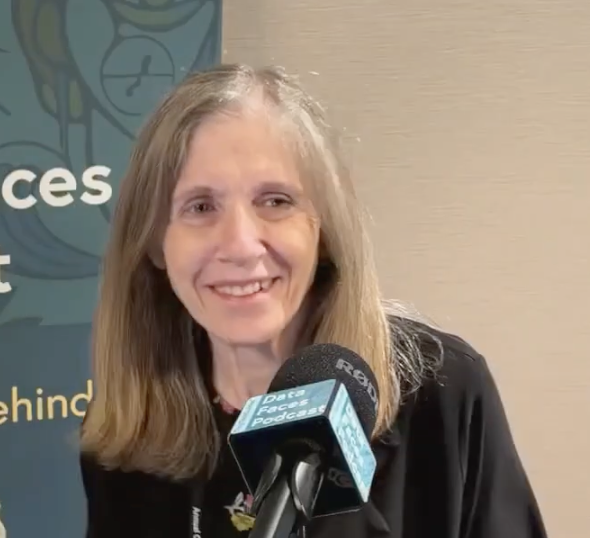
Dr. Fern Halper is the founder of the AI Foundations Group and VP of research at TDWI. A nationally recognized data and AI researcher and educator with research roots at Bell Labs, she is the author of Data Makes the World Go ‘Round and a leading voice in AI governance.
In this interview
- How AI governance differs from data governance, and why confusing the two leads to mistakes
- Why unstructured data carries a 20-point trust deficit compared with structured data
- A three-stage pipeline for governing the documents that feed generative and agentic AI
- Why companies hit a value ceiling when they run generative AI without their own data
→ Browse all on-location interviews: Data Faces Podcast — On Location
Full transcript
David Sweenor 0:00 I’ll just do a quick, like just an intro.
Fern Halper 0:04 Okay.
David Sweenor 0:05 And what’s your title? Do you have a title? Do you want me to use?
Fern Halper 0:08 Yeah, I’m the founder of the AI Foundations Group and the VP of Research at CDWI.
David Sweenor 0:15 Founder of AI what?
Fern Halper 0:16 Foundations Group.
David Sweenor 0:19 And VP?
Fern Halper 0:20 VP of Research at CDWI.
David Sweenor 0:25 Okay, and I’ll just ask you to introduce yourself. You can tell us about as much or as little about either of those if you want. Okay. And that’s it. Okay. Are we good? That’s on?
Fern Halper 0:38 All right. And you want us to look there?
David Sweenor 0:41 Yeah, that’s the main camera. This is just testing some things out. All right, here we go. You ready? I’m ready. Hello, and welcome to the Data Faces podcast on location. We’re coming to you live from the CDO IQ event in Cambridge, Massachusetts, right next to MIT. Today, I am joined by Dr. Fern Halper, founder of the AI Foundations Group and the VP of Research at TDWI. Thanks for joining us on the Data Faces podcast.
Fern Halper 1:15 Glad to be here. Thanks for having me.
David Sweenor 1:17 Can you tell us a little bit about yourself and the organizations you’re affiliated with?
Fern Halper 1:22 Sure. So I’ve been doing data and AI for the past 30 years. I actually started off as an oceanographer, a geophysical oceanographer, collecting time series data from the Gulf of Mexico. Yeah. I read an article in I won’t even say when it was because that will date me, that said that the amount of data in the world could fill a football field and go a mile high. And I said, the future’s in data. So I went to Bell Labs and actually worked with some of the early machine learning algorithms, but then always wanted to see what was sort of next. So I became an industry analyst and I’ve been dealing with data and AI and really what makes companies succeed with AI and data for like the past 20 years.
David Sweenor 2:05 I think it’s how we met. I’ve worked for a few data and AI companies, and that’s how we came to know. The name of the show for it is Data Faces, so I like to get behind people in their professional careers. So what did you want to be when you grew up?
Fern Halper 2:19 I wanted to be an astronaut.
David Sweenor 2:23 There’s still time.
Fern Halper 2:23 Yeah, so I thought that actually going out to sea and being an oceanographer and being in isolated environments for long periods of time in places that others didn’t go would… suit me to be an astronaut, but it turns out that I had retinal issues and I was disqualified right away.
David Sweenor 2:44 Well, you know those modern spaceships, it looks so easy now. They’re just kind of sitting there, like the old ones, and it’s all these buttons, you didn’t know what they do.
Fern Halper 2:51 I’m going up. When I can afford it, I’m going up.
David Sweenor 2:54 All right, excellent, excellent. So you have a session here at the event. Governing AI starts with governing data. Can you tell us a little bit about the premise and the thoughts behind this?
Fern Halper 3:04 Yeah, so the idea was that we want to talk about what AI governance is about, how it’s different from data governance, because a lot of people think that they’re the same. You know, but really what we see organizations doing, the mistakes that they’re making, how they’re actually being successful, and most sort of run from data governance to agentic AI. So, you know, really sort of what works and what doesn’t work.
David Sweenor 3:29 And what are the big kind of, you mentioned people get confused with data and AI governance. What are the big differences in your mind?
Fern Halper 3:37 To me, data governance is about everything that we’ve been taught. ensuring data quality, accuracy, completeness, timeliness, consistency, viewing data as products, as an asset that needs to be trusted, AI governance, and everything that goes along with that, and compliance, obviously. AI governance is more about governing the systems themselves. So the data governance is about what, if you can trust the data, the AI governance is about what systems do with that data and how they’re working and if they’re not working.
David Sweenor 4:15 And so you mentioned trusted data and data quality a few times in there. It seems like we’ve been talking about crappy data for a long time. Are we ever not going to talk about crappy data?
Fern Halper 4:30 No, we’re never not going to talk about crappy data. Is it getting better or just getting worse? Well, you know what’s interesting is that organizations have been dealing with structured data forever. And still in the TDWI data governance maturity model, the median score is 58 out of 100. So there’s still issues, obviously. And now they’re dealing with unstructured data, which is what generative and agentic depend on. And the trust gap between structured and unstructured data is like 20 percentage points. So just when they thought maybe they were getting a handle on their structured data, along comes unstructured data. So now it’s another problem.
David Sweenor 5:11 You know, that is super fascinating to me because, like, we can’t get rows and columns right, which seems fairly straightforward. I know there’s lots and lots to it, but we can do distributions. But how do you even start to think about unstructured data? Because, like, we all have, just as a simple example, file name, dash, final, final, PDF, before. How do you think about this?
Fern Halper 5:38 Organizations have to start thinking, it’s sort of the same idea, like a pipeline, I think. Pre-processing, processing, and accessing. If you think about the pre-processing, you’re dealing with all these documents, the complete set of documents. Some of the metrics are the same, but they can mean something different for unstructured. So, you know, you sort of think about, I have to classify these documents. You know, are they complete? Are they accurate? Or do I have duplicates of these documents? Some of the same basic stuff. But then with unstructured data, you want to be able to extract out entities and relationships and themes and, you know, what we were doing 15 years ago with text analytics. So there’s that processing step. Also that you have to control, and then you have to control the output that comes out of it. So there’s at least three steps, and there’s similarities, but there’s a lot of differences and rethinking that needs to be done. Even down to like, is the document plausible? Because people, there’s going to be all sorts of threats to these documents. There’s going to be malicious content being input into the documents, etc. So organizations are going to have to deal with that as well.
David Sweenor 6:53 You know, something that’s fascinating to me, so like, you know, way back in the ancient days when we talked about predictive analytics, the organization creating a predictive model, I guess we call it a machine learning model now, it could be predictive or whatever, but they sort of owned everything. They had all the inputs, they generally created the model, then the outputs went somewhere. Now with these… agentic systems and large language models, they don’t sort of own the model, most companies, and what goes into it. How do you think that changes how organizations should think about things? Or is it more risky, less risky? You know, they just don’t own the whole thing, because everybody says, we’ve got to get your data right. But all the crap in the model these days, They didn’t have any say. It was just there.
Fern Halper 7:40 Well, I think that’s one reason also context is becoming so important. We’re hearing that as a theme at this conference about context as sort of helping with governance because if you have context about your own data, then it’s not just the LLM and what that was trained on that the model is going to… bring back to you. Right, right, right. It’s so, but you know, this is what organizations are concerned about. They’re keeping the LLMs private on their premises. You know, that’s good news. And so they’re thinking about that. They have, you know, what, They have guardrails in place about what people can and can’t do. They’re starting to do that. They’re taking a step back, I’m seeing, and saying, no, we can’t just put 10,000 agents out into our company. We need to actually be able to govern this.
David Sweenor 8:32 Yeah, okay. And you have a book, right? I have a book. And it’s called… Data makes the world go round?
Fern Halper 8:40 Data makes the world go round. The data, tech, and trust behind AI’s success. Yes. It was published a couple months ago. Wiley is the publisher.
David Sweenor 8:49 Okay, and what can people expect from this book? Yeah.
Fern Halper 8:54 I wrote the book, actually. I was motivated to write it because with the advent of generative AI, it just seemed like a lot of experts were stepping out of the woodwork. Oh, everybody’s an expert with generative AI, right? Everyone was an expert. And I said, wait a minute. This isn’t how companies succeed with AI. I’ve been looking at this at TDWI for the past 15 years. What does it take to succeed? And so I had put a framework together at TDWI and expanded that framework for the book. And it’s really sort of meant for people that want to understand that they’re going to reach a value ceiling if they’re just using generative AI without their company data. And that in order to… really succeed, they have to care about their data foundations, their skills, the governance, all of the boring stuff. So I wrote it in a way, hopefully, that’s not boring. I have a lot of interviews with people who have succeeded, a lot of companies and practitioners woven throughout the book. So it’s really a Bible, basically, of what it takes to succeed.
David Sweenor 10:02 That’s amazing. I’ve written a couple books, and I’m just curious on… you know, author to author perspective, what surprised you about the writing process or just the whole process of putting a book together? Maybe like you didn’t consider going into it.
Fern Halper 10:20 It was a lot of work. That’s so true. So true. I’ve written a number of dummies books. Yes. Cloud computing for dummies, big data for dummies, hybrid cloud for dummies. But I always wrote them with co-authors. Right. And this time I wrote it by myself. Yes. And I was like, oh boy, I really wish I could have found someone to write this with me because it’s all on you. It’s helpful.
David Sweenor 10:45 Well, I always feel like the beginning is really good, and then as you get into the book, like, I can’t read chapters one, two, whatever ever again. Like, you just sort of go blind to the words on the page, and the end is a little, I don’t know.
Fern Halper 10:57 But I was a woman on a mission. You know, I really wanted to get it down, and I wrote it in six months. Wow. Yeah. Congrats. Yeah, which I was impressed by myself.
David Sweenor 11:08 Congrats on the book. I wish you all the success of the book. Is there anything else that you think our listeners would want to know about in terms of either your… or your courses or you know got a wealth of experience and I know we only have a short time here but you know like people often think how do I get started like we have this you know you said you wanted to be an oceanographer an ocean of data Right.
Fern Halper 11:36 How do I get started here? Now we’re in, it’s not just a technology wave, I call it a tsunami. Right. And that AI is going to expose every weakness that your company has.
David Sweenor 11:48 Right.
Fern Halper 11:49 And it will hopefully highlight the strengths, but you know, you have to get started. You do have to do something about it. And doing generative, just… don’t think about it as just a productivity exercise. I’m going to be more productive. Because you can do so much more with AI than that if you actually put all of the processes that you need to put in place. And that’s what, at the AI Foundations Group, I talk to executives and boards about what they need to be thinking about, trying to bring clarity to this whole AI tsunami that we’re in.
David Sweenor 12:25 Yeah, well, it’s upon us. Well, Dr. Fern Halper, founder of the AI Foundations Group and VP of Research at TDWI. Thank you for joining the Data Faces podcast. It’s been a pleasure having you here.
Fern Halper 12:35 Thank you.
David Sweenor 12:37 Cheers. Awesome.