

Data Faces Podcast — On Location · CDOIQ Symposium 2026
Richard Wang, co-founder of the MIT CDOIQ Symposium, on 20 years of the event, the Pentagon assignment that shaped the CDO role, and why data quality is never fully solved.

Listen: YouTube · Spotify · Apple Podcasts · Amazon Music
About Richard Wang
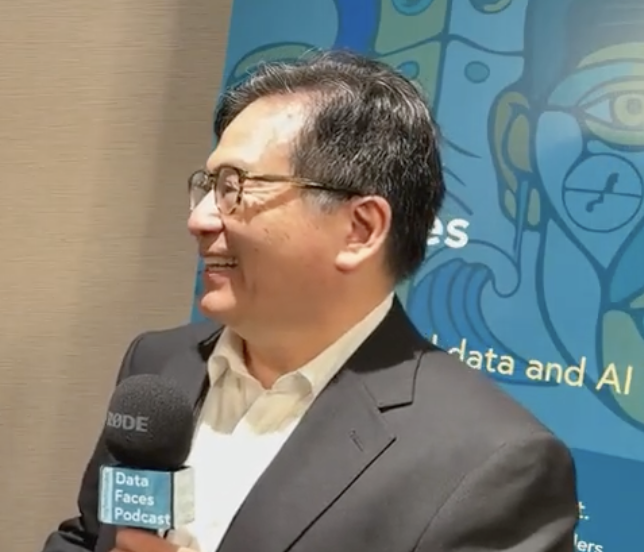
Dr. Richard Wang founded the information quality field at MIT, where he co-founded the Total Data Quality Management program with Stuart Madnick, and he has chaired the CDOIQ Symposium since 2007. He served as Deputy Chief Data Officer of the U.S. Army and as the first CDO of the State of Arkansas, and his advocacy helped mandate a chief data officer in every U.S. federal agency. At the 20th annual symposium, he received a Lifetime Achievement Award.
In this interview
- How the CDO role went from one researcher’s dream to more than 2,000 chief data officers worldwide
- Why solving one data quality problem reveals the next, and where accessibility fits in
- What data archaeology is, and why losing people means losing institutional knowledge
- How AI collapsed three weeks of PowerPoint work into five minutes
→ Browse all on-location interviews: Data Faces Podcast — On Location
Full transcript
David Sweenor 0:00 All right, here we go.
David Sweenor 0:03 Hello, and welcome to Data Faces live on location. We’re coming to you live from the CDO IQ event in Cambridge, Massachusetts. I’m here with Dr. Richard Wang. Thanks for joining us on the Data Faces podcast.
Richard Wang 0:16 You’re most welcome. Welcome aboard.
David Sweenor 0:18 You are the co-founder of the CDO IQ event. Tell us, how’s it been over the journey, the 20 years?
Richard Wang 0:26 Every year I say I want to quit but then I continue and people tell me I cannot quit because this is the only symposium they come every year. So it’s been 20 years. We have done quite a lot of things for the field and I’m very proud of it.
David Sweenor 0:42 Yeah, and there was a whole room earlier. Congratulations on the Lifetime Achievement Award. A whole room standing and clapping. I think one of the biggest takeaways for me was the community that you’ve built. That must feel pretty good.
Richard Wang 0:56 Yes, I feel good, and so are the attendees, because they came over here yesterday, and they said this is another ticket that we get. It’s basically the people who came over here again and again and again, like a repeated customer, so to speak. Right. And that’s what you want, and we build a unique community that other symposiums are not able to duplicate, and it’s really good.
David Sweenor 1:22 What was it like, you sort of invented the CDO kind of role or helped promote it. What was the world like before we had this role and all these processes and frameworks that you’ve come up with?
Richard Wang 1:34 That’s a good question. In the old days, very, very old days, it was something called ADP, automated data processing. Right. And it went into the database systems and went to data warehouse. We go to kind of server computing and… and so on and so forth. And I was a pioneer in 1988 to 1990 into a area called data quality research and industry. I spawned data quality industry for quite a while until 2000. And the milestone is in 2009, I went to the Pentagon. I was invited to go to the Pentagon. Oh, okay. They pay me to learn for two years. To spend their money. Spend your money. My money? Okay. I came to MIT and say the U.S. Army needs to modernize their data systems. Right. They have a lot of data. And the U.S. Air Force has 30 data. And they said, that’s you. So I went for two years. What I learned in the process is that I realized that the reason that we don’t have money for data quality vendors and consultants is because we don’t have a voice in a C-suite.
David Sweenor 2:52 Right.
Richard Wang 2:52 So I came up with the notion that we have to have a chief data officer in every organization. Basically, I said my dream, my mission is to have a chief data officer in every major organization with budget, authority, and resources. Okay. And it so happens at that time it’s a big data era. Right. So company built on that momentum plus at that time the president was Donald Trump. He signed into policy. He may not even know it. Right. But it was in the law that every federal agency have to have a CDO. Oh, that’s great. And there are two companies. One is called IBM. Another one is called Gartner. They went to the first MIT Army Forum. Okay. At Crystal City, Virginia, next to the Pentagon. Right. And IBM came out and said, that’s a good idea. So it was Gartner. So the two went out and they started practice for chief data officer, both of them, independently. Right, right. And so that basically pulled the stream of activities and by 2018, Gartner claims In their report, they say there are more than 1,000 CDOs already in the world. And today, it’s more than 2,000. Every company basically have a data leader, either called senior vice president of data analytics or AI or whatever, but now it’s kind of institutional things, so to speak.
David Sweenor 4:28 Because of your dream and your vision, we’re much closer to reality. So data quality, a huge topic. It seems like it’s always been a mess. Are we getting closer to solving the data? Why is it so hard for companies to fix the data quality issue?
Richard Wang 4:45 Yes and no. I was one of the pioneer researchers on data quality. I published all the seminal papers in 1990s. The issue with data quality is not solved, but once you solve a data quality problem, the next problems pop up.
David Sweenor 5:04 Right.
Richard Wang 5:04 Data quality, the first, whenever I went to a company, and the company says, well, we don’t have access to data, I know this company’s in their early stage. Right. Because if you don’t have access to data, how do you know how good it is? Right. The problem with companies is they don’t realize accessibility is one of the key data quality dimensions.
David Sweenor 5:28 Right.
Richard Wang 5:28 Which I published in 1990s.
David Sweenor 5:29 Right, I remember that.
Richard Wang 5:31 Yeah, so they’re accessible. And so once you have access to the data, it’s like now you have a car to the library or to Amazon, a password. Guess what happened? You go to the library, you find books. You have access here to, you go to the library, you… find a book and it’s written in Russian.
David Sweenor 5:51 Right.
Richard Wang 5:52 Doesn’t do you any good.
David Sweenor 5:53 Right.
Richard Wang 5:54 And once you translate into your language, then you start to read it and say, oh, it’s all junk. I already know about it. It has no value.
David Sweenor 6:01 Okay.
Richard Wang 6:02 So there are four stages called intrinsic all the way to accessibility. So that’s the process that you see in data quality. In every company, they solve one problem. It evolves to the next problem. Plus, after a while, they have people, they… That people go, they lost memory. So we actually come up with a term called data archaeology.
David Sweenor 6:25 Oh, data archaeology. Okay. I like that.
Richard Wang 6:27 Yeah. Repeat the same process, even though you have the continuous improvement, but you lose the people. People are the most important. They have the knowledge.
David Sweenor 6:37 Well, that brings up a good question. So you mentioned people is super important. It’s hugely important to the community you’ve built. How is AI changing maybe the rules of data quality or its importance to organizations? Do you think it’s made it more important? Is it the same importance? Or has it changed anything for companies?
Richard Wang 7:00 Well, this goes back to 1960 or 70 when human made machine systems. I am a firm believer that AI and data will be interactive and come together.
David Sweenor 7:14 Right.
Richard Wang 7:15 Maybe in two years, maybe five years, maybe ten years. Human plus machines, not just… Human leverage AI to do their work. As a matter of fact, this morning I gave a keynote on the next 20 years, and I said, I, the slides, about one third of them, you just use AI. Right. I’m not shy to say that.
David Sweenor 7:36 Yeah, but two years ago, people would have been embarrassed. Well, I don’t use AI. It’s my pure brain. And that has totally changed, right?
Richard Wang 7:42 No, totally changed. And, you know, you use AI systems. Before AI, it took me three weeks to create PowerPoint. Oh, I know. Five minutes is done. I had my assistant. They all used AI system called Pilot or ChatGP or Cloud. Okay. Yeah. So you leverage it. It’s a tool for human effort. Sure. That’s what I’m saying. You know, there may be some AI machine that can talk with girls and boys, but that’s not what we are.
David Sweenor 8:15 Okay. So we just, you know, the 20th anniversary of CDOIQ. You have sort of companion forums all over the world springing up now. I think we have the Nordics, Japan, probably other regions. Where do we see, what do we see for the next 20 years and, you know, what’s different?
Richard Wang 8:34 Well, I think we just, for me, I do my share of work, we just continue to push to continue what we’re doing, and it’s getting momentum, we get more people coming to the symposium, many of our graduates are coming back every year, and in different areas, and so that’s what I’m doing, I do my share of work. Sure. There are stakeholders, there’s sponsors like vendors, the important component, they bring innovative technology, they bring software, We have speakers who are industry thought leaders. We have attendees. We have people like yourself in the media who help promote the whole thing together. And one new thing I’m trying to do for next year is encourage with paper. So we come in with a CDO, IQ, Best Paper Award. Oh, that’d be great. Those are new, and only time will tell. All right. Charlie Chaplin says time is the best author.
David Sweenor 9:30 There we go. Well, always innovating. Dr. Richard Wang, co-founder of CDOIQ. Thank you for joining the Data Faces podcast on location. Thanks for your time.
Richard Wang 9:39 Bye-bye now.