Capital One CDO Amy Lenander and Christina Egea on curating data products
Listen now on YouTube | Spotify | Apple Podcasts | Amazon Music
What decides whether anyone uses the data product your team just built? When a data team finishes one, the quality is usually better than the previous generation, but adoption stays flat anyway. What do you do? Typically, the team responds by evangelizing harder and escalating to whoever runs the reluctant business unit. Amy Lenander, Chief Data Officer at Capital One, thinks all of that arrives too late to help, because the decision that governs adoption got made long before the build ever started.
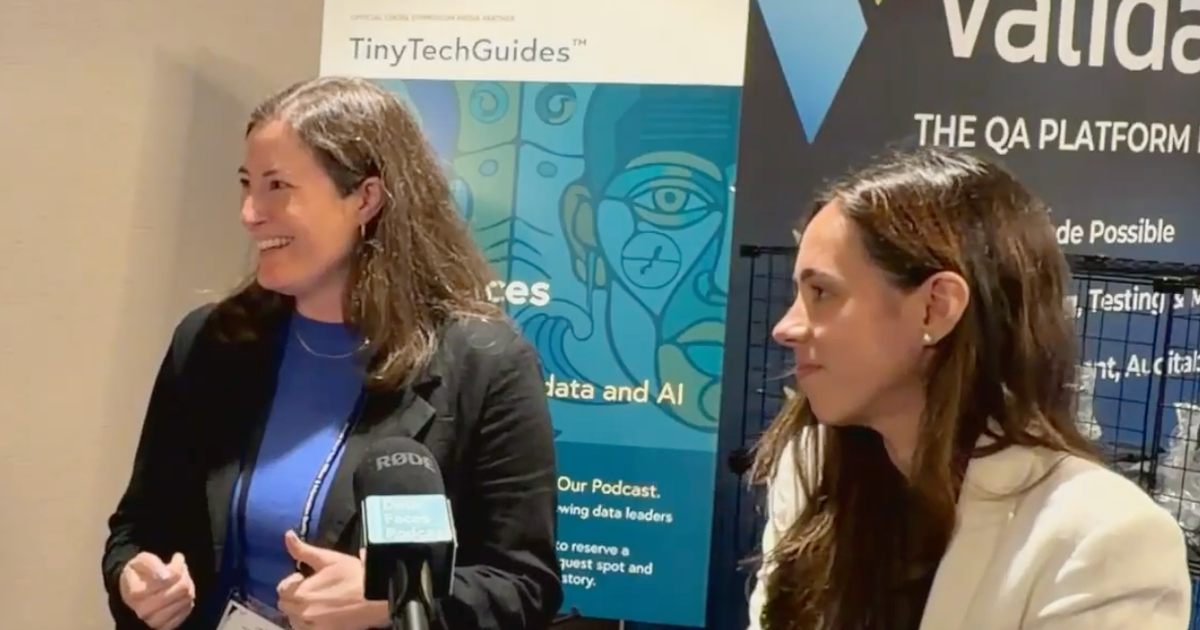
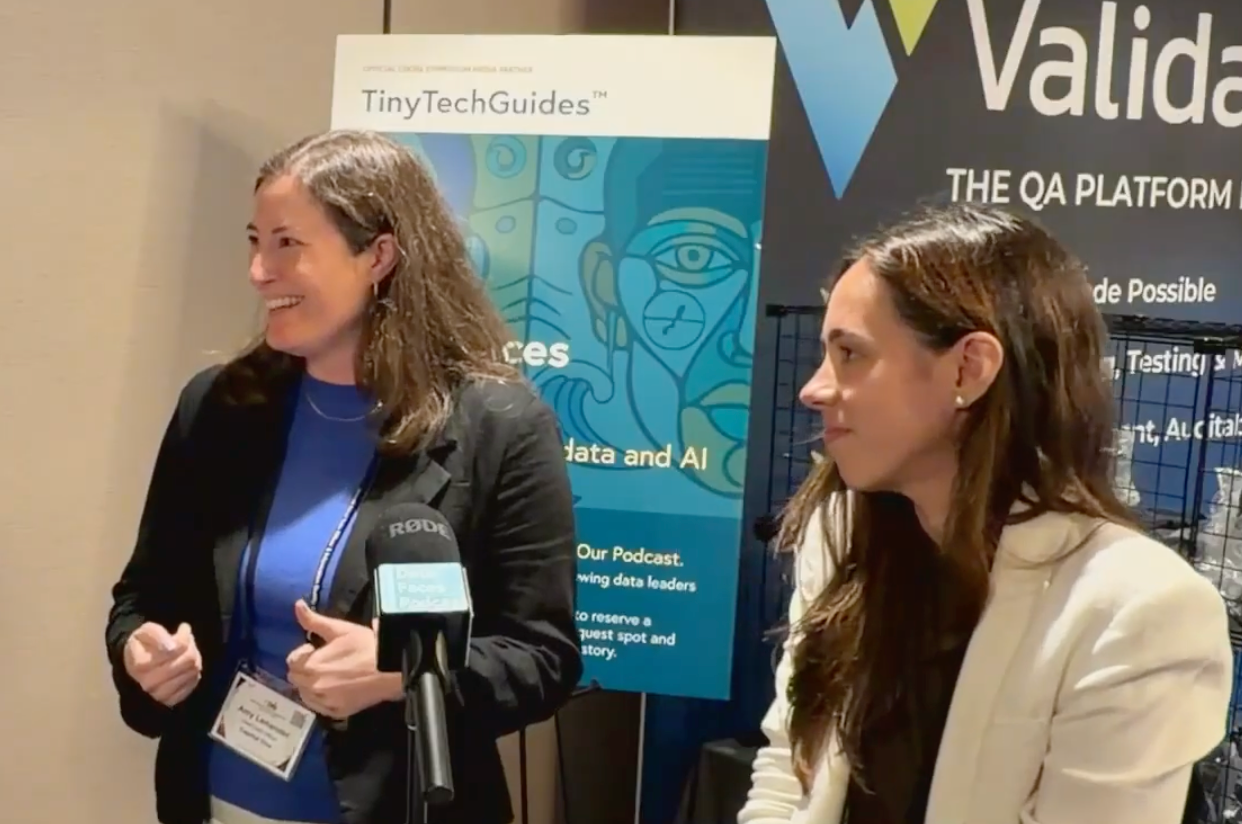
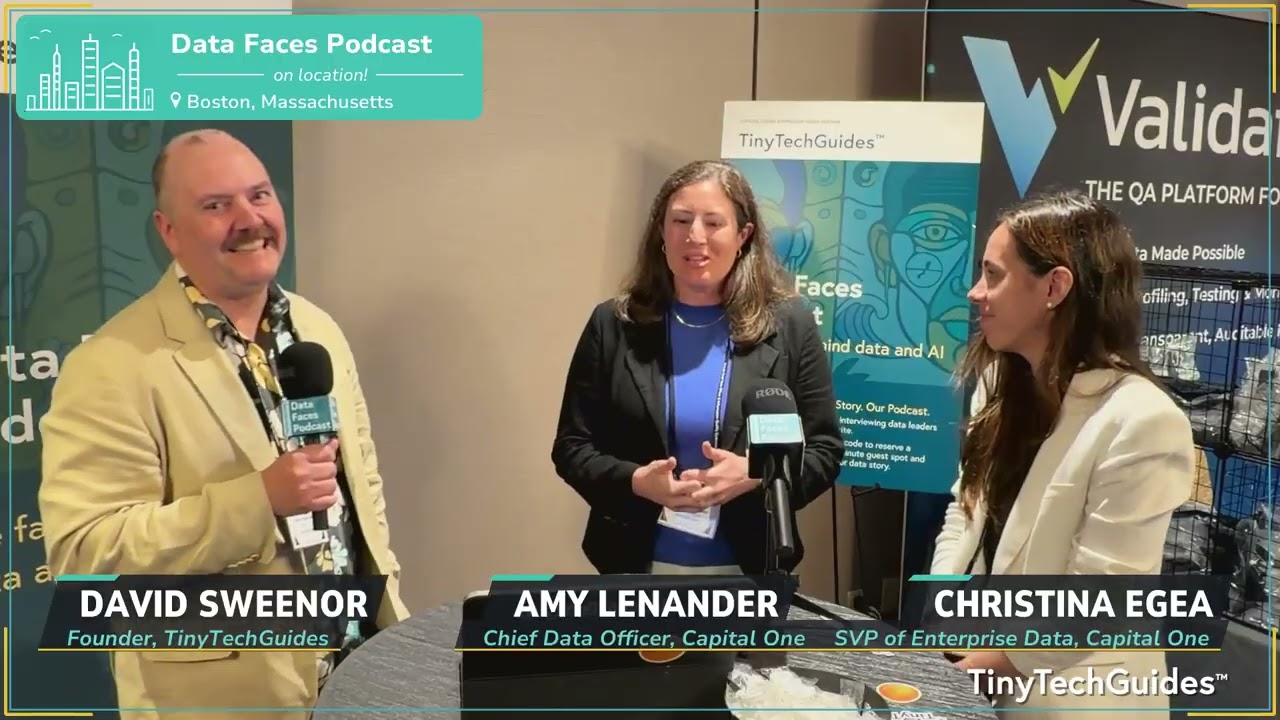
I caught Amy and her colleague Christina Egea, SVP of Enterprise Data, at the CDOIQ Symposium in Cambridge, Massachusetts, and pulled them in front of a Data Faces microphone.1 Their session, “Doubling down on data products to drive business value,” followed the talk Amy gave the previous year on Capital One’s broader data transformation. Data products drew more interest than anything else that year, so they double-clicked on the piece of their strategy that peers find least familiar: Capital One curates a deliberately small set of data products instead of letting every domain publish its own.
“One of the things that we do that I think is most unique among the companies I’ve talked to is being very intentional about curating the data we want to manage as data products.”
— Amy Lenander, Chief Data Officer, Capital One
That restraint is a design decision rather than a resourcing constraint, and it traces back to a question Christina’s team asks before building anything: will this still hold up at the hundredth use case?
About Amy Lenander and Christina Egea
Amy Lenander became Chief Data Officer at Capital One in February 2023, capping two decades at a company she joined as an analyst who made decisions from however much data would fit in a spreadsheet.2 She has led loyalty and rewards, served as CEO of Capital One’s UK business, and worked across credit card and lending. Because she came to the data seat from the business rather than from engineering, Amy has what most Chief Data Officers (CDOs) acquire secondhand: a working sense of where the real impact in each business sits.
Christina Egea is SVP of Enterprise Data on Amy’s team, and she has spent three years building Capital One’s data product strategy. Their data ecosystem keeps growing by acquisition — Capital One completed its purchase of Discover in May 2025 and its purchase of Brex in April 2026 — so any strategy worth adopting has to survive a footprint that expands faster than a roadmap.34
In this episode, Amy, Christina, and I discuss:
- Why the fastest data product to build is usually the one that helps least
- How a study of company-wide usage collapsed a sprawling data landscape into nine categories
- The case for one accountable owner on every data product
- Why a data product covering 70% of what someone needs will never displace the feed covering all of it
- What three times faster time to market rests on
Watch the full conversation here:
The hundredth use case is the design decision
Christina Egea describes the tension at the center of Capital One’s data product strategy as pressure from two directions at once. One side of the company asks why the team cannot reach the market more quickly, while the other asks how anything built that fast could be correct, reusable, or safe for customers. Both questions are reasonable, and a data organization that answers only one of them ends up with either a backlog or a mess. Christina resolves it by being explicit about which use case her team is building for.
“The fastest thing to build is the thing for a single use case. The harder thing to build is the thing that will scale.”
— Christina Egea, SVP of Enterprise Data, Capital One
Capital One aims well past the first requester. Christina told me her team focuses on making sure a data product will scale well past a single use case, past the next five or twenty, out to something closer to the hundredth use case and the hundredth customer. A specific use case still gets most data products launched, because someone has to want the thing badly enough now to fund it, but the design target sits far beyond whoever asked first. A data product scoped to one requester can hard-code their assumptions and skip the modeling that would let another team use it next quarter.
Christina also names the hardest part of the whole endeavor, and it is not the part most people guess. Getting started is what hurts. The payoff arrives on the far side of that first set of data products, once teams have adopted the same product five or twenty times and the flywheel begins to turn on its own.
Nine categories covered most of the usage
Capital One did not begin its data product work by drawing a domain map or carving the catalog along org-chart lines. Christina’s team studied how data was already being used across the company, asking which core categories and domains that usage fell into. Despite enormous breadth and depth across the business, roughly nine data categories accounted for most of the consumption, and those nine became the first data products the company built.
Measured usage is what makes curation possible, and curation is where Amy locates Capital One’s real point of difference. Two kinds of data qualify in her model. The first is the most-used data in the company, which earns its place because so many lines of business reuse it. The second is data the company believes carries real value but nobody has drawn on much, because getting to it has been too hard. Both are chosen for leverage rather than volume.
“We’ve very intentionally started with the data products that have the most leverage to the company.”
— Amy Lenander, Chief Data Officer, Capital One
Amy’s read on where that impact concentrates comes from having run the businesses she now serves, and the endless list of things a data team could improve becomes tractable once you know which ones the business genuinely needs. Her background also helps with a less comfortable part of the job, because her team has to get business units to do things they would rather not, which she compares to eating your vegetables.
The top-down start was only the opening move. Each business unit has since built a bottom-up view of the data products it needs, while Christina’s central team maintains the framework that holds the picture together.
One owner, and no overlap
Every data product at Capital One has one accountable owner who makes the final decisions on it. Amy is direct about why that matters at her company’s scale: one owner per product, responsible for the decisions and for making sure the products work together well. Plenty of the building is distributed across business units. Without a single named owner, two teams publish their own version of the customer table, and nobody has the authority to say which one is right.
Christina’s central team spends a meaningful share of its time on the shape of the portfolio, working toward a universe of data products that is mutually exclusive, where the pieces do not overlap, and each product’s scope is defined.
“Really making sure that we’re investing in a universe of data products that’s mutually exclusive, that the things don’t overlap, that they clearly link together but have boundaries is a place where my team spends a bunch of our time.”
— Christina Egea, SVP of Enterprise Data, Capital One
From there, Christina’s team scopes each data product and names its owner, then models the data into an ontology before building the assets that bring it to life, including the application programming interfaces (APIs) and tables consumers touch. Settling semantics in that ontology first is what keeps the hundredth use case reachable, because the definitions get negotiated once rather than relitigated by every team that shows up later.
Adoption is a listening problem
Asked what to do when a data product is demonstrably better and nobody uses it, Amy does not reach for another enablement session. She puts the question to the people who have not switched, and then does the harder part, which is hearing what they say.
“The first thing is to listen to the answer when you actually ask that question, to stop pushing and start listening.”
— Amy Lenander, Chief Data Officer, Capital One
The answers are rarely mysterious once someone asks. Switching from a working data feed to a new data product is painful, and the person being asked to move already has something that produces numbers today. Winning a brand-new use case is far easier than displacing an incumbent feed, because displacement forces the consumer to absorb migration work on top of their actual job. They may agree the data product is better and still wonder whether it is worth the trouble.
The coverage trap is the same principle seen from the customer’s side. A consumer might tell Amy’s team that the data product covers 70% of the data they need, and 70% will not displace a source that covers all of it, however much better the newer thing is. Her response is to listen and go build the missing 30%, because a data product meant for broad reuse has to cover the ground its consumers stand on.
Amy frames the discipline in product management terms, which carries a warning for data teams that have never had to win a customer. Nobody churns in a way that shows up on a dashboard, so consumers keep using the old data feed and say nothing, and Amy reads that silence as information about the product.
“They don’t pay for your data, but they vote with their feet. So you need to really deeply understand them like a good product manager would.”
— Amy Lenander, Chief Data Officer, Capital One
The numbers stand on something
Christina is careful about how she presents Capital One’s results, and the caveat she leads with is more instructive than the figures that follow. The company’s data product investments stand on the shoulders of its foundational ones, she says — a core set of platforms, catalogs, and an integrated lake.
With that foundation in place, the returns are specific. Capital One sees roughly three times faster time to market for use cases that launch on data products, measured against how the same work went before, and about 30% lower cost to maintain data once it lives in a standardized data product held to a higher quality bar.
For anyone benchmarking against those numbers, the sequence matters more than the percentages. Capital One measured its usage before picking its first data products and curated for leverage instead of coverage, and only then named an owner for each one and settled the semantics before building anything on top. The three times and the 30% arrived after all of that, which makes them the result of the strategy rather than the argument for starting it.
Watch the full conversation and read the transcript on the Data Faces CDOIQ page for Capital One.
Based on insights from Amy Lenander, Chief Data Officer, and Christina Egea, SVP of Enterprise Data, at Capital One, featured on the Data Faces Podcast.
Podcast highlights
- [0:39] David introduces Amy Lenander and Christina Egea on location at the CDOIQ Symposium in Cambridge, Massachusetts
- [2:11] Amy on the session title, “Doubling down on data products to drive business value,” and why data products drew the most interest at the prior year’s talk
- [2:54] Christina on top-down buy-in, data maturity, and building data product frameworks with the right ownership
- [4:14] Amy on curating data products by leverage, and why it is the most unusual thing Capital One does
- [5:22] Christina on building for the hundredth use case rather than the first
- [6:26] Christina on the nine categories of data that covered most company usage
- [7:55] Amy on coming to the CDO seat from the business, and getting partners to eat their vegetables
- [9:51] Christina on the hardest part of scaling data products
- [11:18] Amy on adoption as a listening problem, the 70/30 coverage trap, and voting with their feet
- [13:13] Christina on three times faster time to market and 30% lower maintenance cost
About David Sweenor
David Sweenor is the founder of TinyTechGuides and host of the Data Faces Podcast. He is an international speaker, advisor, and the author of eleven books on artificial intelligence, analytics, and B2B marketing, including Generative AI Business Applications, The CIO’s Guide to Adopting Generative AI, and Modern B2B Marketing. With more than twenty-five years in analytics and AI at companies including Alteryx, Tableau, TIBCO, SAS, IBM, and Dell, David advises technology companies on product marketing, content strategy, and go-to-market execution. He holds several patents and has been named a top influencer in data and analytics by Onalytica, Thinkers360, and Analytics Insight.
Connect with David on LinkedIn and subscribe to the Data Faces Podcast for conversations with the people shaping enterprise data and AI.
Footnotes
-
CDOIQ Symposium. "The 20th Annual CDOIQ Symposium." July 21–23, 2026, Hyatt Regency Cambridge, Massachusetts. https://2026cdoiq.org/ ↩
-
Capital One. "Interview with Amy Lenander, Chief Data Officer." Capital One Tech. https://www.capitalone.com/tech/culture/amy-lenander-chief-data-officer-interview/ ↩
-
Capital One Financial Corp. "Capital One Completes Acquisition of Discover." May 18, 2025. https://investor.capitalone.com/news-releases/news-release-details/capital-one-completes-acquisition-discover ↩
-
Capital One. "Capital One Completes Acquisition of Brex." April 7, 2026. https://www.capitalone.com/about/newsroom/capital-one-completes-acquisition-of-brex/ ↩
Related Posts
Your AI stack will be wrong in 12 months
Data in one place is not value