Qlik CTO Sam Pierson on adaptable architecture and AI economics
Listen now on YouTube | Spotify | Apple Podcasts | Amazon Music
▶ Watch the full episode and read the transcript: Sam Pierson on adaptable AI architecture
I have spent my career on both sides of the data platform business. In the first half, I built data warehouses and did data science and analytics at IBM. In the second half, I marketed data platforms at companies like SAS, TIBCO, Alteryx, and Alation. That means I have pitched freedom from vendor lock-in a number of times, and I have also worked with enough buyers to know how much that promise matters to them. So when a CTO tells me freedom is the way to win at AI, I want to know what is in the code and what is in the brochure.
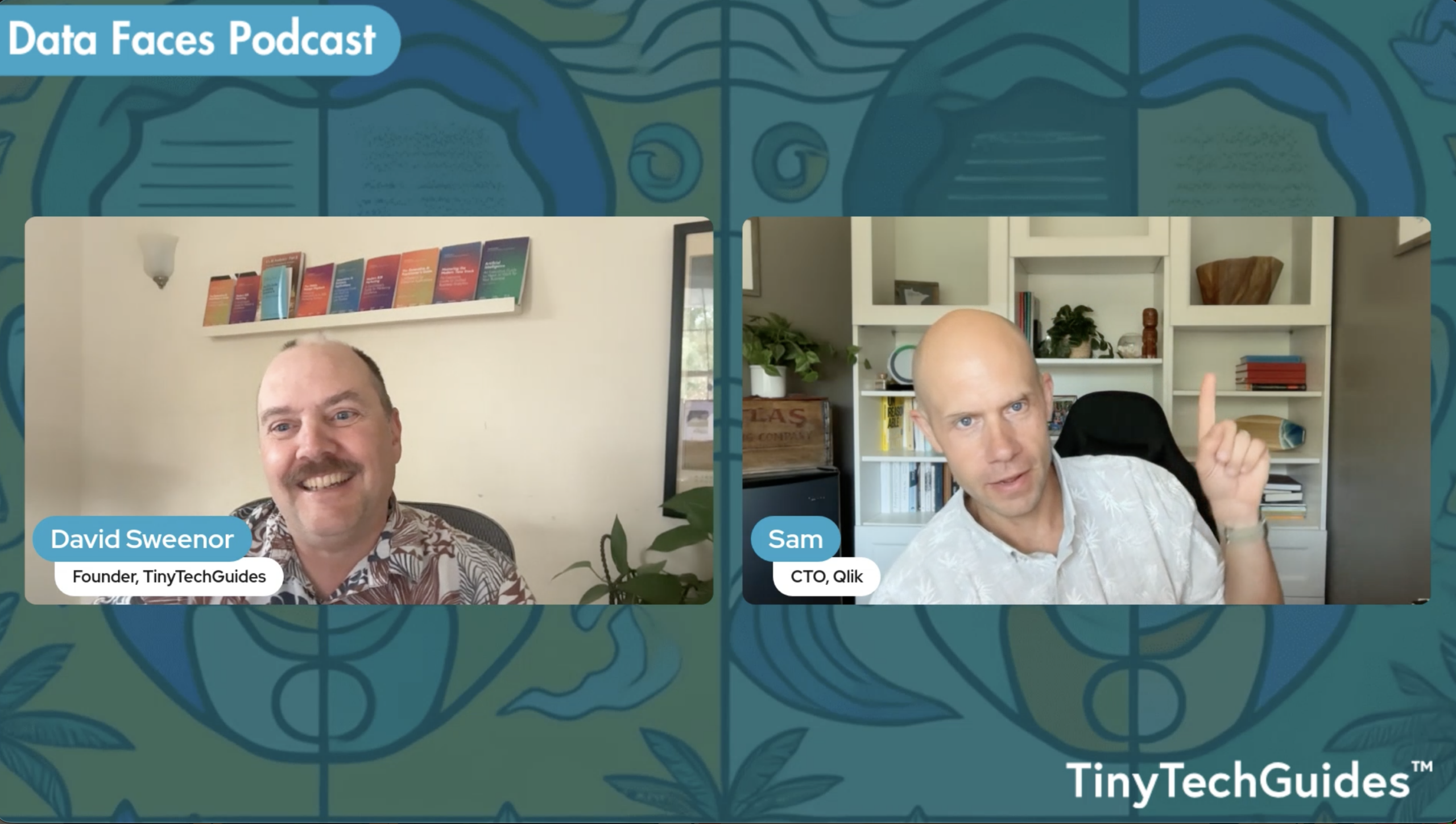
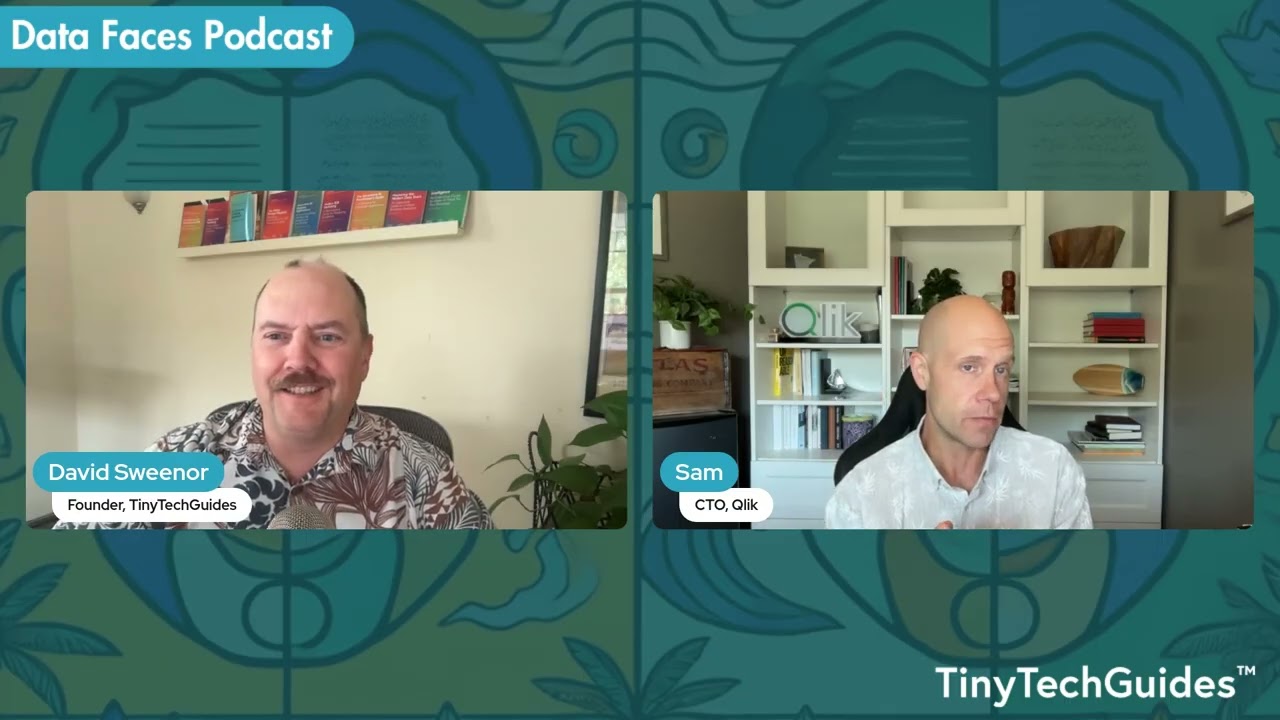
Sam Pierson joined me on the Data Faces Podcast to discuss this notion. As Chief Technology Officer at Qlik, he owns the cloud and AI platforms as well as the development teams for both. As CTO of Talend, Sam joined Qlik as part of the acquisition, so he knows a thing or two about messy enterprise data. His argument runs counter to the instinct to pick a winner. The models will keep overtaking each other, the patterns will keep changing, and the AI conversation itself will look different in a year. What you can control is how quickly you can pivot, and most of that, along with your increasing AI bill, gets decided in the architecture before a model ever processes a token.
About Sam Pierson
Sam Pierson is the Chief Technology Officer at Qlik, where he leads engineering and spends much of his week talking with customers. Before Talend and Qlik, he held engineering leadership roles at Illuminate Education, Datica, SPS Commerce, Veritas, and Symantec. He holds an MBA and a computer science degree from the University of Minnesota.
In this episode, Sam and I discuss:
- Why AI is pushing enterprises to rebuild their data architectures on open formats like Apache Iceberg
- The model selector Qlik wired in early, and how it routes a task to a model that is good enough but 10 times cheaper
- Where AI token costs pile up before a model ever runs, and how a pre-calculated in-memory engine avoids them
- Whether freedom from vendor lock-in is a real architectural property or a story the industry tells itself
- Why 97 percent of enterprises have budgeted for agentic AI while only 18 percent have fully deployed it
Watch the full conversation here:
An architecture you can take apart
Sam has been around long enough to watch the architecture pendulum make several full swings. Huge monolithic databases gave way to open distributed systems in the Hadoop era, the market consolidated again around a handful of big cloud data platforms, and now the momentum is swinging back toward open. Apache Iceberg, an open table format that keeps data readable by any engine, sits at the center of the current swing, and Sam calls it absolutely huge right now.
In his telling, AI itself is driving the rebuild. Companies rethinking their data architectures for AI do not want to be locked into any one system, partly for vendor impartiality and partly because no one can say what next year’s patterns will demand. Nobody wants to re-architect everything and then, six to twelve months later, chalk it up to a sunk cost and then pursue the next new thing. So buyers are demanding modular designs at the storage and compute layers, and again at the metadata and model layers, where each piece can be decoupled and swapped without disturbing the rest.
Qlik has put its weight behind that direction. Its Open Lakehouse is built on Iceberg,1 and in January the company joined the Open Semantic Interchange, a vendor-neutral industry effort to standardize semantic definitions so business meaning travels with the data instead of living inside any single tool.2
“We may have a completely different conversation about AI in 12 months… having the ability to migrate or swap out certain parts of the stack in the future is almost a must-have.”
— Sam Pierson, Chief Technology Officer, Qlik
Good enough and 10 times cheaper
The most concrete example of adaptability Sam described is the model selector his team wired into the platform early on. The lesson came from the past decade of software architecture: the move away from the monolith toward microservices, where strong interfaces abstract away details so that any one piece can change without breaking the rest. His team knew the frontier models would keep trading places on the leaderboards, so they refused to hard-wire any single one into the product.
“The router inside of our platform can make the decision of what’s the best model for this task, or what is the best cost-performance trade-off, and maybe route this to a model that’s good enough but it’s 10 times cheaper.”
— Sam Pierson, Chief Technology Officer, Qlik
I asked who makes that choice, the platform or the user, and Sam called it a combo platter. Inside the product, Qlik maintains a family of models that it benchmarks and evaluates constantly, and the user never sees any of it. When customers reach the platform from their own AI ecosystem, whether they are building an agent or connecting from a tool like Claude Desktop via the Model Context Protocol (MCP), they have an explicit choice of model and skills.
The tokens you never have to buy
Back in my semiconductor days at IBM, I thought of data as plumbing, and I said so out loud, which made my ETL developers furious. Sam was more diplomatic when I raised the cost question, but his answer vindicated my old developers. Where the data preparation work happens decides what everything downstream costs.
Point an LLM directly at structured data in a cloud data warehouse and watch the meter run. A single question can take ten minutes as the agent inspects the schema, filters it, and analyzes each round of results, generating tokens the entire time. Multiply that by every question an enterprise asks in a day, and you have found one of the places Sam says companies are burning money without realizing it.
Qlik is sitting on an unusual answer here, and Sam admits some luck is involved. It is better to be lucky than good, he joked. The Qlik engine, developed three decades ago, reads data into memory and precalculates multidimensional analyses and their relationships. The company built an AI-friendly interface to that engine, so once a question reaches it, the inference cost is zero. Compared with the warehouse pattern, Sam says customers get higher-quality answers at lower latency and a much lower token cost per question, an argument that echoes what Josh Howard told me about AI being only as good as the data underneath it.
Is freedom real, or a story vendors tell?
Having written my share of freedom-from-lock-in marketing, I put the uncomfortable question to Sam directly. Is this an architectural property you can point to in the code, or a story the industry tells itself? He gave me the honest version. Freedom starts as a philosophy. Not many vendors operating at Qlik’s scale remain independent, and even strong partners like Snowflake and Databricks would understandably prefer that your workloads run on their platforms. Qlik’s bet is that facilitating choice is worth more than capturing it.
Architects have long memories, though, and that history gives the philosophy teeth. The people building today remember being beholden to a small number of powerful vendors, and they refuse to go back, an instinct Sam now sees extending into model choice. For some buyers, the flexibility is peace of mind they will never cash in. He insists it is more than insurance because, as new technologies and patterns emerge, his customers are actually making the switches.
For a buyer trying to separate real openness from brochure openness, the episode suggests a practical test. Check whether your data sits in an open format you could walk away with. Read the terms for a plain statement that the vendor does not train models on your data, a commitment Qlik makes explicitly. Ask about bring-your-own-key encryption and sovereignty options in the regions where you operate. A vendor that passes is selling you an exit, which is the strangest and most reassuring thing a vendor can sell.
Matt Hayes made the data-side version of this argument a few weeks ago on this show, that owning your data keeps enterprise AI affordable. Sam runs the same principle one layer down, at the models and the compute. And if you are wondering whether the freedom people and the governance people at Qlik get into shouting matches, they do, but Sam swears the matches are usually about hockey or baseball.
The prompt-clone test
Two recent guests set up a question I could not resist putting to a CTO. Donald Farmer argued on this show that software features are dying because AI can clone them, and April Dunford called that claim absolute BS. Sam completed the trilogy without hesitating. “Largely it’s BS.”
“If you literally could just get copied in an afternoon by a prompt, it’s probably not all that valuable of a business.”
— Sam Pierson, Chief Technology Officer, Qlik
The line cuts both ways, and Sam knows it. His team sat down and did the work of articulating what is genuinely hard to copy, and the answer was the engine, the data fabric that feeds it, and the governance, security, and quality machinery wrapped around both. What changes is who shows up at the front door. Sam expects fewer people to log into a dashboard and perhaps a hundred or a thousand times as many to use Qlik in the background, through MCP, from inside tools like ServiceNow or Claude Desktop.
Still the first inning
Qlik’s own research shows how early all of this remains. In the company’s 2025 Agentic AI Study, 97 percent of large enterprises had committed budget to agentic AI, yet only 18 percent reported full deployment.3 When I asked Sam why the money runs so far ahead of the deployments, he did not blame the technology. Anyone deploying capital wants to know what downstream productivity comes back for a given token budget, and most organizations cannot answer that yet because the practices are not well understood. We are just in the first inning, he told me.
His prescription follows from that honesty. Start with narrow use cases where the value is provable, and pair outside expertise with the people who hold the business context, because that combination, in Sam’s words, is the magic spot. The models will keep improving, and none of it will rescue an organization that locked itself into last year’s answer. The winning AI stack is the one you can change your mind about, at a price you can defend.
Listen to the full conversation with Sam Pierson on the Data Faces Podcast.
Based on insights from Sam Pierson, Chief Technology Officer at Qlik, featured on the Data Faces Podcast.
Podcast highlights
- [0:06] Introduction and welcome to the Data Faces Podcast
- [1:16] Sam’s role as CTO at Qlik
- [2:00] First job: the teenage lawn-mowing business
- [2:34] What running Talend taught him about where companies get stuck
- [3:55] How AI changes the data integration job
- [7:18] Baking context and guardrails into the data itself
- [9:06] The role of unstructured data
- [10:13] Open formats, Apache Iceberg, and the architecture pendulum
- [13:07] How hard is it to swap out a component?
- [13:43] The model selector and routing to the 10x cheaper model
- [16:02] Token costs, ROI, sovereignty, and IP protection
- [18:43] Is freedom from lock-in a philosophy or an architecture?
- [21:44] Who picks the model, the platform or the user?
- [22:58] Token-maxxing and the zero-inference-cost engine
- [25:43] Freedom versus governance inside Qlik
- [28:05] The prompt-clone question: “largely it’s BS”
- [31:04] Using Qlik through MCP instead of a dashboard
- [32:33] 97 percent budgeted, 18 percent deployed
- [35:30] Close
Frequently asked questions
What is AI model routing?
AI model routing is the practice of directing each task to the AI model best suited for it, based on capability, latency, and cost, instead of hard-wiring one model into an application. Qlik built a model selector into its platform early, benchmarking a family of models and routing each job to the best cost-performance option. As CTO Sam Pierson describes it, the router can send a task to a frontier model when quality demands it or to a model that is good enough but 10 times cheaper.
How do open data formats like Apache Iceberg reduce vendor lock-in?
Apache Iceberg is an open table format that keeps enterprise data readable by any query engine, so the data layer is not welded to a single vendor’s system. Storing data in open formats lets an organization swap storage, compute, or analytics components as technology changes, without migrating the data itself. That flexibility is a leading reason enterprises are rebuilding their data architectures for AI, and it is why Qlik built its Open Lakehouse on Iceberg.
Where do enterprise AI token costs come from?
Much of an enterprise AI bill accrues before a model produces an answer. When an agent queries structured data in a cloud data warehouse, it inspects the schema, filters it, and analyzes intermediate results, generating tokens the entire time, and a single question can take minutes. Architecture decisions made long before deployment, such as pre-calculating analysis in an in-memory engine with an AI-friendly interface, can cut the token cost per question dramatically while improving answer quality and latency.
Can AI clone any software feature with a prompt?
Qlik CTO Sam Pierson calls that claim largely BS. Software that could genuinely be copied in an afternoon by a prompt was probably never a valuable business, and the market shows no wave of software companies losing their revenue to prompt-built clones. The durable advantage sits below the feature level, in assets like a pre-calculated analytics engine, the data fabric feeding it, and the governance and security machinery around both, which cannot be reproduced by generating code.
Why have so few enterprises fully deployed agentic AI?
Qlik’s 2025 Agentic AI Study found that 97 percent of large enterprises have committed budget to agentic AI, yet only 18 percent report full deployment. The blockers are data quality, integration with existing systems, and an inability to prove what downstream productivity comes back for a given token budget. Sam Pierson describes the industry as being in the first inning, where practices are not yet well understood and narrow, provable use cases are the sensible starting point.
How can a buyer tell whether a vendor’s openness is real?
Test for openness in the contract and the architecture rather than the marketing. Confirm the data sits in an open format you could take with you, such as Apache Iceberg. Read the terms for an explicit commitment that the vendor does not train models on your data, and ask about bring-your-own-key encryption and regional sovereignty options. A vendor that passes those checks is giving you a credible exit, which is the strongest evidence that its openness claims are real.
About David Sweenor
David Sweenor is the founder and host of the Data Faces podcast, where he talks with the people who are making data, analytics, AI, and marketing work in the real world. He is also the founder of TinyTechGuides and a recognized top 25 analytics thought leader and international speaker who specializes in practical business applications of artificial intelligence and advanced analytics.
With over 25 years of hands-on experience implementing AI and analytics solutions, David has supported organizations including Alation, Alteryx, TIBCO, SAS, IBM, Dell, and Quest. His work spans marketing leadership, analytics implementation, and specialized expertise in AI, machine learning, data science, IoT, and business intelligence. David holds several patents and consistently delivers insights that bridge technical capabilities with business value.
Books
- Artificial Intelligence: An Executive Guide to Make AI Work for Your Business
- Generative AI Business Applications: An Executive Guide with Real-Life Examples and Case Studies
- The Generative AI Practitioner’s Guide: How to Apply LLM Patterns for Enterprise Applications
- The CIO’s Guide to Adopting Generative AI: Five Keys to Success
- Modern B2B Marketing: A Practitioner’s Guide to Marketing Excellence
- The PMM’s Prompt Playbook: Mastering Generative AI for B2B Marketing Success
Follow David on Twitter @DavidSweenor and connect with him on LinkedIn.
Footnotes
Footnotes
-
Qlik. "Qlik Open Lakehouse Now Generally Available, Giving Enterprises Rapid, AI-Ready Data on Apache Iceberg." Qlik Press Release, 2026. https://www.qlik.com/us/news/company/press-room/press-releases/qlik-open-lakehouse-now-generally-available. ↩
-
Qlik. "Qlik Joins Snowflake & Industry Leaders to Support Data and AI Interoperability Across the Ecosystem Through the Open Semantic Interchange." Qlik Press Release, January 27, 2026. https://www.qlik.com/us/news/company/press-room/press-releases/qlik-joins-snowflake-and-industry-leaders-to-support-data-and-ai-interoperability. ↩
-
Qlik. "Qlik 2025 Agentic AI Study: Budgets Surge, but Data Readiness Delays Scale." Qlik Press Release, October 16, 2025. https://www.qlik.com/us/news/company/press-room/press-releases/qlik-2025-agentic-ai-study-budgets-surge-but-data-readiness-delays-scale. ↩
Related Posts

The AI tell hiding between your sentences
Data in one place is not value