April Dunford on why competitors can’t easily copy your software
Listen now on YouTube | Spotify | Apple Podcasts | Amazon Music
▶ Watch the full episode and read the transcript: The death of SaaS is a myth
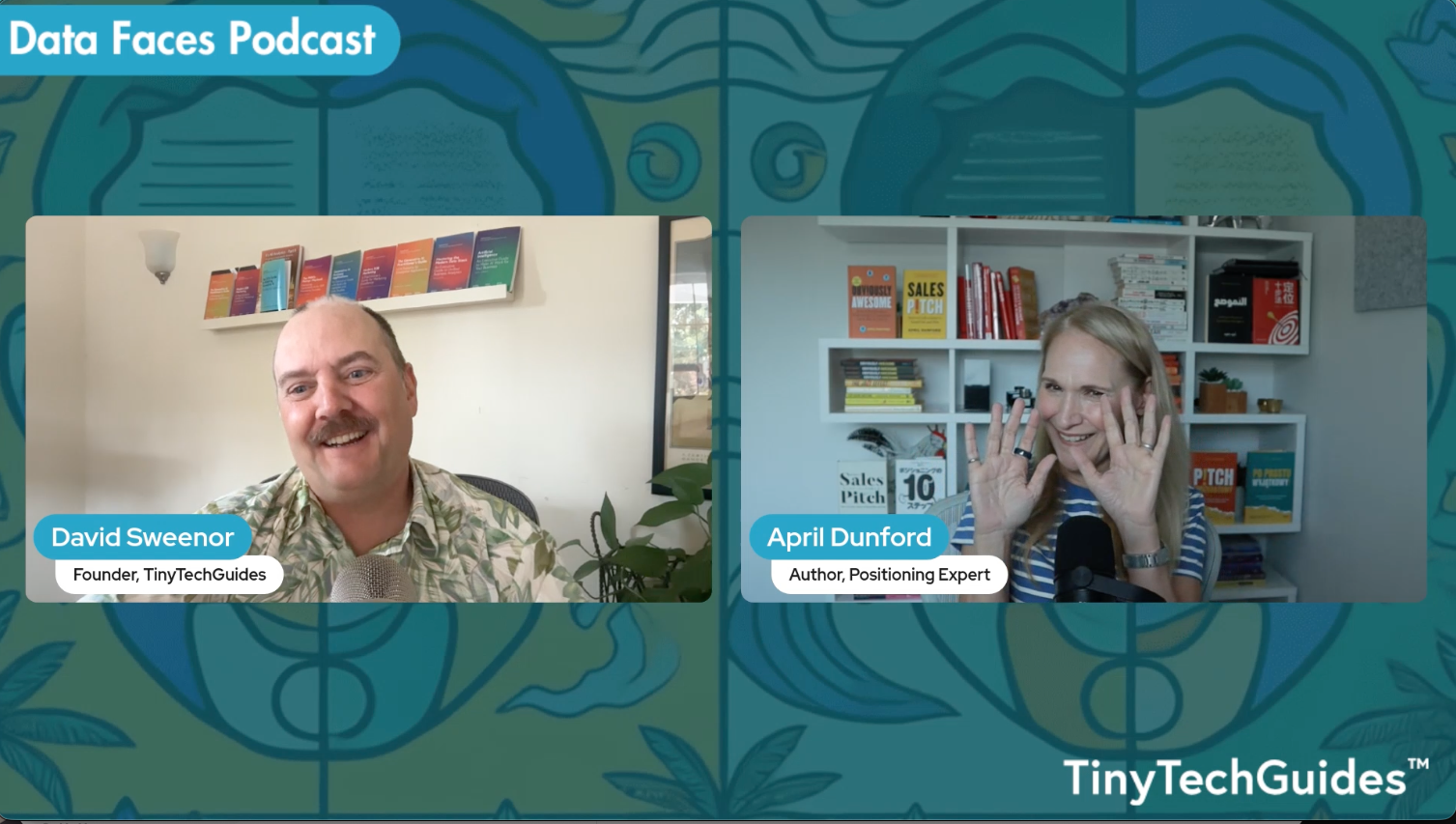
At a recent industry event, I listened to a room full of data and AI leaders reach a consensus that should terrify every software vendor. Any capability in modern software, the group agreed, can now be replicated by a competitor with a prompt, more or less overnight. It’s the same logic powering the SaaS-is-dead obituaries filling my LinkedIn feed. Why buy software at all when you can vibe-code your own? I’ve heard versions of that claim on this show before, and I wanted to test it against the person who has spent a decade helping B2B tech companies figure out what makes them different. So I put the claim straight to April Dunford.
Her verdict took two words, and I’m cleaning one of them up for print. Absolute BS.
The rest of our conversation was April building the case, story by story, for why the clone-anything claim falls apart inside real software companies. If you market or sell a technology product, her argument changes how you answer the question every buyer eventually asks. Why should I pick you?
“That is the most ridiculous statement I’ve ever heard. That is just fundamentally untrue.”
— April Dunford, Positioning Consultant and Author
About April Dunford
April Dunford is a positioning consultant who works exclusively with B2B technology companies, helping them get precise about who they compete with, what they have that nobody else does, and which customers that difference fits best. Before going solo, she spent 25 years as a startup executive, running marketing at seven B2B tech startups, most of which were acquired. Her positioning methodology has now been battle-tested with more than 300 technology companies, from early-stage startups to Google and Epic Games. She is the author of Obviously Awesome, newly updated and expanded in a second edition released in February 2026, and Sales Pitch, and she hosts the Positioning with April Dunford podcast.
In this episode, April and I discuss:
- Why “we have AI” now carries about as much weight as “we have a login screen”
- What’s wrong with the claim that any feature can be cloned with a prompt
- How one CRM’s unusual data model won deals its biggest competitor couldn’t touch
- Why even companies with enormous resources can’t copy whatever they want
- Why positioning projects don’t fail for the reason most marketers think
Watch the full conversation here:

“We have AI” is a login screen
Before we got to the clone myth, April and I talked about a frustration every marketer has felt over the past three years. A product team ships a new capability, leadership wants AI in the headline, and nobody has asked what the AI does for the customer. April told me this was a far worse problem two years ago, when every company that wasn’t AI-native wanted to sprinkle AI on the messaging and call it strategy. She thinks the industry has matured past that stage. She hasn’t worked with a company in two years that didn’t have AI running somewhere in the product.
That maturity is also why the claim has stopped meaning anything. When every product in the category uses AI, saying so is a statement of parity, and parity is not positioning. April’s test cuts through it in three questions. What capability does the AI enable? Is that capability different from what competitors offer? And why should a customer care, which in her world comes down to whether it makes them money, saves them money, or reduces their risk?
“If there is no difference in the capability, then we have nothing to talk about. It’s like saying we have a login screen. Sure, buddy. Everybody’s got a login screen.”
— April Dunford, Positioning Consultant and Author
If your AI capability is table stakes across the category, she argues, you can stop talking about it. The positioning work starts where the parity ends.
It’s just a simple matter of programming
So what about the clone claim itself? April has heard it before, and it predates generative AI by decades. Twenty years ago, she worked for a CTO with a standing answer for it. Whenever the team worried that Google or SAP could build their product too, he would lean back, cross his arms, and say, yep, it’s just a simple matter of programming. We can build it, and they can build it. But they won’t, and they can’t, for a thousand reasons.
The first of her thousand reasons is that nobody starts from the same place.
“If anybody could wake up tomorrow and vibe code the backend of Salesforce, it’d already be done. That is a 20-year computer science project.”
— April Dunford, Positioning Consultant and Author
April is happy to concede the small stuff. If you vibe-coded a scheduler for your kids’ after-school activities, good for you. An enterprise product is a different animal. It carries years of dependencies, security requirements, and a data model that somebody sweated over, and none of that regenerates from a prompt.
The second reason is the business around the software. Early in her career at IBM, April needed three developers for six months to build one feature, inside a business unit doing five billion dollars in revenue. It took her four months to make the case, and the answer was still no, because those three developers were more valuable somewhere else. Even a company with seemingly unlimited resources doesn’t get to build whatever it wants. Every engineering hour has to make sense for the existing product, the existing customers, and the go-to-market machine that sells it.
The moat is in how the product was built
Every company April works with has capabilities its competitors cannot copy. That isn’t a consultant’s polite reassurance. After three hundred client engagements, she considers it settled.
“I have yet to work with a company that does not have differentiated capabilities that their competitors cannot and will not build.”
— April Dunford, Positioning Consultant and Author
She gave me an example from earlier in her career. A company began life as a contact manager and nearly went broke, and then a consulting pivot landed them a bank that wanted a CRM. So they built one, on the contact-manager codebase they already had. Ten years later, that product’s underlying data structure was unlike any other CRM on the market. Every other CRM keys its customer records to the company. Theirs keyed on people. That accident of heritage let it model relationships that have nothing to do with employers, like two executives who sat on a board together or belonged to the same golf club. Investment bankers, who live and die by who knows whom, bought it in droves. The dominant CRM vendor of the day couldn’t respond, because matching the feature meant throwing out its entire data structure and rebuilding a two-billion-dollar product around a new one. As April put it, vibe coding or not, you’re not copying that feature.
The same dynamic showed up in a workshop the week before our conversation. On a feature checklist, her client and its acquisition-built competitor look identical. In deals, the client wins, because its single product shares data across the entire process and the competitor’s three bolted-together products don’t talk to each other.
None of this means old code is an advantage. When I asked April whether legacy was becoming a moat, she told me she meant nearly the opposite. Successful products get built when a founder looks at the incumbent and decides they would build it differently. HubSpot didn’t set out to copy Salesforce. Its founders built a CRM informed by everything they knew about marketing, in reaction to a product where marketing came later as a bolt-on. Differentiation traces back to a philosophy about the right way to solve the problem, and that philosophy gets baked into the architecture where a checklist never looks.
Why positioning fails in isolation
Near the end of our conversation, I asked April why positioning projects always feel rushed, expecting a lecture about skipped customer interviews. She laughed and warned me this was the episode of her being contrary. Rush, she said, is good. Getting a team aligned on positioning should be fast if you follow a structured process instead of vibes. Positioning breaks down when marketing tries to do the work alone, keeping sales out because they’ll just disagree with everything and product out because they’ll have opinions. Yet those two teams hold the answers marketing needs most.
“Who ends up on a short list against us? Nobody knows the answer to that question better than sales.”
— April Dunford, Positioning Consultant and Author
In enterprise software, sales is a remarkable proxy for how customers make purchase decisions, and product teams are often sitting on secret sauce that nobody markets because nobody else understands it. April’s fix is to get the cross-functional team in one room, have the little fight about what matters, and come out aligned. Executing a position in the market can take years. Agreeing on one shouldn’t.
Your moat didn’t disappear
SaaS isn’t dying. AI has made surface-level differentiation cheap to copy, and that sliver of truth is carrying the entire obituary. A screen layout, a clever workflow, a feature that lives where everyone can see it- those may well be gone by your competitor’s next release. What a prompt cannot reach is the differentiation buried in your product’s architecture, its heritage, and the philosophy it was built on. Finding it means getting all the way down to the guts of the thing, with the people who built it in the room, and translating what you find into value a customer cares about. That was true before AI, and April has three hundred companies’ worth of evidence that it is still true now.
Listen to the full conversation with April Dunford on the Data Faces Podcast.
Based on insights from April Dunford, positioning consultant and author of Obviously Awesome and Sales Pitch, featured on the Data Faces Podcast.
Podcast highlights
- [2:25] Small-town valedictorian, an acceptance to med school, and the decision to choose engineering instead
- [3:54] When tech marketing departments were staffed entirely by engineers
- [7:15] The 25-page AI-generated positioning document, and “you read that?”
- [12:11] April’s so-what chain, from capability to customer value
- [14:20] The claim that any feature can be cloned with a prompt, and April’s two-word verdict
- [15:00] “It’s just a simple matter of programming”
- [17:48] Why IBM said no to three developers in a five-billion-dollar business unit
- [20:10] The CRM whose primary key was people, and the investment bankers who loved it
- [27:14] HubSpot, Salesforce, and building in reaction to the incumbent
- [30:18] Rush is good, and the part of positioning that gets shortchanged
- [33:29] Why sales knows the shortlist better than anyone
Frequently asked questions
Is SaaS dead because AI can copy any product?
No. The death-of-SaaS argument rests on the idea that any software feature can be cloned with a prompt, and positioning expert April Dunford calls that claim fundamentally untrue. Surface features can be copied. The differentiation that wins deals lives in a product’s architecture, data model, and founding philosophy, and a competitor cannot replicate those without rebuilding its own product and migrating its install base. SaaS businesses defend that moat the same way they did before generative AI.
Can a competitor really clone any software feature with AI?
Not the features that matter. Positioning expert April Dunford, speaking on the Data Faces Podcast, calls the claim that AI lets competitors copy any software feature fundamentally untrue. Surface-level software features can be copied quickly, but an enterprise product carries years of dependencies, security requirements, and data-model decisions that a prompt cannot regenerate. Rebuilding the backend of Salesforce, she notes, is a 20-year computer science project. Even competitors with enormous resources ration engineering hours by business case, so most theoretically copyable features never get built.
What makes a software feature hard to copy?
Architecture and heritage make a software feature defensible. A capability is hard to copy when it depends on decisions buried deep in how the product was built, especially its underlying data structure. April Dunford’s example is a CRM whose records are keyed on people rather than companies, which let it map relationships between executives that no rival could see. Matching that feature would have required the dominant CRM vendor to throw out its data structure and rebuild a two-billion-dollar product.
How should you position AI capabilities in a B2B product?
Run April Dunford’s so-what chain. Name the capability the AI enables, ask whether that capability differs from what competitors offer, and then translate the difference into customer value, meaning it makes the customer money, saves the customer money, or reduces risk. When every product in a category uses AI, the bare claim “we have AI” is a statement of parity, like advertising a login screen, and it belongs nowhere near your headline.
Who should be involved in positioning work?
A cross-functional team. April Dunford finds that positioning fails when marketing does the work alone and treats sales and product as obstacles. Sales knows who shows up on competitive shortlists better than anyone in the company, and product teams understand differentiated capabilities that nobody else can translate into value. Her method brings those groups into one room with a structured process, has the argument once, and reaches alignment fast. Executing a position takes years, and agreeing on one should not.
About David Sweenor
David Sweenor is the founder and host of the Data Faces podcast, where he talks with the people who are making data, analytics, AI, and marketing work in the real world. He is also the founder of TinyTechGuides and a recognized top 25 analytics thought leader and international speaker who specializes in practical business applications of artificial intelligence and advanced analytics.
With over 25 years of hands-on experience implementing AI and analytics solutions, David has supported organizations including Alation, Alteryx, TIBCO, SAS, IBM, Dell, and Quest. His work spans marketing leadership, analytics implementation, and specialized expertise in AI, machine learning, data science, IoT, and business intelligence. David holds several patents and consistently delivers insights that bridge technical capabilities with business value.
Books
- Artificial Intelligence: An Executive Guide to Make AI Work for Your Business
- Generative AI Business Applications: An Executive Guide with Real-Life Examples and Case Studies
- The Generative AI Practitioner’s Guide: How to Apply LLM Patterns for Enterprise Applications
- The CIO’s Guide to Adopting Generative AI: Five Keys to Success
- Modern B2B Marketing: A Practitioner’s Guide to Marketing Excellence
- The PMM’s Prompt Playbook: Mastering Generative AI for B2B Marketing Success
Follow David on Twitter @DavidSweenor and connect with him on LinkedIn.
Related Posts
Build data products for the hundredth use case
Your AI stack will be wrong in 12 months