

Data Faces · Episode 45 · August 11, 2026 · 38 min
April Dunford on why competitors can’t easily copy your software.

Listen: YouTube · Spotify · Apple Podcasts · Amazon Music
About April Dunford
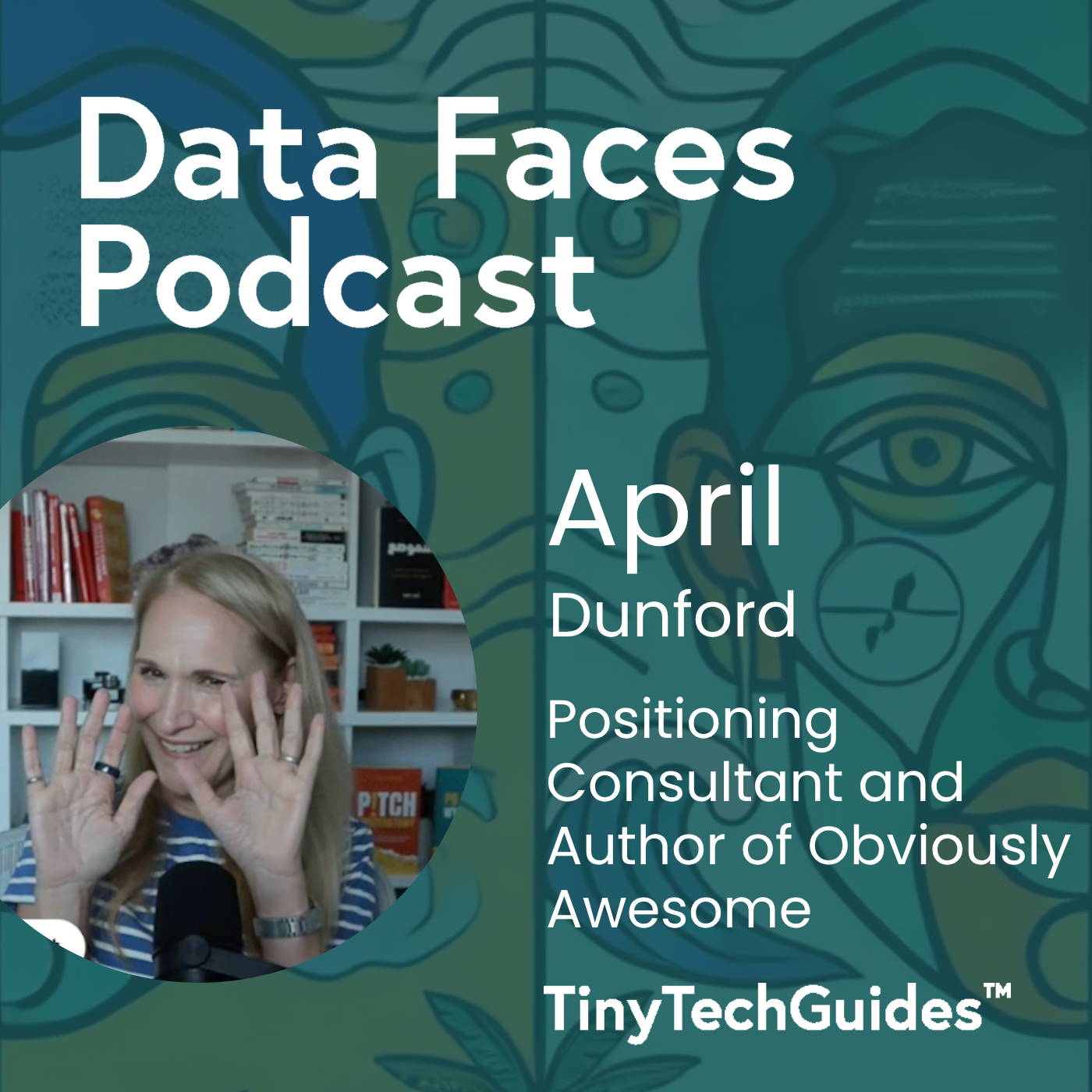
April Dunford is a positioning consultant who helps B2B technology companies get clear on what makes them different and how to tell that story. She spent about 25 years as a startup marketing executive, most of them as a VP of Marketing at companies that were largely acquired, before going independent in 2015. Since then she has worked with more than 200 technology companies, from startups to names like Google and Epic Games. She is the author of Obviously Awesome (2019), the book much of the tech industry reaches for to understand positioning, and Sales Pitch (2023), and she hosts the Positioning with April Dunford podcast. She got her start in technology marketing at IBM.
In this episode
- Why “any software feature can be cloned with a prompt” falls apart the moment you look inside a real software company
- Why “we have AI” is a statement of parity, table stakes like a login screen, not a differentiator
- Where a real moat lives: the architecture, data model, and founding philosophy a competitor can’t copy overnight
- The CRM keyed on people instead of companies, and why a two-billion-dollar competitor couldn’t match it
- Why positioning projects fail when marketing works alone, cut off from what sales and product know
→ Read the full article: The death of SaaS is a myth
Full transcript
David Sweenor 0:05 Hello, everyone, and welcome to the Data Faces podcast. I’m David Sweenor, founder of TinyTechGuides and your host for today’s show. In this show, I talk with people who are actually making data, analytics, AI, and marketing work in the real world. What’s exciting, what’s messy, and what’s coming next? Today we have April Dunford. If you are in B2B tech, you probably recognize her name. She spent a career leading marketing at a number of companies before she became the person to call when companies have a great product, but nobody understands why. She’s written a few books, obviously awesome in sales pitch. I would recommend them. Great read. So today we’re going to talk about something that keeps just about every marketer up at night. AI and how that impacts your messaging, your market messaging. So April, welcome to the Data Faces podcast. It’s great to have you here. It’s great to be here.
April Dunford 1:01 It’s great to be here.
David Sweenor 1:02 Yes. And for those who may not be familiar with your work, could you just give us a quick overview of what you’re all about and what your company does?
April Dunford 1:10 Yeah, sure. So I’m a consultant. It’s just me. And I work with B2B tech companies. And very specifically, I do positioning work, which is helping companies get really tight on the definition of who it is precisely that we are competing with, what we have that’s different, what the value is that we can deliver that no one else can. And who is that value a best fit for? So put another way, who’s the best fit customer? And I also work with companies on like, once we figure that out, how do we tell the story about that? And because most of the companies I work with are B2B and they’re kind of enterprise-y, you can think of it as a sales pitch. Like how do we actually, when we’re in a first call with a customer and they’re like, hey, what are you guys all about? How do we tell the story in a really compelling way that makes them want to move forward with us?
David Sweenor 2:02 Yeah, certainly a well-needed, skill in this day and age with AI. But before we jump into the topic du jour, the name of the show is Data Faces. So we like to get behind the faces and understand just a little bit about you and beyond your professional career. So I’d like to ask, you know, what did you want to be when you grew up?
April Dunford 2:25 Yeah. So you know what? I grew up in a really small town. And, um, but I, you know, but I got really good marks and like, you know, I was top of my class in high school, valedictorian and all that stuff. And so in a really small town, you know, at least in my really small town, if you’re really smart and you looked around and said, what’s the best job in town? The best job in town is the doctor.
David Sweenor 2:47 Okay.
April Dunford 2:50 So we’re just sort of like, okay, I’m going to go be a doctor. So I, you know, I did pre-med. Oh, wow. Yeah, I did. I did pre-med. I actually got accepted into med school. And then I had a bit of a crisis. Like, do I actually want to be a doctor? Or did I just, was that just the play, you know, at the time? And so I happened to be… doing pre-med at this really good engineering school and had a bit of a moment where I was like, I don’t know, like if I look at the stuff I was doing in high school, like I was programming and I had a lot of fun at that. And like, maybe I’m actually supposed to be in tech and not actually in med school. And so then I made the switch to engineering and the rest sort of followed on, but I just sort of, so I said no to med school and then I didn’t go.
David Sweenor 3:35 Yeah. That’s just really interesting. I’ve worked with a lot of different companies and product marketing teams. And one thing, especially in B2B, a lot of the best marketers I know, they have a STEM background or former engineers or whatever. I’m just curious if you see that as well.
April Dunford 3:54 And let me tell you, like, so they’re going to give you the old granny story on this. Like when I started in tech, that wasn’t weird at all. So, so, you know, I started tech in the late nineties. So this is how old I am, date myself here. But back in the late nineties, you know, if you went to work at a tech company, you know, you know this was before we had a lot of packaged applications like everybody was rolling their own stuff and so we were selling very very technical things to very very technical buyers and so if you looked at the marketing department the marketing department was all engineers people with computer science backgrounds and stuff because My first job, we were selling an SQL database to database people. I had to be able to go in there and write SQL queries and talk about inner and outer joins and stuff. You didn’t come out of marketing school to do that. People that came out of marketing school, they went to consumer packaged goods companies. I didn’t meet a person with an actual marketing degree until I had been working in marketing and tech about 10 years.
David Sweenor 5:05 Yeah, yeah.
April Dunford 5:06 And then we saw them pop up. But everybody else, like even when I went to bigger companies, like at one point early in my career, I was at IBM and all the execs above me were mechanical engineers. Like if you ask them, what did you do in school? They’d be, oh, yeah, I did mechanical engineering. And then here he is, vice president of marketing. Like, yeah, it wasn’t that weird. Now I think it’s a little bit different. Now we’ve got, you know, people come from all over and end up in marketing. But yeah, But back then, it wasn’t weird at all. Everybody I worked with on the first team, everybody had a computer science degree. I was the weird engineer.
David Sweenor 5:40 Yeah, it’s funny. Well, we have that shared experience. I started my career at IBM and was there for 12 years. Microelectronics, everybody was an engineer by trade and the different levels of the people that communicate and had people skills. They seemed to go up and the people that just wanted to…
April Dunford 5:56 code or do whatever they’re doing they yeah yeah i actually went to ibm twice i was there once like early in my career sort of junior working in toronto and then um just where i’m from and then and then i got sucked back in a second time the second time was more fun i went to headquarters i had sort of a headquarters job um but uh But yeah, IBM was cool. Then IBM’s a client of mine now. And so it’s fun to see the difference between IBM 20, 30 years ago and IBM right now is a really different animal.
David Sweenor 6:31 I hear you. Well, you may have noticed a little thing in the market that’s… Really, probably since November, I don’t know, three or four years now, 2022, AI. I’m sure you’ve heard of it.
April Dunford 6:46 Yeah. We don’t really get to talk about anything else these days, do we? I know.
David Sweenor 6:51 It’s the only topic. I saw this post from you on LinkedIn. It said, in the age of writing with AI, the ability to make a point with very few words is going to become a superpower. Yeah. The cherry on top is knowing that no writing is required at all. I love that quote because you see these LinkedIn posts are filled with emojis. They’re novellas. I’m like, who reads this stuff?
April Dunford 7:15 Well, I think that there is like… some people that are just like blown away by the ability to sort of feed AI, you know, gen AI, I think a prompt and come up with this big, long thing. And it’s, and it’s people that have really struggled with writing, right? People that are like, you know, we’re, you know, we’re techie, we’re not writers, you know, and, and, and isn’t this amazing? I could do this thing and I can have the, you know, and it was people that sort of wanted to be able to produce a 25 page document on something and now they can, right? Yeah. but but but what i’m seeing is you know in my work before I go work with a company, I kind of asked for some background, right? So I’m like, if you have competitive analysis, I want to have a look at that. If you have done previous messaging or positioning stuff, I want to see that. If you have sales materials, I want to see that. And it used to be, I just got the stuff that I asked for. Now what I get is I get that stuff, but I often get two or three other obviously… ai produced documents they’re just massive these huge things so so that post came out of frustration that the team that i’m about to work with who is a great team by the way sure and you know so their heart’s in the right place they’re trying to be helpful and so they created this document to sort of give me some background but man the thing is 30 pages And it is, you know, it needs some editing. And so it’s really hard to parse because it’s trying to sound smart. And so it’s really, really hard to parse. And I think, man, you could have given me bullet points and it would have been easier to consume. Like a page of bullet points would have been great. Or even better yet… you know, we’re going to have a prep call. So we’re going to get on the call and they could probably explain that 25 pages in about five minute conversation. So anyway, so some of this stuff, I still think that we are, we haven’t quite gotten our arms around where and when is it appropriate? to use AI and to not use AI. And there are some places where I think it is not appropriate to use AI or at least not use it without some heavy, heavy editing or some other things that are happening after. I find this a little disappointing that we’re this far in and we’re still seeing… some folks out there are kind of with this idea that, you know, there don’t, doesn’t need to be any humans involved in any of this stuff. Now we can just, we could just do it all with AI. But, but I mean, that’s obviously not true.
David Sweenor 10:00 Yeah. A bit short sighted for sure. And then you have to take your novella they sent you and then put it in AI to summarize. Can I tell you, can I tell you the end of this story?
April Dunford 10:10 Here’s the end of this story. I had a meeting with them after and I said, okay, listen, my dudes, I read the 25 pages and the guy looked at me and said, you read that? I can’t believe you read that. And I was like, okay.
David Sweenor 10:26 Right. Okay.
April Dunford 10:28 We don’t, we’re not getting bonus points for producing 25 pages and have me go, Ooh, that’s big. I mean, what is the point? Like if you can’t read it, I can’t read it. If you didn’t bother reading it, why should I bother reading it? Like, I don’t know. Some of this stuff frustrates me a little bit, but the guy was surprised that I’d read it. And I was like, what did you think I was going to do with it, man?
David Sweenor 10:50 Right. Right. Well, To that point on AI, I’m sure all of your clients and all of my clients, when they’re looking for a new product release or launching capabilities and they’re like, oh, we got AI. I’m like, great. What’s it do? Well, it does it faster. I’m like, okay. But everybody else has the same stuff.
April Dunford 11:13 Yeah.
David Sweenor 11:13 So like, how do you reconcile that when you work with companies? Is there, everybody’s so enamored or like, like birds, they’re chasing the shiny object and like, Oh, we got it. Yeah. I’m like, it’s great. It’s necessary, but it’s not differentiating. It’s not interesting, really. It’s not unique. So how do you, how do you reconcile that with your clients? Yeah.
April Dunford 11:33 I will say that on this one, I feel like we’re getting more mature. I feel like that was a really bad problem two years ago. Two years ago, in the workshops I was doing, if it was not an AI-native company, then the companies were like, well, we’ve got the AI. We’ll just stick AI. I don’t know what I’m talking about yet. But I feel like we’ve matured past that, which is great. So I think we’ve got to the point now where, okay, everybody’s using AI for something. I mean, I don’t… I haven’t worked with a company in two years that, you know, there wasn’t AI getting used inside the product somewhere. I mean, everybody’s using it.
David Sweenor 12:10 Right.
April Dunford 12:11 But what we really need to understand is like the, so what, like, so what, what’s the AI actually doing for you? So what is the capability that the AI is enabling enabling? And then when I look at that capability, why should a customer care? What is the actual business value that that capability is enabling? Yeah. this is what we really have to extract like you know it’s a bit like saying i programmed it in python i’m like who cares what we care is how’s this thing going to make me money how’s this thing going to save me money that’s what we’re trying to get at in the work that i do now of course on the technical team and the folks that built the thing, I mean, they’re elbows deep into how exactly did this thing get done. Um, and the job in positioning, I think is to look at, you know, we enabled this capability using AI or leveraging AI in some way. And. does that give us a capability that is different than what the other guys have? I mean, we’ve got competitors, customers are looking at competitors. So because we leveraged some AI technology to do that, does this mean the capability is slightly different than what everybody else can do? Because we use it in a novel way. We did something in a novel way. Is there something different here? And does that, how should that difference matter to a customer? Yeah. Again, is this helping them make money? Is it helping them save money? Is it helping them reduce risk? What’s it actually helping the customer do? And so if all I’ve got is parity, meaning all the competitors are using AI to do a thing, I am using AI to do a thing, that thing is exactly the same as everybody else’s, and there is no difference in the capability, then we have nothing to talk about. Because there’s nothing differentiated in it. And what we’re saying is that capability is now table stakes in the category. And we can stop talking about it. It’s like saying we have a login screen. Sure, buddy. Everybody’s got a login screen. You know what I’m saying? It’s like that.
David Sweenor 14:20 I agree with you. So, you know, given that notion, I was at an event probably a month ago. And… what the consensus at this event was a bunch of, you know, data and AI leaders, any software capability can be replicated by a competitor with, with a prompt, essentially.
April Dunford 14:43 That is.
David Sweenor 14:45 Overnight.
April Dunford 14:45 Absolutely. Bullshit.
David Sweenor 14:49 Like, Oh, well, I like this. You heard it first.
April Dunford 14:51 So let’s talk about that.
David Sweenor 14:52 Let’s talk about that. And so.
April Dunford 15:00 So when I, I worked for a really, really smart CTO once long, long time ago. This is like 20 years ago. And we used to talk about that. Like we used to say, Oh my gosh, we’ve built this thing. And Google or IBM or SAP or name your big company at the time. Yeah. They could build it too. They could build it too. And the CTO used to lean back with his arms crossed and he’d say, yep, it’s just a simple matter of programming. We don’t know how to do programming. It’s just a simple matter of programming. We can build it. They can build it. But the reality is they won’t and they can’t for a thousand reasons. A thousand reasons. One is we are not all starting from identical products.
David Sweenor 15:49 That’s true.
April Dunford 15:50 We are not. We’re not. So if anybody could wake up tomorrow and vibe code the backend of Salesforce, it’d already be done. But that is, that is a 20 year computer science project.
David Sweenor 16:03 Sure.
April Dunford 16:04 Like that is not, I’m going to wake up in the morning. Now, if you have a little wee thing, like I’m putting together a schedule for my kids after school activities. I hear this example all the time. Oh my God, I’ve, I’ve coded this thing. It’s like, yeah, yeah. You know what? You, you probably could have done that with a coding tutorial. Yeah. right and and github but okay now we can do it vibe coding without even doing that okay fine we can do that but what we can’t do is like take a product everybody’s got a product already understand all the dependencies of the of this product and what it already has and what it already does and then say, I’m going to vibe code a completely different thing on top of that, that understands all these dependencies, does all the things, does all the security, does all the, has, you know, figures out the data model, figures out the nine, like, are you kidding me? And we are not seeing that. We’re not seeing that at all because that’s a really, really hard problem to solve. Like it’s the same way we didn’t just have, you know, Google or IBM or SAP just pop up one day and say, oh, we’re just going to make Figma because we can. Right. Like nothing in the business supports that. Right. So I would have to start it from scratch. I’d have to do the thing. I would have to build the thing. I would have to have it make sense for the rest of my product. I would then never even, nevermind any of that. Then I would have to figure out how to sell it.
David Sweenor 17:47 Right.
April Dunford 17:48 So there’s the whole go-to-market motion on that. Do I have a sales team that could sell that? Like IBM could wake up tomorrow and decide to build any old thing, but they would have to take resources off of the things they’re already building and the things they’re already doing. Like when I was at IBM, I tried to get this feature built. I had to make this business case for it. And I needed three developers. I’m working in a business unit that does 5 billion revenue. I need three developers and six months to go build this thing. It took me four months to make the case. And they said, no.
David Sweenor 18:25 Right.
April Dunford 18:26 Because those three developers were better used somewhere else. So even in a company with seemingly unlimited resources. You know, we don’t get to just wake up in the morning and vibe code anything we want. It’s got to make sense for the business. It’s got to make sense for the existing customer base. It’s got to move the thing forward. This has always been true. Now, where I think things are in trouble, right? Where what probably does keep you up at night is if you’ve got some thinky little thing, right? The community calendar for the kids activities or whatever, and you happen to be charging 10 bucks a month for that. Well, that may be that.
David Sweenor 19:02 Well, you know, someone hit me up for like a podcast, you know, you get podcasts, everybody’s like, oh, we can do your podcast production for you. And I’m like, I just, I’m like, how much is it? And they said like, it was like, it was over, it was like 1200 bucks for like two episodes a month. I’m like, hey, I would do that. Everything you’re saying in like 10 minutes, it’s already doing it for me. Like what, like, I can’t make more than that. Why the hell would I ever work with you? Right.
April Dunford 19:27 Right. Right. But I mean, so, so there’s some things. Okay. But, but what we don’t have is this idea that features don’t matter anymore because anyone can build a feature. That is the most ridiculous statement I’ve ever heard. Like that is just fundamentally untrue. I have yet to work with a company that does not have. differentiated capabilities.
David Sweenor 19:57 How do you get them?
April Dunford 19:58 That their competitors cannot and will not build.
David Sweenor 20:02 All right. So when you’re, double click on that, when you’re, when you’re talking to your prospect ever, like they would have to throw out their entire model.
April Dunford 20:10 I’ll give you an example.
David Sweenor 20:12 I want to know how you can get this out of their heads. Cause they’re so enamored.
April Dunford 20:17 There’s a thousand things like it’s like, But I’ll give you the, like, I can’t talk about my own clients because I’m going to give you an example of it like, like ancient history one, but it’s the same idea. So I worked for this company and they, they ended up being a CRM company, but they started as a contact manager. Remember people had those, we’re going to manage our contacts. So they were a contact manager. And then that business didn’t work out or whatever. And they almost went all broke and they, they pivoted into consulting and then they got a consulting gig work for a bank and the bank wanted this thing. And what they wanted was a CRM. So they built a CRM and they had this thing. Okay. But they built it on the code base of this contact manager because they had it sitting around. Right. So then they built this thing. And then, you know, fast forward 10 years, we’re selling this thing and the underlying data structure, your data people, you understand this. The underlying data structure is completely different than any other CRM. Every other CRM, the underlying data structure, what’s the primary key? The primary key is company. Everybody has a relationship to the company, right? And that’s how we keep track of people in a CRM. Every CRM is built like this. Well, not our CRM because we were a contact manager. So the primary key is people. Okay. Uh huh. Now, what does that give us the ability to do? Well, it gives us the ability to manage relationships that have nothing to do with companies. So I can build a relationship. If two people belong to a golf club together, I can model that relationship, but they don’t work together. They’re associated with other companies. This is a fundamentally different data structure, right? And it unlocked the capability of. I could manage, I could really get some deep insight into who knows who. Hey, look, these guys used to sit on a board together. Hey, look, these guys went to the same university. Look, they’re both members of the Harvard club. Oh, look, they have this, whatever, even though they don’t sit, oh, they’re sitting on board, you know, like, but they don’t work at the same company, but I know they know each other. Now, so we were having great success selling this thing to investment bankers because that’s how those guys sell. They’re like, who knows who? They sell something to one guy and then they’re like, oh, they want to call this guy’s buddy and say, hey, I just sold your friend this thing and now I’m going to sell you this thing. So we’re making all kinds of money doing that. And so then the big CRM company at the time… couldn’t match us because in order to do that, they would have to throw out their entire underlying data structure and rebuild their product. And by the way, they’re making 2 billion revenue. They have a huge install base. Vibe coding or not, you’re not copying that feature. Like you fundamentally just are not copying that feature. Not gonna happen. Can’t do it. And there are every company I work with has stuff like this. The underlying architecture of the product is such that they got a thing and can unlock a capability and the other guys simply cannot do it. I’ll give you an example from last week. Worked with a company last week. They built out this broad set of capabilities for a certain market. Their biggest competitor grew by acquisition. So the biggest competitor has three products to do the thing that this company does in one product. Now, if you look at them and you just did feature function checklist, you might say, oh, these things kind of look the same. But when you look at where the magic happens, right? Like when I say, how do you win a deal against these guys? They say, well… We can do this particular thing and they can’t. Well, how is it that you do that? Oh, well, because we have shared data across this process, this process, and this process. When this happens, the third thing knows what’s going on. The other guys can’t. Why? No shared data.
David Sweenor 24:06 Right.
April Dunford 24:07 Again, they’d have to throw the three things out, rebuild a whole new product. Maybe they can vibe code that. Let’s try. We’re going to vibe code the thing. We’re going to throw it. Oh, we got to migrate the whole install base now to the new vibe coded thing. That’s great. And then, you know, the whole data structure is going to be different. Like, come on, like, this is not a copyable feature. We don’t just wake up in the morning and say, oh yeah, we got that too.
David Sweenor 24:33 You know, this raises really an interesting question to me.
April Dunford 24:41 I think people that say this have never actually worked inside a software company and attempted to build software. Right, right. Some things are really easy. You’re right. Some things, they’re kind of superficial, blah, blah, blah. You know, we think this looks pretty. We can make ours look pretty. We think this little thing will work. This little thing will work. But most of the companies that I work with, there is something fundamental in the base architecture of this thing. And it was built that way for a reason. Because the founders looked at the competitor and said, well, that’s dumb. How they did that was dumb. I’m going to do this a completely different way. And because they’ve done it in a completely different way, there’s a whole bunch of stuff they can do that the other guys can’t. The trick here is you’ve got to get all the way down. Right. to the guts of this thing. And we can’t just stay at the surface level and say, well, they say they do that too. It’s like, yeah, but they fundamentally cannot. You change the data over here, the other thing doesn’t know because they don’t share data. Sorry.
David Sweenor 25:43 Yeah, this is really interesting to me.
April Dunford 25:46 So what I’m hearing… As a data person, like I come from database stuff and most of the companies I work with now are sort of deep tech, deep stuff. And a lot of this stuff comes down to like what’s happening down at the architecture level that’s different. And then how does that different architecture unlock something for customers?
David Sweenor 26:06 Okay. So what I’m hearing a little bit then is that… due to their heritage or how the software was built. You know, he said, hey, the founder built it for a reason because the other, it was dumb how they built it. Maybe legacy is a better term now. Like I’m hearing some of it. It’s, they’ve had, this is like, I think we’re talking about, you know, large.
April Dunford 26:30 Not all these companies are old.
David Sweenor 26:32 Established big software companies, you know, enterprise scale. They’ve been around for a while. So they have these unique capabilities that are determined by the architecture. So is legacy maybe becoming a competitive advantage?
April Dunford 26:45 Well, I’m saying the opposite of that.
David Sweenor 26:48 I’m saying if you’re… Well, legacy meaning it’s the heritage, right? Because they built it for a specific reason. Yeah.
April Dunford 26:56 But they built it because they looked at the heritage thing and said, if someone were to build that now, they wouldn’t build it that way.
David Sweenor 27:03 Right.
April Dunford 27:03 Because we got different tools and different understanding of how this works and different understanding of where this market ends up in 10 years. And so if we were to go build this again, we’d build it differently.
David Sweenor 27:13 Sure.
April Dunford 27:14 Like if you look at HubSpot, HubSpot’s CRM is not a copy of of Salesforce. It is attempting to build this in a better way. It is attempting to do this in a way that makes up for all the things that people don’t like about Salesforce. When the HubSpot guys sat down, they weren’t saying, let’s just vibe code the copy of Salesforce. That was not the point. What they were like is like, let’s build a thing. And, you know, because they come from a marketing background, right? They’re like, let’s build a thing that’s informed by all this stuff we know about marketing. Whereas Salesforce was like, marketing was a bolt-on.
David Sweenor 27:53 Right.
April Dunford 27:54 Came after. and so most new products that come on the market are built that way like they’re you know because if it was just a copy you’d never sell anything you never sell anything right it has to be differentiated so most good successful products are built, you know, as a reaction to the thing that was in the market that a smart person wakes up in the morning and says, well, that’s dumb. Why they built it like that? If they had built it this way, it’d be better because it would do all these other things. Or, you know, that’s fine for that group of customers, but this group of customers needs something different. So I’m going to build something different, special for them. And that’s how you end up getting early traction in the first place. So almost every company I work with, again, I’m not working with really, really small brand new businesses that haven’t figured out whether or not they’re a thing yet. Most of the companies I work with, they’re, you know, at the very smallest, they’re like 20, 30, 40 million revenue. But a lot of the companies I’m working with, they’re a hundred million revenue, 200 million revenue. And. you know, they are not sitting around saying, how do we copy exactly what the competitor does? It’s not what these people are doing at all. It was never the MO of that company to do that. So if you look at it, generally what they’ve got is a completely different philosophy about how to approach the problem. And we are not so much fighting features, although the features are different and the capabilities are different, but they’re different for a reason. They’re different because the company fundamentally had a philosophy that said, we are going to take this approach because we think this other approach is not the right way to do it.
David Sweenor 29:35 Right.
April Dunford 29:36 And so in the positioning, if we can bring that out to the front. and be like, look, there’s this approach or this approach and let’s contrast them and talk about what you get with each of those. And I’m going to convince you that my approach is better for a customer like you.
David Sweenor 29:53 Okay. Do you find that I’ve done a lot of messaging and positioning over my career with different companies and I feel like it always tends to be rushed. They don’t do sort of the due diligence, the homework, the customer interviews, the partner, all the things that you would need to do to figure this out. I’m just wondering.
April Dunford 30:18 I’m actually, I feel like this is the podcast of me being contrary, but I actually feel like Rush is good.
David Sweenor 30:28 I think here’s the thing. I mean, I’m not, I’m not going to say, I don’t want to wait all year for it, but you know, like, but people are like, we’ve got to have this done tomorrow. Cause we got, you know, some, whatever. I’m like, okay.
April Dunford 30:39 Well, yeah. Like I think parts of it get rushed. Like, I think the parts, the part that gets rushed is the person gets rushed. I think in my opinion, is that marketing is trying to just do this on their own. And, and they kind of see everybody else as an obstacle. Like, well, let’s not bring sales into this.
David Sweenor 31:04 Oh my God. They’re just going to disagree with everything we say.
April Dunford 31:07 Like, let’s not bring the product team into this. Oh my God. They’re going to have opinions.
David Sweenor 31:12 Right.
April Dunford 31:12 You don’t want, we want that. Whereas, you know, again, if we’re enterprise company, which is a lot of the companies I work with. So it’s, we’re talking about enterprise software. Sales is actually an amazing proxy for how a customer thinks in a sales process. Well, sure. So customers, you know, marketers will say, well, we got to go do the customer research. Yeah. And it’s like, yeah, okay, we can go talk to customers. But I see very few companies doing customer research that is actually focused on how did the customer make a purchase decision instead of what they’re looking at is why do you love us? What do you love? What do you not love? How are you using us today? All that kind of stuff, which there’s great value in that. But when we’re thinking about positioning, what I really need to get at is how did you make that decision to pick us? Right. Right. How did we get on the short list? Who else was on the short list? Why did you pick us over the other guys on the short list? Which is a moment in time thing. Right. And if you go to a customer a year later and say, what do you love about us? Sometimes they love totally different things than what they picked you for. They’d be like, well, we picked you because you were the only ones that met the security requirements or whatever, whatever. And then you ask them what they love about. They’re never going to mention that. Right. Or they’ll say, you know, the other guys didn’t have this thing and you did. And, you know, but again, if you ask what the day to day, what do they love? They’ll say, oh, I love your support. And I love. the way you know whatever and it’s like well you never even were exposed to my support before you actually purchased so that’s not why you bought us right it might be why you were new but it’s not why you bought us But sales knows this stuff. The problem is you got to have a little bit of finesse in extracting it from the sales team. They think a certain way, right? And people don’t ask them stuff a lot, right? So if you walk over to the sales team and say… Why does everybody love our stuff? You know, you’re going to get a lot of different answers there. And they might, you know, sales is always obsessed with the one big deal. They might be thinking about the one big deal as opposed to how does this work in general?
David Sweenor 33:28 Right.
April Dunford 33:29 But if I were to say something, if I was to ask a question like, you know, who ends up on a short list against us? Nobody knows the answer to that question better than sales.
David Sweenor 33:41 Right.
April Dunford 33:42 And like, who’s a real threat to us? Like, who do we actually lose deals to? Not who we could lose deals with. So if I think about what gets rushed, it’s that. Like, you know, we’re not pulling the sales string. And then the same thing in product. Because what I’ve seen is often… often these products, because again, the ones I’m, I’m working with are kind of, you know, they’re fairly technical. These are not easy products to understand necessarily. Right. And we’ve got a marketing team that you maybe doesn’t fully, fully, deeply understand everything about the product and a sales team ditto, but I got a product team that knows a lot. Right. If anybody really understands this stuff, it’s them. And often what I find in the workshops that I do is that there’s some secret sauce there right under everybody’s nose. And marketing is not marketing it because they don’t understand it. Sales isn’t selling it because they don’t understand it. And products all pissed off. Like they’re all sitting there going, nobody ever talks about my cool thing that we built.
David Sweenor 34:48 Yeah. Right.
April Dunford 34:49 Like, well, if only. And it’s because it’s hard, right? Nobody really knows how to talk about the value of it. Nobody really understands what it does. They’re having a hard time translating that to value. So I think the part that gets rushed is, you know, like you say, marketing gets under the gun. CEO says, come on, come on. We need new messaging on the homepage next week. And I don’t think the block is that they’re not spending enough time doing customer interviews and all that other stuff. I think it’s hard for marketing to go get the information they need from inside the company, from the sales team, from the product team, to make really good positioning decisions. So in the work I do, it’s fast. We don’t spend a lot of time, but… But we are getting a cross-functional team together and we’re having a little fight about stuff, right? About what’s important and what isn’t important. And what do we see in the field versus, you know, product management sees a slice of what’s going on in the field. Sales sees a slice. Marketing sees a slice. CEO sees a slice. And those slices are all different. And so we want to get everybody in the room together and then work through it. But in… You know, I think executing on a positioning, making your position real out in the market, that takes a long time. But getting a team to get agreement and alignment on a position, if I’ve got the right people in the room and we’re following a process that isn’t just vibes, right? We’re following a process that’s kind of structured, then I think we can get to something really, really fast. At least that’s been my experience. But… Um, but we got to get the right people in the room. We have to dedicate some time. We have to, you know, you know, pause game, get the whole gang together. Okay. Now we’re going to do this thing, work through it so that we’re all in agreement and alignment and then go execute on it and executing on it might take years, but, um, but getting good positioning, I think shouldn’t take too long, but the trick is we got to have, we got to have the right people together in the room.
David Sweenor 36:56 All right. Well, April, this has been a fascinating conversation. If people want to learn more about you, your books, where can they find you?
April Dunford 37:05 What’s the best way to… Oh, aprildunford.com. But I mean, you can just Google me. Like, I think the books are a good place to start. Like, if you’re kind of curious about positioning, like, you know, I have a point of view on… And I think there’s lots of ways to do positioning, but I have a point of view on if you’re a B2B tech company, you know, selling kind of enterprise-y stuff, you’re in market, you’ve been in market a while. My first book, obviously awesome, is designed to… give you a way to think about that. And if you wanted to try and tackle this on your own in house, there’s a process that you can follow for that. So I would start there. And then, you know, if you decided you you’re stuck and you need help beyond that, April Dunford.com is where you can find me. You can follow me on LinkedIn, but I’m not very active on LinkedIn.
David Sweenor 37:54 Okay. Well, I appreciate you joining the data faces podcast. This has been an amazing conversation. Thanks for joining.
April Dunford 38:03 Thanks so much. Thanks for having me.
David Sweenor 38:05 Cheers.