Leigh Felton on speed, sameness, and the junior employee who asks why
Listen now on YouTube | Spotify | Apple Podcasts | Amazon Music
▶ Watch the full episode and read the transcript: Why De-Biasing AI Is Impossible | Leigh Felton
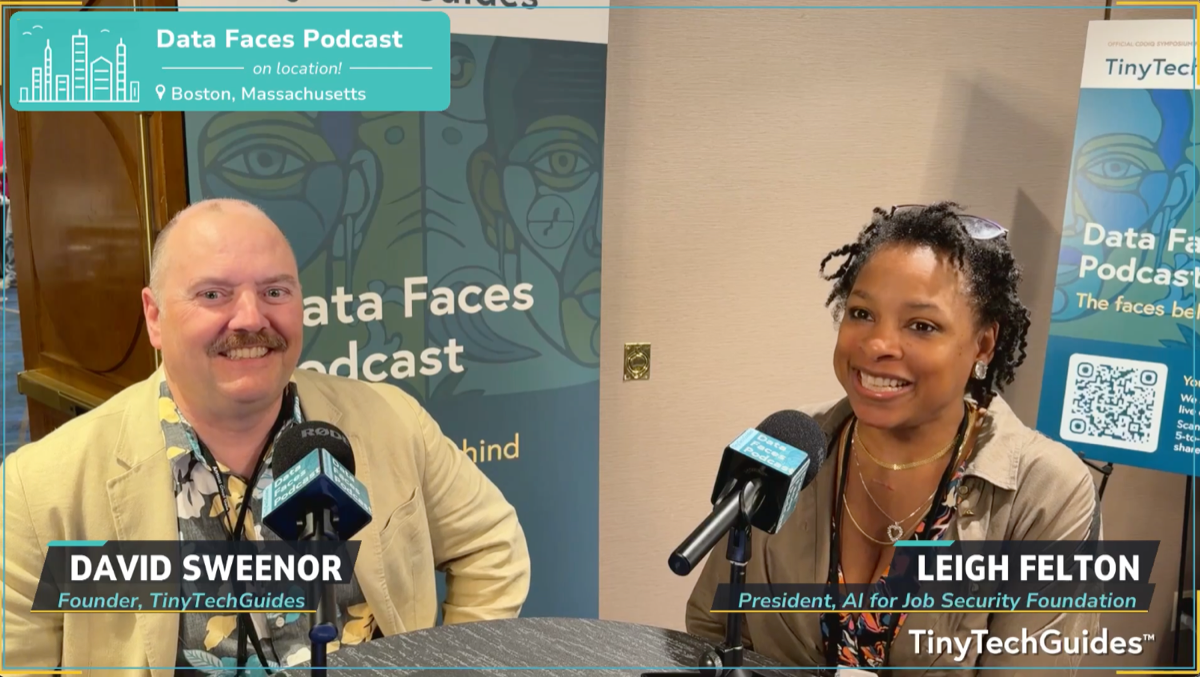
Ask most executives what generative AI is for, and you'll hear some version of the same answer. It makes people more productive and faster. Leigh Felton spent 20 years at Microsoft, where she headed the company's first ethical AI enablement program, and she thinks that answer is where the trouble starts. Speed is easy to see, so it becomes the measure, and the thinking that should happen between the prompt and the published result drops out of the process.
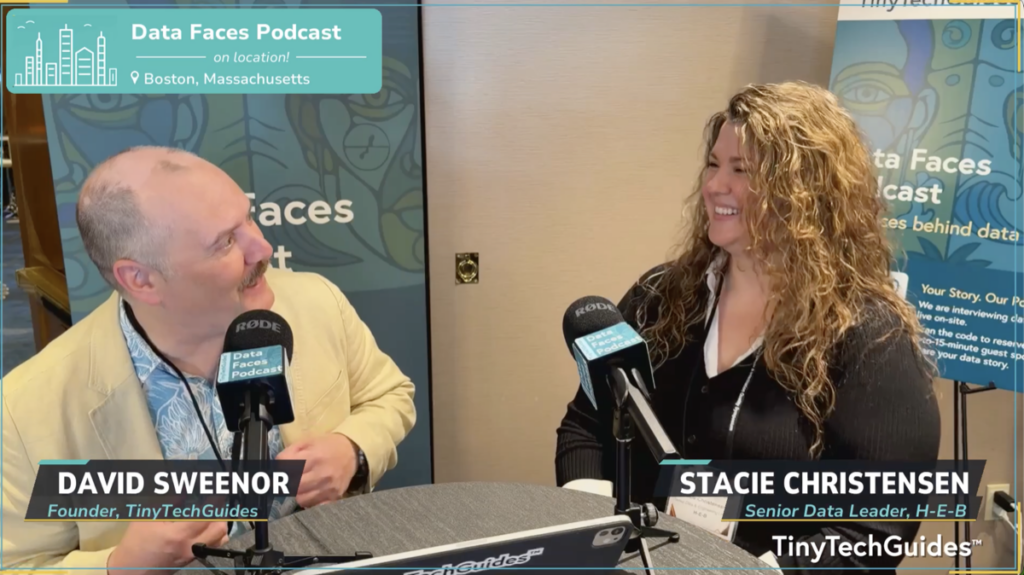
I sat down with Leigh, now president of the AI for Job Security Foundation, on location at the CDOIQ Symposium in Cambridge, Massachusetts.1 She has a name for the habit she sees spreading through offices, and she calls it AI think.
"What I call AI think … is just taking the slop that AI is producing and publishing that. That is not productivity, but that is the subconscious thought that people are associating with AI, that it should just be able to make everything faster."
— Leigh Felton, President, AI for Job Security Foundation
It's an uncomfortable argument for anyone who uses gen AI every day, and I include myself in that group. So, what does AI think cost you? Leigh's answer covers your productivity and your voice, along with the next generation of people who would otherwise question how work gets done in the age of AI.
About Leigh Felton
Leigh Felton is president of the AI for Job Security Foundation, a 501(c)(3) nonprofit that helps communities, students, and faculty understand what AI is, how to control it, and how to keep and create jobs for the future workforce. She spent 20 years at Microsoft, where she headed the company's first ethical AI enablement program.
She is also the author of the two-volume I Could've Been CEO Yesterday series.2 Volume one, But AI Algorithms Say I'm a DEI Risk Today, looks at how AI trained on historical data limits who gets an opportunity, and volume two, Does AI Decide Who'll Be CEO Tomorrow?, argues that autonomous AI shouldn't be the end goal for organizations. She writes a newsletter on Substack, puts out a weekly video message every Friday, and invites anyone who disagrees with her to start a conversation on LinkedIn.
In this episode, Leigh and I discuss:
- Her two-volume book series on AI, hiring, and who gets to lead
- Why she treats AI as an environment that shapes how people think
- How to talk about AI productivity in the language a chief data officer uses
- AI think, the sea of sameness, and why she won't let AI genericize her
- Why junior employees will see what 30-year experts stopped questioning
Watch the full conversation here:
What "AI think" means
AI think is the habit of accepting what a gen AI tool produces and passing it along without using your noggin and applying your own critical thinking. Leigh's examples are familiar to anyone who works with these tools: a developer takes the code a model returns and moves it forward, or a writer publishes the first draft a chatbot hands back. The work gets done, and nobody did much thinking along the way.
She traces the habit back to how the technology was introduced. ChatGPT arrived as artificial intelligence, and Leigh doubts that millions of people would have signed up overnight if OpenAI had described it the way she does, as "a probabilistic engine that is statistically guessing based on patterns that it recognizes." When you believe the thing on the other side of the prompt is sentient and intelligent, checking its work starts to become optional. But if you use it regularly, you see its foibles and shortcomings.
Research on gen AI and critical thinking illustrates the point. In a survey of 319 knowledge workers who shared 936 examples of using gen AI at work, researchers from Microsoft Research and Carnegie Mellon University found that higher confidence in gen AI was associated with less critical thinking, while higher self-confidence was associated with more.3 The more people trusted the tool, the less they questioned its output. But the people who trusted their own judgment kept checking.
That second finding helps explain Leigh's stance. She has been in the industry for 30 years, and she told me plainly that AI will never write, strategize, or decipher better than she can. You could hear that as bravado, but the survey suggests it's protective, because confidence in your own expertise keeps you reviewing the machine's work.
Why faster output can mean less productivity
When I asked Leigh how she gets a chief data officer (CDO) to care about any of this, she said you have to speak their language. Tell a CDO they need governance and rules, and you'll get "blah, blah, blah" and a request for the box to check for the regulators. Talk about productivity, the language most large companies speak right now, and you get their attention.
"If it's actually the engineer pushing back on the AI and they're collaborating, they're adapting, they're really building something new, even if it takes 19% longer for that task, they are actually being way more productive."
— Leigh Felton, President, AI for Job Security Foundation
The 19% figure comes from METR, a nonprofit research group. In a randomized controlled trial run in early 2025, 16 experienced open-source developers worked through 246 real tasks, and when they were allowed to use AI tools, they took 19% longer to finish.4 Before the study, they expected AI to speed them up by 24%. Even after being slowed down, they believed it had sped them up by 20%.
In February 2026, METR published new data on late-2025 AI tools and estimated an 18% speedup for the developers who returned from the original study, although it called the new results unreliable because so many developers now refuse to code without AI at all.5 In the original study, developers felt faster while running slower, which is AI think in a single data point. The work felt fast, so they never checked whether they were coding any faster.
I told Leigh I see the same thing in marketing. Someone sends over an AI draft, fixing it takes longer than writing it would have, and the AI slop cleanup just moves to a different desk. Then I offered what I thought was the fix, which is to stop accepting the first output and use the model as a challenger, asking it for a thousand reasons why something is right and a thousand more why it's wrong. Leigh pushed back and went a step further, telling me not to ask the AI for the reasons at all. Work through the problem with your own expertise, she said, and then ask the model what you're missing. Her point stung a little, because my challenger approach still lets the model set the terms and outsources your brain.
The proverbial "sea of sameness"
Leigh and I finished each other's sentences when the conversation turned to AI-written content. Scroll LinkedIn for five minutes, and you'll find the same "it's not this, it's that" construction in post after post, along with the same rhythm and the same tidy three-part lists. Her diagnosis is that people let AI set the parameters. Even when they ask for a thousand options, the model decides what the options look like, and the writer picks one. Leigh won't work that way, and when a draft doesn't sound like her, she rants to her AI about it until it does.
"I know when I'm giving AI my voice, and I stop it. I don't let it genericize me. So if you think about all these articles and publications and LinkedIn posts, they're starting to sound the same. The sea of sameness is well upon us."
— Leigh Felton, President, AI for Job Security Foundation
Her picture of good thinking comes from old movies. A writer at a typewriter makes a mistake and throws the crumpled page on the floor. Five minutes later, the writer picks it back up because something on it triggered an idea. Working through a problem looks like that pile of crumpled paper, and she worries that people have stopped doing it. They ask the model for a thousand reasons and take what comes back, and nobody goes back to the floor.
The person who asks why
Near the end of our conversation, I asked Leigh whether she's optimistic about the future of work. She is. Leigh believes AI will never be as smart and intelligent as people. She also knows that belief has to spread beyond her into schools, universities, and organizations, especially the ones whose leaders think they can replace their associate and junior roles and keep a few 30-year experts to run things.
Then she told the turkey story. Experienced people can see what's right and what's wrong and can organize just about anything, but they also cut the turkey in half before it goes in the oven, because their mothers did it that way, and so did their grandmothers, and nobody has asked why in generations. Then a junior person walks in and asks. The answer turns out to be that their ovens were smaller.
Leigh sees junior employees, especially Gen Z, as the people who notice what experts stopped questioning, as long as they don't give in to AI think themselves. Jim Jinright made the hiring side of this case on his Data Faces episode about the tech job market. As AI takes over the small, well-defined problems that junior people used to learn on, the bottom rungs of the career ladder disappear. Put the two episodes together, and an organization that cuts its junior roles loses its training pipeline along with the people most likely to ask why the turkey gets cut in half.
"It's so super critical that we give them that opportunity to write their book, crumple up the paper, and continue to think."
— Leigh Felton, President, AI for Job Security Foundation
How to avoid AI think
How do you keep yourself and your team out of AI think? Here's what I've learned works, and most of it comes straight from Leigh.
- Set the parameters before you prompt: Decide what good looks like, from your own expertise, before the model offers its version. For writing, that can be a style guide, and for analysis, it's the hypothesis and the questions you want answered. When I ran a cold-prompt test against my own battlecard workflow, a fresh Claude out-wrote my 2025 prompts, and what still mattered was my judgment about which jobs to automate and how to check the results in the field.
- Treat the first output as a draft to argue with: Leigh rants at her AI until the draft sounds like her. You can skip the ranting, as long as you say what's wrong and make the model try again, which is the collaborating and adapting she counts as productivity.
- Ask the model what you're missing: Do your own thinking first, then ask the model, "What don't I see?" Leigh says that kind of back-and-forth expands what your AI can do for you, and the co-adaptation makes it stronger over time.
Team leaders should also look at what they measure. When cycle time is the only AI metric on the dashboard, the team gets rewarded for AI think, so pair it with a measure of quality and protect the junior roles where people still learn to ask why.
I summed up her argument as message number one: don't let AI replace your brain. Leigh agreed, adding that people can think, imagine, and make judgments, while AI can't do any of those things. Faster tools make that advice more important, since the faster the output arrives, the easier it is to skip checking it.
Listen to the full conversation with Leigh Felton on her Data Faces Podcast episode page.
Based on insights from Leigh Felton, President of the AI for Job Security Foundation, featured on the Data Faces Podcast.
Podcast highlights
- [0:00] David welcomes Leigh Felton to Data Faces, on location at the CDOIQ Symposium in Cambridge, Massachusetts
- [0:25] What Leigh wanted to be when she grew up
- [1:06] Inside the AI for Job Security Foundation
- [1:36] Volume one of I Could've Been CEO Yesterday, and AI trained on historical data
- [3:29] Volume two, and why autonomous AI shouldn't be the end goal
- [4:48] AI as an environment that shapes how people think
- [6:55] How to get a chief data officer to care, in the language of productivity
- [8:39] Faster versus more productive, and what Leigh calls AI think
- [9:41] Why accepting the first output is the most common mistake
- [10:09] Don't let AI genericize you, and the sea of sameness
- [13:30] Will AI ever be smarter than people?
- [14:14] The turkey story, and why junior employees matter
- [15:45] Where to find Leigh's books, newsletter, and weekly video
Frequently asked questions
What is AI think?
AI think is a term Leigh Felton, president of the AI for Job Security Foundation, uses for accepting what a generative AI tool produces and publishing it without applying your own critical thinking. A developer who moves model-generated code forward unchecked, or a marketer who posts a chatbot's first draft, is doing AI think. Felton argues that the habit gets mistaken for productivity because it makes work faster, even though no one did the thinking.
How does generative AI affect critical thinking?
A 2025 survey of 319 knowledge workers by Microsoft Research and Carnegie Mellon University found that higher confidence in generative AI was associated with less critical thinking, while higher self-confidence was associated with more. Workers who trusted the tool questioned its output less often, and workers confident in their own expertise kept checking it. The findings support Leigh Felton's argument that people who rely on their own judgment are less likely to fall into AI think.
Does AI make developers less productive?
The evidence has changed over time. METR's early-2025 randomized trial found that experienced open-source developers took 19% longer on tasks when they could use AI tools, even though they believed AI had sped them up by 20%. In February 2026, METR estimated an 18% speedup with late-2025 tools for returning developers but called that data unreliable. The finding that has held up is that developers' sense of speed didn't match their measured speed.
Why does AI-generated content all sound the same?
AI-generated content tends to sound the same because writers let the model set the parameters. Even when people ask for many options, the model decides what those options look like, so posts converge on the same constructions, such as "it's not this, it's that." Leigh Felton calls the result the sea of sameness. Her fix is to bring your own voice and expertise first and push back on drafts that don't sound like you.
Should companies replace junior roles with AI?
Leigh Felton argues against it. Experienced employees often keep doing things the way they always have, and junior employees, especially Gen Z, are more likely to ask why. Her example is a family that cuts the turkey in half for generations because an earlier oven was too small, until someone new asks. Cutting junior roles removes the people most likely to question inherited habits, along with the small problems they learn on.
About David Sweenor
David Sweenor is the founder of TinyTechGuides and host of the Data Faces Podcast. He is an international speaker, advisor, and the author of eleven books on artificial intelligence, analytics, and B2B marketing, including Generative AI Business Applications, The CIO's Guide to Adopting Generative AI, and Modern B2B Marketing. With more than twenty-five years in analytics and AI at companies including Alteryx, Tableau, TIBCO, SAS, IBM, and Dell, David advises technology companies on product marketing, content strategy, and go-to-market execution. He holds several patents and has been named a top influencer in data and analytics by Onalytica, Thinkers360, and Analytics Insight.
Connect with David on LinkedIn and subscribe to the Data Faces Podcast for conversations with the people shaping enterprise data and AI.
Footnotes
Footnotes
-
CDOIQ Symposium. "The 20th Annual CDOIQ Symposium." July 21–23, 2026, Hyatt Regency Cambridge, Massachusetts. https://2026cdoiq.org/ ↩
-
Felton, Leigh. I Could've Been CEO Yesterday series (V1: But AI Algorithms Say I'm a DEI Risk Today; V2: Does AI Decide Who'll Be CEO Tomorrow?). Amazon author page, accessed October 1, 2026. https://www.amazon.com/stores/Leigh%20Felton/author/B0C442RJ6R ↩
-
Lee, Hao-Ping (Hank), Advait Sarkar, Lev Tankelevitch, Ian Drosos, Sean Rintel, Richard Banks, and Nicholas Wilson. "The Impact of Generative AI on Critical Thinking: Self-Reported Reductions in Cognitive Effort and Confidence Effects From a Survey of Knowledge Workers." Proceedings of the 2025 CHI Conference on Human Factors in Computing Systems, Association for Computing Machinery, April 2025. https://doi.org/10.1145/3706598.3713778 ↩
-
Becker, Joel, Nate Rush, Beth Barnes, and David Rein. "Measuring the Impact of Early-2025 AI on Experienced Open-Source Developer Productivity." METR, July 10, 2025. https://metr.org/blog/2025-07-10-early-2025-ai-experienced-os-dev-study/ ↩
-
METR. "We Are Changing Our Developer Productivity Experiment Design." METR, February 24, 2026. https://metr.org/blog/2026-02-24-uplift-update/ ↩
Related Posts
Are industry analysts still relevant when AI builds the shortlist?
Why data initiatives fail before technology is the problem