

Data Faces · Episode 47 · August 25, 2026 · 36 min
Qlik CTO Sam Pierson on adaptable architecture and AI economics.
Listen: YouTube · Spotify · Apple Podcasts · Amazon Music
About Sam Pierson
Sam Pierson is the Chief Technology Officer at Qlik, where he leads engineering across the cloud and AI platforms and spends much of his week talking with customers. He joined Qlik as the Chief Technology Officer of Talend when the two companies came together, so he knows a great deal about moving and integrating messy enterprise data. Before Talend and Qlik, he held engineering leadership roles at Illuminate Education, Datica, SPS Commerce, Veritas, and Symantec. He holds an MBA and a computer science degree from the University of Minnesota.
In this episode
- Why AI is pushing enterprises to rebuild their data architectures on open formats like Apache Iceberg
- The model selector Qlik wired in early, and how it routes a task to a model that is good enough but 10 times cheaper
- Where AI token costs pile up before a model ever runs, and how a pre-calculated in-memory engine avoids them
- Whether freedom from vendor lock-in is a real architectural property or a story the industry tells itself
- Why 97 percent of enterprises have budgeted for agentic AI while only 18 percent have fully deployed it
→ Read the full article: Your AI stack will be wrong in 12 months
Full transcript
David Sweenor 0:06 Hello, everyone, and welcome to the Data Faces podcast. I’m David Sweenor, founder of TinyTechGuides and your host for today’s show. In this show, I talk with the people who are actually making data, analytics, and AI work in the real world. What’s exciting, what’s messy, and what’s coming next. My guest today is Sam Pierson, Chief Technology Officer at Qlik. He came into Qlik as Talend CTO, so he knows a thing or two about moving and integrating enterprise data. Sam has been saying that the way you win with AI is not by betting on one model or any one platform, but keeping the freedom. to adapt as everything underneath you keeps changing. So today we’re going to get into what that freedom means in terms of architecture. How do you choose the right components without getting locked in and the economics of this doing it cost effectively? So let’s dive in. Sam, welcome to the Data Faces podcast.
Sam Pierson 1:00 David, great to be with you today. Thanks for having me.
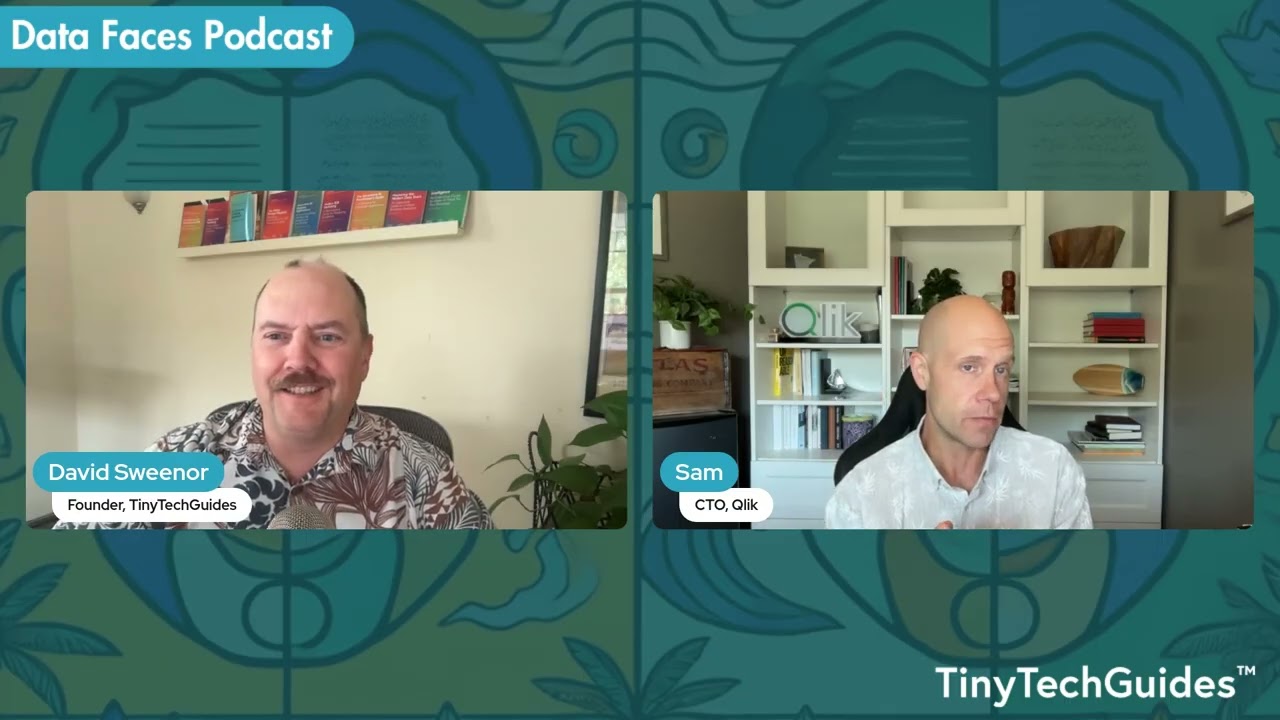
David Sweenor 1:03 I appreciate the support with the Aloha shirt. So you are definitely on brand, A plus so far.
Sam Pierson 1:10 Yeah, I got my little statue here too. So we’re right on brand for sure.
David Sweenor 1:16 All right, very good. So can you just tell us a little bit about yourself and what you’re doing over at Qlik?
Sam Pierson 1:22 Yeah, so I’m the chief technology officer here at Qlik. I look after the engineering teams, partner with our product management team, partner with our go-to-market teams, talk with customers all the time. So it’s a fairly external role as well, but been absolutely just a blast and just a great place to be given everything that’s happening in the industry right now.
David Sweenor 1:44 Yeah, it’s certainly an exciting time to be here. And one of the premises of the show, Sam, is it’s called data phases. So it’s to get behind everybody’s professional life and their LinkedIn profile. So I always like to throw an icebreaker out there. What was your first job?
Sam Pierson 2:00 Yeah, my first job, you know, I was just, you know, early, you know, sort of early teenager. It was the lawnmower, the lawnmowing grind. You know, we had a lot of folks in the neighborhood who couldn’t get out there and mow their lawns all summer. And so I went around and kind of built up a little book of business there. And yeah, basically spent the summers, you know, mowing lawns and hauling grass around. Yeah. Teach you a bit about how to sell and how to how to deal with people. Right. Oh, for sure. For sure. Yeah.
David Sweenor 2:34 Excellent. So, you know, you came I mentioned you came to Qlik as, you know, from from the Talend acquisition. So what is your sort of overall like, you know, about data integration? We’ve been talking about data integration for quite some time. Where do companies get stuck in? How does that shape the way you think about the notion of freedom today?
Sam Pierson 2:55 Yeah. Well, look, I think it’s a perennial question. It comes up all the time. I know we’re going to talk a lot about AI. But if you go back in time a bit, even back to the Hadoop craze, whether it’s for doing machine learning, whether for data lakes or for just operational things, it’s like enterprise’s data is always this really valuable asset that they can use to create an advantage for themselves. I think we look at some of our customers who are really mature. in this space and they’re doing it well, their business just runs smoother. And I think, especially now, as you start thinking about the challenges that people have in getting AI into these production environments, it’s never been more relevant like it always has been. Sure.
David Sweenor 3:55 Yeah. And one interesting thing about AI, I’d like to get your perspective on how maybe it’s changed things. So I used to work on semiconductors and had a team of people that were building applications to analyze the data that came from these manufacturing processes.
Sam Pierson 4:10 And I always thought of data as plumbing, how hard is that you’re moving data to and fro.
David Sweenor 4:15 And my ETL developers, they would get really mad at me. Oh, yeah. Say things like that. so with ai though it’s sort of changing the game like like how does how does ai change how we should think about data
Sam Pierson 4:31 Yeah, I mean, I think it’s super interesting because I think the industries are, they are converging actually quite a bit. So it’s not just about data integration anymore. I think, and Qlik is both in the analytics and AI and data integration and data governance. sort of end-to-end type of products, right? And I think where if you rewind the clock, 15, 20 years, these were very separate things. They might have had interfaces into each other, but now these things are really starting to get connected end-to-end. And I’ll just give you an example of that, right? It’s like, again, you’ve got a dashboard out there, you’ve got a visualization. That… And if that dashboard is built on your production enterprise data and you’re making decisions off of that, right? You’ve got decision makers who are either looking at that or you’ve got teams of analysts that are looking at that. it has to be correct, right? And today, I think the change that we’re seeing is that people are, like that job is changing. I think you still, there’s still a core set of use cases where it’s like, you gotta have that traceability, it has to be locked and loaded into that platform. But the way that people consume that information is changing quite a bit. And the reality is, is like, if you’re using Claude or using OpenAI, or any of these frontier models as an enterprise, you have to have a reliable way of connecting that data into those platforms. And I think the way that those platforms analyze that data is also different, right? And so now you’ve got not only data integration, you’ve got things like data warehouses, you’ve got lake houses, all the way into the analysis. And that’s just, I think, in a few of the ways that we see our users doing the job differently. And what has led us to really, I think, lean into things like MCP, a natural language interface inside of the product, all of those things. But at the core part of it, it’s still like having reliable data that’s clean that you can trust and make decisions on. Because without that, you’ve got hallucinations, you’ve got wrong data. And all of a sudden now, these frontier models can make very convincing cases off of the wrong data. And I think it’s much more opaque than it is
David Sweenor 7:18 or than it has been historically with those dashboards right and so are you finding that we sort of have to start to bake instructions into the data and what i mean by that is whether we call it metadata context or semantics or pick your term du jour You mentioned the AI, we don’t want it to hallucinate. So while the LM is doing its thing, sort of you have to have these rules embedded in the data structure. Is that the right way to think about it? I know that’s probably a part of it and there’s prompts, there’s guardrails and things like that, but there’s probably instructions and things, guardrails right within the data structure. Is that how people should think about it?
Sam Pierson 8:00 yeah yeah and i think i know we look i look at some of the things that we’ve done internally so um you know we like we use Qlik products to do you know to build out our own agents that are powering the rest of the business and like what we like what we have found is that know number one like just having the data foundation there and making sure that that is quantifiably reliable and high quality but then the other piece is just the additional context that’s on top of that data being able to feed that also in as a um as a context into the llms as you’re either doing queries or you have agents running like being able to have that context along with the data really brings the the quality and the accuracy of those answers to the next level and uh yeah so i think it’s it’s something that is uh it’s in it’s incremental to what we’ve seen historically sure and then when we’re talking data you know a lot of people when they think about dashboards we’re transforming
David Sweenor 9:06 numbers and columns into something more useful. But when you talk about data, are you talking also about the unstructured piece of it as well? You know, as unstructured data, what role does that play in this these days?
Sam Pierson 9:19 Yeah, I mean, yeah, totally right on the structured side. I think on the unstructured side, there’s like the again, like the way that the Frontier Labs and the LLMs work, that unstructured data is almost equally powerful, right, for unearthing insights. I think, you know, and frankly, like, I think, you know, whether it’s like analyzing call logs or analyzing support cases or comments that people leave, right? Like, you know, still being able to have a pipeline and a life cycle for that data is still super, super critical, right? And whether that’s on a time basis or whether it’s, you know, cohorts of users that are sending things in, think, you know, still having a strategy around unstructured is, you know, is equally important. Right, right.
David Sweenor 10:13 And, you know, one of the big premises you have in Qlik in general is this notion of openness and the freedom to to choose and so you know i’ve seen announcements on you know apache iceberg and osi open semantic interchange how important is that for your your your clients and prospects these days to get that sort of foundation Correct. I’m just curious kind of how they’re thinking about it because we’ve had a lot of proprietary things over the years and it seems like we’re moving a little bit towards more of the open side of it these days.
Sam Pierson 10:51 Yeah. I think there’s a couple of ways to think about it depending on which layer of the stack you’re in. Maybe starting from the bottom, I think, again, this is something that it’s like a pendulum that kind of swings back and forth all the time, right? Like you had these huge monolithic databases, and then that sort of swung into like the open distributed databases. Thank you. Then it sort of comes back into Snowflake and Databricks, which have had great success and are partners of ours. I think what people recognize is that being like. Being able to store these things in an open format gives you the flexibility to move them around. So for example, Iceberg is something that’s absolutely huge right now. I think as people build out these patterns for AI, and frankly, it is the impetus for a lot of people rethinking their data architectures. like they do not want to get locked into any given system. Like they want to have as much flexibility as possible. One, I think for risk and sort of vendor, you know, vendor impartiality. But I think the other, the other thing that’s here is like, you know, we, we may have a completely different conversation about AI in 12 months, right? The concerns of 12 months from now may be completely different because there could be different patterns. It could be different technology. And. having the ability to migrate or swap out certain parts of the stack in the future is is is almost like a must have because people you know you don’t want to go through this whole like i’m going to re-architect everything and then you six to 12 months from now all of a sudden like i got to throw away this thing that i just put a bunch of investment in to move to the next new thing so i think you’re seeing a lot more of these modular open architectures and that’s at storage it’s at compute it’s at the metadata layer it’s at the model layer uh that’s like those are all the conversations that we’re we’re a part of with with the users that we’re talking to
David Sweenor 13:07 Yeah, and one thing that strikes me is the whole data analytics and AI space is evolving so fast today. And so six months ago on the model side, say it was ChatGPT, then we were enamored with Gemini, now we’re enamored with Claude, next month we’ll be enamored with something else. Your role as CTO, we’re talking a lot about OSI and Iceberg, tomorrow it might be something else. Who knows what it is. How hard, Is it for a company to swap out these components? I know it’s modular, but it’s still a bit of work, isn’t it?
Sam Pierson 13:43 Yeah. Yeah. I think, you know, and I think we have taken a lot of lessons from just best practice, like software architecture. Yeah. that have been learned over the last decade. I think, you know, you look at things like the move to microservices, right? Like away from the monolith, or you talk about decomposing a database. And I think having those strong, like having strong interfaces to these different areas and decoupling and abstracting away the detail is super important. This is something that even as we built out our, our agentic framework, we knew that all of these models were going to be very competitive over time. So one of the key decisions we made very early on was to have this interface that would basically be the model selector. And now we’re in a position where, depending on what task the user wants to go do inside of Qlik, or if they’re coming in from an AI tool like Claude Desktop, the you know the the the router inside of our platform can can basically make the decision of like okay what’s the best model for this task uh or you know and now increasingly what’s like what is the best cost performance trade-off that i’m going to make and maybe route this to a model that’s good enough but it’s 10 times cheaper Right. And so I think like, there’s a, it’s not just the, it’s not just the, the model choice itself, but now with, I think some of the more advanced models that are coming out all the time, uh, then you have things that end up being more cost-effective, like being able to have that flexibility is super, super important.
David Sweenor 15:35 Yeah, I think that. That’s actually an interesting point. I was wondering, so, you know, from a CTO, a technology perspective, you’re like, yeah, I want these components. I want to be able to put in there whatever I’m interested in. So how much my question is, you know, beyond that principle, how much of that is driven more by economics versus like an IT perspective? Or maybe you can’t undo those things. Maybe they’re too confounded. I’m just curious kind of how people think about that.
Speaker 3 16:01 Yeah.
Sam Pierson 16:02 Yeah, I think so. I mean, I think the economics of it are, I think there’s multiple, right? I think you’re always bounded by the capability that you have inside of your team. Obviously, if you choose the right tools, it gives you additional capabilities. But I think the two biggest things on our users’ minds right now, one is cost, because the cost of tokens is very high. Again, depending on what you’re doing, depending on how many you’re using, depending on how sort of wild you get on that front. But I do think the bigger question around cost and token efficiency is what is the ROI that you are seeing as a business? and look and we have these conversations with our board as well right it’s like you know on you know on one hand it’s like well very obviously this is the right thing to do like go embed ai in these processes go figure out how to automate things faster um But then like being able to articulate the downstream productivity. And so I feel like it’s sort of both of those have to be considered at the same time because you may actually be okay incurring a lot of token cost. if you’re getting the business benefits from it and that’s demonstrable and you have the KPIs that are around it. I would say the other hot topic right now is also just the sovereignty and the IP protections and how people are feeling. about using these tools and potentially you know giving away the the secret sauce that makes their business tick right and so you know for Qlik like we’ve been very clear in you know in our t’s and c’s and the way that we build our our products is like we’re not like we’re not training on your data we’re not feeding that stuff back into the models right and so uh you know Customers can have confidence that they’re protected on that side of things. And then I think the final thing is just on the sovereignty front, we’re deployed all over the world. We’re deployed in the Middle East, across Europe, APAC, North America. And all of these different regions are really like there’s new regulations coming out. There’s new impetus to basically say like, okay, hey, we want to steer away from these certain models. We want to steer towards these. Potentially looking at things like open source models that are open and not being…
David Sweenor 18:43 explicitly not being trained you know or fine-tuned so i think those are those are a couple of the things that that are that are weighing on everybody depending on where you are in the world yeah i know sovereignty is a huge topic it keeps count costs and it keeps coming up over and over again so back to this no notion of you know this freedom from from lock-in is that a company philosophy is it an architectural pattern is it something that is embedded in the code like how do we or maybe it’s all of the above like how do we how do we think about this this notion of a freedom from from lock-in for for you know people are considering considering this yeah i would i would say um you know it is definitely a philosophy of ours i think um
Sam Pierson 19:35 If you look at all of the vendors that are out there, there’s not too many that are operating at the scale of Qlik who are truly independent, right? I think you look at like, know there there’s been consolidation on the data side of the house um right like you’ve got you know informatica is sort of off the table right like they’re more vendor aligned um obviously you’ve got like the you know even and even like the snowflakes and the databricks of the world right like they’ve got like they’ve got a preference of like they think it would be best for you to run your workloads there So I think for us, where we have gone with this is that we recognize that customers want to have choice and flexibility. And so the way for us to help, if we can facilitate that and make that easier, then there’s definitely a value to be had there. So I think like that’s more on the more on the more on the on the philosophical side and where where I think we fit in. But certainly, you know, any any architect that you talk to, anybody that’s building things today. Right. Like they are also trying to avoid getting pinned, getting pinned down. I mean, I think people again, like they look back at different vendors and it could be. could be a Microsoft, could be an Oracle or a VMware from way back when, and they don’t want to go back to that where they’re beholden to a small number of very powerful vendors. And I think now that’s even extending into, like I was talking about the model choice. I think that’s extending into the model choice as well. People want to have a degree of flexibility, even if it’s peace of mind. But what we’re seeing is people are actually making the switches here as these new technologies and these new patterns come out.
David Sweenor 21:44 right and so when you say model choice the the the software within your your platform Is that selecting it for them or is the user of that saying, hey, I want to use this for that? Or maybe it’s a combination of both. I only want to use models one, two, three.
Sam Pierson 22:01 How does that work? Yeah, sort of a combo platter there. So inside of our own product, we have a family of models that we benchmark and run evals on constantly looking for what’s going to have the best cost performance. And that’s all abstracted away. It’s not something that the user has to worry about. Now, if they’re using Qlik within their AI ecosystem, whether that’s building an agent, building an automation, or just using something like Cloud Desktop or OpenAI and accessing it through MCP, then they have a very explicit model choice and skill choice when it comes to how they interact with our product and how that data comes back into that LLM and how that’s preserved or not or helps to tweak the future interactions that they have with that system.
David Sweenor 22:58 Okay. And then on this notion of token maxing, I guess would be our term for today. How much of these costs happen before anything even hits the model? I’m sure there’s a lot of smarts built into your… the platform and the data prep steps and all that stuff that if you did things differently, it might cost you a hell of a lot more than, you know, maybe being smarter up front. So like, what’s the balance there?
Sam Pierson 23:31 Yeah. And it, and it really depends on and how you do it. But the, the difference that I would, that I would articulate here is to say, if you like, if you just get a, if you just get an LLM and you start to build agents that are looking at data, um, and i’m saying like structured data so things that might be held in a in a cloud data warehouse sure um you have like there are published white papers from the frontier labs where they’ve been working on this, right? And asking a series of questions and those questions going off and taking 10 minutes because they have to go look at the schema, they have to filter that schema down, they have to analyze the results, right? And I think like all of those are like, that is a perpetual throughout that entire process is like you’re generating tokens as it fetches new results, as it processes those results. difference um and you know it’s better to be lucky than good here i think is like the Qlik the Qlik engine that was developed three decades ago where we read data into memory we pre-calculate the multi-dimensional analysis the relationships uh we have been able to build an ai friendly interface to that engine and so now um which is which is like zero inference cost right like once like once you’re hitting that engine right and so what we’re what we’re seeing is that i think compared to the cloud data warehouse model or or even frankly like just dumping data into a project with a with a um with an llm like you can now get higher quality answers in a in a much lower latency at a much lower token cost on a per question basis and you get to you know harness the power of the multi-dimensional analysis that the engine is known for um something that is is much more difficult in a in a sql oriented world right right okay
David Sweenor 25:43 And, you know, we’ve had a couple of your colleagues on the show, Brendan Grady and Matt Hayes, and talking, we spoke a little bit about, you know, trust and control. And so you own this platform. We’re talking about freedom. So we got governance and freedom. Are they at odds? And do you guys, do you guys get into shouting matches or do they, I’m just curious of like.
Sam Pierson 26:06 there compromises that need to be made on both sides to balance freedom versus you know governance and and safety yeah no i think um we get into shouting matches but it’s usually about like hockey or baseball okay right all right corporate you know yeah i think like i mean as it relates to the product um No, I think on the freedom side, I think we’re all pretty aggressive about wanting to unlock all the capabilities that we see coming all the time, right? And we’re constantly pushing the engineering teams to go faster and how do we get these models enabled? quicker and faster. Right. And and we do. But we also take a lot of care to do that responsibly, making sure that we’ve got the right guardrails in place from a systems perspective. Right. And I think all of those have to be there for enterprise adoption anyway. And maybe it’s different in the consumer with a consumer lens on the enterprise, like everyone is pretty aligned on that. And then I think on the governance side. This is something like, you know, again, Qlik processes tons of customer data every minute of every day. And as a result of that, like we have had to earn the trust and we’ve had to earn the right to do that. And that includes things like bring your own key, We’re constantly in audit and compliance season. Security is something that’s super top of mind for us. And at the same time, we’re pushing those teams to move faster as well. So I think at the end of the day, we’ve all got the same incentives, which is, hey, we get the innovation out there. We enable customers to do amazing things. And that’s the shared vision across everybody.
David Sweenor 28:05 right right excellent excellent this is sort of uh maybe it’s a philosophical question i don’t know but i had a previous guest on actually the episode came out today donald farmer he knows Qlik uh quite well and one of the discussions we had was that you know software features and any competitive mo around them sort of die you know like if we can clone this capability with a prompt tomorrow yeah um know what’s the advantage so my question to you as the cto is when you think about things like that number one do you believe that’s true because i had another guest i said that’s bs but anyways and number two how does that think about for how you go about building and architecting
Sam Pierson 28:48 Qlik in the future? So look, I do think largely it’s BS. I think there’s so much FUD out there about what AI is going to do. And again, if you kind of look at the data, it’s like, I don’t know, you just don’t see piles and piles of companies, suddenly revenue goes to zero.
David Sweenor 29:13 Well, we don’t have 10 Qlik’s out there.
Sam Pierson 29:15 Yeah. Yeah.
David Sweenor 29:16 Like we have had AI for quite some time. There’s just only one Qlik.
Sam Pierson 29:20 Yeah. So I think like and like if I can sort of get right to the point, I think I think software that does not have a durable advantage. And there’s tons of different modes that you can have inside of software. But I think if you literally could just get copied in an afternoon by a prompt, it’s probably not all that valuable of a business. And this is where we really sat down and did the work to articulate… What do we feel like is the clear differentiation and the power of what we offer? And again, that’s where when I was talking about the way that the role of analytics and the way that that job is done today is changing, we still have a very important role to play, even if it means that we don’t have as many users maybe coming to Qlik.com and looking at a dashboard. But I would say, I would offer, there’s probably a hundred or a thousand times as many users that are going to be using Qlik in in parallel with those ai tools and taking advantage of the power of the engine using the the data fabric that powers the data that goes into the engine having the governance and the security and the data quality metrics and all that like there’s an enormous amount of work there and um that is that is not something that is that is easily uh easily clonable i guess is like
David Sweenor 31:04 But so what you’re saying, though, they might be not using the Qlik UI. Maybe they’re accessing it through an MCP or something and putting it in, you know, maybe they work in service now. I know you guys have a partnership with that. Yeah.
Sam Pierson 31:15 Yeah. I would surface things.
David Sweenor 31:16 If I’m a service now person, I don’t want to go to Qlik because I’m in service now. I just service it there. That’s what you’re saying there, right?
Sam Pierson 31:23 Yeah, totally. Totally. And I think but again, it’s like, OK, you know. I do and I do think that there will always be there will always be a space for the the operational dashboards that you just that have to be locked and loaded. Right. I mean, like we’re not getting like the SEC is not going to get rid of like filings in favor of just like having a LLM. There’s going to need to be auditability and proof and a trail around your data that can’t be done on an ad hoc basis. Now, if you’re just playing around with some data and you’re doing it inside of cloud or open AI, then at some point… yeah maybe maybe we are feeding that data or we’re feeding the insights into that engine but it uh but it is still super valuable but it’s just the job the job changes and the way you do that job is going to change and so that but i think like we’re like we’re on that curve and it are the things that we’ve launched over the last year reflect that, you know, that change in demands from our users.
David Sweenor 32:33 Yeah, it’s been been quite impressive. You had a number of great announcements. So maybe the final question today, I think Qlik had some research that said I might have the numbers slightly wrong, but, you know, something like 97% of people have, you know, have some budget for agentic AI and, you know, maybe 18% have deployed it. so why do we have this gap you know maybe from a cto perspective is there is there flexibility about you know they don’t want to open things up to customers are they worried about guardrails they worry about costs all the above like what why why do we have this get this huge lots of budget that’s a lot of Real enterprise deployments, I’ll say.
Sam Pierson 33:15 Yeah. Well, and this is a little bit of what I was talking about before, where it’s like, I think if anybody that runs a business that’s deploying capital and deciding what’s the appropriate token budget for it, a a part of a business or for a given a given job like they’re going to want to see like all right if i index if i invest x into tokens what is the downstream productivity why right and i i just think like where we are today is like we’re still we are like just in the first inning this is something that is so early like and again i think you’re going to start to see these like very narrow use cases where things are uh things are doable they will get built out from there the models will continue to improve the ability to have long running tasks will extend to you know a very long time um but there’s just like there’s just a ton of practices i think that are just not well understood and you know and not easy to do and this is this is also why i think you have things like you know we do this right it’s like the ai advisory services professional services that can come in and like look at your business look at your data patterns look at how all this stuff is set up and um and then it’s like getting getting those that expertise put together with the people who have the business context that i think is like that is the magic uh that’s the magic spot and i think you start to see more success when that happens i think it’s just a matter of time you know we’re we’re just early um that’s but you know again trusted partner trusted data that’s like that’s where i think it all needs to start with absolutely well sam Pierson cto of Qlik where can people find out more about you and what Qlik’s up to if they’re interested yeah i mean look right now best the best place to find me is on linkedin uh we’re writing all sorts of stuff over there uh at Qlik.com there’s a blog on Qlik.com as well and you can get access to all of our white papers and uh and see what we’re doing on the product side there
David Sweenor 35:30 All right. Well, very good. This has been a fascinating conversation. I appreciate joining the Data Faces podcast. Thanks for having me, David.