LightsOnData's George Firican on autonomy levels, budget windows, and accountable owners
Listen now on YouTube | Spotify | Apple Podcasts | Amazon Music
▶ Watch the full episode and read the transcript: George Firican on the Data Faces Podcast
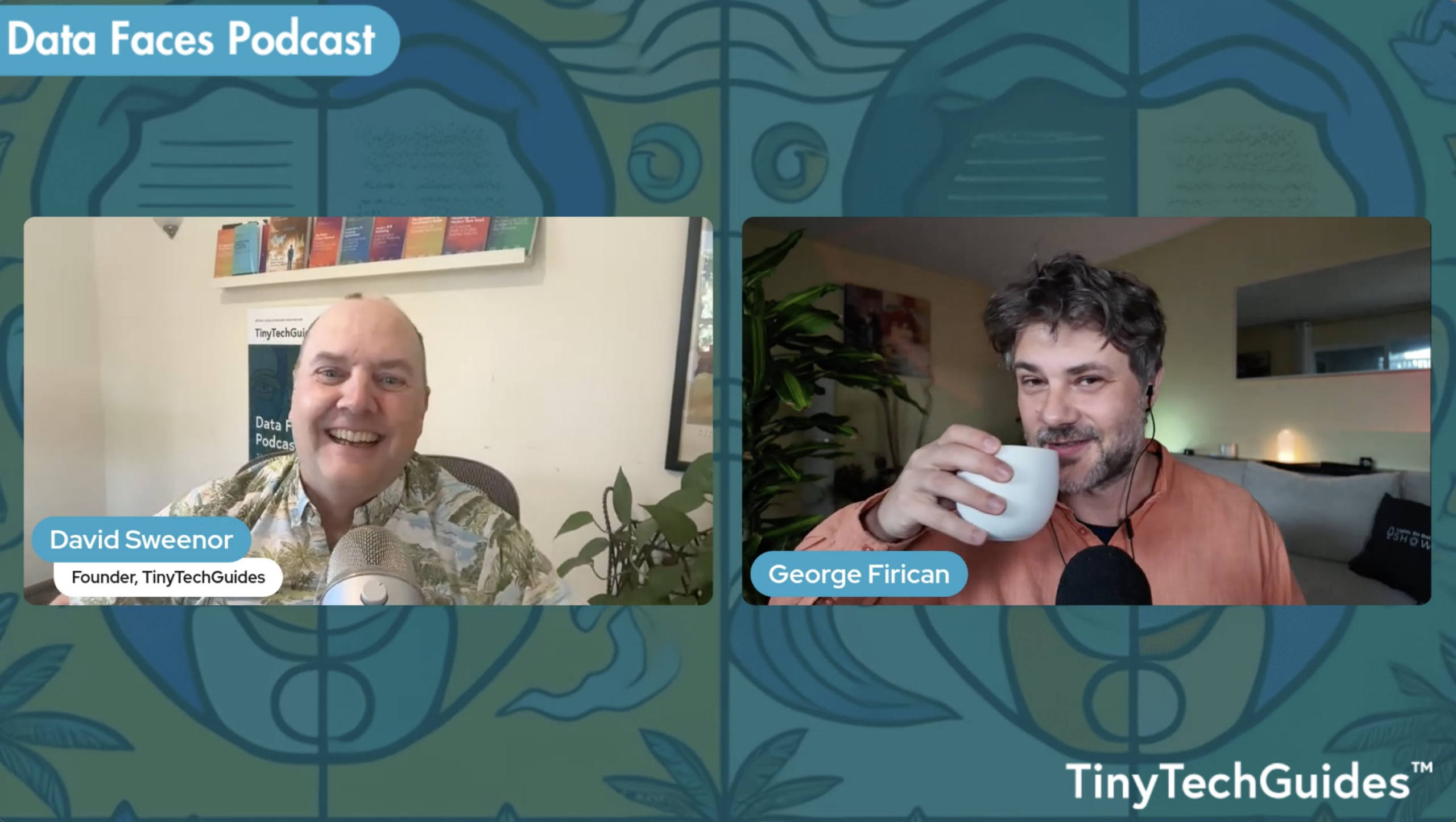
While researching this episode, I ran into a term that was new to me: governed context. I spent a stretch of my career marketing a data catalog at Alation, so I had a sneaking suspicion I'd seen this product before, and George Firican confirmed it. He heard the term everywhere at Big Data London, and to him it's "the same body of work kind of repackaged under whichever label the budget is attached to." A few years ago, that work was called a catalog for self-service analytics. Today it's context for AI agents.
George speaks from inside the work. Besides founding LightsOnData, he leads data governance, BI, and data science teams at the University of British Columbia, so, as he put it, "I kind of live with the consequences of everything that I'm about to say." He's glad AI finally got executives to pay for data governance, but he also thinks you can't AI your way out of bad governance. Our conversation kept coming back to one question: who owns AI governance when AI makes thousands of decisions an hour?
"The levels aren't really defined by how smart the car is. They're defined by who drives."
— George Firican, Founder, LightsOnData
About George Firican
George Firican is the founder of LightsOnData, where he teaches practical data governance, data quality, and data management in plain language through courses, a YouTube channel, and the LightsOnData Show. He has more than 15 years of experience running data governance, data quality, and BI programs, and he leads data governance, BI, and data science teams at the University of British Columbia. George also teaches Data Governance in Practice with O'Reilly and Pearson, and he recently launched a LinkedIn Learning course, Data Governance in the Age of AI.
In this episode, George and I discuss:
- Whether "governed context" is new work or a new label for the data catalog
- Why AI opened a budget window for data governance, and how to keep it open
- What AI can do in data governance, and the business decisions it can't make
- How the six levels of driving automation apply to AI decisions
- Who should own AI governance: the data team, legal, or the AI team
Watch the full conversation here:

Governed context and AI budgets
George says the switch from "data catalog" to "governed context" follows the vendor buzzword hype cycle every year. Vendors brief the analysts, the analysts coin new categories, and buyers write the new term into their RFPs. Malcolm Hawker calls this habit "the semantic pedantic," and on Ep 49 said that AI-ready data is the wrong question. George's guess for next year's term, since agents keep going off the rails, is "governed intent." That’s a scoop – you heard it here first!
The renaming bothers him less than you'd expect, because it elevates the importance of data and AI governance to business leaders who apply more budget to this underserved area. By the second year of generative AI, George started hearing executives ask for it: "Hey, data governance, we need data governance so that we can get AI right." He calls it a budget window, and he thinks it stays open as long as governance is funded the right way.
"If that governance umbrella is a line item inside an AI project, then that kind of dies when the AI project dies."
— George Firican
A failed AI pilot is often the best argument for governance funding because the cause is usually inconsistent definitions, data nobody owns, or data nobody can trace. Gartner predicted in early 2025 that through 2026, organizations would abandon 60 percent of AI projects that aren't supported by AI-ready data.1 George's advice is to use that AI money to build things that outlive the AI project. H-E-B's Stacie Christensen made a similar argument on Ep 54 about why data initiatives fail before technology does.
Set the autonomy level: one AI decision at a time
AI accelerates some of the drudgery involved in data governance. It can spot duplicate records and suggest matches; it's good at standardizing formats, flagging anomalies, and even drafting policies and business definitions. But George doesn't think AI can decide what's true for the business. "AI can tell you if two records kind of look to be the same person," he said, "but I feel that only the business side can decide whether they should be treated as the same person." That decision has consequences that someone has to answer for: who gets credit for a transaction, who gets an email, and whose credit score changes. A model gives you a probability, and governance supplies the accountability.
So how much should you let AI decide on its own? George borrows a framework from the automotive industry. SAE International's J3016 standard defines six levels of driving automation, from level 0 (no driving automation) to level 5 (full driving automation).2 George likes that the levels describe who drives, who monitors, and who takes over when something goes wrong, and that each level applies to the feature that's engaged.
In data governance, a specific AI decision can run autonomously even when the data platform as a whole doesn't. George's example is address standardization, which might run at level 4 and go mostly unnoticed, while merging customer records stays at level 1 or 2 because a wrong merge changes what happens to a real person. Sorting your AI decisions this way gives you a list of what you can automate, when, and with what risk, rather than one blanket policy for "the AI."
Accountability when AI makes 10,000 decisions an hour
Whenever AI governance comes up, someone says we need a human in the loop, and I've always thought the math doesn't work. If AI is going 50 miles an hour and the reviewer can only go five, the reviewer can't keep up. George agreed. "If a model makes, I don't know, 10,000 decisions in an hour and a human has to review each one, that's not really oversight, right? That's more rubber-stamping, if you will, with some extra steps there."
He'd rather ask two different questions: how much is at stake, and how much autonomy has this decision earned? The EU AI Act sets the legal minimum by sorting AI systems into risk tiers and requiring that people be able to oversee, override, or stop high-risk systems.3 But the volume problem doesn't dissipate; in fact, it’s growing every day. When a regulator asks who approved a specific output, George says the only answer at volume is that "nobody approved that specific output of itself, but a named accountable person approved the system from which the output came." When I asked about regulated industries, where the law may require a person to review each lending or medical decision, George said consequences decide whether the review becomes a click exercise. The organization treats the review as real work only when a reviewer who clicks yes without reading faces real consequences.
Air Canada learned the cost of having nobody own the system. Its website chatbot told a grieving customer he could apply for a bereavement fare after booking, contrary to the airline's policy. When the customer took Air Canada to British Columbia's Civil Resolution Tribunal, the airline suggested, in the tribunal's words, that the chatbot was "a separate legal entity that is responsible for its own actions." The tribunal disagreed in February 2024: "It should be obvious to Air Canada that it is responsible for all the information on its website."4 The tribunal awarded about $650 plus interest and fees. I'm still befuddled that the airline fought a refund that small in court. As George summarized the ruling, "You deployed it. You own it."
Who owns AI governance?
George makes the case for the data governance team first. Most AI risks start as data risks: where the training data came from, whether it's biased or accurate, and who may use it for what. Data governance already has the machinery to answer those questions, from data owners and stewards to lineage and quality rules, so organizations extend it rather than build a new function. That's why so many data governance teams are now data and AI governance teams.
But some AI risk isn't data risk. Hallucinations and prompt injection fall outside a data team's expertise, and so do the questions of what an AI agent is allowed to do and whether anyone should use AI for a given decision. Interpreting regulations, contracts, and liability belongs with legal. And most data governance teams are already under-resourced, staffed by stewards without the title, and now they're inheriting AI governance too. Orion by Gravity's Lucas Thelosen raised the same ownership question on Ep 57, predicting that agents will sprawl the way dashboards did.
"I think the data team should kind of be the engine… not the whole car."
— George Firican
George splits ownership of AI governance: the data governance team does the engine work, while the business, legal, and the AI or data science team share accountability for the rest. He also wants practitioners to know the work well enough to catch AI mistakes, so his governance courses pair AI prompts with templates. "You have to do it by hand until you can tell when the model is wrong," he said. He wants every practitioner to write a business definition from scratch and test it against an odd case, trace one critical data element end to end, and profile raw data before asking AI what's wrong with it. Leigh Felton raised a related concern on Ep 56 about what "AI think" does to critical thinking at work.
Where to start before the AI budget window closes
If AI money is funding governance at your organization right now, here are three things I'd do this quarter:
- Fund governance outside the AI project: Put data ownership, business definitions, and quality checks in a standing budget that survives any single pilot. When a pilot fails, write down whether the cause was governance, because that record makes the case for the next budget cycle.
- Assign an autonomy level to each AI decision: List the decisions AI touches, from formatting addresses to merging customer records, and decide for each one who monitors it and who takes over when it goes wrong.
- Name an accountable owner for every AI system: Pick one person who approved the system and can answer a regulator, and bring legal and the AI team into AI governance alongside the data team.
At 10,000 AI decisions an hour, nobody reviews them one by one, so governance has to exist before the decisions start. Data governance teams have long waited for executives to fund this work, and they should spend the money on something that keeps running after the pilot ends.
Listen to the full conversation with George Firican on his Data Faces Podcast episode page.
Based on insights from George Firican, Founder of LightsOnData, featured on the Data Faces Podcast.
Podcast highlights
- [0:05] David introduces George Firican and the topic: what AI is doing to data governance
- [2:17] Rewinding tapes: George's first data-entry job
- [3:57] What is governed context?
- [6:38] Why the data industry keeps inventing new terms
- [9:06] Can you have too much context?
- [10:11] AI opens a budget window for data governance
- [14:10] AI can improve data quality, but it can't define business reality
- [15:31] The human-in-the-loop math problem
- [16:08] Self-driving car levels for AI decisions
- [24:04] Who owns AI governance?
- [26:50] Are AI agents past the experimentation phase?
- [30:38] Why George's courses pair AI prompts with templates
- [31:41] Data lineage in the age of AI
- [32:51] The Air Canada chatbot case
- [34:45] Rooster
Frequently asked questions
Who owns AI governance?
AI governance usually starts as an extension of the data governance team, because most AI risks begin as data risks, such as biased, inaccurate, or improperly used training data. George Firican, founder of LightsOnData, says the data governance team should be the engine of AI governance, not the whole car. Risks like hallucinations, prompt injection, and AI agent permissions belong with the AI or data science team, while interpreting regulations, contracts, and liability belongs with legal.
What is governed context?
Governed context is a recent vendor term for the business context that AI agents use, managed with data governance. It bundles the business glossary (definitions), the data catalog (where data lives and where it came from), and the semantic layer (how metrics are calculated). George Firican of LightsOnData sees it as the same core data governance work as the data catalog era, held to a higher bar and renamed for AI agents.
How do you keep human oversight when AI makes thousands of decisions an hour?
Reviewing every AI output one at a time doesn't scale. If a model makes 10,000 decisions an hour and a person reviews each one, George Firican calls that rubber-stamping with extra steps. Instead, set an autonomy level for each type of AI decision based on what's at stake, borrowing the idea from SAE International's six levels of driving automation, and have a named accountable person approve the AI system that produces the outputs.
What can AI do in data governance, and what can't it do?
AI handles detection work in data governance well, such as spotting duplicate records and suggesting matches, and it can draft business definitions and policies. According to George Firican of LightsOnData, AI can't decide what's true for the business. It can say two customer records probably describe the same person, but only the business can decide whether to treat them that way, because the decision affects real people.
Why do AI projects fail because of data governance?
Many AI pilots fail on governance problems like inconsistent definitions, data nobody owns, and data nobody can trace. Gartner predicted in early 2025 that through 2026, organizations would abandon 60 percent of AI projects that aren't supported by AI-ready data. George Firican of LightsOnData recommends funding data ownership, definitions, and quality checks as a standing program rather than a line item inside an AI project. Hence, the work survives when a pilot ends.
About David Sweenor
David Sweenor is the founder and host of the Data Faces podcast, where he talks with the people who are making data, analytics, AI, and marketing work in the real world. He is also the founder of TinyTechGuides and a recognized top 10 AI thought leader and international speaker who specializes in practical business applications of artificial intelligence and advanced analytics.
With over 25 years of hands-on experience implementing AI and analytics solutions, David has supported organizations including Alation, Alteryx, TIBCO, SAS, IBM, Dell, and Quest. His work spans marketing leadership, analytics implementation, and specialized expertise in AI, machine learning, data science, IoT, and business intelligence. David holds several patents and consistently delivers insights that bridge technical capabilities with business value.
Books
- Artificial Intelligence: An Executive Guide to Make AI Work for Your Business
- Generative AI Business Applications: An Executive Guide with Real-Life Examples and Case Studies
- The Generative AI Practitioner's Guide: How to Apply LLM Patterns for Enterprise Applications
- The CIO's Guide to Adopting Generative AI: Five Keys to Success
- Modern B2B Marketing: A Practitioner's Guide to Marketing Excellence
- The PMM's Prompt Playbook: Mastering Generative AI for B2B Marketing Success
Follow David on Twitter @DavidSweenor and connect with him on LinkedIn.
Footnotes
Footnotes
-
Gartner. "Lack of AI-Ready Data Puts AI Projects at Risk." Gartner Newsroom, February 26, 2025. https://www.gartner.com/en/newsroom/press-releases/2025-02-26-lack-of-ai-ready-data-puts-ai-projects-at-risk ↩
-
SAE International. "J3016_202104: Taxonomy and Definitions for Terms Related to Driving Automation Systems for On-Road Motor Vehicles." SAE Mobilus, April 30, 2021. https://saemobilus.sae.org/content/j3016_202104 ↩
-
European Commission. "Article 14: Human Oversight." AI Act Service Desk, accessed October 15, 2026. https://ai-act-service-desk.ec.europa.eu/en/ai-act/article-14 ↩
-
Civil Resolution Tribunal of British Columbia. "Moffatt v. Air Canada, 2024 BCCRT 149." February 14, 2024. https://decisions.civilresolutionbc.ca/crt/crtd/en/525448/1/document.do. Summary: Lifshitz, Lisa R., and Roland Hung. "BC Tribunal Confirms Companies Remain Liable for AI Chatbot-Created Information." Torkin Manes, February 27, 2024. https://www.torkin.com/insights/publication/bc-tribunal-confirms-companies-remain-liable-for-ai-chatbot-created-information ↩
Related Posts
What it takes for AI tools to deliver business results
“Your AI is lying to you” is the wrong worldview