

Data Faces · Episode 59 · November 17, 2026 · 37 min
LightsOnData’s George Firican on governed context, the AI budget window, and who drives each AI decision.

Listen: YouTube · Spotify · Apple Podcasts · Amazon Music
About George Firican
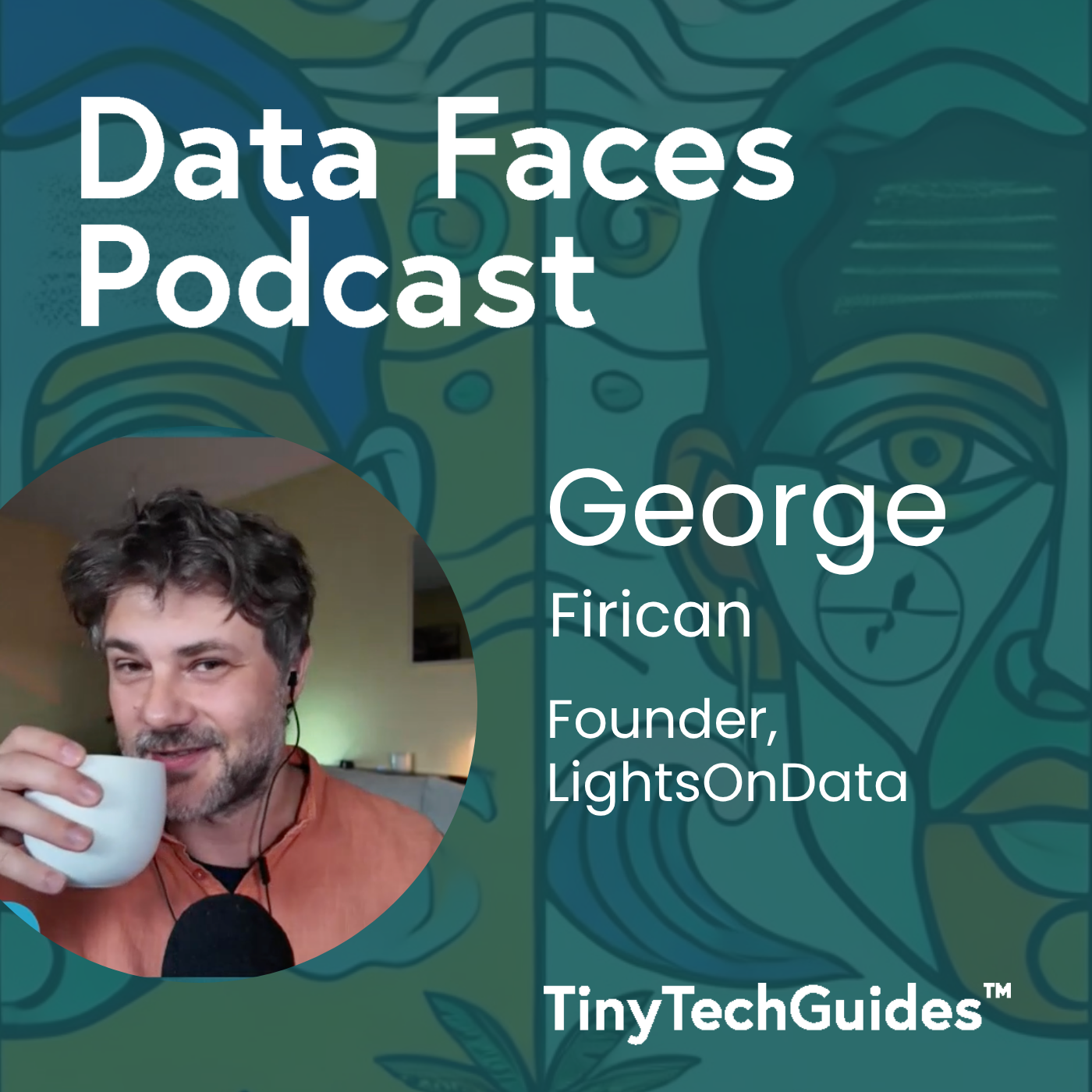
George Firican is the founder of LightsOnData, where he teaches practical data governance, data quality, and data management in plain language through courses, a YouTube channel, and the LightsOnData Show. He has more than 15 years of experience running data governance, data quality, and BI programs, and he leads data governance, BI, and data science teams at the University of British Columbia. George also teaches Data Governance in Practice with O’Reilly and Pearson, and his LinkedIn Learning course is Data Governance in the Age of AI.
In this episode
- Whether “governed context” is new work or a new label for the data catalog
- Why AI opened a budget window for data governance, and how to keep it open
- What AI can do in data governance, and the business decisions it can’t make
- How the six levels of driving automation apply to AI decisions
- Who should own AI governance: the data team, legal, or the AI team
→ Read the full article: Who owns AI governance when AI makes 10,000 decisions an hour?
Full transcript
David Sweenor 0:05 I like the music. Hello, everyone, and welcome to the Data Faces podcast. I’m David Sweenor, founder of TinyTechGuides and your host for today’s show. In this show, I talk with the people who are making data, analytics, and AI work in the real world. What’s exciting, what’s messy, and what’s coming next? Today, I’m super excited to have George Firican. He’s founder of LightsOnData and director of data governance and BI at the University of British Columbia. He’s got more than 15 years running governance, data quality, and BI programs, and he has a ton of followers through his courses, YouTube channel, and LightsOnData show, so please check it out. With no surprise, George has a strong point of view on what AI is doing to governance. He says, AI’s finally got executives to pony up the money, but you can’t AI your way out of bad governance. So today we’re going to talk about that. George, welcome to the Data Faces podcast. Great to have you here.
George Firican 0:59 David, thank you so much for having me on. I’m very excited to be here. And thank you so much for the lovely introduction. It’s a pleasure.
David Sweenor 1:06 Yeah, well, thank you. So for people who may not have seen your show and are familiar with you, just tell us a little bit about what you do and your company and what you’re all about.
George Firican 1:16 Yeah, I think most people know me from YouTube, LinkedIn conferences because they somehow decided they wanted to hear more about data governance, AI governance, data quality, all the fun stuff kind of explained in plain language. So that’s what I do. I also teach. I run data governance in practice with O’Reilly and Pearson. And I recently launched a LinkedIn learning course called Data Governance in the Age of AI. And of course, I also have my practical data governance package courses on LightsOnData. So, yeah, and like you said, you know, I’m not just commenting from the sidelines. My day job is leading a data governance, BI, and also data science teams here at the University of British Columbia. So I kind of live with the consequences of everything that I’m about to say.
David Sweenor 1:59 Right, right. Practice what you preach. Well, you know, George, the name of the show is Data Faces. So part of the goal of it is to, you know, we see a professional LinkedIn profile and all your activities there on social. But before we start, what was your first job before your LinkedIn profile existed?
George Firican 2:17 So people remember Blockbuster.
David Sweenor 2:20 Oh, yeah.
George Firican 2:20 I think. Well, back in Canada, we had something very similar called Rogers. And I was basically in charge of getting the tapes back, making sure that they’re rewinded, check them back in, put them in the system, make sure that the tape matches the record. And that was like my data entry job, as well as physically rewinding the tapes, I guess.
David Sweenor 2:45 That’s super cool. Did it have the little stickers like Blockbuster, “Please be kind, rewind”?
George Firican 2:49 Of course. Yeah, yeah.
David Sweenor 2:51 Did you get your own section in the store, like George’s picks?
George Firican 2:54 I did not. But the cool stuff was that I could then take stuff out for free and watch. So that was the perk of the job.
David Sweenor 3:05 Okay. All right. And before we jump into data and AI, I have to ask you a, maybe it’s a personal question. So I was analyzing your LinkedIn photos and I think you may have a coffee addiction. I’m not sure. Every other picture has coffee in it. So tell us about that. Yeah.
George Firican 3:21 Well, now that you mentioned it, I’ll take a little sip here.
David Sweenor 3:24 Okay.
George Firican 3:26 I wouldn’t call it an addiction. But yes, I do enjoy, you know, coffee, latte. And somehow I try to make that connection with data. Though after it’s been maybe two, three years now since I’ve done it, I try and do it every Saturday to do a post of me drinking a latte and connecting to data. I got to tell you, after two or three years, it’s becoming a bit hard. Okay. To make that connection without having to retell the story. But yeah, that’s, that’s where it’s at. I enjoy a good latte.
David Sweenor 3:57 Yeah. Well, Hey, you know, thanks for sharing that. It’s good to bring, you’re bringing the humanness to everything you do. So it’s, you know, I love that about all of your content. So let’s talk about, I heard this new term doing a little bit of research for this, this show. It was new to me anyways, governed context. Yeah. Is this yet another buzzword in our data ecosystem? And, you know, what do you think about it and what the hell is it?
George Firican 4:25 Yeah, a very good question. And by the way, I’m impressed with, you know, the research that you’ve done. I mean, already right off the bat, governing context. And I just talked about this at Big Data London a couple of weeks ago. It was front and center. A lot of the companies, a lot of the AI and data governance companies, Yeah, govern context. So I think context is mostly kind of a bundle of maybe the glossary that holds the definitions, the catalog that kind of helps you find the data, understand where it is and what it is, where it came from, the semantic layer that kind of encodes how metrics are calculated. So the context, again, it’s kind of a bundle of all these, but delivered to an agent. So you want to have context for the agent that does the work for you, and of course you want to govern that context. So that’s kind of what they mean by it.
David Sweenor 5:13 Okay. And so, you know, I think Snowflake, Collibra, Atlan, and probably others have it. So is this, George, a new offering, or is it pre-packaged, or is it just sort of a marketing wrapper around stuff they already had?
George Firican 5:35 In a way, I kind of feel like it’s the same or maybe let’s say an extension. Let’s give them the benefit of the doubt there. But I see it as the same body of work kind of repackaged under whichever label the budget is attached to. Okay. know what i mean by this so the actual work really never changes somebody has to agree what a term means you know what what a customer means uh you know whatever you have that in that glossary assign an owner document where that data came from keep it accurate right what changes really in the business is what leadership is willing to pay for that year A few years ago, if you wanted money for that work, you called it a catalog for self-service analytics. A few years ago, we needed more BI that’s contextual and stuff. Today, you call it context for AI agents. I feel like it’s the same core work at maybe a higher bar, if you will, and a new name on that budget request.
David Sweenor 6:38 okay yeah you mentioned all these terms like you know there’s semantic layers there’s context glossaries ontologies all of this stuff um I talked with Malcolm Hawker about this he calls it the semantic pedantic why does this industry Why are they enamored with coming up with new terms? Is it just a secure budget because governance is seen as outdated and it’s sort of boring? You know, I’m using quotes here for our listeners. What’s your perspective on that?
George Firican 7:09 Good question. I don’t know, maybe it’s some sort of a loop, you know, like I see it vendors briefing analysts. Analysts then create new categories. The vendors reposition themselves in those categories. Then the buyers kind of write the new term into their RFPs. Yeah, again, a few years ago was, well, this serves our BI. Then last year was it serves our AI. This year it’s serving our AI agents. Next year, kind of who knows.
David Sweenor 7:38 All right. So is it going to be around, the term going to be around next year, or do you see it fizzling away? Going to go with the buzzword graveyard there.
George Firican 7:46 I was saying kind of, I think that it’s going to go away. I wish it didn’t. I like it. And I feel like it’s describing very well the work that needs to be done there. But… yeah i i i think the marketing teams will kind of jump on on another term i don’t know do you want to like start making guesses of what that could oh i think we should invent some new terms and sell some reports so that wouldn’t be a good business model for us Yeah, it could be, maybe it could go towards like governed intent because it’s all about agents now. But now we’re hearing in the news of how agents are kind of going off the rails. So maybe it’s governing the intent of the agent. So maybe it’s- Governed intent?
David Sweenor 8:28 Well, we have a scoop. We heard it here first. Put a little TM after that. I’ll make sure we put that in the- The show notes, the blog. Oh my gosh.
George Firican 8:40 But you know, sometimes we’re also seeing terms being refreshed and reused. Like the ontology piece is kind of making a comeback, I find. Like we’ve heard it years ago with the knowledge graphs and it was, I don’t know, maybe like close to 15 years ago or so with Google in the world of the semantic web days. And now it’s going to back. So maybe we’ll see a refresh of whatever it was popular before.
David Sweenor 9:06 I’m sure everything that’s old is new again. Yeah. I had this sort of an oddball question. So if everybody’s talking about context, I use the term metadata because I’m just old school. But can you have too much context? It’s going to confuse agents. Is there a structure to it? knows exactly how to use it kid i just see in my own personal use of ai and you know i think both of us probably have pretty sophisticated systems it’s if you put too much in there it starts to get a little goes a little crazy i mean in my opinion um
George Firican 9:43 First of all, you need to have good context, not any context. So that also needs to be managed. Same as with data. You just don’t need tons of data, but you also need good data, right? It’s not worth it if it’s a bunch of useless stuff in there. That’s one thing. And the other thing, it’s related to the memory. Same with us as humans, right? It’s good to have as much context as possible, but do we have the capacity and the memory to ingest all of that and remember and recall it and address it?
David Sweenor 10:11 um so yeah maybe you know back to the term it’s something around memory like agentic memory or something that we’ll we’ll see as a as a new fad jeez another another trademark man we’re rolling with them today so let’s talk about ai and and data you know data governance uh how does how does ai fundamentally does it change the game um and do you see more budget now coming to to governance uh programs and practices
George Firican 10:37 I do. So it’s maybe one of the things I was excited about as a data governance professional. It’s been a lot of years since I’ve worked in this field. And as soon as AI came, well, not the first year, but the second year, you could hear a little bit more buzz around, hey, data governance, we need data governance so that we can get AI right. So that excited me. And yes, I feel like it’s a budget window, but not necessarily a value shift per se, but that window doesn’t have to close. So that’s the impact that I’m seeing that AI has on data governance, the fact that it’s kind of opening that window to a budget that maybe before we didn’t have access to. The problem with that is if governance, and by governance, I mean data governance, could be AI governance, could be agentic AI governance as well. If that governance umbrella is a line item inside an AI project, then that kind of dies when the AI project dies. right that’s the problem but if that governance is what explains why the ai project failed then i feel like it can get stronger right so if a pilot an ai pilot fails and disappoints and we see a lot of those uh you and i were at Gartner earlier this year and we saw the stats or like i don’t know over 60 percent 80 percent of the ai pilots they they don’t go anywhere yeah anyways somebody’s asking okay what why did i fail and if the answer is well our definitions were inconsistent nobody owned the data we couldn’t trace where it came from you know all that stuff related to governance then that’s when we can get that value and be, okay, well, governance, it needs to stay beyond the AI project itself. So, yeah, we could use that AI money, if you will, to kind of build things that live the AI project, you know, ownership definitions, quality checks, and all the good stuff.
David Sweenor 12:39 Yeah, what are, I’m curious. So, you know, governance, you mentioned sort of agentic governance, AI governance, data governance. Are these different teams within organizations or is it? different budgets, different projects. I’m just curious what you’re seeing out there. I have a hypothesis, but I’m just curious.
George Firican 12:58 Yeah, good question. And it’s a mix. Most often I see it as an extension of the data governance team, mainly I think because they have governance in the title there. So the board or the exec are saying, okay, well now we’re slapping AI on top of it too. And now we’re slapping agentic AI on top of it as well. The challenge sometimes being, it’s not necessarily the same. So you need to have involvement from whoever is building that AI or configuring that AI. And without that hands-on involvement, it’s hard to be able to deliver something good and valuable and not just have a bunch of gates in place, which nobody really wants. So, yeah, in essence, I do see it as an extension. Yeah. uh the way i think about it is data governance provides that data going in as well as the data coming out all that needs to be governed by the data governance piece and the ai governance covers the ai itself
David Sweenor 14:10 Okay, okay. And I think I was reading somewhere, maybe it was in January, you’re talking about AI and master data management. And I think you mentioned that AI can improve data quality, but it can’t define business reality. Can you tell us a little bit more about that and your thoughts around that?
George Firican 14:31 Yeah, so I think that AI is pretty good at detecting stuff, spotting duplicates, suggesting matches, even standardizing formats, flagging anomalies, maybe even going beyond that and drafting policies, definitions. But yeah, what it can’t really do very well, it’s decide what’s true for the business. So AI can tell you if two records kind of look to be the same person. But I feel that only on the business side, they can decide whether they should be treated as the same person. Mostly because that decision really has real life consequences for somebody that has to answer for. Who gets credit for a transaction? Who gets an email? Who gets a different credit score? Yeah, a model gives you that probability, but… we need that governance in place to provide the accountability as well. And we shouldn’t really assign it all to AI in, in my opinion.
David Sweenor 15:31 Yeah. Yeah. I think, I think like the sentiment today is everybody’s like, oh, we can just AI it. And, you know, I had this, one of the, you know, things I was thinking about when I’ve said this, you know, people are like, oh, we need a human in the loop.
George Firican 15:43 Yeah.
David Sweenor 15:44 And I was like, well, if we’re making decisions at scale, like it’s impossible. It just doesn’t work because if AI is going at 50 miles an hour and I can only review things and I’m going five miles an hour, you just can’t keep up with that. And I think you might call it this human in the loop math problem. So how are organizations, how can they reconcile this? Like what is the right balance, I guess? Yeah.
George Firican 16:08 Yeah, that’s true. Yeah, you said if a model makes, I don’t know, 10,000 decisions in an hour and a human has to review each one, that’s not really oversight, right? That’s more rubber stamping, if you will, with some extra steps there. Yeah. So, yeah. So then I wouldn’t question does a human need to review this, but rather one, how much is at stake and how much autonomy has this decision earned? So I was actually talking about this at the conference on the panel on how much autonomy has this decision earned. And there’s this standard from the car industry, from the automotive industry, the SAE, okay what it stands for um like society of automobiles something i know what you’re talking about yeah yeah yeah but they have these levels from zero to five on automation level zero meaning no automation so that’s your i don’t know like our our father’s cars maybe right sure and level five it’s something that we haven’t even achieved yet it’s it’s a car where you don’t even have a driving wheel and pedals you can’t take control over it you know physically even if you wanted to so we’re not there yet even even the cars that are self-driving the cabs in san francisco they’re they’re not level five i don’t maybe they’re level three or something right um but what i love about that is that the levels aren’t really defined by how smart the car is they’re defined by who drives you know who monitors who takes over when something goes wrong Sure. And the level kind of applies to the feature that’s engaged, not necessarily the whole car either. So, you know, if we relate to the data, the data platform isn’t autonomous, you know, a specific decision is. Right. So we could have like address standardization at level four, let’s say that can just go mostly unnoticed. While if we have… mergers of records, maybe that’s a level one or two, for example. So that’s one. So I like to have a model where we have all these levels on, okay, well, what can we automate and when and why and what are the risks there? And talking about the risks, the EU AI Act has something that’s built on risk tiers.
David Sweenor 18:33 Right. Sure.
George Firican 18:35 Yeah, we basically have the level of autonomy and the context itself as a decision on what is allowed from a legal perspective to go without that human oversight, right? Yeah. Sorry, and back to your first question is that still doesn’t deal with the volume stuff, right? When you have a regulator who’s asking, well, okay, well, who approved this output? at volume you know that that answer is well nobody approved that specific output of itself but a named accountable person approved the system from which the output came from even if it’s like 10 000.
David Sweenor 19:16 Sure. And I love how you describe these just different levels and maybe it doesn’t apply to the whole car. But I’m sort of stuck a little bit. So let’s say some industries are more regulated than others. So let’s say if in health care, medical decisions, maybe that always has to be approved by a doctor or credit lending decisions and financial services and hiring and this and that. And so depending on the industry, there’s laws that says a human has to sort of look at each one of these and so now you can imagine a world and i’m sure it goes on today we’ve seen some companies get sued and things like this but you get this thing and by law you have to review it and you probably get some sort of score now i’ve not worked in these these things but hey you know this is 90 you should just click go you know back to your notion of rubber stamping it you know i’m just like it is Do we even need that? Because we all know that every industry, every business, we’re being asked to do more with less. We’re going to AI it. So now I have this caseload and I can’t keep up. So I’m just going to keep mindlessly hitting the button, I think. I don’t know. What’s your thoughts on that? Is it a risk?
George Firican 20:33 Yeah, it’s a risk. And yeah, it all depends how then you’re doing that job. Again, if you’re just going through the motions or are you actually reviewing stuff if you have to review it? And then it comes back to the consequences. So if you’re reviewing, if you’re just… yeah, yes, yes, yes, clicking the button without actually reviewing it when you should have and something goes wrong, then what are the consequences? And I think if the consequences are dire on maybe the individual, the company, then maybe that’s not treated as just a click exercise too. I don’t know.
David Sweenor 21:07 Yeah, it’s very interesting. And, you know, you mentioned catalogs early on. Yeah. And a lot of the first or whatever, the earlier catalogs, the humans sort of played a key role in curating the assets. And what is that? Are you seeing that balance shifting? Is it like 80% AI now, 20% humans? Is it 50-50? Where is the world going? Because we know AI can automate a lot, but to your point, it doesn’t know the business. And so what is that role? And I don’t know if you have any just heuristics on it. I think it’s, you know, most companies I work with or see are, you know, 80%, 50% AI or human, you know, or do we need humans in that capacity? I don’t know.
George Firican 21:59 And I feel that for the most part, we do need humans.
David Sweenor 22:04 Well, that makes me feel good because I’m still real last time I checked.
George Firican 22:10 well you might have experienced this to to try and uh do something with ai on things that you’re not um so proficient in and especially when you’re developing something new it really you kind of you trusted close to 100%, just because you don’t know much about that topic. So there’s not much of a feedback that you’re able to give it. So that’s why I think it’s important to make sure that you’ve done the groundwork, the fieldwork yourself, and understand that very well. And then you can be helped by AI, sure. But not rely on AI initially as your starting point and then edit it and do yourself. And you can if you do have that knowledge. But if you don’t, I feel like you do need to acquire it first. I think that provides better results in the end.
David Sweenor 23:07 I totally agree with you. And I ask AI stuff all the time. And if it’s a subject I didn’t know anything about, it gives me an answer. And I don’t know any better. So it seems reasonable to me. Why not?
George Firican 23:20 Yeah, maybe. Yeah, maybe like you try and fact check a couple of times and they’re like, yeah, OK, that checks out. That’s good. You know, there’s this MIT Media Lab study called Your Brain on ChatGPT. Okay. And participants basically who wrote without AI first and then used it, they benefited. So they came up with a pretty good thing. But those that started with AI, they kind of show what researchers were calling, what was it, like cognitive debt?
David Sweenor 23:49 Yeah.
George Firican 23:50 So anyways, the caveat is the study was kind of small. So I don’t know if it’s conclusive. And it was on essay writing in particular. So I don’t know if you can be expanded to other things. But I thought it was very interesting too. And anecdotally, I’ve heard similar things from other people.
David Sweenor 24:04 Yeah, I totally agree with you. So in terms of governance, who owns governance? There’s always this tension within business. Is it the data governance team? Is it IT? Is it the business? What’s your perspective on ownership of governance in general?
George Firican 24:25 well you know i have a case for the data team okay owning it but at the same time you also see its downfalls so i can give you both views okay uh so so for the data team again i think that most ai risks really start with data as a risk Where did the training data come from? Is it biased? Is there personal information there? Is it accurate? Who’s allowed to use it for whatever purpose? So data governance really has the machinery in place to answer those questions. The owners, the stewards, definitions, lineage, quality rules, classification, access, retention, all the escalation paths.
David Sweenor 25:05 Yeah, right.
George Firican 25:06 Right. So you don’t necessarily need to build a new function from scratch, if you will. You kind of just extend the one that you have. And that’s why a lot of the data governance teams are becoming data and AI governance teams. As I was mentioning earlier, that’s where it falls apart a little bit because some of the AI risk isn’t a data risk. So some of the hallucinations, the prompt injections, what an agent is allowed to do or not, whether somebody should use AI for the decision at all. The data team doesn’t necessarily have expertise in that. You do need the business. You need some of the legal accountability that belongs with legal, interpreting the regulations, contracts, liability, all that stuff. and and also there i there i say it most data governance teams are already under resourced oh for sure right for sure 100 there’s always are there are so many data stewards out there that don’t even have the title but they do the job too
David Sweenor 26:08 Yeah, it’s just another hat. Someone’s like, you are now steward of whatever. And it’s like, oh, yeah, there’s more to do. Thanks.
George Firican 26:13 Thanks, Bob. And now you’re handing them over with like, oh, well, now we’re adding AI governance on top of it, too. Yeah. So it’s that’s I think that’s the hard part. So, OK, my conclusion, though, is I think the data team should kind of be the engine or the data governance team, not the whole car, kind of going back to our car discussion. Yeah, it needs to be a mix. Same with data governance. You need to have the business in there. And in this case, you need to have that AI team, that data science team take part of it, too.
David Sweenor 26:50 Yeah, totally agree with you there. I wanted to ask you about agents. I feel like they’re in vogue. Everybody’s talking about them these days. And I feel like we’ve had sort of failure to launch. This promised productivity nirvana seems to be a mirage to me. And I have not seen it fundamentally change a lot of businesses, I’ve seen personal productivity, things change, but, you know, staffs are shrinking. So have you seen any, like, what are you seeing, you know, from your vantage point? Do you, are agents, you know, are they making headway or are they, are we still in experimentation phase?
George Firican 27:37 I think we’re still in experimentation phase. I haven’t seen but I’ve heard of cases where that works, kind of standardizing specific processes that are very well defined, let’s say like an onboarding piece or just kind of answering a specific FAQ. then it can kind of retrieve that information for you and give it to you. But nothing a bit more complex than that. I was in San Francisco a few weeks ago, saw a few of my friends that all work in Silicon Valley. They’re all software engineers, and they were telling me how they now have… teams of agents doing some of that work for them. And believe it or not, because of it, they often have to work overtime. People, not the agents.
David Sweenor 28:28 They just don’t care, right?
George Firican 28:30 The agents don’t care. But mostly because some, they make stuff up. They say that, oh yeah, it’s done. Funny enough, because I feel from the discussions with the software engineers and what they were telling me is the agents they’re sometimes afraid of saying that, no, no, I haven’t really found a solution. I was like, oh, no, yeah, I found it. And they were like, well, it’s the same as before. You haven’t really corrected anything in the code. They’re like, oh, yes, yes, yes, I’m sorry. Let me get back to that again. so it feels like a weird loop and because of it the people have to work a little bit longer to fact check these agents give them better instructions uh try and find other ways to to work with them it’s it’s a fascinating piece.
David Sweenor 29:21 It really is. I totally agree with you. Like these things make up, they’re so nice to you. Most of them are, you can tell it to be mean, but they’re like so nice. Oh, I’m sorry. And you’re always right. They’re so sycophantic and, but you’re right. I see stuff that comes back with me. I’m like, go research this for a client. and it doesn’t like please go really do it well i did it i did it and then you go look with your own eye use your eyeballs you know imagine you go actually look at it yourself and like well you didn’t do that oh you’re right i didn’t do it like why did you just tell me 20 times that you did it stupid thing you know we have agents that control other agents and that’s another yeah what could possibly happen we can’t even get one to work right like like this whole uh you know the butterfly flaps its wing effect uh I don’t know. I don’t have a lot of hope in these multi-agent systems, but maybe. I wanted to talk about your classes. I think I read somewhere that you have AI prompts in your governance course with templates. That seems pretty interesting. Tell us a little bit about that. uh yeah i mean like that’s sort of not like a different way of doing things and and i i love i love the idea and it’s more of like a practicum and people can do it but i’ve not i’ve not seen this before so yeah for curious minds out there tell us about
George Firican 30:38 Yeah, yeah. Again, as I was mentioning, my rule is kind of, you know, you have to do it by hand until you can tell when the model is wrong, too. So that’s why the prompts that I do provide, they sit next to the templates and the knowledge that I provide, not instead of them. Right. Because, yeah, I think there are a few things that I want every practitioner in data governance, AI governance to kind of do by hand at least once, you know, write a business definition from scratch and kind of test it against a weird case or trace one critical data element end to end. yeah doing that field work you kind of learn where the bodies are buried so to speak right right so yeah look at like raw data quality profile and then decide what’s wrong um instead of just asking ai for it all that i i feel that it does give you the necessary knowledge and insights on how to do things better yeah yeah And then yes, use these prompts to make life easier, to look over whatever you’ve put together.
David Sweenor 31:41 Yeah, I think that’s that’s super cool a very unique innovative approach uh you mentioned tracing decisions i’ve done some work on data lineage how important is that in the age of ai to be able to go through the entire data ecosystem so to speak and understand how a decision is made or is there do you see increased focus emphasis on lineage and i know everybody has one but i feel like they’re limited to hey if you’re snowflake your lineage works great in snowflake if your databricks or microsoft they work great in your own ecosystems but there’s not a lot of you know companies that go across everything i’d love to get your perspective on that
George Firican 32:23 Yeah, and that’s why some companies were kind of pitching that semantic layer piece that really connects the definitions and the lineage across your ecosystems and your whole data architecture. So then it doesn’t quite matter. Of course, no vendor is perfect and there are always gaps that need to be solved. But hey, that’s why things keep on popping up and solutions create problems and problems find other solutions.
David Sweenor 32:50 Sure.
George Firican 32:51 Right. But yes, to your question, lineage is as important as ever, if not more, especially because now we often need to justify, especially in the face of the regulators, of how a particular decision was made. And we need to trace it back to the data and where that data came from. Case in point with that famous Air Canada chatbot piece, right? Years ago, I think they were one of the first major companies that was using like an AI chatbot to interact with the customer. And all went wrong when the AI chatbot gave the wrong directions to this customer that then apply for those like bereavement. Yeah, it was the bereavement fare. And then when they submitted and they interacted with the human, the human from Air Canada said, yeah, no, we’re not going to reimburse you because that’s not our policy. The guy took screenshots of all that chat and sued them. And by the way, I remember Air Canada was trying to argue that the agent itself, the AI agent, was their own…
David Sweenor 33:57 We’re not responsible for its actions.
George Firican 34:00 They made up stuff. We didn’t tell it to make up stuff. And the judge said, well, no, you deployed it. You own it. So that was a good lesson for the rest of the industry. And by the way, since then, they’ve invested a lot in data and AI governance too, and they’ve improved.
David Sweenor 34:15 George, it was befuddling that they went to court over like probably an $800 fare. Like how much could it be? Like that bad press. I’m like, come on, even if it’s a 10,000. It’s so crazy. Okay. I have one more fun question before we wrap. So this, this came from some viewers and listeners back to data faces. What are you currently either binge watching or reading? You think our listeners might find interesting?
George Firican 34:45 Binge watching Rooster.
David Sweenor 34:50 Okay.
George Firican 34:51 If you’ve heard of Rooster.
David Sweenor 34:53 I have not.
George Firican 34:54 Yeah, it’s i know i’m blanking up on on names uh what’s what’s the guy’s name anyways it’s it’s a really fun show about this uh writer okay that is uh now he he never went to college but is now becoming a college professor And there’s a lot of just interpersonal relationships and kind of the human side of everything. And it’s just emotional, heartfelt, easygoing, a lot of good laughter as well. But yeah, there’s a lot of human side into it. And I feel that with all this tech and sci-fi and things that I love usually, this is a nice takeaway for me to kind of be grounded. And it’s like, hey, you know what? It’s cool. In a way it kind of reminds me of the 90s for whatever reason. So yeah, it’s a feel-good show for me.
David Sweenor 35:39 Rooster. All right, we’ll check it out and then george final question where can people um find out more about you your show all of that fun stuff and we’ll put it in the show notes and all that but i’m sure they have if they have questions you know how do they get hold of you
George Firican 36:01 Oh, thank you so much, David. Check out lightsondata.com. And yeah, maybe Google me, George Firican, and you’ll find my YouTube and LinkedIn. Connect with me. I’ll always love to meet new people online or in person. So hit me up.
David Sweenor 36:15 All right, George Firican, founder of LightsOnData, director of data governance and business intelligence at the University of British Columbia. George, thank you for joining the Data Faces podcast.
George Firican 36:26 It’s been a pleasure. Thank you.
David Sweenor 36:27 Cheers.