Huwise's Franck Carassus on why business users (and AI agents) have outgrown the data catalog
Listen now on YouTube | Spotify | Apple Podcasts | Amazon Music
▶ Watch the full episode and read the transcript: Franck Carassus on the Data Faces Podcast
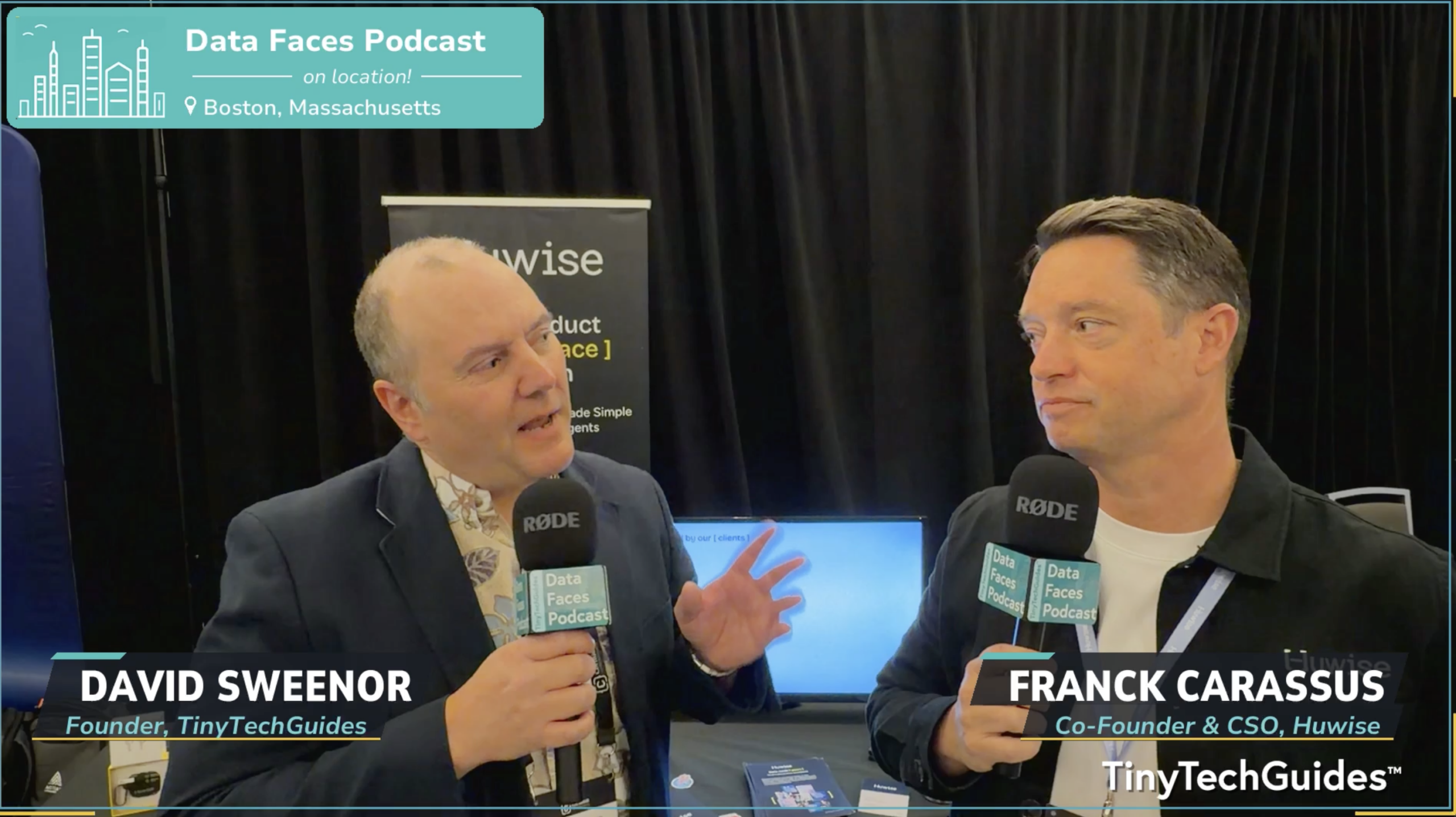
At CDAO Fall in Boston, I sat down with Franck Carassus, Co-Founder & CSO of Huwise, to talk about why the data catalog most organizations built is still not helping the business find a trustworthy number.
"A data catalog is a good thing when you want to find some information. Imagine a library — knowing where the book is, that Victor Hugo wrote it, how many pages. That's interesting. But as a business user, I want to read the book. That's where a data marketplace comes in."
— Franck Carassus, Co-Founder & CSO, Huwise
Everything about how Huwise builds for the 80 percent of non-technical users, and for the AI agents now sitting alongside them, grows from that one distinction.
About Franck Carassus
Franck Carassus is Co-Founder & CSO of Huwise, a data marketplace platform that helps non-technical business users find, access, and consume certified data products. Connect with Franck on LinkedIn.
In this episode, Franck and I discuss:
- The library-vs-marketplace distinction and who the platform serves
- Certified data products and why they matter more now that agentic AI is in the loop
- The living-context layer that turns usage into a trust signal
- One customer who retired 300-plus dashboards and saved over $10 million
- How to start without a six-month program plan
Watch the full conversation:
The catalog did its job. That is the problem.
Catalogs were built to answer a specific question: where does this data live, who owns it, and what does the column mean? Data engineers spent half their day hunting for the right table, and a catalog fixed it. Then finance analysts, marketing managers, and regional sales leads showed up asking the same question, none of whom had written a SQL query. The catalog told them where the book was but did not help them read it.
"A data marketplace is a way to enable users to find, access, and consume data, not only metadata. The philosophy is more e-commerce. As an organization, you are showcasing data products — a few dozen or hundreds, versus thousands — and you let business users discover, search, and access the products."
— Franck Carassus
For anyone who's used enterprise BI systems, you'll recognize a familiar scene. A VP asks for Q3 revenue by product and three reports came back, all technically correct and none agreed. This leads to elongated arguments about how the metrics are calculated, whose report is correct, and why they don't match – week after week. This infighting disappears when somebody owns a trusted version of the metric the business consumed. Franck calls that owned version a certified data product.
Why certified matters more now
"Usually less is more," Franck told me. "It's better to have 20 data products than thousands. And it's even more important with AI, because if you plug an agentic AI into this with no human in the loop, the AI will act on the data."
A human staring at a questionable number can push back. An agent will not — it books the appointment and recuts the forecast over the weekend before anyone checks the number underneath.
Gartner forecasts more than 40 percent of agentic AI projects will be canceled by the end of 2027, with inadequate risk controls among the top drivers.1 The pilots that survive give their agents something trustworthy to act on. A certified data product has an owner, defined metrics, and an SLA, with access controls attached. The one hundred dashboards can stay — the agent is not pointed at those.
Living context: usage as a trust signal
Most catalogs die of neglected adoption. Ten or twenty power users log in, and the rest of the organization never does. A marketplace captures who is using which data product, then surfaces that usage back to the next user.
"If you know the finance department is an avid user of this data product, it's very interesting — they are usually on the metrics. As another user, maybe you can trust them because they are using this product. If you know your CFO is using this data product, you will probably use the same to be sure you are fully aligned."
— Franck Carassus
Amazon learns what you buy and recommends what similar customers bought. A marketplace does the same with certified data products. An agent that sees a product used weekly by the CFO's team, with a certified owner, has a better basis to act than one looking at a raw table.
The 20/80 split your catalog never served
Franck returned to a single split throughout the conversation.
"In any organization, you have 20 percent of people who are data savvy, SQL ninjas. They can do many things. We serve the other 80 percent. They are frustrated, and if they are not execs, they cannot send an email to the CEO asking for a dashboard and have it in half an hour."
— Franck Carassus
Most enterprise data platforms pitch themselves as serving the whole business, then end up serving the data-savvy 20 percent because the tools assume query skills nobody outside IT has. A marketplace is designed for the 80 percent in. One Huwise customer in the US retired 300 Power BI dashboards after moving to certified data products, and the math came to over $10 million saved. A Forrester TEI on Huwise reports a composite 474 percent ROI and 50 percent less search time.2
Two personas now: humans and agents
The marketplace has to serve two audiences now, and the second one acts without a human in the loop. Franck put the distinction plainly:
"We have two personas now. Humans need an interesting look and feel. Agents don't care about UI or UX, but they do care about context, quality, and trust."
— Franck Carassus
A platform built for humans alone cannot serve agents, and one built for agents alone abandons the 80 percent of humans the marketplace exists for. Both need the same shared definitions of revenue, customer, and pipeline. On Episode 58 with Simba's Christopher Chen, Chris called that shared-definition layer a semantic layer. A data marketplace is one practical form of it.
Start small, but start something
I asked Franck what a data leader should do on Monday morning, staring at a sprawling data estate.
"Start small, but start something. Pick a pain. Maybe the pain is the finance department where they need to find information on revenue. Build a few dozen certified data products. See the usage. Iterate."
— Franck Carassus
Three concrete moves translate that into something you can run this quarter.
- Pick one impactful, yet painful domain (not the entire business). Finance, sales, or customer success — the team where the "where do I find the number" ticket has been open for two years. Scope the first release to that domain's twenty most important questions.
- Certify fewer data products than feels reasonable. Fifteen is a defensible first release. Each one needs an owner, a definition, and an SLA; access rules travel with it. The marketplace earns trust because the set is small enough to defend.
- Capture usage from day one. Record who is using each certified product and surface that signal to the next user. Hesitant users adopt once they see the CFO's team opens this product weekly, and that signal is only there if you collected it from the first query.
None of those moves requires the full catalog rework most governance programs reach for first. They do require someone owning the metric definitions and the access rules. The marketplace is where that ownership becomes visible to the business and to the agents acting on the numbers next quarter.
Listen to the full conversation with Franck Carassus on his Data Faces Podcast episode page.
Based on insights from Franck Carassus, Co-Founder & CSO of Huwise, featured on the Data Faces Podcast.
Learn more:
- Visit Huwise to see the data marketplace platform
- Read the Forrester Total Economic Impact study on Huwise (474% ROI, 50% search time reduction)
- Connect with Franck on LinkedIn
Podcast highlights
- [1:24] The library-vs-marketplace analogy
- [3:45] Certified data products for AI
- [5:10] The living-context layer
- [7:51] 300 dashboards retired, $10 million saved
- [8:56] Where to start: pick a painful domain
- [10:16] The 20/80 split
- [11:46] Humans and AI agents as two personas
Frequently asked questions
What is a data marketplace, and how does it differ from a data catalog?
A data marketplace is a platform where business users find, access, and consume certified data products with a self-service, e-commerce-style experience. A catalog documents where data lives, who owns it, and what each column means — it serves the roughly 20 percent of data-literate users. A marketplace delivers the data itself to the other 80 percent and to the AI agents acting alongside them, and it surfaces usage signals so a new user sees which products the finance team or the CFO already trusts.
Why do certified data products matter for AI?
Agentic AI acts on data without a human in the loop, raising the stakes on quality and governance. A certified data product carries defined metrics, an owner, and an SLA, giving an agent a trustworthy foundation to act on. Gartner forecasts more than 40 percent of agentic AI projects will be canceled by the end of 2027, with inadequate risk controls among the top drivers.1
How many data products should an organization start with?
Fewer than feels reasonable — 15 to 40 certified products is a defensible first release. Each needs an owner, a definition, an SLA, and access rules. A smaller certified set builds trust faster than a sprawling catalog.
What results have organizations seen?
One Huwise customer retired 300 Power BI dashboards and saved over $10 million. A Forrester TEI on Huwise reports 474 percent ROI and 50 percent less search time.2
Where should a data leader start?
Pick one painful domain — finance or sales, where the "where is the number" ticket is already open. Build a short list of certified products and let adoption prove the model before expanding.
Footnotes
Footnotes
-
Gartner. "Gartner Predicts Over 40% of Agentic AI Projects Will Be Canceled by End of 2027." Gartner Press Release, June 25, 2025. https://www.gartner.com/en/newsroom/press-releases/2025-06-25-gartner-predicts-over-40-percent-of-agentic-ai-projects-will-be-canceled-by-end-of-2027. ↩ ↩2
-
Forrester Research. "The Total Economic Impact of Huwise." Commissioned study, 2025. https://www.huwise.com/en/forrester-tei-study/?utm_source=tinytechguides&utm_medium=blog&utm_campaign=cdao&utm_content=footnote-forrester-tei. ↩ ↩2
Related Posts

Context engineering for marketing isn’t what vendors are selling you
Who owns AI governance when AI makes 10,000 decisions an hour?