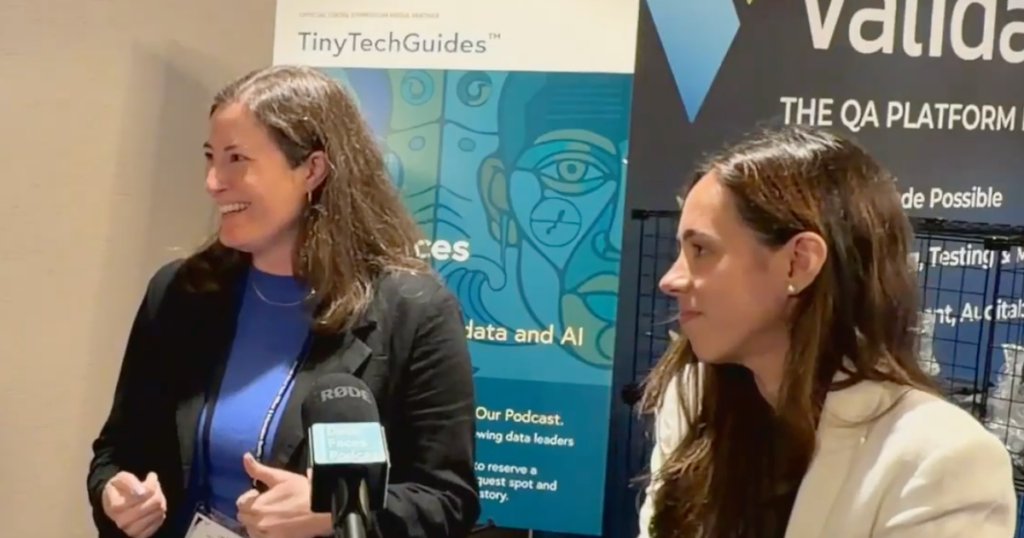
Adesso Associates’ Gina von Esmarch reveals how teaching AI your context beats generic automation
Listen now on YouTube | Spotify | Apple Podcasts | Amazon Music
▶ Watch the full episode and read the transcript: Why your AI sounds generic (and the three-step fix)

Last week, three different B2B companies showed me their AI-generated customer personas. I couldn’t tell which belonged to which company. Neither could they.
This is the hidden cost of AI trained on “the world’s internet”—it produces modal outcomes, smoothing away the specific details that make your organization different. Your market analysis becomes technically correct but strategically useless, indistinguishable from your competitors’.
There’s a bronze plaque in San Francisco’s Little Italy with a barcode on the corner. Scan it, and a century-old immigrant story comes alive through audio—the person’s own voice layered onto permanent bronze. The plaque remains primary; technology amplifies rather than replaces. This is precisely how data leaders should think about AI deployment: preserving what makes you unique while using technology to make it more powerful.
About Gina von Esmarch
Gina von Esmarch is the founder and CEO of Adesso Associates, where she focuses on the intersection between culture and technology. With over 25 years of experience, she has pioneered approaches that preserve specificity at scale—from America’s Cup innovations still in use today to heritage preservation projects that bridge the analog and digital worlds. Her core insight: AI excels when taught to think in YOUR context, not everyone’s.

The averaging trap and why it matters now
When AI is trained on massive datasets from across the internet, it learns patterns that apply broadly but not specifically to individual cases. Data science leaders now face a real risk of deploying tools that erase what makes their organization different.
Consider how your company describes its values and tone of voice. You’ve spent years developing a unique approach to communicating with customers, incorporating specific terminology that resonates with your target market, and accumulating institutional knowledge about what truly matters to your users. But when you ask AI to generate content or analyze patterns, it defaults to the generic middle. Your company’s hard-won perspective gets smoothed into industry-standard language that could belong to anyone.
Gina von Esmarch has spent her career protecting this kind of specificity. She helps organizations preserve their unique voices while adopting new technology. “I think it’s sometimes a misconception that tech is the future and things that are of cultural relevance can be looked at as the past, one’s fast, one’s slower moving,” she explains. “And in fact, that’s one of the intersections that I really like to stop and look at, because I think they both evolve in tandem.”
Every organization has what Gina calls culture. In business, we recognize it as the accumulated knowledge about how things actually work here, not how they work in theory. The stories your sales team tells, the way your product team thinks about problems, and the specific language your customers use. Your AI deployment should amplify these unique elements, not erase them.
I think it’s sometimes a misconception that tech is the future and things that are of cultural relevance can be looked at as the past, one’s fast, one’s slower moving. And in fact…they both evolve in tandem.
— Gina von Esmarch, Founder & CEO, Adesso Associates
The Little Italy proof of concept
The San Francisco Little Italy Honor Walk recognizes notable individuals of Italian American heritage who have made significant contributions to the city. After vetting historical figures, from baseball legend Joe DiMaggio to Dr. Mariana Bertola, the organization creates bronze plaques that are installed in North Beach.
On one corner of each plaque, there’s a barcode.
“These plaques have a barcode, and that barcode was sort of future-built,” Gina explains. “You can scan this, you can get even more detail than what you’re reading on the plaque. And then from there, you could potentially hear stories of an individual in their own voice or in some of their words in their memoirs.”
You have the opportunity to use technology to amplify, preserve, and in no way dilute what that experience is…getting them to engage and have that technology reflect their identity as a brand or an organization—that’s a win. — Gina von Esmarch, Founder & CEO, Adesso Associates
The organization didn’t replace the bronze with a digital display. The plaque remains the primary experience. The technology creates an invitation to go deeper. In your data organization, this means building AI tools that make your domain experts’ knowledge more accessible, not replacing those experts with generic outputs. Your institutional knowledge is the bronze. AI is the barcode that amplifies it.
Even the plaque text itself was refined using AI to hit precise word counts. But AI didn’t write the stories or decide what mattered. Those decisions stayed with people who understood the cultural context. “You have the opportunity to use technology to amplify, preserve, and in no way dilute what that experience is,” Gina says. The result? “Getting them to engage and have that technology reflect their identity as a brand or an organization—that’s a win.”
Why cognitive collision enables specificity
Solutions like “put a barcode on bronze” don’t emerge from teams where everyone thinks the same way. They require a collision between different perspectives. Someone who understands heritage preservation meets someone who understands engagement technology. That cognitive collision isn’t optional in AI deployment. It’s the mechanism that prevents your outputs from becoming generic.
Gina’s been that outside perspective multiple times, most dramatically in the America’s Cup. “I was never a sailor. I was in the world of trying to make the complicated consumable to a broader public,” she recalls. When she asked why they hired someone without a sailing background, the answer was direct: “You saw things differently. You were going to do things differently. Maybe some of those things weren’t going to work, but they were certainly going to be interesting to try.”
You saw things differently. You were going to do things differently. Maybe some of those things weren’t going to work, but they were certainly going to be interesting to try. — Gina von Esmarch, Founder & CEO, Adesso Associates
The work she brought from the tech world was “quite disruptive for that world” at the time. The innovations she introduced are “still in existence today, and that’s 25 plus years later.” But achieving this meant accepting discomfort. “That diversity of thought didn’t give me a lot of allies in the room, necessarily.”
When your AI deployment feels frictionless and everyone agrees immediately, you might be building toward generic outcomes. Is anyone from customer success challenging your data team’s assumptions? Is the product pointing out that your categories don’t match how customers think? That friction creates specificity.
Training AI to think in YOUR context, not everyone’s
“You can guide it and train it and teach it to think similarly,” Gina says about working with AI. Your goal isn’t to program it or constrain it, but rather, to teach it.
That verb choice matters. Teaching implies relationship, iteration, and the transmission of specific knowledge that can’t be downloaded in a single prompt.
In practice, this means feeding AI your actual customer transcripts, rather than letting it generate them from its training data. It means using AI to create variations of YOUR product messaging, then having domain experts identify which versions sound authentic. As Gina discovered with the bronze plaques, AI excels at refinement and condensation when given specific source material. But someone who knows the context must guide what matters.
You can guide it and train it and teach it to think similarly, so that when you start your process, you’ve already shortcutted a lot of the things that might have taken you longer. It can propel you. It can propel your team. — Gina von Esmarch, Founder & CEO, Adesso Associates
“If you’re prudent and include culture, however that interprets in your business, you’ll definitely have that different perspective,” Gina warns. Have someone from outside your data team review AI outputs before they ship. Product managers and customer success teams will immediately spot generic outputs because they live in the specificity every day.
The alternative? Generic outputs that could belong to any company. “Common queries will not be generated,” the AI itself admits when prompts lack specificity.
Start with one particular thing
Gina’s advice for getting started is pragmatic. Don’t try to solve AI deployment across the entire enterprise. Start with one project where specificity matters, where a generic output would be obviously wrong to anyone who knows your business.
Years ago, when consulting on social media strategy, Gina tested her own advice in a completely different domain. She wrote a cookbook as a proving ground. “I had been consulting on how to grow your social footprint. And in fact, I thought, well, this is an opportunity for me to actually try out and see if everything that I’ve done and told my clients about in fact works.” The result? “I’m relieved to say it did. It did work. It was a good model.”
For data teams, your proving ground might be generating customer health scores that account for your unique product usage patterns, rather than relying on industry-standard metrics. Or creating market research summaries that preserve outlier insights instead of smoothing them into trends. Or building internal documentation that uses your team’s actual terminology, not generic tech company language.
Pick the project where failure would be obvious and fast. A bad customer health score reveals itself when an account churns unexpectedly next week. Generic documentation reveals itself slowly through a lack of adoption. Optimize for fast feedback loops.
Technology can be a way for you to really explore more, do more, and find that it can tie and bring new ideas into your world you might not have thought before—not because it’s going to give that all to you, but because you can guide it. — Gina von Esmarch, Founder & CEO, Adesso Associates
Give your first project at least a quarter. Teaching AI to think in your context requires iteration. Success looks like outputs that make your domain experts say, “yes, but here’s what it’s missing,” not “this could be about anyone.” That response means you’re preserving specificity, even if imperfectly.
The Little Italy plaques are permanent bronze. Your AI outputs might be more permanent than you think. Once they shape strategic decisions or are embedded in team thinking, they’re hard to undo. Treat prompt development like code review. Nothing AI-generated ships without someone who knows your context verifying it sounds like you, not like everyone else.
Listen to the full conversation with Gina von Esmarch on the Data Faces Podcast.
Based on insights from Gina von Esmarch, Founder and CEO at Adesso Associates, featured on the Data Faces Podcast.
Podcast Highlights – Key Takeaways from the Conversation
Technology and culture evolve in tandem, not in competition
[00:03:24] “I think it’s sometimes a misconception that tech is the future and things that are of cultural relevance can be looked at as the past, one’s fast, one’s slower moving. And in fact…they both evolve in tandem.”
Diverse thinking creates lasting innovation, even when it’s uncomfortable
[00:05:31] “You saw things differently. You were going to do things differently. Maybe some of those things weren’t going to work, but they were certainly going to be interesting to try.”
Testing strategies in the proving grounds validate consulting advice
[00:11:35] “I had been consulting on how to grow your social footprint. And in fact, I thought, well, this is an opportunity for me to actually try out and see if everything that I’ve done and told my clients about in fact works.”
About David Sweenor
David Sweenor is an expert in AI, generative AI, and product marketing. He brings this expertise to the forefront as the founder of TinyTechGuides and host of the Data Faces podcast. A recognized top 25 analytics thought leader and international speaker, David specializes in practical business applications of artificial intelligence and advanced analytics.
Books
- Artificial Intelligence: An Executive Guide to Make AI Work for Your Business
- Generative AI Business Applications: An Executive Guide with Real-Life Examples and Case Studies
- The Generative AI Practitioner’s Guide: How to Apply LLM Patterns for Enterprise Applications
- The CIO’s Guide to Adopting Generative AI: Five Keys to Success
- Modern B2B Marketing: A Practitioner’s Guide to Marketing Excellence
- The PMM’s Prompt Playbook: Mastering Generative AI for B2B Marketing Success
With over 25 years of hands-on experience implementing AI and analytics solutions, David has supported organizations including Alation, Alteryx, TIBCO, SAS, IBM, Dell, and Quest. His work spans marketing leadership, analytics implementation, and specialized expertise in AI, machine learning, data science, IoT, and business intelligence.
David holds several patents and consistently delivers insights that bridge technical capabilities with business value.Follow David on Twitter @DavidSweenor and connect with him on LinkedIn.
Related Posts
Data quality is everybody’s job when the alert means 140 million people

AI-ready data is the wrong question