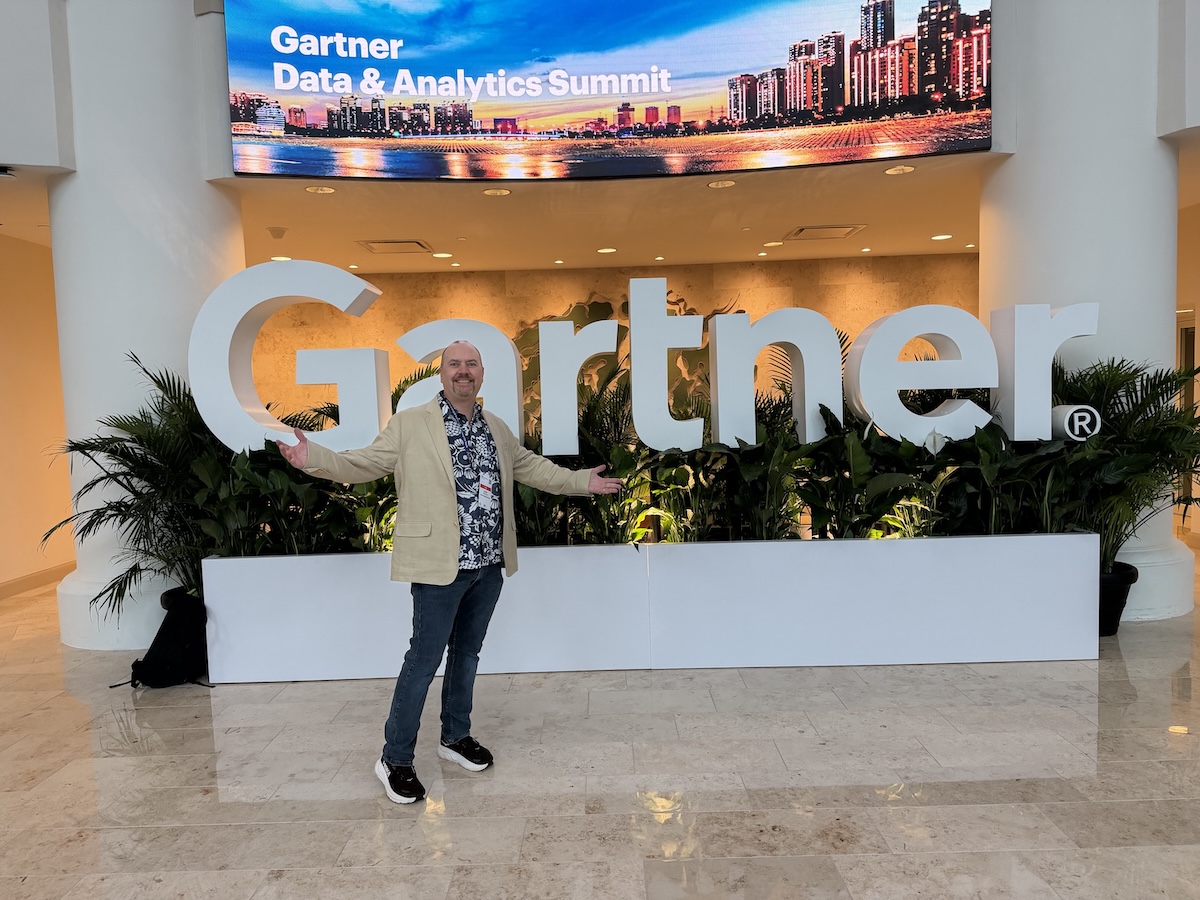
A practitioner’s field report from Gartner D&A Summit 2026
Four out of five organizations are deploying AI. Only one in five is hitting its ROI targets.[1] I’ve been to the Gartner Data & Analytics Summit eight or nine times over the years, and I’m not sure if it’s déjà vu or a movie I’ve already seen.
When big data was en vogue, we saw the same thing. Everyone rushed to adopt the technology, even though few understood it or could articulate the returns. The pay was always “next year.” Big data had its 3 Vs of Volume, Velocity, and Variety. Some people stretched it to 7, because apparently three wasn’t enough to describe the problem. The AI era already has its own shorthand, and I’m calling them the 3 Ws – washing, wishing, and waiting.
I spent three days at the summit in Orlando this March, and the 3 Ws were everywhere. They explain why that 1-in-5 number is so low, and they’re the same symptoms that dragged big data down a decade ago.[2]
Washing
The vendor side and the practitioner side might as well have been at two different conferences. On the expo floor, every booth was a native “AI agent” company. I couldn’t figure out what half of them did because the messaging was identical. Big data washing became AI washing, which became agent washing, and the label keeps rotating while the behavior underneath stays the same.
A Gartner analyst warned against this pattern in a session on AI agents in analytics and BI, recommending evidence-based evaluation with real-world scenarios instead of trusting vendor marketing claims.[3] Good advice, but the expo floor didn’t get the memo. Booth copy sounded like it was written by the same LLM, and vendor presentations felt forced. The AI slop is feeding itself, and Gartner predicts a $58 billion market shakeup as GenAI and AI agents challenge mainstream productivity tools.[4]
“Big data washing became AI washing, which became agent washing.”
— David Sweenor, Founder/CEO, TinyTechGuides
Wishing
The hallway conversations told a different story compared to the keynotes. Practitioners weren’t talking about what’s working, but about what isn’t working yet. Session after session pointed to 2027 and 2030 as the years when AI will finally achieve nirvana and deliver on its promises.[5] The finish line keeps moving, and big data had the same timeline problem. The returns were always coming “next year,” just around the corner, right after you got your data sh*t in order.
Six out of ten IT leaders are worried about AI agent cost overruns, but only two out of ten D&A leaders share that concern.[6] That disconnect should worry everyone. The people closest to the data aren’t worried about the costs, and the people paying the bills are.
“The returns were always coming next year, just around the corner.”
— David Sweenor, Founder/CEO, TinyTechGuides
We might be one bad quarter away from CFOs redirecting AI budgets to other mission-critical priorities, or worse yet, replacing agents with actual employees. When results don’t materialize, the panacea that is AI dissipates, which is what happened to big data. The enthusiasm evaporated the moment CFOs started asking tough questions about returns, and while the technology survived, most of the budgets didn’t.[7]
Waiting
The “vendor conference” sold AI-first futures, while the practitioners who need to make all of this work understood that the foundations aren’t there. Everyone is waiting, and the waiting comes in three flavors.
“Organizations are building AI on top of foundations they don’t trust.”
— David Sweenor, Founder/CEO, TinyTechGuides
Waiting on the data
Most catalog and context layer vendors are still built for structured, tabular data. Today’s AI strategies depend on documents, images, and code, which current tooling wasn’t designed to handle, and no one seems to be addressing. Meanwhile, the conversation has moved to metadata, semantic layers, and context layers as the connective tissue that makes AI work. As Scott Taylor puts it, context is the new oil.[8] By 2027, Gartner expects 40% of IT spending on data management to target multistructured data, and AI data readiness spending will increase sevenfold from 2025 to 2029.[9] The money is apparently coming. Who’ll build the plumbing? Agents or people?
Waiting on governance
Everyone is pro-governance, and for most companies in the US, that’s about as far as they’ll go. AI governance, the kind that covers model risk management, bias testing, usage controls, and agentic oversight, is barely on the radar.[10] Only 14% of IT leaders said they were confident their data and content assets are secured and governed.[11] Organizations are building AI on top of foundations they don’t trust.
Waiting on people
Gartner reports that only 6% of D&A and AI leaders consider themselves fully AI-ready when it comes to people, skills, and change management.[12] I’m not sure I agree with that number. People are using AI all over the place, whether their organizations are ready or not. The formal readiness programs haven’t caught up yet, but informal adoption has already happened. Change management alone can require up to twice the effort of the implementation itself.[13] Scott Brinker calls this pattern Martec’s Law, where technology changes exponentially while organizations change logarithmically.[14] That’s why most companies are still staring at the empty shelf long after the technology has moved three aisles over.
Big data had all three of these problems. Organizations bought the tools before fixing the plumbing, skipped governance, and underinvested in people. The AI era is repeating the same mistakes.
Same plot, different city
The Hangover Part II was essentially the same movie in a different city, with a new hotel and another bachelor party leading to the same bad decisions. That’s what this feels like.
The reasons four out of five organizations aren’t hitting their AI ROI targets are the same reasons big data underdelivered. Only the buzzword changed. The organizations that closed the distance last time invested in the boring stuff, the blocking and tackling.[15] They focused on governance before it was fashionable, fixed data quality before the next platform purchase, and developed people instead of cutting headcount. None of it was exciting, but all of it worked.
The technology works, and the big data technology worked too. What didn’t deliver was everything around it,[16] which is where the washing, wishing, and waiting did their damage. No new generation of AI agents will fix that for you.
Frequently asked questions
What are the 3 Ws of AI?
The 3 Ws of AI are Washing, Wishing, and Waiting. Washing is vendors rebranding existing products as “AI agents” without real AI underneath. Wishing is that practitioners are deferring AI ROI to 2027 and 2030, while only one in five organizations hits current ROI targets. Waiting is the shortfall in data readiness, governance, and change management. Together, the 3 Ws explain why most AI investments fall short.
What is AI washing?
AI washing is the practice of rebranding existing products as “AI” or “AI agent” without meaningful AI underneath. At Gartner D&A Summit 2026, nearly every expo booth marketed “AI agent” products with near-identical messaging. The pattern mirrors big data washing from a decade ago. The label keeps rotating while the behavior underneath stays the same.
Why are so few AI deployments hitting their ROI targets?
The 2026 Gartner CIO Survey shows that four in five organizations are deploying AI, but only one in five hits ROI targets. The failure pattern repeats big data’s mistakes. Organizations bought tools before fixing data foundations, skipped governance (only 14% of IT leaders feel confident), and underinvested in people. The technology works; the execution around it keeps failing.
Why are IT and D&A leaders divided on AI cost concerns?
At the 2026 Gartner D&A opening keynote, six out of ten IT leaders said they were worried about AI agent cost overruns, but only two out of ten D&A leaders shared that concern. The people closest to the data aren’t worried about costs, and the people paying the bills are. AI budgets may come under CFO scrutiny before D&A teams expect it.
Where should D&A leaders focus to improve AI ROI?
Focus on the three foundations most organizations are waiting on: data readiness, governance, and people. Gartner expects 40% of IT spending on data management to target multistructured data by 2027, with AI data readiness spending growing sevenfold from 2025 to 2029. Only 14% of IT leaders are confident in governance, and only 6% of D&A leaders are AI-ready on people and change management.
About David Sweenor
David Sweenor is the founder and host of the Data Faces podcast, where he talks with the people who are making data, analytics, AI, and marketing work in the real world. He is also the founder of TinyTechGuides and a recognized top 25 analytics thought leader and international speaker who specializes in practical business applications of artificial intelligence and advanced analytics.
With over 25 years of hands-on experience implementing AI and analytics solutions, David has supported organizations including Alation, Alteryx, TIBCO, SAS, IBM, Dell, and Quest. His work spans marketing leadership, analytics implementation, and specialized expertise in AI, machine learning, data science, IoT, and business intelligence. David holds several patents and consistently delivers insights that bridge technical capabilities with business value.
Books
– Artificial Intelligence: An Executive Guide to Make AI Work for Your Business
– Generative AI Business Applications: An Executive Guide with Real-Life Examples and Case Studies
– The Generative AI Practitioner’s Guide: How to Apply LLM Patterns for Enterprise Applications
– The CIO’s Guide to Adopting Generative AI: Five Keys to Success
– Modern B2B Marketing: A Practitioner’s Guide to Marketing Excellence
– The PMM’s Prompt Playbook: Mastering Generative AI for B2B Marketing Success
Follow David on Twitter @DavidSweenor and connect with him on LinkedIn.
[1]2026 Gartner CIO Survey, n=2,437.
[2]Sweenor, David. “Beyond the AI Hype: What 20% of Companies Get Right.” TinyTechGuides, February 11, 2025. https://tinytechguides.com/blog/beyond-the-ai-hype-what-20-of-companies-get-right/.
[3]Macari, Edgar. “Activating AI Agents in Analytics and BI Platforms.” Gartner Data & Analytics Summit, March 9-11, 2026, Orlando, FL.
[4]Sallam, Rita. “Top Data and Analytics Predictions for 2026.” Gartner Data & Analytics Summit, March 9-11, 2026, Orlando, FL. See also Gartner, “Gartner Announces Top Predictions for Data and Analytics in 2026,” press release, March 11, 2026, https://www.gartner.com/en/newsroom/press-releases/2026-03-11-gartner-afromnnounces-top-predictions-for-data-and-analytics-in-2026.
[5]Sallam, Rita. “Top Data and Analytics Predictions for 2026.” Gartner Data & Analytics Summit, March 9-11, 2026, Orlando, FL. See also Gartner, “Gartner Announces Top Predictions for Data and Analytics in 2026,” press release, March 11, 2026, https://www.gartner.com/en/newsroom/press-releases/2026-03-11-gartner-announces-top-predictions-for-data-and-analytics-in-2026.
[6]Ronthal, Adam, and Georgia O’Callaghan. “Opening Keynote: Navigate AI on Your Data & Analytics Journey to Value.” Gartner Data & Analytics Summit, March 9-11, 2026, Orlando, FL.
[7]Sweenor, David. “The AI-Powered CFO: Why Finance Must Shift from Control to Cognition.” TinyTechGuides, March 11, 2025. https://tinytechguides.com/blog/the-ai-powered-cfo-why-finance-must-shift-from-control-to-cognition/.
[8]Sweenor, David. “Truth Before Meaning — The Three-Word Fix for Data Management.” TinyTechGuides, April 7, 2026. https://tinytechguides.com/blog/truth-before-meaning-the-three-word-fix-for-data-management/.
[9]Showell, Nina. “Unstructured Data Is the Missing Ingredient to Prepare AI-Ready Data.” Gartner Data & Analytics Summit, March 9-11, 2026, Orlando, FL.
[10]Sweenor, David. “Why Bad AI Governance Kills 95% of Enterprise Projects Before Production.” TinyTechGuides, September 9, 2025. https://tinytechguides.com/blog/why-bad-ai-governance-kills-95-percent-enterprise-projects/.
[11]2025 Gartner GenAI Enterprise Survey, n=360.
[12]2025 Gartner Survey, n=353.
[13]Ronthal, Adam, and Georgia O’Callaghan. “Opening Keynote: Navigate AI on Your Data & Analytics Journey to Value.” Gartner Data & Analytics Summit, March 9-11, 2026, Orlando, FL.
[14]Brinker, Scott. “Martec’s Law: Technology Changes Exponentially, Organizations Change Logarithmically.” Chiefmartec, June 13, 2013. https://chiefmartec.com/2013/06/martecs-law-technology-changes-exponentially-organizations-change-logarithmically/.
[15]Sweenor, David. “Why 80% of AI Projects Fail (And the Three Boring Decisions That Save the Other 20%).” TinyTechGuides, October 21, 2025. https://tinytechguides.com/blog/why-80-of-ai-projects-fail-and-the-three-boring-decisions-that-save-the-other-20/.
[16]Sweenor, David. “The $40B Reason Enterprise AI Projects Fail: It’s Not the Tech.” TinyTechGuides, September 6, 2025. https://tinytechguides.com/blog/the-40b-reason-enterprise-ai-projects-fail-its-not-the-tech/.
Related Posts
Your AI stack will be wrong in 12 months

The AI tell hiding between your sentences