

Data Faces · Episode 49 · September 8, 2026 · 38 min
Profisee CDO Malcolm Hawker on fitness for purpose and what a semantic layer cannot fix.
Listen: YouTube · Spotify · Apple Podcasts · Amazon Music
About Malcolm Hawker
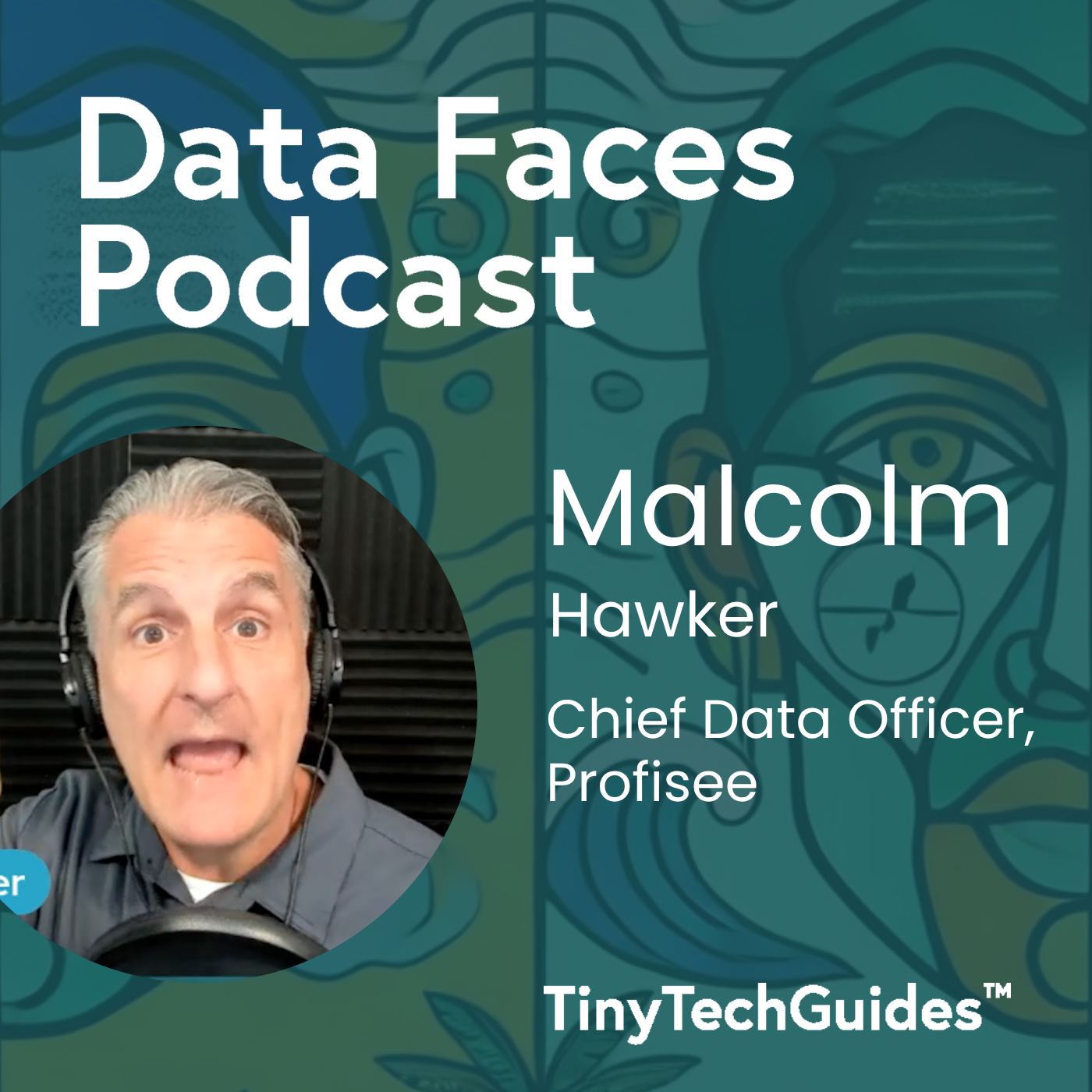
Malcolm Hawker is the Chief Data Officer at Profisee, a master data management vendor, where most of his job is external thought leadership. He spent three years as a Gartner analyst covering master data management and governance, and before that held IT leadership and product roles including Distinguished Architect at Dun & Bradstreet. He hosts the CDO Matters podcast and wrote The Data Hero Playbook.
In this episode
- Why “AI-ready data” is an overloaded term that collapses a spectrum into a binary
- Why the cost of being wrong decides whether an AI use case can go into production
- The difference between defining what a customer means and knowing which customer record is real
- Why telling your CEO “garbage in, garbage out” is a career-limiting move
- The semantic pedantic feedback loop, and how data literacy went from nonexistent to a top-three problem in a single year
→ Read the full article: AI-ready data is the wrong question
Full transcript
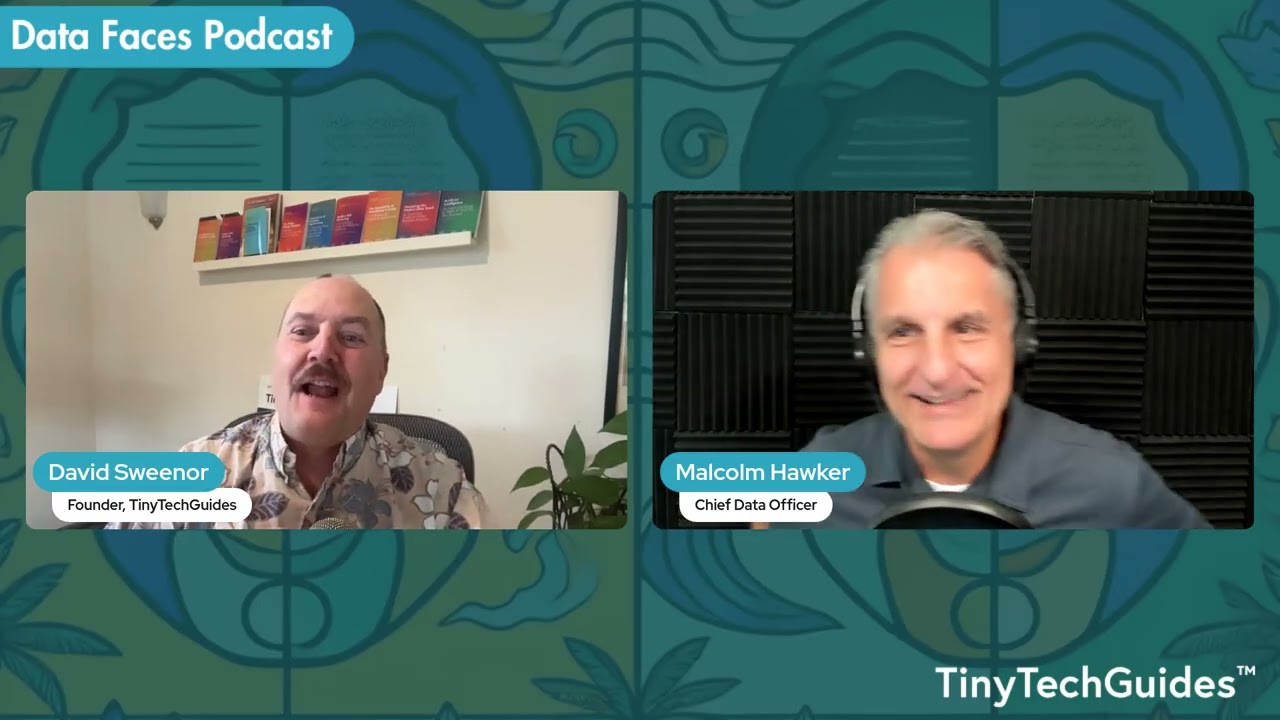
David Sweenor 0:06 Hello, everyone, and welcome to the Data Faces podcast. I’m David Sweenor, founder of TinyTechGuides and your host for today’s show. In this show, I talk with the people who are actually making data analytics and AI work in the real world. What’s exciting, what’s messy, and what’s coming next? Today, I’m joined by Malcolm Hawker. He is the CDO at Profisee. He’s the host of the CDO Matters podcast, former Gartner analyst and author of the Data Hero Playbook. Malcolm has spent a fair amount of time, I would say, around master data management, data governance, product strategy, and enterprise data leadership. So today we are going to talk about what happens when companies try to build AI on crappy data. So let’s dive in. Malcolm, welcome to the Data Faces podcast.
Malcolm Hawker 0:52 Thanks for having me, David. I’m excited to be here. I was grooving to your tropical vibes there. I’m still on my second cup of coffee. So, yeah, it should be interesting. I’m looking forward to our conversation. It’s going to be fun.
David Sweenor 1:06 Yeah, I’m super excited. Appreciate the comment on the music. So can you just tell us, for people who are unfamiliar with your work, a little bit about yourself and what you’re doing over at Profisee?
Malcolm Hawker 1:18 Oh, God. I should. Well, I won’t do the whole chronology of 30 years. I started, gosh, a long time ago. I’ve been in IT my entire career. And I’ve been in data or directly data adjacent for that entire time. Kind of the high level here is that… I started software, found my way into IT, found my way into IT operations, found my way into data and analytics. And then I took a little bit of an interesting curve out of IT management and into more what one would call thought leadership. Had this lofty title at a company called Dun & Bradstreet. My title was Distinguished Architect. I guess they gave me that because my hair was going gray.
David Sweenor 2:14 At least you got hair. I got nothing up here.
Malcolm Hawker 2:20 It’s on its way out the door. Every day I look and the hairline’s receding, so I’m cherishing what little I’ve got left. Then I transitioned over to Gartner. Gartner was a lot of fun, kind of like the peak, the pinnacle, as it were, for thought leadership in the data and analytics space. Enjoyed my run for three years at Gartner, and now I am the chief data officer at Profisee. I’m an externally facing chief data officer. I have run data analytics functions internally as an internally facing CDO. I’ve deployed governance. I’ve deployed MDM. I’ve deployed data quality tools. You name it. But now I provide mostly thought leadership. I’m externally facing supporting Profisee clients, but more importantly, supporting the market writ large. Three quarters of my job is is basically thought leadership advocacy. promoting the value of good data, good data management, promoting the value of governance. We believe at Profisee that a kind of a rising tide lifts all boats. Sure. And my task is to be a trusted advisor in the marketplace. In doing that, I build a LinkedIn following. People want to come and hear me speak at conferences. And the goal is, is hopefully that we build a positive association between myself and my company. And if you ever do need what my company does, which is master data management, you’ll think of us first. That’s kind of the high level strategy there. But the way I describe it, David, I’ve got the greatest job in the world. I get to be in the market. I get to be in, you know, in front of some of the largest companies in the world who have big challenges related to data and analytics and help them with those, which is really, really cool.
David Sweenor 4:03 All right. That’s awesome. Well, thanks for being here. Before we dive into the topic, I always like to ask a get to know you type question. So before professional Malcolm existed, what did you want to be when you grew up?
Malcolm Hawker 4:22 I had so all the way through high school, through college and even into my early professional career, I had convinced myself that I wanted to run a record company.
David Sweenor 4:34 Oh, OK, great.
Malcolm Hawker 4:36 I had convinced myself that I was going to be the next Richard Branson. I was going to start my own record label and and build this catalog of amazing music and bring music to the masses. I’m kind of deeply moved by music and I love music. I have a soundtrack constantly playing in my brain, but I’m not musically inclined. I don’t think I could play anything like, you know, at all, right? Bongos, I’d probably struggle to play bongos, but I still am moved by music.
David Sweenor 5:06 I should break them out.
Malcolm Hawker 5:09 As it turns out, my wife is gifted in this regard, and she’s kind of my other half. So she gets to be the musical half, and she can play anything, and she’s got an amazing voice. But yeah, that’s the answer. I wanted to own a record company. I went back to graduate school, and I focused, actually, my graduate thesis on copyright law. So my whole graduate work was focused mostly on the internet, believe it or not, at the time. Oh, wow. This is like 1995. The World Wide Web. And I wrote my graduate thesis on copyrights as they pertain to the distribution of music. Back then there was this thing called Napster, which was breaking the entire… through um anyway music still near and dear to my heart i no longer want to be the owner and manager of a record company um but you know still something i’m i’m that’s a good memory thanks thanks for that question it’s fun yeah well i mean and so are you one of the are you an audiophile then do you still have you have a record player or have you moved on to streaming and cd you know past cds to streaming and all that stuff Well, being a technologist at heart, I went whole hog on digital. I had a massive record and CD collection and I tragically sold them all and digitized everything. But now as I age, I’ve actually been tinkering with the idea of going and getting an LP and rebuilding some of my library and getting some of the old wax. Yeah. Because there’s just something about that experience, right? With the wax, with the vinyl, and listening and being immersed in those types of recordings. It’s just something you feel. And I know everybody’s like, you’re crazy. But I’m telling you, I feel it. And I’ve actually been doing some research, believe it or not, on how to get back set up so I can run some vinyl. Be fun.
David Sweenor 7:02 Okay. Well, yeah, there’s a whole thing out there. And I’m sure you could spend your retirement on a little click. There you go. Hold it. Final again. But anyway, let’s talk about AI. There’s a lot of noise out there. And I see a lot of companies talking about context and documents and metadata and semantics. And I think I saw somewhere that you’re saying that, you know… Context breaks down when the underlying data is wrong. So a lot of companies are saying, hey, we need to be AI ready or we have AI ready data. What do you say to them? And are they wrong? Are they right? And what the hell does it mean to be AI ready? It’s so confusing. Oh, my gosh.
Malcolm Hawker 7:46 That’s such a great question. And it’s kind of a little, I don’t want to say depressing. It’s concerning to me that… You know, nearly four years later, so ChatGPT exploded onto the screen. What was that like, late 2020? November 2022.
David Sweenor 8:02 November 2022, because my book came out in April 2022.
Malcolm Hawker 8:05 There you go. It’s almost irrelevant. So as we record this, it’s August 26. So we’re coming up on four years, and we’re still kind of grappling with what all of this means. And when it comes to AI-ready data… AI-ready data is data that supports a given use case. I mean, literally, that’s it. If the use case is supported, the use case is an online chatbot agent, then the data that is AI-ready is data that supports the outcomes insofar as they support a given AI use case. And I know that sounds super squishy, but it kind of aligns to the idea of high-quality data that is data that is fit for purpose. And the same thing is true with AI, right? Data is AI ready when it fits the purpose of what you’re trying to do with AI, right? If you’re trying to use AI to build some idea of a forward-looking propensity model, right? You need high quality, accurate, consistent, trustworthy data. If you need data that mimics human speech… right, then clearly you don’t really need extremely high quality data. I’ll give you an example. ChatGPT was built on the internet, not exactly a bastion of high quality data, right? Sure. So these are extreme ends of this poll, which is LLMs run on text were built on the internet, right, which is a complete cesspool insofar as data quality is concerned, but still somehow they managed to work. Right. The other end of the spectrum would require extremely high quality, accurate, consistent, all of it, especially if you’re building, you know, if you’re doing things in the healthcare space or anything that has more legal compliance or audit regulations. And that fully actually explains why so many POCs are failing is because what people are finding is that they’re deploying these probabilistic systems into use cases that have historically run on very deterministic rules. Meaning if thens, if very deterministic, I can control what this thing says, I can predict what this thing says, I can audit what this thing says, and what it says and what it does will fall within the confines of my governance policies. What they’re learning is, lo and behold, it doesn’t all the time. And we don’t know why it doesn’t, right? This is something the AI geeks would call the attribution problem. We don’t know why it does what it does. We just know that we can’t fully ever control it. We can deploy all of the complex rag patterns and grounding and context graphs and knowledge graphs, and this thing will still behave radically at times. So… The idea of AI ready data is a really bit of a overloaded term because it is deterministic in nature. It’s kind of like garbage in, garbage out. It’s inherently deterministic and ultimately kind of irrelevant, right? Because what is high quality to marketing may not be high quality to finance and on and on. Same is true with AI. There’s no one size fits all answer here, but vendors are pouncing on this stuff. Everybody is talking about AI quality. or ai ready um we we internalize this idea of a binary yes no it’s ready it’s not ready measurement of our data when in fact it might be ready it might not be ready just depends on entirely what you’re trying to do okay so it’s a spectrum and what i’m hearing is it’s ready for a specific use case then right It could be, right? What you have right now out of the box may be sufficient for a specific use case. Marketing, for example, right? Where the cost of being wrong is arguably reasonably low. I’m sending you a coupon. I don’t care, right? a digital coupon, it doesn’t matter.
David Sweenor 11:55 Right, right.
Malcolm Hawker 11:56 If the cost of being, yeah, if the cost of being wrong is reasonably low and there’s enough benefit from applying AI to automate that business process where the benefits of automation outweigh the costs of being wrong, well, then maybe your data is ready to go. But there are a whole… bunch of other use cases out there where it’s absolutely not. It’s not ready. Where if you’re trying to do any sort of specific marketing to a specific person or even a specific demographic or a specific group of people, if you’re trying to model the behavior of a given customer, if you’re trying to understand what offer is going to be best for this customer next, you’re going to need a level of accuracy that requires some idea of higher quality data. A lot of people these days are talking about context. Yeah. Context is great. You need it. You need it. In and of itself, LLMs cannot just consume raw tables of data. They can’t. If you point an LLM at some tables and say, tell me something insightful about my customers. They don’t know what customers mean out of the box. They don’t know what your joins are between your customer table and your product table and your location table or anything else. It doesn’t inherently know any of that stuff. What it wants is text. Yeah. And what you’re giving it is a bunch of tabular data that to that LLM mean absolutely nothing. So the way to make that data more actionable is to layer some idea of context over top of it, what most people are calling a semantic layer, which are the things that define kind of key terms, right? That define what a customer is, defines what net revenue is, defines what even a location is, even defines what time means. That stuff is all really, really important. What people in the knowledge management world call, they call that the T-box. like not golf tee box, T as in the letter box, terminology box, right? All of that stuff is critical. What most people aren’t talking about these days is what a knowledge engineer would call the A box, which is the actual values of customer, the values of product, right? Is Malcolm Hawker currently a customer? And if I have five different Malcolm Hawkers and we don’t know which one really is me, or maybe it’s David Sweenor with S-W-E-A-N-O-R, And which David Sweenor is the right David Sweenor? So there’s a whole other world out there related to identity management, related to master data management, related to good old-fashioned data quality that is critical to enable trustworthy, accurate, and consistent behaviors of AI. People just are kind of not talking about because they’re talking about terminology. They’re talking about what things mean. That’s the general consensus around the semantic layer. It’s important. Don’t get me wrong. You need it. But if you’ve got 15 different versions of David Sweenor, all the context in the world isn’t going to solve that problem. Yeah.
David Sweenor 14:49 So it’s both.
Malcolm Hawker 14:50 Yeah.
David Sweenor 14:51 Okay. Well, I want to talk about… A friend of the show, Scott Taylor, brought this up before. You coined this term, the semantic pedantic cycle. Yeah. But I want to ask you a question before we get to that, because you mentioned something very interesting. So you mentioned garbage in, garbage out. We’ve all heard this, and I get it. We talk about quality. How do people… think about this with unstructured data. Because a lot of folks I talk with, we’re still talking about rows and columns, and it’s fairly straightforward. But with unstructured data, what do you mean? Is there a concept of garbage in, garbage out? I can’t control what I’m going to type into the prompt. Maybe I could put some guardrails in there. I could probably put some guardrails on what comes out. But what does that mean in the context of unstructured data?
Malcolm Hawker 15:44 First of all, the whole concept of garbage in, garbage out gives me hives.
David Sweenor 15:50 It’s a predictive analytics, right? I mean, it was kind of, that’s kind of how I thought about it anyways.
Malcolm Hawker 15:56 Well, so at a very high level, I get the sentiment of garbage in, garbage out. I mean, I get it. But I think it’s highly problematic to our industry. highly problematic. And the reason is because data quality is not a one size fits all. The right definition of what is good data is data that is fit for its purpose. And like I said before, sometimes lower quality data may be good enough. Sometimes higher quality data is required. When we overlay this idea of it is or it isn’t garbage or not garbage, we really sell ourselves short. Not to mention the fact that If I’m the CDO and I’m sitting in a boardroom and my CEO looks at a piece of paper and says, hey, CDO, I see two David Sweenors on this report. Which one? What’s going on here? I thought we only had one customer named David Sweenor. Would you ever as a CDO or VP of data analytics or anybody, would you ever look at that CEO and say, oh, sorry, boss, garbage in, garbage out?
David Sweenor 17:00 You’d never do it.
Malcolm Hawker 17:02 Career limiting for sure. You said it. It is absolutely career limiting because first and foremost, it disempowers us. It says all of those tools we’re spending millions on, the Snowflakes, the Databricks, the DBTs, the MDM platform, the data quality platform, all of my pipelines, everything. I’m powerless. Sorry, garbage in. What are you going to do? Right, which is a complete disservice to the stuff that we work on day in and day out. That aside, the idea of how do I apply data quality in this world of unstructured data is an extremely hard problem, and we’re really not talking about it enough. If I read a paragraph of text and come to one conclusion, and you read a paragraph of text and come to a different conclusion, who’s right? Right. That’s a rhetorical question, right? Sure. We can have an interesting academic argument about, oh, okay, well, then we need to break it down into component pieces. We need to chunk it out, also known as vectorizing the data. That’s great. And then you could try to apply some idea of traditional 12 dimensions of data quality against those individual smaller chunks, maybe. But the minute you do that, you start to lose all the context. So there’s an interesting paradox here to be able to apply more consistent machine type driven rules for data quality. We have to make things small, which is what we do in data analytics forever and ever. We atomize the data into tables. We strip it of all of its context. Get rid of all the stuff that LLMs actually need, which is context, stick it into tables, and then we can apply some very binary, very deterministic data quality rules to say, does it conform or does it not conform to our data quality rules? In the world of text… In the world of text, it’s a completely different game. And that text is exactly what LLMs digest, right? We’re not typing SQL statements into that window when we’re chatting with ChatGPT. We’re literally typing text. So this problem, I think, if I had… a giant pot of gold or a bucket full of money, I’d be investing in startups focused on solving the data quality for unstructured data problem because it’s a hard problem. We’re going to need to figure it out.
David Sweenor 19:26 And I think it’s underserved by the market. So I think I’m hearing from you as well. Okay. So back to the semantic pedantic cycle. Yes. We’ve been in this case a long time and there’s new terms. So I used to call it metadata. I still call it metadata. Now we got semantics and context layers and ontologies and knowledge graphs. Tell me what’s going on here and tell us what thought of the semantic pedantic cycle because it’s confusing to a lot of people.
Malcolm Hawker 19:57 Well, yeah. So I originally did this as a tongue-in-cheek thing on LinkedIn, but the more I thought about it and the more I tested my model, the more it actually worked. And I called it semantic pedantic feedback loop. And I created it… because I was trying to figure out exactly why we keep making new names for the same things, right? Why do we keep giving these new names to things that have long existed? And then I figured out, wait a minute, this explains the entire hype cycle, right? And it’s this idea of a loop where… The punditry, thought leaders, Gartner analysts, consultants, others want to differentiate themselves in the market. They want to be seen as smart. And in the case of Gartner, want to create new insights because they have a subscription-driven business model. And they have to create… They have to create the perception of newness, right? Because why am I going to renew my subscription? If everything you’re telling me from a best practice perspective is evergreen, right? It really doesn’t change that much, which is true. And if it really doesn’t change that much, then there’s an incentive built in to create new stuff. There’s an incentive for me as a podcast host and a pundit, as a conference speaker… new stuff because I want to create a presentation about the data mesh or to talk about data products or to talk about anything hype worthy. So that class, those people start making stuff up. Then vendors hear that and the vendors jump on the bandwagon and start making stuff up. Then the same Gartner analysts that started this process and the same consultants and the same thought leaders that started all of this start to hear what they created being echoed back to them by the vendors. Oh, wait a minute. This is real. Right. Hold on a second. Data literacy is real. The data mesh is real. Everybody’s talking about it. And the more the vendors start to talk about it, then the general public starts to talk about it because then all of a sudden, the CDOs and VPs of data and analytics start to hear from their vendors and they go to conferences and they start to hear this stuff. And they’re like, wait a minute, I’m hearing an awful lot about data products. I’m hearing a lot about the data mesh and data literacy. Obviously, this is important. I guess I need to be, I need to be, you know, you know, informed about all this. I better call my Gartner analyst. Hey, Gartner analyst, tell me this thing. What’s this data mesh thing? What is this? Then Gartner analyst says, hey, look, it’s real. Told you. It’s real. And that goes and goes and goes and goes and goes. And new things can be created completely out of the ether. I’ll give you an example. Data literacy. In 2017, every year Gartner does a CDO survey, hundreds of CDOs. In 2017, and they ask every year, what are the top five roadblocks to your success as a CDO? In 2017, data literacy was never on the list. Didn’t even exist as a problem in 2017. In 2018, they put it on their survey for the first time. Lo and behold, it’s number three. Overnight, literally, Literally, it goes from never existing to not being a thing to the number three roadblock. Sure. How is that possible?
David Sweenor 23:30 That’s a rhetorical question. Well, it was a checkbox on their survey the next year, obviously.
Malcolm Hawker 23:36 And most importantly, it was a checkbox that in essence said that my biggest roadblock is your knowledge. Right. It’s people. Right. It’s not me. It’s you. It’s them. It’s not me. It’s not my tools. It’s not my skills. It’s not my products. It’s not my dashboards. It’s not my data quality tool. It’s nothing. Oh, sorry to break it to you, David. It’s your lack of knowledge that is holding me back as your CD.
David Sweenor 24:05 My employees are holding me back. for running my company.
Malcolm Hawker 24:09 So all of a sudden, data literacy, ba-ding! It pops up on this survey and it skyrockets and it has stayed in the top three to five biggest roadblocks of CDOs ever since. It went from nothing, not a roadblock, not a problem because it was never on a survey. That’s a perfect example of the semantic pedantic feedback loop where it’s like, okay, we made a new thing, data literacy, because it previously existed, by the way. It was called training.
David Sweenor 24:36 Yep.
Malcolm Hawker 24:36 Just FYI. You’re in the training business. You’re in the knowledge business, right? There was a word for it, and it was called training. We slap a new label on it called data literacy that just actually happens to be a little judgmental because the opposite of that is illiteracy. And then it takes off. Now, don’t get me wrong. Training’s critical. Of course it’s important. Of course these things are important. It’s just… They can be born out of the ether and created by forces. And that’s the semantic pedantic feedback.
David Sweenor 25:17 I love that. Well, thank you for sharing that. I have another question, but I’m not going to… You bet. So your company specializes in MDM, among other things, right? Yeah. And so how does… And I used to… When I did data warehousing, I would argue with my… architect, chief architect, I never understood MDM. I got it mechanically, but I felt like I want to drive back to source systems to fix those things, but I’m like, nah, we’re going to build all these tables to do all these mappings and keep the systems kind of crappy. That was sort of my thought. How does MDM apply to unstructured data?
Malcolm Hawker 25:59 I don’t think we know yet. I don’t think we know yet. I mean, there’s a simple answer, and then there is a far more complex answer, right? So, master data is the data that is shared widely across the organization, right? It arguably is, I colloquially refer it to as the connective tissue across the organization. Right. It’s your customer data, your product data, your asset data, the data that is literally flowing between highly disconnected business processes. Golden record, right? We have the golden record. But example would be quote to cash, right? Quote in a CRM system, cash in an ERP system. And customer data, contract data, product data is literally moving between those two systems and needs consistent definitions, consistent quality standards, consistent structure even. That’s master data. Data that describes master data, so the metadata of master data, is also technically master data. So when it comes to unstructured data, you could have a paragraph of text describing a given customer. The easy part of the answer is your customer will be named somewhere in that text. David Sweenor will be named inside that text, right? And I think it would be reasonably… Easy. I don’t want to say easy, but reasonably easy for us to profile that unstructured data and know with reasonable certainty that this paragraph is saying something about David Sweenor. So that’s, to me, so there’s kind of two key things there when it comes to MDM and unstructured data. One is profiling, right? And profiling a whole, just imagine email, like imagine your Outlook servers profiling your data so that you know there’s a reference to your master data objects.
David Sweenor 28:00 So you’re pulling out all the entities, essentially.
Malcolm Hawker 28:03 You’d have to. I think you’d have to, or you’d want to. Yeah. Right. That’s that’s the biggest problem to solve when it comes to MDM and unstructured data is knowing when things are relevant, meaning when knowing when things report. So of all the terabytes and terabytes of I’ll use email as a great example. Because it’s probably one of the more extreme examples. Of all the terabytes of data you’ve got out there, 80% of it is probably just cruft. Who cares? I don’t need to go and scan an email about you making a dinner reservation tonight. I don’t care. But if you’ve got an email that is saying something important about your customers, you’re going to want to know that. So step one is profiling. Step two is being able to say, okay, this has a reference to a known customer. Okay. Step three is going to be the really hard part, which is, are these things that are being asserted about your customers true or not? That’s the hardest problem to solve. And I don’t think we know how to solve that yet because honestly, David, I think the only way we’re going to solve that problem at scale is to use AI. The irony and a bit of a paradox here is that the reason why we would want to solve that problem, making sure that what is said about David is accurate, is so that the AI behaves accurately. Right, right. So you’re going to have a bit of a fox watching the hen house here. But I don’t know any other way around this to be able to do this at scale.
David Sweenor 29:27 There are easier examples. Let’s take semi-structured data.
Malcolm Hawker 29:32 Things like contracts, insurance forms, medical forms that I think are going to be a lot easier because you’re going to know they’re important just by the very nature of what they are. You’re going to know, okay, I should be scanning that stuff and profiling that stuff to determine. But free text, email being probably the biggest example of the hardest problem to solve. Yep. That was tough.
David Sweenor 29:54 All right. Okay. Well, we’re… I had a whole list of questions. We got through maybe a couple of them. I’m sorry. No, no, that’s okay. This is great. This is great. But I want to talk to you about your book, The Data Hero Playbook. Yeah. And I’ve written a few books. My question to you really is, data leaders, are they sort of… playing defense when they maybe should be more on offense and sort of shaping the business conversation. You know, we go to these trade shows and you hear this, well, CDO is more defensive. CAO, CAIO, whatever the new term is today. It’s offense. Is that the right way to think about it? And I’m just, just wanted to hear your perspective. And I’d love to hear a little bit about your book because I don’t have a copy of it yet, but I know I’ll get one.
Malcolm Hawker 30:44 Ooh. Ooh. Okay. We got, we, we got to rectify that. Um, Defense versus offense, okay, fine. But most of the personality types, that metaphor doesn’t align very well. And honestly, the role, the demands of the role, the kind of the idea of going on offense doesn’t necessarily fully align either because ultimately I think you really want an ambassador. You want a collaborator. You want a bit of a politician and the idea of just being on the offense all the time.
David Sweenor 31:17 Yeah.
Malcolm Hawker 31:21 I’m not sure it’s as powerful a metaphor. The better one that I spend is more along the idea of a mindset and embracing a specific mindset. And what I advocate for and what the book is about is the benefits that can come through focusing on what’s known as a growth mindset. So I think the underlying premise of my book is that not nearly enough of us have been embracing a growth mindset. We’ve been embracing the opposite. of a growth mindset, which is more of a fixed or static mindset, which tends to lean more towards the status quo, tends to lean more towards the known, tends to lean towards more conservatism, right? And there is… role to be played there. And sometimes we want data leaders to be a little more conservative, and that’s okay. But I think we definitely need more of that growth mindset. A growth mindset is focused on learning and development. A growth mindset is focused on challenging the status quo. right a growth mindset seeks feedback this is this is critical we need more feedback tell us what’s working tell us it’s not working a growth mindset in the data and analytics space would necessarily mean you improve and build your relationships with the end consumers of your data products that’s what i think we need more of in the data and analytics space because when i was an analyst I had these things called inquiries. Gartner analysts do these things called inquiries. I had 1,500 of them over three years. 1,500 discrete conversations with CDOs, CIOs, VPs of data and analytics. And what I heard across all of those conversations was a lot of the fixed mindset and not enough of the growth mindset. A lot of the fixed mindset was really kind of blaming external factors. Yeah. Right. Talking about a data, lack of data literacy, talking about a lack of a data culture, talking about a lack of engagement and nobody showing up to the governance committee meetings. And woe is me. The CDOs that were succeeding the most and had success with governance, had success with data quality, had success with MDMs were those who were embracing this idea of a growth mindset, right? We’re not going to get it right the first time, but we’re going to learn. We’re going to be focused on customer success. We’re not going to be data driven. We’re going to be customer driven. We’re going to learn from our mistakes. We’re going to grow and develop and we’re going to put a premium on… learning and development. That’ll lean us more towards being a little more innovative, being a little more risk-taking, not haphazard, but a little more risk-taking. That’s what I focused the book on, the benefits of doubling down on growth mindset. There’s plenty of quantitative data that says that that’s a good thing. And I really start talking about how we as data leaders do this in our organizations. How do we structure our… data? How do we focus our efforts? How do we build better data products? That’s a big focus of the book, and I’m really proud of it because it’s one you don’t hear an awful lot about. We talk a lot about tech and a lot of how to build a data mesh or how to do data pipelines, and those things are important, and they’re cool, but the leadership guide, how to actually think, how to think about your customers, how to think about your data, how to think about your role, we need a little bit more of.
David Sweenor 34:43 Okay, I love that. Well, thank you for sharing that. And we have time maybe for one more get to know you question. This came actually from a couple of the audience members that have done a number of these shows. And they’re like, common thing is people want to know either what you’re currently reading or what’s your kind of current TV show that you’re into. So the name of the show is Data Faces. So to get behind the new faces and the data. So reading your favorite TV show that you’re currently into.
Malcolm Hawker 35:18 So don’t watch TV shows. Don’t watch TV. My video entertainment is YouTube. And I will turn my brain off. I like a lot of the DIY, like restoring a, insert name here, restoring an old chateau in the middle of France. Anything that is like DIY where I can kind of think, I could do something. I could restore that log cabin in the middle of nowhere. I could do that. That’s YouTube. In terms of reading, I have two books on my desk. I’m going to grab one. Hold on. Okay. Sorry about that. I wanted to give a shout out because I wrote, not the foreword, but I wrote a praise quote for it. This one, Bridging Knowledge, Data, and AI. Okay. It’s by my friends from the company Enterprise Knowledge. There’s three authors there, Joseph Hilger, Lulit Tesfaye, and Zach Wahl. It is the… It is an amazing book talking about context, talking about semantic layers, talking about ontologies, talking about knowledge graphs. And for the average data person, I would view this as required reading.
David Sweenor 36:31 Okay, we’ll put that in the show notes for sure, so people can find that.
Malcolm Hawker 36:34 Yeah, I can’t even get through it because I get through a paragraph and then I reread it and then I reread it. If you ever wanted to know what an ontology is, if you ever wanted to know what a knowledge graph is, a context graph, a facet, an attribute, an A box versus a T box, all of the kind of the things that knowledge engineers and knowledge managers have been talking about for years, we as data managers need to figure this world out. And it’s a great book to help you to do that.
David Sweenor 36:58 Okay.
Malcolm Hawker 36:59 Then I’ve got one more here that I haven’t started yet, but it was recommended to me by my friend Juan Sequeda, Dave McComb’s Software Wasteland. Juan said I have to read it, so I’m going to read it. But those are the two that are sitting on my desk right now.
David Sweenor 37:13 All right. Well, very good. So, Malcolm, the final question is for people who are… Confused about all the semantics that are out there and MDM, where can they find a little more about you? And if they have questions and want to follow up, what’s the best way to get ahold of you?
Malcolm Hawker 37:29 Best way is LinkedIn. I am prolific on LinkedIn. Post pretty much every day. There are three Malcolm Hawkers on the planet Earth, or at the very least, insofar as LinkedIn is concerned. There are three of us, and I’m easily found. But also, my profile name is malhawker. If you search malhawker… For a profile, you’ll find me on LinkedIn. Otherwise, you can find me through the Profisee website as well. But LinkedIn is the easiest way. And I do monthly Ask Me Anythings live on LinkedIn. I publish two podcasts a month, which is the CDO Matters podcast, where I’m talking to data leaders about their biggest challenges. I’m pretty easy to find. But thank you, David. I really appreciate that.
David Sweenor 38:09 Well, Malcolm Hawker, CDO of Profisee. Thank you for joining the Data Faces podcast. It’s been an amazing conversation.
Malcolm Hawker 38:16 Thanks, David. Really appreciate it. It’s been fun. Cheers.