

Data Faces · Episode 57 · November 3, 2026 · 35 min
Gravity’s Lucas Thelosen on red blindness, deterministic math, and agent sprawl.
Listen: YouTube · Spotify · Apple Podcasts · Amazon Music
About Lucas Thelosen
Lucas Thelosen is the founder and CEO of Gravity, the company behind Orion, an AI analyst. He started as an analyst during the 2008 financial crisis and put his first AI into production in 2010 for Countrywide. After founding DAS42, one of the largest Looker consultancies, he joined Looker’s executive team and, when Google acquired Looker, went on to lead Google Cloud’s data and AI product organization.
In this episode
- Whether BI is dead, and why so few employees open the dashboards their company builds
- Why Gravity put deterministic code between the AI and the math
- How an AI analyst can personalize every answer and still keep everyone’s numbers the same
- What “ambient learning” means for keeping AI context up to date
- What happens to analysts, and why Lucas thinks administering AI agents is next year’s big topic
→ Read the full article: It’s the end of BI as we know it (and I feel fine)
Full transcript
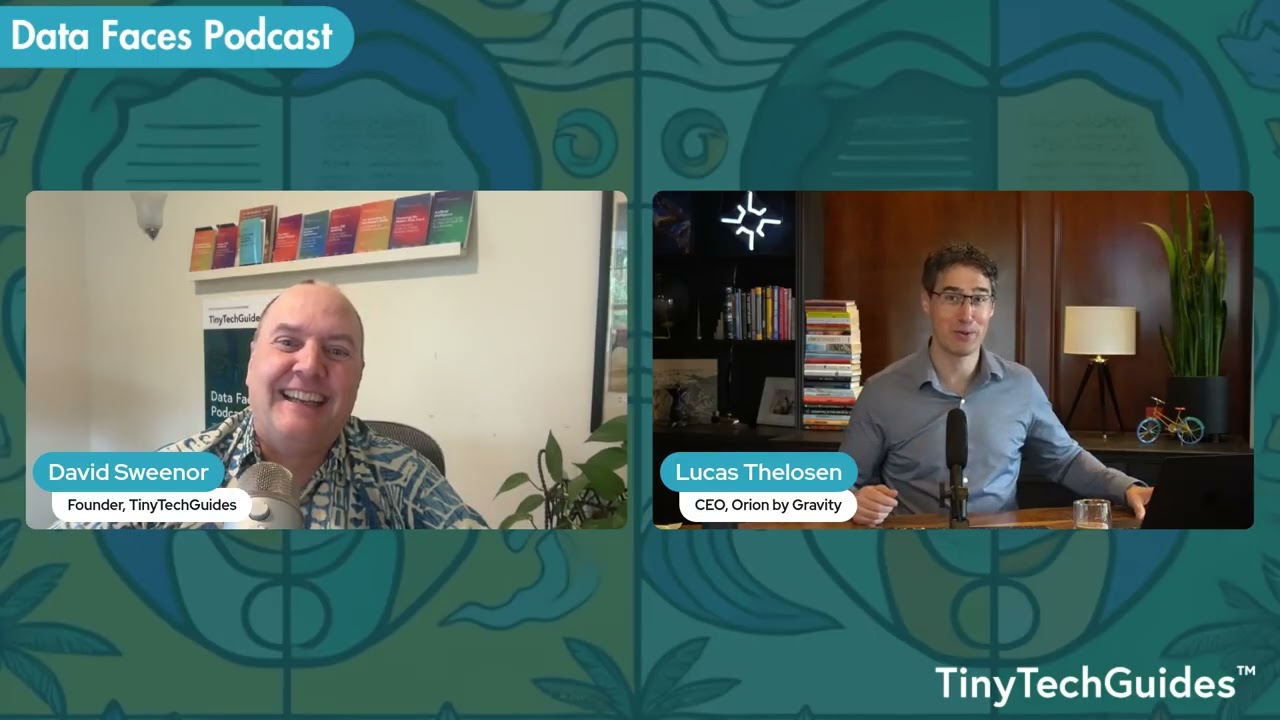
David Sweenor 0:06 Hello, everyone, and welcome to the Data Faces podcast. I’m David Sweenor, founder of TinyTechGuides and your host for today’s show. In this show, I talk with the people who are actually making data, analytics, and AI work in the real world. What’s exciting? What’s messy? And what’s coming next? Today, my guest is Lucas Thelosen. He’s founder and CEO of Gravity, the company behind Orion, an AI analyst. Lucas has been around for a while. He’s built DAS42, which was one of the largest Looker consultancies. It’s been at Google and he’s done a number of things. So today we’re going to be talking about the future of analytics, what that looks like and what does it take for a business to trust an AI analyst and what happens to the people who do that work today. So let’s dive in. Lucas, welcome to the Data Faces podcast. So can you just tell us a little bit about yourself and your company and what you’re up to over there?
Lucas Thelosen 1:02 Thank you so much for having me here, David. Yeah, so I’m German, as you maybe can tell by my accent, but I’ve been in the U.S. for the last 20 years. I raised four daughters here in Boulder, Colorado. So I’m a proud dad. And during that time, you know, coming to the U.S., I was really focused on analytics my whole time. I started as an analyst in the financial crisis. Not a great time to start any career. So anyone worried about AI right now and the job market, you know, in 2008 was a bad year. um yeah so i started as an analyst but i think the you know the opportunity you get as a young person is always like new technology comes in and and you you roll up your sleeves with that new technology right so for me it was cloud uh cloud was just starting and this massive compute clusters right so i built my first ai in 2010 for countrywide which became bank of america they got acquired and so um it was amazing to see you know actually artificial intelligence in production for a massive use case um yeah and then you already touched on on the journey right i built a consulting company around it that became also the the top snowflake consulting firm still is um and then i joined the executive team at Looker, a business intelligence dashboarding product we got acquired by google and then i led google’s product org for data and ai
David Sweenor 2:18 Wow, so you know a bit about this space, so I’m super excited to have you here. The name of the show is Data Faces, so we like to get behind people in their professional careers. So my first question of the day is, what did you want to be when you grew up?
Lucas Thelosen 2:35 Yeah, so that’s a good question. I have to think about that for a moment. So my dilemma was I love numbers. So I’m actually, like, I love numbers. I always listen to numbers, but I also really like people. And so what do you do? I studied economics, but I really wanted to be an ambassador, if I could be an ambassador, because I thought it would be so cool to see different countries, different perspectives, put me into their shoes, see it from their point of view. And it turns out that also is really, really good if you’re in consulting, if you’re in tech and you’re working with different customers to put yourself into their shoes, feel their pain, understand. they’re coming from and don’t just come in with you know your point of view and and put that onto them right and assume everything is going to be the same so i guess i got to be a little bit of an ambassador right like i mean especially at google when you get to visit all these different companies um or at Looker right like it’s uh yeah yeah no it’s bringing you know numbers and and people together i guess in some ways it’s also what a what a good leader in data does
David Sweenor 3:36 Yeah, it’s actually interesting that you wanted to be looking at your educational background and economics and political science.
Lucas Thelosen 3:43 So there’s a lot to talk about, but we’re going to talk about data. So we’re going to shy away from that. I think that’s a totally different show.
David Sweenor 3:52 So question for you. I’ve had a number of guests on the show in the data and AI and analytics space, as you can imagine. And I’ve heard this phrase every show I’ve been to conferences, BI is dead. And so that’s my first question, is BI dead?
Lucas Thelosen 4:15 Yeah, I mean, you know, it’s always evolving. That’s how I see it, right? Like it is, it is always evolving. I do think, I mean, the one thing that’s different this time is, you know, if you ask the product leader at any of the major dashboarding products, they will tell you in private that actual usage numbers are really low. People don’t, you know, like the average employee at a company is not super excited to go and look at a dashboard, right? Because it, like, how does it relate to the day-to-day? people really want is they want to be better at their job they want to understand how they can overachieve on their goals so i think now with ai you can actually take it that far you can say hey my goal for the quarter is to hit these numbers um you know how can i achieve that so then the an that the ai analyst can then do the digging for you it can run the 120 queries and permutations and whatnot and actually give you those results that are very tangible for your job versus the dashboard which is you know i think dashboards will always be there we need them for team meetings we need them for qbrs and all these things but um relating like digging deep on each number and then relating it to the individual’s person’s goal for the quarter for the month whatever it might be It’s not there, right? You can’t build that many of us. You can’t build enough like that. And so people don’t dig, right? Like you don’t have the time to dig deep. You don’t have the time to understand the tools to ask the questions. So now having actually products that are able to dig for you, but that’s life-changing. That is a real differentiator. And it’s really cool to see how much they have matured, right? Like our own one, I used to race it because I’m a decent analyst, right? I used to race it when we got into an account with a customer. i went and tried to find the golden nuggets you know the thing that said 10 million dollars and orion did the same right and two years ago i was winning but it really quickly changed right like there’s just the data is too messy i can’t handle it right orion doesn’t give up it keeps going it finds the nuggets yeah and so it’s um it’s a great analyst so now that that evolves the role of the of the people of course right now you’re becoming more of a manager of that ai
David Sweenor 6:22 Yeah. You know, it’s really interesting. I’ve been at a number of companies and, you know, as you mentioned, there’s every one of them. There’s thousands of dashboards out there. Not a lot of insight for sure. And so now you have this notion that this personal analyst is going to work for you.
David Sweenor 6:42 You mentioned racing these things. AI makes up a lot of crap, Lucas. So how can we ensure this notion of trust and that the numbers I’m getting back, how should we think about this?
Lucas Thelosen 7:00 It does make up so much. I have monitors here. I have my ChatGPT, my Claude, Orion, all these different AIs running. And so many mistakes are being made. And so meanwhile, people are meeting at the White House to talk about superintelligence. It’s so dumb. It’s really good. I agree with you.
David Sweenor 7:21 There’s an economic motivation over there, I think.
Lucas Thelosen 7:24 Yeah. It’s like it sounds really smart, but it’s not that smart, you know, on things that I know things about or like if I question it. Right. So when we when we build Orion, we built we built it like two years ago. Right. So this was more like a couple of versions ago of all these AIs. And and it was they were dumber. You know, they were even dumber than they are now. So we had to pretty much put deterministic code wherever we can. So to put this into more layman’s terms, maybe like SQL is great for extracting data from a database. Python is great for data science workflows. So what we did is like, let’s write the SQL ones, let’s write the Python ones, let’s use the AI to actually understand the question and help with a beautiful generation of slide decks and dashboards and collateral, but let’s not use it for everything. There’s many ways we can use non-AI technologies in between. Yeah. And so and then, of course, you know, have other agents check each other. So there’s a back and forth between different AIs of different companies. Right. So run a couple of loops. So we sacrifice speed a little bit to make sure there’s always 100 percent accuracy. And of course, that makes it a little bit more expensive, too. But I think in analytics, right, like, OK, if now, you know, getting this dashboard created and it’s perfect, that now it costs ten dollars versus three dollars worth it.
David Sweenor 8:48 Right. Right.
Lucas Thelosen 8:49 Yeah.
David Sweenor 8:50 okay um i have this in you know back in the bi dashboard era You know, we had all these dashboards and you’d go to a meeting and someone would say, here’s the answer for this particular problem. And someone else got a different number from a different dashboard somewhere else. And so now with this analyst, so we had dashboard sprawl, right? That’s none of it. And now with these agents, I’m going to have a personal… It’s going to be working for me. And what if you have the same agent is hyper personalized to you? Are we going to get the same answer? This notion of are we going to still have this? a very personalized, confidently wrong set of answers. How do we get harmony across the data state we’re looking at?
Lucas Thelosen 9:44 Yeah. So the way if we see data analytics as a linear workflow, like you ask the question over here and then it goes through a series of steps and you get the outcome here. Like within our product, the way we do it is like the question is being digested by an AI and it’s personalized to you. So it certainly is and understands you and how you want things. But then it goes through the same sequel, the same Python that was set up for everybody who has similar questions, similar metrics, similar teams. They all share this. We have this amazing brain visual in essence, like a metrics tree. Um, and then it comes back out. And when it comes back out, it’s again, personalized to you. But the in between is shared across teams. It’s shared across departments. So the numbers that come out are the same, the way it talks to you, right? If you want it to be like, I don’t know, talk like for me, right? I’m German. I need three bullet points, four words each, you know, like, uh, that’s, that’s my communication style. And that’s how it will respond to me for you. It might be a little different, but the numbers will be the same.
David Sweenor 10:47 Okay. and that’s super interesting and so is there this i think i saw uh like a little post from you on linkedin about um there’s going to be evolving roles in data and analytics i think you said data products and then context engineers if i if i remember correctly so do you i guess my broader question is you know how how are jobs going to evolve in the data analytics space
Lucas Thelosen 11:12 Yeah, and that was one of the last papers I wrote as I was leaving my position at Google when my job as a head of product was really thinking about where things are going to go. I think, you know, there’s a major change in the job market and it’s happening rapidly. With these, I just spoke yesterday at the university here to the data science program. And I think it’s a really challenging thing to internalize. The university still is selling you degrees in these fields that are rapidly changing and they’re charging you a lot of money for it. So what do you do? My argument would be that you become a context engineer like that. Like if you are a context architect, because it is really an architecture, like I already see emerging trends of there’s personal context, there’s team context, department context, company context. And how do I, how do I promote things upwards as a mature, very similar to how we thought about semantic layers, you know, like it’s, it’s an essence. Semantic layers maybe gets you 40% there, ontology, data dictionaries. But now it’s much more about the span of control. What does this person care about? What are their goals? All these other things that make for a really good analyst, which you usually get when you are with a company for a couple of years. We need to now systematically document that so that the AI agents can use it. So your job becomes context architect. You are overseeing that. And on the business side, right, if you’re more like how I was in my career, you become a data product manager. You manage data like a product with a roadmap and a vision where things are going to go and how can you mature the organization? How can you move them from what to why and optimization, right? Like that has always been the goal. So like make that make that your your job title, right? And just own that there’s going to be less and less data scientists and just straightforward analysts because the AIs are really good at it.
David Sweenor 13:03 So are you suggesting I change my LinkedIn profile now because it was prompt engineer last year should be it should be context engineer this year?
Lucas Thelosen 13:11 Well, or you could be, you know, every, every little boy’s dream, you could be the senior human in the loop.
David Sweenor 13:19 I love it. I think that’s a better title for me. I do like that. Can you have too much context, Lucas? Everybody’s talking about context, and the amount of metadata out there is a lot more. I don’t know what the factor is, 100x, the normal just data. Can you have too much context? Because everybody’s talking about context and context and context. I keep adding it for different use cases. You can see how this could be overwhelming.
Lucas Thelosen 13:45 Yeah, I mean, think of it like a new hire coming to an organization, right? If you say, hey, you know, take this stack of books and read it. That’s too much context, right? That’s too much, you know, like, because in the end of the day, sure, it’s all helpful information to have, but what do you really want me to focus on? So, you know, write context at the right time, even when the context windows are massive, right? Like you don’t want the AI to over-index on something that it read somewhere in the middle of the stack, you know? So write context at the right time. I actually, for my own self, I have this context mind map. where I have all these different things that I think about and which context becomes relevant when. So it’s all compartmentalized and depending on which use case, the AI is pointed to the right context to be pulled into the task.
David Sweenor 14:33 Okay, super interesting. I’ve noticed, you mentioned the earlier versions of AI, they were dumb and you’re right. I’m pretty impressed with the analytics capability now of, you know, whether using Claude, GPT, Gemini, pick one, you know, I’ve used it to do, say, survey analysis. And it picks out some things I’m pretty sure I would have missed. So we have… people using these services for analytics. And we got the big juggernauts out there, Databricks and Snowflake and others. So why do we need another tool? Is there a reason for you to exist? I guess is the question.
Lucas Thelosen 15:17 Why do we exist? Why are we here? That’s right. Yeah. I mean, there’s a couple of reasons. First of all, you have AI providers whose goal it is that you use as many tokens as possible.
David Sweenor 15:29 Oh yeah. They keep asking me more and more questions. I’m like, it’s like, I’m like, it’s like, go do this. And it’s like, I’m going to use say Claude and Chrome. I’m like, no, just access the API. You have access to my WordPress or something. Just go get it. You don’t need to do this stupid stuff.
Lucas Thelosen 15:42 No, exactly. They want you to burn as many tokens as possible. And then the database providers want you to burn as much compute on the database as possible. Right? So you have two companies, two gigantic organizations on both sides whose goal it is to be as inefficient as possible.
David Sweenor 15:58 Right.
Lucas Thelosen 16:00 That’s a nice way to put it. So do you want, like, would it make sense to have a product in the middle that optimizes the two things, right? Like, and that’s where we come in, right? We, you can connect ChatGPT and Claude and Gemini to Orion, right? So you don’t have to go into a different UI. You can also connect Slack to Orion. So you can just say at Orion and Slack. And then it goes through Orion. Then there is a really nice thing about having a purpose-built product because it gives the data team a cockpit to control context, where context is applied, which questions are being run, who is running it, how is it being organized? So you have full visibility and control. So there is this added layer between optimizing tokens and optimizing database consumption. You also have a control pane that you can use. And then we have advanced caching. So one of our customers, like we were just telling us as a publicly traded company, they saved over 60% on the database costs after they switched from their legacy BI product on Snowflake to us on Snowflake, which is massive. I mean, that is for them, you know, it’s millions of dollars. because we have a caching layer built in that is not in the database. So a lot of questions can actually be answered straight from the caching layer. It builds incrementally. So and it’s super fast. It’s much faster than running it to the database. So your business users can actually get responses back in seconds. You know, like I think for three seconds or so, where most of the I mean, you know it from chat GPT or so that you wait a while, which is unfortunate, not just burning a ton of tokens, but also you have to wait. so um there is a reason to exist between the two it does feel like we’re in a massive arena with giants here that are constantly trying to step on us or don’t even think about us
David Sweenor 17:53 Right, right. Yeah, okay. And then what becomes the role of the analysts, the people that were doing the analysis and, you know, I’ve heard, I’ve worked for a lot of analytics companies and there’s always this analytics for everybody or analytics for all. And you don’t need to be an expert to use this stuff. Do you, how do you think about this and how should companies think of, do I have to have skill or is it, is it dangerous to put somebody that has no experience in doing analytics, you know, any analytics work in charge of doing the analysis?
Lucas Thelosen 18:23 yeah i mean i think you know i said i mentioned like the like being a good context engineer i think is really good also like being a product manager that thinks of your the data experience of your business user as a product like a service that you’re in essence selling or presenting giving to your business users it is still really helpful to be a good analyst and be like yeah this makes sense because as you set up right as you set up orion or as you set up a conversational analytics platform you do need to also give it some feedback initially. Like, this is how we do things. This is not how we do things, right? And it does take a couple turns to get it to how your company thinks about forecasting.
David Sweenor 19:01 But this is business knowledge. It’s not necessarily how to do the math, right? This is like, how does your business work?
Lucas Thelosen 19:06 Yeah, the math, that is pretty set. I mean, that is pretty good.
David Sweenor 19:10 Yeah, I mean, I got my financial calculator here, so that does my math just fine.
Lucas Thelosen 19:14 yeah now the math you know creating cohorts and i mean there are advantages ai has over us like one is you know like i tended to always just have as many columns as my screen was white because you know like like you can only like this is my screen over here right like that’s pretty wide like after that i don’t want any more excel spreadsheet columns you know the same for dashboards like people kind of stopped when it hits the bottom of the screen right right When the number is green, nobody looks at it. So, you know, product analytics and BI tools tell you that nobody drills down on a green number. But sometimes you can actually find really good information if you guys just go like three layers down and everybody focuses on the red numbers. And so this is red blindness. We focus on red.
David Sweenor 19:56 Right.
Lucas Thelosen 19:56 And AI doesn’t. AI looks at both. Right. Because it has infinite time.
David Sweenor 20:01 Okay. All right. Very, very, very interesting. So, you know, I want to maybe talk A lot of businesses in different domains, there’s a lot of regulation, whether we’re talking about finance or healthcare, insurance, et cetera. Are these things auditable? It kind of goes back to the trust, but sometimes you got to stand by what you’re putting forward. So how should companies think about that?
Lucas Thelosen 20:31 yeah yeah that is actually um really interesting so when we talked before about like you know you have chat gpt and gemini on one side and databricks and snowflake and BigQuery on the other side right like why do we exist in between um one of the advantages of having this cockpit and control pane and plane I think I’m saying the word wrong, but the thing in the middle is that you actually have a glass box that you can open up. You can see which assumptions it made, the confidence it has on each assumption. You can see the queries it ran, and everything is logged, everything is documented. Of course, we went through all the security certifications. but um yeah we are we are working with um publicly traded financial services companies right like so um there’s everything is locked and everything is documented and you can see it all there’s full trip there’s no black box okay the glass box the glass box exactly i like that i had not heard that term before i’ve always used the term black glass box that makes total total sense to me
David Sweenor 21:31 Oh, man. So, you know, in the market in general, kind of what’s nobody thinking or talking about as much as you think they should? You know, you’ve talked to a lot of, you know, customers and prospects. You know, what are people missing?
Lucas Thelosen 21:45 well so this this gets me to the very beginning you know chat gpt came out and um it was a chatbot right like and so everybody added a chatbot i was like come on like the number one pain point customers in the in the enterprise space have from the business to business space is actually the administration of the technologies so why did you not build an administrator, why didn’t Salesforce, the first thing they did, build an AI that administers Salesforce for you? Right. Wouldn’t that be the first AI you built?
David Sweenor 22:21 Exactly.
Lucas Thelosen 22:23 So that was that was one of the things we built right away, which is like something that makes sure that if, you know, like everything bloats over time, right? Everything is. So can you actually keep the product lean and optimized so that, you know, dashboards that are not used anymore, slide decks that are not used anymore, are consolidated with dashboards that are used, right? Can you make sure that if there’s any conflict and definitions, you actually highlight that to the administrator so they can resolve these conflicts, right? All these maintenance tasks that make, you know, there’s a reason why people switch every three years from one product to the next. It’s because like there’s this maintenance bloat, right?
David Sweenor 22:59 Sure.
Lucas Thelosen 22:59 And so one of the first things any real AI product should do is having that as a default thing like that itself administers and helps maintain itself, prunes itself, right? So I think that’s crazy. Nobody talks about that. The other thing… It is it is somewhat related. So we are all talking about context right now, of course, you know, context, context.
David Sweenor 23:21 We have to have a buzzword.
Lucas Thelosen 23:23 But but the thing like we have actually done context in the past, right? We called it documentation back then.
David Sweenor 23:30 A bunch of outdated wiki pages that nobody read.
Lucas Thelosen 23:32 Yeah, exactly. So one of the things that we learned from that, right, like we did a great job in my past company on this was one thing we can do now, which I call ambient learning. So ambient learning means you can put Orion into different Slack channels, into different team, you know, whatever your favorite chat application is. And it just listens. And when it detects that there is a shift or drift in thinking, it suggests additions or modifications to what we call the knowledge base, the context. And it’s a maintenance part of context. And it’s absolutely necessary, right? Every organization that ever wrote documentation down realized that a year later is outdated.
David Sweenor 24:15 Yeah, absolutely.
Lucas Thelosen 24:17 And I have not really seen anyone have this ambient learning and constantly reflecting, is the context still up to date? We’re working with this large retailer and they declared that instead of focusing on shoes, they’re focusing on apparel like shirts and whatnot for this quarter. Now that needed to be infused in how the analyst Orion actually does things because otherwise it would point out that shoes are the top performer and we should focus on shoes. And why are we putting mushroom dollars behind shirts the whole time? But knowing that that is the quarterly goal, you don’t document that in a semantic layer. You need to document it in your AI analysts context window and which dashboards does this apply to, right? Like that’s what Orion does for you. It tells you, I just picked this up. I heard about that. Do you want me to make this modification so that we highlight other things in our slide decks and dashboards?
David Sweenor 25:08 So this thing is, is it scanning your emails and Slack? I guess, I mean, certainly up to the organization on what I can listen to. I feel like we’re getting more resistance to all these recordings and things listening to us. And my phone is giving me ads for things that I don’t think it should know. I’m sure it’s listening to me. I think they’ve been sued, but you know. Are people concerned about this?
Lucas Thelosen 25:34 No, so we do it on team channels, you know, where you have like a marketing team, you add it to the marketing team channel, you add it to the sales team channel, right? Like, yeah, you certainly want to, I mean, it’s, you know, everything of course is locked, you know, seriously down. The models never learn from it. All of these agreements have been signed. But yeah, we added to it because it’s hard to separate signal from noise. Like it’s a real challenge. You know, like, I mean, common use case is that people give their meeting note taker, you know, they connect that to Orion as well. So Orion has context from the meeting note taker, we don’t ask you to add it to meetings. It’s just like the summary from the meetings is enough. Yeah. So we just do that. But yeah, it’s always hard to separate signal from noise. And, you know, the more much to your question of is there too much context, right? There’s also too much too many rooms to be part of and too many too much chatter to pick up on.
David Sweenor 26:27 Yeah, and setting this context brings up an interesting question. So in the realm of BI and dashboards, it’s always been rows and columns. And now you’re talking about unstructured data, whether it’s meeting notes, chat histories, and things like that. Is it? Is that a missing element, you think, just in general, in the sort of the BI market? We focused on rows and columns, but it sounds like your solution, Orion, can look at other unstructured data to help inform what it should be focused on.
Lucas Thelosen 27:01 yeah it can um like we have done it for a big amusement park for example they were looking at reviews you know tens of thousands of reviews and what are people saying and where do we maybe want to focus on does it correlate with how food was purchased right like so there are or like whether you know it’s weather related at all um so that is beautiful now you can truly like things you can’t join specifically you can actually now cross analyze you know bringing it together through ai agents um and that opens up some new opportunities like that haven’t been there before yeah which is a i do think the vast majority is still focused on structured data analysis uh you know supply chain analytics marketing analytics all those things but we can now bring in somewhat unrelated trends that don’t need to be in structured data
David Sweenor 28:02 Right, right. And so does Orion need things beyond this? I don’t know if a semantic layer is the right term, but you know, data definitions, like what’s a customer, what’s revenue? Does it need other things? Or do you consider that that’s all just part of the context?
Lucas Thelosen 28:10 yeah so yes i consider it all part of the context but so we don’t necessarily need a semantic layer to start with right like if you have a database connection similar to other products we go through the query log we define you know we can apply a confidence interval to the definitions and it matches the numbers back to past reports that you had so if you have a couple screenshots of your legacy product orion can replicate that and make sure the numbers match up And then it can walk you through where it’s not clear on definitions or where the confidence interval isn’t high enough. And it can ask you to clarify how it should define revenue or new customers, right? If you have something like a dbt model file or so, you know, of course, LookML, you know, all these other semantic layer tools, super helpful. It gives it a leg up, but not necessary, right? It’s not needed. But then beyond that business context that tends to be not quite as documented, right? Like we connect to a bunch of these like Confluence or like other other repositories where you might have documented it before. You can also just give it some spreadsheets, of course, but slide decks. You can upload it into Orion and it figures it out. And then it walks you through where it has questions, where it isn’t certain. So you can just have a conversation with it, just like a new hire that you’re told to read all these things.
David Sweenor 29:26 The stack of books behind you.
Lucas Thelosen 29:27 Exactly. Give it a couple of minutes and then you can have a conversation about it. And it will tell you how confident it is. We actually have this concept of warp drive. Really quick. So warp drive, you know, like this is right out of Star Trek. It is. Yeah, there you go. So yeah, so we have so we yeah, so exactly. So the one of the challenges, right? It’s like we want business users to have fast answers 100% accurate. and so what orion does is like as you set up the marketing team and the sales team and whatnot it applies like how much context it has now and how like did do we reach the bar to engage warp drive so we’re actually able to say now we can go into second response time so we can actually move to super fast because orion orion figured out the 10 000 questions his team is most likely going to ask and the analysis needed for those 10 000 questions and it created this massive you know multi-dimensional cube of vectors and metrics and and it’s ready now we can be split second response time on this approved cube so it’s a very interesting concept to say you know we have now sufficient context enough understanding of your marketing team so we can we can engage warp drive
David Sweenor 30:42 I love that idea. That is super cool. Actually, that brings up another question I had. You know, there’s all these processes that happen in companies that have to happen in a certain way, maybe, especially in like the finance world. You know, there’s a certain way to do close, you know, month close or whatever you’re doing. So. Is there a concept of workflows or this repetitive thing? You want it to occur in almost the exact same way every time. Is there a concept of that in Orion?
Lucas Thelosen 31:14 Yeah, exactly. Everything actually becomes a workflow and you can have the outcome of the workflow be a deliver, you know, be it the delivery of a slide deck before I go to the meetings, you know, a dashboard that is refreshed every Monday morning or something. But it can also be more than that. You can say, you know, like we have customers who is like, I want invoices sent to our suppliers based on over under delivery of certain goods. So it can be very operational analytical workflows. so uh yeah you can see it it’s visual within orion there’s a visual editing tool so it um it takes your initial conversation it shows you don’t shows you the um the different python it applied you know how it thought about this and then the outcomes and where it’s going to be delivered i mean we have like executives that get their monday morning 7 a.m podcast delivered in their email and it tells them how last week was you know what they need to know as they go into the executive meeting on monday morning and it all is in podcast format
David Sweenor 32:08 Okay. Oh, I love that. We should add them to my podcast too. But anyways, maybe the final question on this topic and then maybe one more after, but what does the world look like? I usually would say five years, but things are moving so fast. Next year, how is the world different? What’s nirvana in the analytics market?
Lucas Thelosen 32:32 yeah yeah i hope we will talk more about um administration i know that’s a very boring topic but like how do we administer all of this how do you administer all these agents all this context right because that’s the first thing we built is like we have been in large organizations we know the sprawl and of it all right like so can we make sure that we have a really good control plane um for everybody that is um that’s not really being talked about right now like nobody seems to be worried about all these agents running around doing things employees leaving that set up the agent and nobody knows anymore why why the agent is still running um you know and i think we we have to talk a bit about that because there is of course you know tremendous cost savings in there but also risk right like having this agent still run and do things and not having a central place what’s controlled
David Sweenor 33:21 OK, that makes a lot of sense to me. OK, then I’m going to go back to a data faces question to get behind the Lucas I see before me. What are you either currently reading or binge watching that that your listeners would would find interesting?
Lucas Thelosen 33:39 okay i just read i just like just finished last night uh when breath becomes air and uh it’s a not not an uplifting book per se but okay certainly certainly very um yeah very touching i i highly recommend it to people it certainly makes you appreciate you know all the minutes we have in our life um Yeah, it’s not, I know it’s not about data at all.
David Sweenor 34:01 Well, that’s okay. Cause people have more than their professional professional career.
Lucas Thelosen 34:05 So yeah, that’s, you know, as a, as a dad and just a human being, right. You certainly do have to think about it. And I think we all need to evaluate the opportunities we get in life.
David Sweenor 34:14 Yeah. Okay. Excellent. And so Lucas, where can people find out, find you and find out more about Orion if they’re interested?
Lucas Thelosen 34:21 Yeah, of course you can find me on LinkedIn. bygravity.com is our domain. So if you want to check it out or just Google Orion by Gravity and you will find us there. Yeah, and I would love to hear from people. I always love chatting. As I said, I want to be an ambassador and just talk to people, put myself into their shoes, understand their perspective. So always happy to chat.
David Sweenor 34:40 All right, Lucas Thelosen, CEO of Orion by Gravity. Thank you for joining the Data Faces podcast. It’s been great having you here. Thank you so much for having me. Cheers.