

Data Faces · Episode 53 · October 6, 2026 · 38 min
Clarifeye’s Ken Sanford on capturing expert judgment for skills and agents.

Listen: YouTube · Spotify · Apple Podcasts · Amazon Music
About Ken Sanford
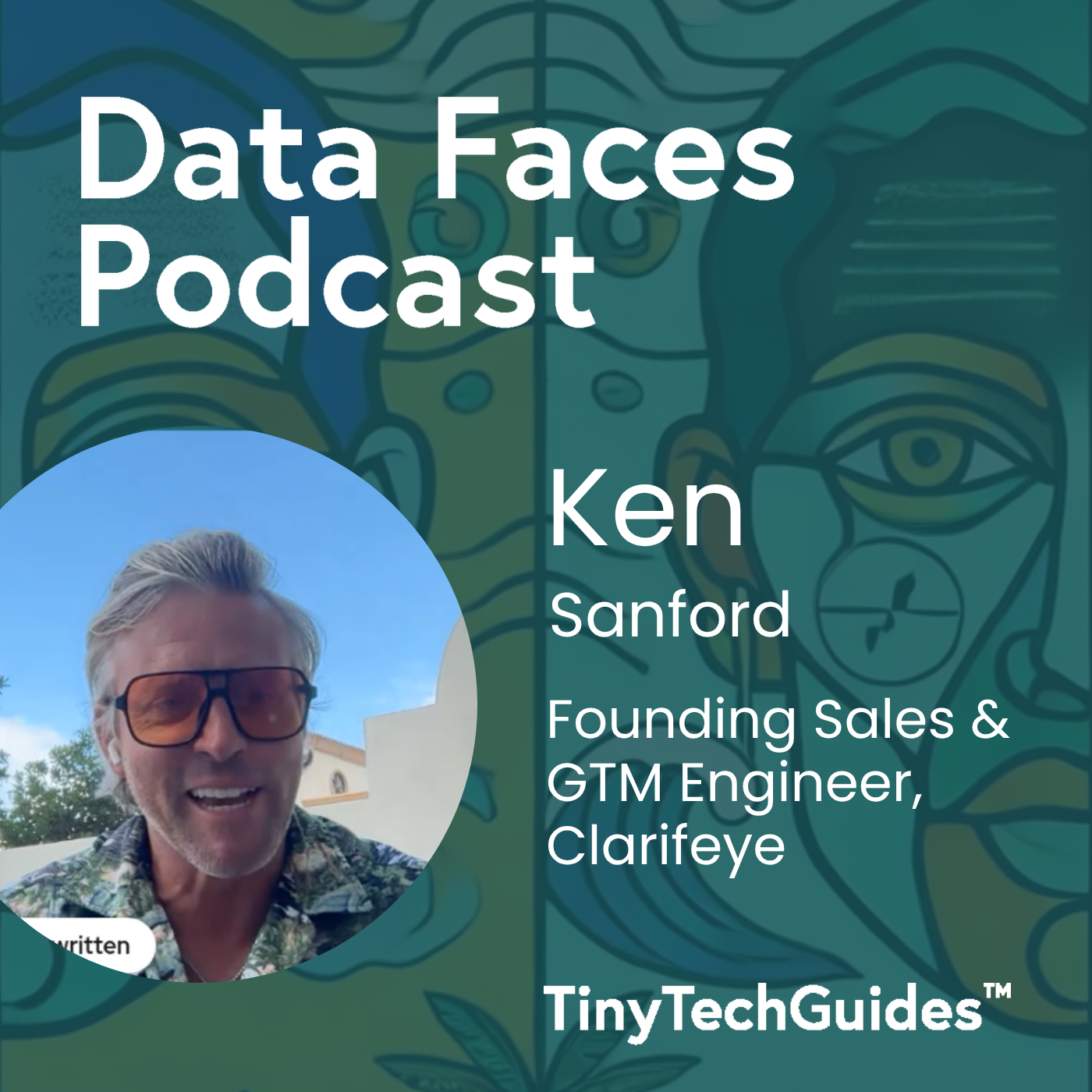
Ken Sanford, Ph.D., leads go-to-market and commercial strategy at Clarifeye, a Paris-based startup that captures the unwritten knowledge in experts’ heads and makes it available to AI. A self-described reformed academic economist with a Ph.D. from the University of Kentucky, Ken spent years in data science at SAS, H2O.ai, and Dataiku, and he and David worked together at SAS about 15 years ago. His first job, at 16, was driving the weekly books of real estate listings around Naples in a 1982 Volvo 240, and these days there is a surfboard in nearly every photo of him.
In this episode
- Why near-perfect document retrieval still leaves AI without the judgment to interpret what it finds
- How an AI interviewer that hunts for edge cases pulls expertise out of people who never wrote it down
- Why the most tech-forward people in a company are the wrong ones to write its AI skills
- How the memories your AI harness builds are your judgment, and why your company should own them
- Where the next generation of experts comes from, and why Ken hires for agency
→ Read the full article: Tribal knowledge is the AI context layer nobody names
Full transcript
David Sweenor 0:05 Hello, everyone, and welcome to the Data Faces podcast. I’m David Sweenor, our founder of Tiny Tech Guides and your host for today’s show. In this show, I talk with the people who are actually making data, analytics, and AI work in the real world. What’s exciting? What’s messy? And what’s coming next? So today my guest is Ken Sanford. He’s an old colleague of mine from SAS. He’s a reformed economist with a PhD from the University of Kentucky. He’s been around the data science world for a bit. He’s been at SAS, H2O, Dataiku, and a number of others. And today he leads go-to-market strategy at Clarifeye. So Ken, welcome to the Data Faces podcast. It’s great to have you here.
Ken Sanford 0:45 David, good to see you, my friend. It’s always a pleasure to chat with you. It’s a lot. Yeah, I mean, what are we, 15 years-ish?
David Sweenor 0:57 It’s been a while. Hey, I appreciate the support with the brand, the Hawaiian shirt, the glasses. You’re outside in a nice tropical location. So kudos to you, A+.
Ken Sanford 1:06 What do you mean support? This is my typical, this is every day.
David Sweenor 1:11 We’re going to get to that.
Ken Sanford 1:12 Except the glasses are an added absurdity. All right.
David Sweenor 1:17 There we go. So, hey, for people who don’t know you, tell us a little bit about yourself and what you’re doing, your company, Clarifeye, what you’re doing over there.
Ken Sanford 1:26 Sure. So as you mentioned, I’m a reformed academic. So I somehow managed to go from economics into more and more data science stuff and spent a lot of time at SAS and a number of other data science companies now with Clarifeye. And so as a late stage co-founder of the company, really what we do is capture unwritten knowledge and make it available to AI. And so if you think about what’s the last step to making AI work the right way, in a world where you have near perfect retrieval of documents, within documents, you have to come up with a way to interpret it. And so there’s always going to be nuance. tribal knowledge living in the heads of experts that define exactly how AI should render decisions on documents. And what we are committed to is helping companies, helping people extract that information and then make it available to AI in a sensible way.
David Sweenor 2:29 Okay. Well, that’s fantastic. We’re going to do a little deep dive on that in a few minutes. But before we get there, we like to get to know the people behind their LinkedIn profiles. Now, yours is pretty unique. There’s a surfboard, I think, in every single picture. And you’re giving away at trade shows, I see. So that’s pretty cool.
Ken Sanford 2:49 I tell you what, this is what happens when you let me, like let an economist try to create a booth property and surfer. You end up with giving away bizarre things at the booth. Everybody can give away iPads or AirPods, but we brought a collapsible surfboard, which actually did have some… tie first uh it’s uh it was a friend it’s a french startup making these surfboards and we’re a french startup making uh knowledge uh these these our knowledge system um but also uh you can use our tool for onboarding and off-boarding people and of course there’s the there’s the tie into the surfboard so it worked great we had hundreds of people come up and and have conversations and uh you know, 40 or so post conference meetings. My last few weeks have been very busy, but fortunately the surfboard worked.
David Sweenor 3:42 That’s super cool, Ken. So, so to get to know you a little bit beyond your surfing expertise, what was your first job before your professional self existed?
Ken Sanford 3:57 This is before our acting career, right, David?
David Sweenor 3:59 Well, I have a question in here about, was Iron Man 2 or 3? I can’t remember. It was 3. Movie star extras. That’s right. I made the cutting room floor. I’m pretty sure I was not there.
Ken Sanford 4:10 I don’t think I made it either. They actually asked me back. We’ll get into this in a second. But they asked me to come back and do a tiny part at night. And if you remember that day, it was… yes it was it was a whole day it was brutal like sitting in a room you weren’t allowed to have your phone you weren’t allowed to do anything you just had to sit and stare at the wall because of course they didn’t want any of the the iron man knowledge out of the world right and we just sat there all day long anyway they asked me to come back and i said this is this is awful i’m never gonna i’ll never do this again you know and it was i think i mean it could have been a real part i could it could have been you and rdj and i know hanging out man what happened gosh we come down to wilmington spend all night don’t sleep i said no i have a job what am i doing all right so first job first job back uh was actually this one’s fun Do you remember how MLS, how real estate listings used to be like pre-internet, pre-web used to, there would be a book of real estate listings every given out to realtors. And so my first gig, like I think I was maybe 16 and I just got my license, was to take these giant phone books, put them in the back of my old 240 Volvo. Well, in 1982, 240. And I’d load the back up with these phone books, basically, and drive them around all the real estate offices in Naples. And I mean, it made me into a decent driver, I guess. But at the same time, you know, it’s almost absurd to think of that. That’s how real estate listings were given out. Like, you know, every week you’d have a new book and then there would be updated prices and information and then. Anyway, that’s that first gig that I can remember. Boy, the world is different.
David Sweenor 5:58 It certainly is. Well, thanks for sharing that, Ken. I’m super excited to have you here today because this morning for a client, I was interviewing a partner of a client. And actually, they talked about… data quality, and I asked them what was missing. And the individual said, well, you know, tribal knowledge and what’s in people’s head. And this was like three hours ago. And when I went to the CDOIQ event in Boston earlier this year, I did 24 different interviews with data leaders and AI leaders. And I concluded… that no one is focused on unstructured data and nobody, and I didn’t even really put two and two together for the tribal knowledge. So tell us why this is so important for companies.
Ken Sanford 6:46 Sure. So first off, it is very important to take your unstructured information and turn it into something that is machine readable, AI readable, structured in the right way. So combination of vector databases, graph databases, all very important. That’s the starting position to build a good RAG system which will retrieve information inside your company. But the real challenge is, How do you add context around that information? Sure. And how do you get that travel knowledge out of the heads of experts? And so there’s ways to try to do this. One of them, of course, is to use sort of an indirect capture, go into Slack and Teams and Confluence and attempt to recreate context inside of those environments. reality most of the really important things uh most of the intuition the judgment was never written down so how do you actually get that well uh we’ve devised a uh an interview system which is data aware context aware up to some point in time And an assistant called Clara actually pushes edge cases, hunts for exceptions. She’s constantly looking, almost think of it as creating hypotheticals, which an expert would then render judgment on. And by rendering judgment, we create a more deterministic environment for the LLMs to matriculate over.
David Sweenor 8:20 And when I was looking at the website earlier, you know, it said, Clara, you know, helps you finish the project. So, like, what’s the project? Like, what’s the goal? Because, like, you know, we have this abyss of the world of possibility. And how do you give it, like, focus on what it should look at and understand?
Ken Sanford 8:41 So each of these interviews are… fairly highly parameterized. Of course, if you choose to be, there’s a mode of Clara where it’s purely brainstorming. But more often than not, think about how a consultant would begin a project to document a business process. They would have a certain set of steps that they would go through. And so Clara attempts to mimic that as best as possible. So there is some parameterization to the interview process.
David Sweenor 9:13 Okay, and does it call you on the phone? Does it Slack you? Does it email you? How does it get this bot? I mean, I don’t answer my cell phone, so if it tries to call me, I’m not picking up, just letting you know, unless you’re in there.
Ken Sanford 9:26 I mean, so we just created a brand new voice mode that actually allows for a phone call. As you can imagine, sometimes the phone call is not the cleanest way to have Clara interact with the end user because the… the prompt, if you will, the question can potentially be quite long, right? So some interviews are good from a phone perspective. Some of them are just easier to read and respond to. But what we spend a lot of time with is gamifying the interview process to where it doesn’t feel burdensome, where it’s five minutes a day, 10 minutes a day. But again, you don’t have to ask people that many questions when Clara becomes context aware. of all the other documentation that exists. Right. So if you take all your prior transcripts, if you take all your even your skills that you build inside of Claude right now and start from that, then then the amount of hunting can be pretty targeted. And so basically filling out these artifacts, which. You know, it’s oftentimes they come in the form of reasoning workflows, ontologies, business process maps, things like that. You know, that. Shit, I lost my train of thought. Sorry.
David Sweenor 10:51 Well, it was very important, Ken. Don’t worry about it. Don’t worry about it. So are people resistant? to talking with a bot. I know my kids talk to Claude all day. I’m like, well, you need some real friends. So where are people on the spectrum?
Ken Sanford 11:11 Interesting. David, as shocking as this might be, the first person to talk to me about dealing with their kids talking to AI too much. I’m curious about this. I mean, as an expert in the field, how are you approaching this?
David Sweenor 11:28 Are you interviewing me, Ken?
Ken Sanford 11:30 I want to know. I want to know.
David Sweenor 11:31 It’s actually pretty tough because the world’s knowledge is there, but you can coach it in whatever direction you want. And it lies all the time, too. So I tried to tell them, hey, it’s very sycophantic. It tells you, hey, that’s a great idea. You should do this. Oh, that’s a great idea. You should do this. They’re often conflicting advice. So I said, use it as a tool. Yeah. But you got to do your own homework beyond what that is. Maybe you should go try Gemini next. Is that a quad or something?
Ken Sanford 11:58 Right, right, right, right. Interesting. Yeah. It’s tough.
David Sweenor 12:02 Yeah. So are people that are being interviewed by your assistant, are they reticent? Are they… Don’t care?
Ken Sanford 12:12 What’s their sentiment? There is occasionally, at least early on, mild resistance. But I will say that once people begin to actually think about what the harnesses are doing behind the scenes… you begin to realize this is what all the harnesses are already doing. They’re just being less obvious about the way that the hunting is occurring, right? So every time you interact with an LLM inside a harness, you’re creating memories and those memories are ultimately your judgment. And so it’s the exact same thing, except we’re a little more obvious about what we’re doing, right? We’re just giving it, we’re giving those artifacts, which again, our memory is artifacts, but we’re giving those artifacts to the end user as their own IP, right? So a company now has the ability to store their own IP and move between harnesses, right? So the ability to then shift at any moment in time from one platform to another. or one model set to another. Many of our customers, we find we get higher quality answers when we downgrade the model and use fewer tokens, basically.
David Sweenor 13:29 So how does this work? So a customer or a new customer comes to you and they have a set of… business processes that they want to understand? Or like, I’m just trying to like, how does, how do companies like, where do they start? I mean, they’re like, I need this thing. Is it onboarding? Like, what are they doing?
Ken Sanford 13:48 So the onboarding, offboarding starting point tends to be a good one for proving up the… possibility, efficacy of using interviews. But I would say that the most likely, most urgent need that companies have often is around a project, a specific type of transformation project. And oftentimes that’s coming in the form of a software migration project. So if you think about what a software migration project, you know, to make this sort of really make sense, imagine you have a consultant helping a company implement, say, NetSuite from, say, a merger. So I’m trying to blend two different NetSuite systems into one larger integration system. A consultant traditionally interviews different stakeholders inside of a company about what kind of reports I need. the current state of the system and once you understand the current state of the system then i have to plug it into the future state of the system and what Clarifeye actually will enable is that entire process to be not only documented but actually um accomplished uh with with ai so basically uh Clarifeye becomes a big translator moving from current state system to future state system that’s a that’s a pretty tradition we’re seeing a lot of repetition in that So actually the applications are, we’re a horizontal platform. So it works for any application, but we’re seeing that bubble up as a more urgent need, right? So project specific transformation.
David Sweenor 15:20 Interesting. So I’ve had some previous guests on the show and, you know, we’re talking about, you know, one says one guest said, hey, your AI is done without the data. And the other said, you know, it’s context. But it sounds like here you almost have like a third layer. It’s like it’s like the reasoning. and business rules experts. Is that something… That’s exactly it. Is that how you view it? Is that how you view it?
Ken Sanford 15:45 I usually think of the things as being all the explicit and all the implicit, where implicit previously was really in the heads of experts. Increasingly, more and more of that context is being… You know, it’s being built from indirect sources, Slack, Teams, Confluence, messy or noisy things. What we really do is elicit additional unwritten information. So really parts of knowledge that were never documented.
David Sweenor 16:17 Yeah, I find this fascinating. You know, we’ve all heard about knowledge bases and, you know, wikis are outdated as soon as they’re written. So is this something you have to… Wiki’s a push, right?
Ken Sanford 16:31 Wiki… Right.
David Sweenor 16:32 You have to continually update this, Ken, or…
Ken Sanford 16:36 So it’s both, right? So certainly the Clara interview process allows for constant updates. of interviews, so you can take them as frequently as you need. But Clara’s real advantage is she’s working behind the scenes to try to find knowledge gaps and try to find discrepancies between, say, how two experts would treat a similar problem. And she’s going to actually create a signal, and that signal needs to be arbitrated by some knowledge owner. And so the Clara experience is literally surfacing… surfacing discrepancies constantly from the harness, right? So as someone, the way that ultimately end users often work with us is calling from Claude or ChatGPT at the same time, the Clarifeye knowledge store, which is effectively, it’s an MCP to knowledge. And then if at any point, the end harness user overrides or conflicts with something that I’ll give you a great example. I was using one of our own internal knowledge stores And I kept getting the word, I kept having to build blog content, right? Yeah, sure. And so it kept using the word ship, all right? Because AI loves to use the word ship.
David Sweenor 17:50 Among many other words.
Ken Sanford 17:51 And I can’t stand it, like it drives me nuts. And when humans start talking like that, I know they’re using too much AI, right? My new thing is when I talk to people and they say the hook is, or here’s the fact, or some like ridiculous crap, I know they need to take a break, right?
David Sweenor 18:08 We’re going to delve right into this, Ken.
Ken Sanford 18:11 So ship, right? So ship is one of those words. Like we’re shipping more stuff. And I’m using Clarifeye from the harness. And I said, don’t ever do that again. And so what happened was at that point, Claude sent Clarifeye a signal. that inside the knowledge store, that needs to be explicitly written as a brief and eliminated in certain different artifacts inside the platform. And so next time I walked into Clarifeye, I saw Signal and said, you need to resolve this. Is this true? Like, do we want to kill the word ship? And then I said, yes. And she went in and fixed all the artifacts. And so that’s the always-on component to this. And of course, it’s collaborative. So somebody else might like the word ship, and then we have to resolve that.
David Sweenor 18:58 Very interesting. I had a question for you. So we see all these headlines about AI and jobs. And I always feel like leaders of companies, they’re talking about, we’re going to improve productivity. And so we’re going to use AI to do whatever. And they’re thinking, I think maybe behind the scenes, hey, we can reduce our workforce by a certain percentage. Now, with this, do you think these leaders ever think of AI could replace themselves, or are they a special snowflake, Ken, that only them has this? And with something like this, maybe we could get in their head. I’ve always wondered that, because the person that thinks of it, they’re special.
Ken Sanford 19:50 It definitely gives you a way to quantify intuition. in a new and different avenue. So whether the leaders, I mean, again, I think it’s, to me, it’s an opportunity. It’s almost like prideful, which is maybe the right, maybe, you know, we all know it’s kind of a sin here, but it’s like nice to be able to document your thinking and then actually be able to say, this is how I think about problems. Being able to hand that intuition over to other people, I think is a superpower. And one of the things that I love about the way that we the way that we are documenting is we’re very much a pull. Right. So if you look at the way that skills are built, skilled in the Claude skills are built inside of organizations today, it’s often done by the most tech forward people in the organization, which is not all bad. But the challenge is, is those people are likely not the ones with the 25 or 30 years of intuition. Right. And so that’s a big problem. You want people inside of organizations building the skills who have the intuition for how the skills should work, not the people that happen to be staying up all night. um playing on playing in chat gpt right like they’re not the ones they’re not the ones i want building skills i want my my 25 30 year old 30 year mature folks in an in a particular job doing that And so how do you do that? Well, you make it, you make it pull as opposed to push. Right. And so effectively that’s what we’re, that that’s how we’re putting this into practice.
David Sweenor 21:27 That’s interesting. You said handing it over is a superpower. I had to write that one. Now we’re going to have to go test this and talk to some, some leaders. And can I, I’ve got to maybe a double click on your 25 to 30 year old veteran besides like nursing or firefighting. Who’s at a company for more than five years these days.
Ken Sanford 21:46 I mean, I don’t know, but you and I share a common employer that I think has quite a bit of tribal knowledge that I think could be captured.
David Sweenor 21:57 It rhymes with the word ass.
Ken Sanford 22:01 Yes. I just wanted to be clear. I so badly want to have an engagement with them. And I call all my friends over there and say, guys, we have the solution to your…
David Sweenor 22:16 to uh the the all the the people leaving problem not leaving but retiring you know sure sure they’re of age okay well so you know this this notion of expert so let’s just say we could we can codify some of our expertise and ways of thinking um if if Clarifeye can encode their judgment into an agent, so to speak, where does our next generation of experts come from? And what is left for me to do? Maybe you could teach me to surf because I’m feeling like I’m on the precipice of having a lot of time on my hands.
Ken Sanford 22:53 Full disclosure, I’m about eight years, seven years into it. So I’m definitely not that good. So you asked about where does the expertise in the future come from? I think about this a lot. with writing academic papers. And so much of the process of writing an academic paper is doing those lit reviews and trying to uncover all the folks that have thought in a way similar to yours before. And so what’s my contribution? And I think about it as how would I ever develop this How would I get back to the same level of knowledge, in my case, about optimal pricing as I did from before? And then I think… know maybe it’s just an accelerant for for getting to the the stand on the shoulders of giants so i think we’re just our fear is where are the next experts coming from i think what’s happening is we’re creating um such specialized expertise which is not a bad thing right like the the uh next generation of economists will very quickly get up to speed on everything that everybody else has done. And their level of creativity will be just at the cream. And they won’t waste so much darn time rehashing stuff that we all know has already been done. it’ll just i think we’re just going to create a sort of a race of ultra specialized experts they’re just going to be really really specialized everybody will be great at one little I think as long as you have curiosity, if you don’t have any curiosity, you’re probably.
David Sweenor 24:41 Yeah, that’s actually, you know, the skills question always comes up. And, you know, I don’t you know, my background was in physics and I remember doing all these hand integrations and like 20 pages later, I have zero equals zero. And I’m like, this is a Zen moment. i don’t know what that meant but i know you didn’t want anything else but zero equaling zero you knew you knew you did it right but i don’t actually know what it what it meant um am i better off for used to knowing how to do integration. I can’t do it anymore. I don’t know.
Ken Sanford 25:14 Isn’t that a terrible moment? I sometimes have those.
David Sweenor 25:17 I mean, I looked at my notebooks, but last time I moved, I’m like, this is my handwriting, but it was like hieroglyphics. I’m like, I don’t like upside down triangles and crosses. And I’m like, it’s going to be on the pyramids. And I just, I couldn’t decipher it at all. It was weird how you lose these things. you do you do i i feel like at some point i gotta i have to go back and take another calculus class i was trying to describe how useful it was to somebody the other day and i i glitched for a second like it came back but it took a took a second it does it does but so you know given this your so your premise is you think people are going to be hyper specialized so to speak and i’ve had other other guests and you you mentioned the term curiosity as well which is more of a general skill so when you’re like if you’re looking to hire people, you know, and, and whatever you do, what kind of skills do you look for? And I know like people will say like, Oh, communication and collaboration, which are great, but that’s not the crap you see in the job description at all.
Ken Sanford 26:16 I think I, you know, the, the best I can, the best thing I can, I mean, obviously curiosity is important, but, but agency, you know which I like. Yeah. I like folks that just ask for forgiveness as opposed to permission because they try stuff out. There’s definitely an entrepreneurial FAFO group of people, kids these days that I think have some of that. Sure. Yeah, I guess we know what FAFO is. But anyway, they like that. And I think the AI world encourages that. There’s also an alternative group of people that have less of that. And so I guess deciphering who has… who asked for permission and who just does stuff is is is probably uh i think a pretty pretty valuable skill you want people to get it done so it’s like a night commercial yeah it’s just expensive you know i was thinking about uh i was also talking to a buddy about um companies that that are succeeding with AI and the ones that aren’t. And believe it or not, I still talk to companies and they got VPN issues and they only get to use co-pilot.
David Sweenor 27:30 And it’s just so bad for those people.
Ken Sanford 27:32 And I’m thinking like, Oh my God, just quit, just quit your company because you, you are. You’re so far behind if you can’t just buy whatever software you need and expense it. That’s the only way that this is going to work. Or you have to make sure at night you go home and blow your tokens with saying up all night with Claude. If not, you’re really getting far behind. I see these big companies. You asked what’s going to happen. It’s probably not till some second round of integration where there’s so many acquisitions of these tiny companies and then they ultimately change the internal behavior, right? I mean, we’re a team of 12. We’re growing. We could grow. I think we could grow 50 fold and not hire a single person. That’s awesome. That’s how you… that’s this new world right is is is that that there are there are new companies that are just exploding with with i don’t want to call profitability but like exploding with with creating value um And it’s going to take a long time for the giant health insurance companies of the world or the, you know, the old school retailers of the world to experience that.
David Sweenor 28:56 They will, but it’s going to be displaced by someone who’s, you know, more, you know, born.
Ken Sanford 29:02 Yeah, I mean, they’ll buy them. You know, you know how this is going to go. You’re going to buy them. But but, yeah, eventually, eventually the kind of. lovable type growth, you’ll eventually, you’ll see that inside of, you know, they’ll just replace the old company. It’ll still be called, whatever.
David Sweenor 29:22 All right. I had another question about Clarifeye. So I think I read somewhere that you have these like process blueprints that come out of the engine that are version history, they’re auditable, like… seems like very old school way of doing things. And like, why didn’t you just jam it all into a vector store or something like that? Or do people want to see this?
Ken Sanford 29:49 A lot of it is for human readability, right? There’s human readability creating… Creating a more deterministic set of steps is something that we do hold near and dear. The simpler you can represent that information, the more likely it is that the LLM might follow some of these rules. That’s a huge chunk of it. We certainly have a very intense RAG system inside of the tool, but for representations of unwritten knowledge, we generally think of it as write it, write it old school, pen and paper, write it, write it down. And you’re exactly right. So business process maps show up. Reasoning workflows are pretty human readable as well. And then, you know, the artifacts are only constrained by your imagination. So Clara built a number of artifacts that are sensible, and then you can specialize, make them as specialized as you’d like.
David Sweenor 30:43 Okay, all right. I want to ask you…
Ken Sanford 30:46 You should try it. So one of the fun things, David…
David Sweenor 30:49 Yeah.
Ken Sanford 30:50 …for me is, use it to build your own personal career. Like, you take interviews about different times in your career and then build out this personal career knowledge base. It’s got so many fun applications. You can, of course, make resumes real quick. You’re going to hook me up. We’re going to do it. It’s super fun, right? Because you remember things about your SaaS experience or, you know, time at H2O that you totally forgot, right? And you get to write it down and it makes its way into your resume or job description or just, you know, somebody wants to… I’m almost at the point where if somebody wants to hire me, I’m like, here’s my job. Here’s my knowledge base. Like, have fun. Like, ask questions. And if you… If you find conflicts in it, then you know I’m full of BS, right?
David Sweenor 31:40 Right. Oh, my gosh, that’s funny. I will try this. I have sort of a prediction question for you, you know, so you can’t look at a news feed today and not see something about how I think we’re on the. Like before it was like, AI is going to really help humanity. I think we’re at end of days on our prognostications today, a greater than 10% chance or whatever the hell that prediction was. You know, what’s your take on this? I think a lot of these come from people that I think there’s a lot of… other motivations for saying some of these things. But I work with AI a lot as well as you, and it’s dumb. It’s dumber. It’s really good at some things, and it’s totally stupid at other things. So just what’s your, as someone, an expert in the field, what’s your take on kind of where we are in the, say, the next, where’s it going in the next year or two?
Ken Sanford 32:35 End of days? No, definitely not. Not in the days. I mean, you have to, This was came up in another conversation. You have to kind of back it into a corner in order for it to start acting in a in a nefarious way most of the time. Right. So and no one would not really would back it into a corner, you know, unless you’re trying to make it breaks up.
David Sweenor 32:57 You’re trying to try to break it. Yeah.
Ken Sanford 32:59 So so, you know, I do think those a lot of the talking heads are are, you know, sort of selling papers. Right. So it’s. well i i did i did send somebody i said i said expert marketing right there i just sent him a headline from like the washington post or i don’t know one of these newspapers and like a expert marketing right there so so you know my my prognosis around around most of this is that um i mean i i’m i i don’t think i don’t think that this is a More often than not, I don’t think there’s going to be these really bad outcomes. I have a lot of hope that in certain industries, health, we’re going to make major improvements in the quality of life, certainly around drug discovery and just keeping track of behavioral information. I hooked up the GPT health thing the other day. I’m not fearful at tapping into my Epic or Epic accounts or whatever. That’s fine. I always think of all these problems as to the uninitiated, New York City is a very dangerous place. right because there’s there’s there are there are probably more bad actors there than anywhere in the world like it can but there’s also many many many good actors and there’s so many people and so many eyeballs on it that it’s one of the safest places to be because you can’t really get away with stuff right and so i think of privacy and data in a very similar way we’re um The more eyeballs you have on it, the more things you have connected, the less likely that you’re going to get hacked for these bad reasons. That’s sort of my… It’s been my thesis very early on, and I maintain that, I think.
David Sweenor 34:58 I like this. You’re a techno-optimist. So I have maybe one more question related to my first question about your first job. And then we’re going to find out where people can find you and more information. The question, this came from some listeners and viewers that said, you should have got to ask more questions about the people. So what is your favorite… either TV show that you’re currently binging or book or something that you’re reading?
Ken Sanford 35:27 Because people are like, oh, I would go watch that and read that if so-and-so said that.
David Sweenor 35:31 So what do you want to do, reading or watching?
Ken Sanford 35:34 Well, let me go book. Let me go book. One of the ones that I think is… It’s just great. It’s called West of Jesus. And really, it’s not a religious book, per se, at all. It’s about a… Stephen Kotler is a writer that, you know, I kind of think of him as like the Malcolm Gladwell of Flo. Okay. He was, you know, wrote for the New York Times. And then… In the book, he had always surfed when he was younger, but he got Lyme disease and he came back to surfing. And what he kind of found about surfing was that he was treating his own depression and sadness and illness. And it sparked this curiosity in him to then study optimal experience. And so flow state, which is ultimately what he’s discovering in the book, which has now been his sort of passion the last 15 years. is, uh, you know, he, he chronicles the, um, the discovery of, of, of flow in himself. And, uh, but the book is just, it’s phenomenal. But for anybody who has, who loves the water, um, it’s such an easy read. It’s, it’s, it’s great. So I’m throwing out a weird one. Okay. Well, no, that’s fine. Just stay on brand.
David Sweenor 37:05 No, that’s okay. We’re going to, we’ll throw that in the show notes. And so last one can, um, before we wrap. Where can people find you and find more about Clarifeye if they’re interested?
Ken Sanford 37:15 Yes. Okay. So Clarifeye.ai, spelled exactly as E-Y-E, right? That’s a great way to find me. kenneth.sanford@clarifeye.ai is the email address. And of course, you can reach out on LinkedIn. Pretty easy to find on there as well. Or just bug you, David.
David Sweenor 37:35 Well, look for the guy with the surfing picture on LinkedIn and you’ll find you.
Ken Sanford 37:39 You know, I wish I got to do it as much as it looks like I do it, you know? And I found, honestly, it’s been one of the best things from my career because everybody either has done it, wants to do it, or is one. And, you know, then there’s a brotherhood, sisterhood, and then you’re in. So it’s been a really good thing. And it gives you something else to do aside from, you know, playing on AI all day.
David Sweenor 38:08 Right. Perfect. Well, Ken Sanford, leading go-to-market at clarifeye.ai. Thank you for joining the Data Faces podcast. It’s been great to have you here.
Ken Sanford 38:19 David, thanks for having me, and I’ll talk to you soon. Cheers.