

Data Faces Podcast — On Location · CDAO Fall 2026
Shapor Naghibzadeh, co-founder and CEO of QueryStory, on 15 years of cybersecurity at Google Chronicle, the “hard and crunchy outside, soft and gooey interior” problem agentic AI is about to repeat, and why giving agents your credentials is the wrong model.

Listen: YouTube · Spotify · Apple Podcasts · Amazon Music
About Shapor Naghibzadeh
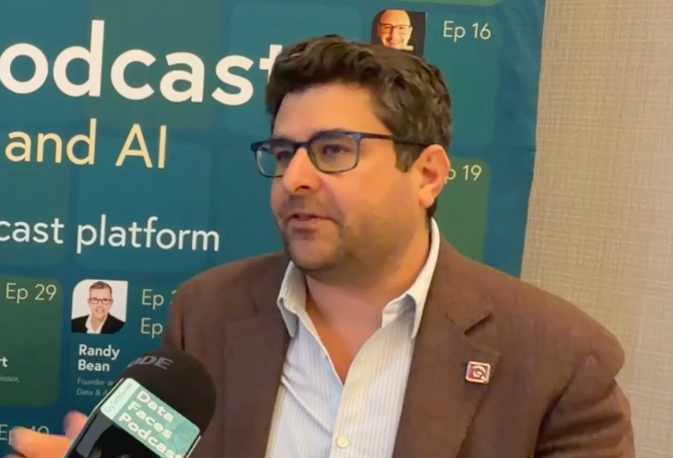
Shapor Naghibzadeh is co-founder and CEO of QueryStory, a full-stack data platform for agentic analytics. He spent 15 years at Google building the data platforms behind Chronicle, Google’s cybersecurity operations business, where he led teams designing zero-trust architectures for enterprise security data. QueryStory came out of stealth in August 2026 with a model that treats agents as narrow, job-specific operators under intent-based access control, drawing on the investigation-and-narrative pattern that defines modern cybersecurity work.
In this interview
- Why zero trust maps directly onto agentic AI
- The “hard and crunchy outside, soft and gooey interior” problem agents inherit from firewalls
- What “vibe analytics” is and why it creates agent-dashboard sprawl
- The access control gap that lets agents export the whole customer list to a thumb drive
- Why specific agents for specific jobs beat autonomous agents with your credentials
→ Browse all on-location interviews: Data Faces Podcast — On Location
Full transcript
Shapor Naghibzadeh 0:01 All right, here we go.
David Sweenor 0:05 Hello and welcome to the Data Faces podcast on location. I’m David Sweenor and we’re coming to you live from CDAO Fall in Boston, Massachusetts. This is the show about people making data analytics and AI work in the real world. What’s exciting, what’s messy, and what’s coming next. Today I’m here with Shapor Naghibzadeh. He’s co-founder and CEO of QueryStory. He spent a lot of time at Google Security, and now he’s got a new startup that came out of stealth we’re going to talk about today. So Shapor, welcome to the Data Faces podcast on location. Thanks, David. So for those who don’t know you or QueryStory, tell us a little bit about yourself and what’s going on over there.
Shapor Naghibzadeh 0:49 Yeah. So, you know, like you mentioned, I spent many years at Google building data platforms for cybersecurity specifically. Okay. First at kind of Google, kind of corporate Google, kind of before the days of Google Cloud and started a company called Chronicle that became Google’s cybersecurity operations platform. Okay. And what we’re doing at QueryStory is taking a lot of the lessons learned from many years in kind of fighting the good fight in cybersecurity, using data to do that, and data analytics, and bringing that to the rest of the world, right, in different, you know, outside of cybersecurity, in different kind of use cases, and you know, within a business. Okay, well I’m super excited to get into this, but before we start, the show is called Data Faces, so we like to get behind people in their professional careers so first question to you is what was your first job before the LinkedIn profile existed yeah good question if I go way back I the Wayback Machine let’s hop yeah yeah the Wayback Machine I you know I I was always into technology time I was a little kid we had a Commodore 64 computer growing up so I got you know kind of somewhat proficient out of necessity and kind of you know page one was like basic programming okay so I learned a lot about you know how to make computers work so I was always kind of helping folks in the neighborhood like friends co-workers of my parents like fix their PCs back in the day where You needed to reinstall everything every couple months. Spent a lot of time re-imaging Windows 3.1 computers and kind of doing that as odd jobs.
David Sweenor 2:37 So you’re an entrepreneur, fixing computers, like tech support.
Shapor Naghibzadeh 2:40 I guess so, yeah. Like the original Geek Squad, I think. Yeah, for like $20.
David Sweenor 2:46 Which was a lot of money for a kid. Okay, all right. Well, this is going to sound like a bad joke, so let’s just say you walk into a room full of chief data officers. Given your background in security, what’s the first thing you notice that they’re not worried about?
Shapor Naghibzadeh 3:02 Yeah, that’s a really good question, too. there’s, I mean, it’s, everyone sees what’s happening with AI and like what we call like vibe analytics, right? Sure. You know, it’s not just data. It’s everyone in the business connecting their, uh, you know, AI agents to data. I got God running right now. That’s right. Yeah. And, uh, I think the thing that everyone sees is this sprawl of content that’s getting created from just saying, hey, create a dashboard for me. So that’s the obvious problem of where did this data come from? What’s the lineage behind all of that? But I think the thing maybe that they’re thinking about less that my security brain turns on about right away is, so you’ve connected this software. don’t really, I mean, you certainly don’t fully control, it’s generating code and executing it, can access your data, and it can also access the internet. Right. So there’s like a major security boundary concern there, you know, where it’s, and we’ve seen, and this isn’t like theoretical, right, even the big labs, you know, constantly talk about the risk here, right, that these models, you know, essentially you can kind of guide what they do, but it’s very difficult to control where data flows. And even when you try to restrict things like internet access, if there’s any little hole that’s left open for whatever purpose, it can find a way out, right? And it’s your data that should be, you know, kind of tightly guarded and has access to the internet. There’s a non-zero chance that things that you don’t want to will get out there.
David Sweenor 4:47 Right, right. Okay. So… I think you talk a little about, you know, trust in that, you know, architectures, you know, maybe you need to abandon the trust in model outputs. So, I mean, how should people think about this when they’re designing a gentic architecture? Because to your point, if there’s a leak, they can get out. Now, I have my doubts on some of the news cycles, you see, where like, oh, well, it escaped from like, you’re kind of pushing it in these directions, you know, maybe. Yeah. That was my hypothesis. You know, what should people think about, I guess, when they’re starting out on this? Because you’re right, there’s a lot that could go wrong. It could go wrong very quickly. You don’t want to be on the front page of New York Times, Washington Post, Boston Globe, I guess.
Shapor Naghibzadeh 5:41 Yeah, I mean, the way I think about it is the way the shift in thinking in cybersecurity happened, call it 15 years ago, when we really started thinking about this idea of zero trust. Right. And for non-cybersecurity folks, maybe they’ve heard the term before. We’ve heard it, but I don’t quite know what it means. Yeah, so we used to live in this world of firewalls, right? Like, you know, everyone had their… We’re in a safe zone. Yeah, their work computer, you plug it into the computer at work, you get access to everything, that’s great. If you’re at home, use a VPN. There’s a, you know, a firewall around all the things that you care about, and the bad guys can’t get in. Sure. Right? You know, what the thinking shifted to is like, okay, well, the problem there is that whenever there is any small gap in that firewall… Yep. you lose everything. Right. So we would, in cyber security, we would joke and call it the hard and crunchy outside and soft and gooey interior problem. Right, right. And so we adopted this model called Zero Trust. Okay. Where it wasn’t about whether you were inside or outside, But based on the credentials of the end user, how trusted the device that you’re on, you make a kind of determination of whether that user action has access to the specific piece of data that you’re looking to access. That’s zero trust. There’s no implicit trust in the fact that you’re on the network. And so if you apply that same thinking to agents, it’s about not trusting the output of the model, like zero trust for model output, which means you need to…
David Sweenor 7:21 So this is beyond hallucinations where people take it for granted. It could be wrong. You’re like, I don’t trust it at all. Yeah.
Shapor Naghibzadeh 7:27 So the idea is that you treat the model the same way you would a complete, like an adversary, right? That’s right. you know entity and you have to then uh make a determination based on a bunch of context right the intent of the user what specific piece of data is being accessed and you know guard rails around things that cannot be uh you know violated by the output of the model itself so like for instance you basically set a set of permissions on what the agent is able to do that is rigid. It cannot access this table. It cannot touch the internet at all. You have to basically secure the the action of the agent based on strict infrastructure controls. Right, right. Not just, you know, suggestions in prompting or a skill to say don’t do this. Yeah, in a slide of instructions.
David Sweenor 8:28 I know when I, personally, it’s interesting because personally, like, had this set of instructions, like, don’t do this, do that, and if I switch between, you know, Gemini CLI or Codex or Cloud Code, I’m like, well, why did you go from step one to 18? Well, I didn’t think I needed to do it. So to your point, it’s not just that it’s not prompt.
Shapor Naghibzadeh 8:45 Or the behavior of the underlying model changes that is completely outside of your visibility or control.
David Sweenor 8:51 Okay, so that zero trust. And I think I read somewhere that this concept of blast radius and minimizing the damage of what could potentially happen. Does that feed into this notion of zero trust? Is that part of it?
Shapor Naghibzadeh 9:10 That’s exactly it, Ray. You want to basically use infrastructure controls to strictly control access to what’s possible during the execution of the feature.
David Sweenor 9:23 Is that onerous on the user, right? Because we’ve always had this, you know, we’ve heard for years, you know, shadow IT or whatever you want to call it, right?
Shapor Naghibzadeh 9:33 Yeah.
David Sweenor 9:34 And Sometimes these things arise because I can’t get my company to give me access to, say, Cloud Code as an example. So I’m going to go use my personal account. So I’m curious, is it onerous on the user? And as you see it, promote this shadow IT or whatever it is, these rogue ways of doing things. Because my company has so many restrictions in place, I can’t get my job done.
Shapor Naghibzadeh 10:00 Yeah, no, I mean, that’s an excellent point that’s related as well. Because one thing, I think, in spending many years supporting Google internally, when you hire a bunch of smart people and you put controls in place, they, just like these really smart agents, will figure out ways around them. People will, too. And so I think the, you know, what… organizations and kind of IT and security teams within companies need to think about is how do we reduce the friction as much as possible and do things securely? Not just make it the default way of operating, but make it the best way of operating, right? If you have the ability to do your job really well with the set of tools that is provided and governed by the organization, then why would you go through those extra steps of bringing in a kind of personal account or trying to figure out a way around restrictions? And I think there’s definitely an opportunity for IT organizations to do that today. It, I think, requires a little bit of planning and thinking through what’s the best set of tools. The default of, hey, I’m going to hook this up to my data, but I’m going to do it in a secure way. Because it is a lot easier to have an agent that’s hooked up to the data and working and allows you to do analysis than it is to copy and paste across a security boundary. Okay.
David Sweenor 11:29 Here’s an interesting question that, you know, I was at a conference last week. We ran an agentic roadshow, but we had a lot of people talking about we have agents talking to agents. They’re having meetings with one another. They’re putting meetings on your calendar. It was a little bit hilarious, and I wouldn’t get into that too much. I’m curious about permissions. If I have the right to do something, access something, I give it to my agent, it inherits that right. That agent maybe hands it out. How does that whole thing work? I think there’s a lot to think through there for companies.
Shapor Naghibzadeh 12:08 Yeah, and I think part of it is that… It’s somewhat early days there in the infrastructure that’s available to do enforcement the right way.
David Sweenor 12:19 Let me just say, on that discussion we were having at dinner with someone, they’re like, well, this agent didn’t have access to the S3 buckets to do whatever. And so it asked, this agent did, and so this one shared the credentials with that one. I don’t know if they should have or not. And I just was like, huh, never thought of that.
Shapor Naghibzadeh 12:38 I think what a lot of this agentic security brings up is actually somewhat a failing in access control that we’ve had for a long time. We might grant access to someone, to something for a certain intent, right? Like I might give you access to a customer database because you’re a support person and you need to look up some amount of customer information. Sure. Right? However, I’m not really granting you access of taking the whole customer list and exporting it to a thumb drive and taking it home.
David Sweenor 13:12 Right, right.
Shapor Naghibzadeh 13:13 So our permissions controls haven’t been granular enough. And the issue with agents versus people is that they don’t, like you kind of, By giving you access to that, I have trust that you’re not going to do that to some degree. But you don’t really have that with agents. You don’t know how that intent changes. So one of the things I think that we’ll see evolve is this increased rigor around access controls and how they are applied within organizations, and specifically around how agent access control is enforced.
David Sweenor 13:51 That’s interesting. I’m curious. So just that one example of, just say, a customer list of whatever. So I have this right to access 10 customers. Does that permission follow the asset as it goes? Can you build it? I don’t even know if it’s even technically possible. I’m just curious. Or is it just kind of it goes back to the source and always looks at that? Or is it something more like the permission set follows the…
Shapor Naghibzadeh 14:16 Yeah, I mean, there definitely needs to be, I think this world where we just let the agents operate with our credentials is the wrong model. No bueno. It’s the somewhat, hey, we want to get stuff done today model that we’ve kind of started off on this kind of agent journey with, but that’s clearly, you know, you don’t have to look that many steps forward to see where that breaks down. Okay.
David Sweenor 14:43 Okay. So how does your startup, QueryStory, that came out of stealth, I believe, in August, how does that help with this stuff?
Shapor Naghibzadeh 14:51 Yeah, I mean, one of the things that we do, I mean, to give some context, we’re a kind of full-stack data platform. We do everything from bringing data in, doing ETL on data, doing exploratory data analysis to figure out the size and shape of it, allowing users to do analysis on that data, and then ultimately tell stories with it. That’s where the name comes from, Query of Stories. It’s about asking questions, coming up with some ideas. The whole model comes from the world of cyber security where you’re doing investigations often, asking questions, coming up with a thesis, assembling that into a narrative, and then telling a story on what happened. In that process, we’re using agents along that entire path. And they’re not… fully autonomous agents that can take any action. They’re specific agents for a specific job that operate under a certain set of permissions. And they’re not able to cross the trust boundary because they’re constrained. You could do a lot of the same things using a much more autonomous agent that can kind of do anything. Right. But that kind of brings up all the problems that we’ve been talking about. Right? Yeah. So, you know, very essentially agents that are rolled out in a very controlled kind of permissions restricted fashion to do that securely.
David Sweenor 16:20 Okay. Well, very cool. I have one more data faces question for you. I didn’t prep you for this one. So this comes from our viewers and our listeners. in general, what are you either currently binge-watching or reading that people might find interesting?
Shapor Naghibzadeh 16:42 Oh, man. I mean, binge-watching, honestly, I get such small snippets of time. Yep. Binge-watching is usually YouTube shorts. Okay. Of some kind of… AI-related content, little clips. That tends to be my little time filler in between. All right. But yeah, not a lot of, I don’t know if it’s a disappointing answer, but not a lot of long-form shows. Okay, that’s fine.
David Sweenor 17:17 That’s fine. So, Shapor, where can people find out more about QueryStory and if they have questions, how can they follow up with you?
Shapor Naghibzadeh 17:26 Yeah, I mean, we’re out of stealth, so we have an actual website now, not just a landing page, at QueryStory.ai, and you can find us there.
David Sweenor 17:35 All right, well, Shapor Naghibzadeh, co-founder and CEO of QueryStory, thank you for joining the Data Faces podcast on location from Boston, Massachusetts. Thanks, David. Thank you, sir.