

Data Faces · Episode 17 · July 29, 2025 · 35 min
97% of companies struggle to show AI value. Rich Mendis on what the 3% who win do differently.

Listen: YouTube · Spotify · Apple Podcasts · Amazon Music
About Rich Mendis
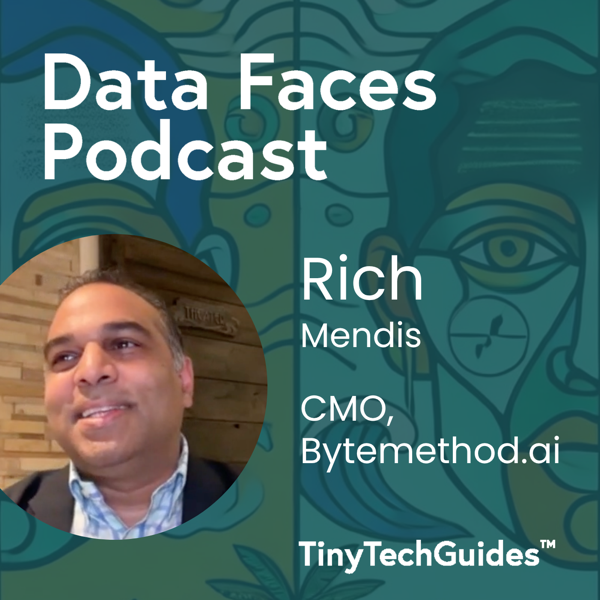
Rich Mendis is the Chief Marketing Officer at Bytemethod AI and has been in the AI space for nearly five years. He previously worked at Higher Logic, applying AI and agentic AI to HR and staffing, and is now helping Dexion — one of the top 10 IT services and staffing firms in the country — build out its AI subsidiary. He has been involved in developing responsible-AI management systems and standards like ISO 42001.
In this episode
- Why 97% of businesses struggle to show AI value
- What the 3% who win with AI do differently
- Agents in the enterprise — reality vs. hype
- Applying agentic AI to HR and staffing
- Responsible-AI management and ISO 42001
→ Read the full article: How 3% of companies win with AI while 97% fail
Full transcript
David Sweenor 0:00 Sweenor,
David Sweenor 0:05 hello everyone, and welcome to the data faces podcast that brings the human stories behind data analytics AI marketing to the forefront. I’m David Sweenor, founder of TinyTechGuides, and your host for today’s Convo. So today I am lucky to be joined by rich Mendes. He is the CMO at bike method AI rich brings a sharp perspective on how AI is being adopted in the enterprise at the height he knows what’s going on. So we’re gonna talk about AI agents, how buyers are thinking about them, and what it’s really like to bring AI in the business workforce. Let’s dive in, Rich. Welcome to the databases
Rich Mendis 0:36 podcast. Hey, David, thanks for having me. Good to see you again. Yeah, thanks for joining.
David Sweenor 0:41 So tell us a little bit about yourself, your company, and you know what you’re what you’re up to?
Rich Mendis 0:45 Yeah, I’ve been, I’ve been in the AI space now for coming up on just about five years. It was at a startup called Higher Logic, where we are applying AI and agentic AI to the domain of HR and staffing, and now we’re part of a larger organization called dexion, which is one of the top 10 IT services and staffing firms in the country, and helping them build out an AI subsidiary called bite method AI
David Sweenor 1:14 that is amazing rich, so maybe a bit of a surprise question. So this part of this podcast is to bring the human stories behind data. So when you were young, did you know you’re going to be a CMO of an AI company, or what did you want to be when
Rich Mendis 1:28 you grew up? I don’t think I knew I’d be a chief marketing officer. No, I I always enjoyed the entrepreneurial side of things. When I was young, we used to have, you know, do these try and create businesses and that with the neighborhood kids and stuff like that. So I guess startups was inevitable at some point, but I did computer science as my undergrad, so I was always a techie at heart.
David Sweenor 1:49 Okay, so you’re out there, like you had your lemonade stand and all of that going on your
Rich Mendis 1:53 lemonade stand, yeah, and then eventually got into tech stuff, and then lost all my useful skills, and now I make PowerPoints.
David Sweenor 2:01 Well, I’m on the Google Slides, so I’m a little bit more advanced on that one. But hey, let’s talk about AI agent, speaking of lemonade. So I see all these demos, they can schedule meetings for me. It’s a little bit mad, I think. But you know, what does the term mean in a modern enterprise beyond Hey, it can schedule things for you. You know, can they? Can they do more than that?
Rich Mendis 2:21 Yeah, I it’s a good, it’s a good question, you know, obviously there are, you know, early, I would say, you know, early demos of this stuff, and scheduling is one thing that’s always a pain in the butt for a lot of people. And so that’s, you’ll see, common, you know, use case demos. But from, from our perspective, you know, and, and kind of way I look at it is an AI agent, you almost have to think of as like a, you know, a human assistant, that it’s a piece of software that can reason and act autonomously on behalf of a human, likely pursuing like a specific goal that you’ve given it. And it can understand state and memory, and it can interact with other systems or other agents or other people as necessary. And the one important, you know, caveat I like to add into that is it should especially interact with other humans when it comes to making decisions that impact other humans in a meaningful way. Right? So in the enterprise, this could be, you know, we came from the HR space, so, you know, making hiring decisions or firing decisions or legal issues or financial matters, things like that. There’s, there’s, you know, a degree to which, you know, AI agents can do stuff and times when it should come in and, you know, loop in a human to help make decisions.
David Sweenor 3:42 All right, so rich, it’s a great description, so let’s double click a little bit. We both work in marketing. Give me example of like, what an AI agent would look like, you know, perhaps in a marketing function, or,
Rich Mendis 3:53 yeah, sure, it’s so many there’s a company called litho that I’ve, I’ve consulted to recently, they are building AI agents in the marketing space that help in the content operations world, right? So, you know, the most obvious ones, I think, that we all have used are, you know, generative AI to be able to help generate marketing content. But imagine agents that can help funnel that content to the right people for approvals or apply brand voice and brand compliance on all assets that are created and and, you know, be part of that review process, right? Or can help find, you know, existing assets in a digital asset management repository that meet the requests that are coming in. So there’s, there’s lots of different examples, I think, of agents in the in the marketing context,
David Sweenor 4:47 that’s amazing. So do you see the model moving forward? Is it going to be, you mentioned, there could be a number of agents interacting with humans. So do you see the model is going to be like, there’s an agent per task? Are they going to. More specialist or generalist, I think, is what I’m running through
Rich Mendis 5:03 my head. I think, just like on, you know, humans, you’ll have both, right? You’ll have generalist or horizontal agents that are performing a function across, you know, business units, or you’ll have highly specialized or not or and you’ll have highly specialized agents that are performing a specific function, right? So if you take a look at a hospital, for example, you might have agents helping, you know, an x ray technician interpret data that’s coming across. But then you may have a horizontal, you know, agent that’s going across a variety of things to understand, you know, how to do billing in a medical setting, right? And so I think you’ll have a mix of both.
David Sweenor 5:44 Okay, I like that. So given that we’re going to have this army of agents, you know, what’s the one misconception that enterprise AI that you see repeatedly in your conversations? Yeah, I
Rich Mendis 5:57 think, man, there’s so many, but
David Sweenor 6:00 it’s so many, pretty nascent, right? So, yeah, I
Rich Mendis 6:04 think, you know, the two that I would, I would highlight are, you know, people tend to think of this technology as, you know, as a general capability, like, you know, or, like, a product that you can just plug in, you know, like, Hey, I’ve got this AI agent. I’m going to plug it in and do something. But it’s, it’s more like, you know, AI is more of a horizontal capability, agentic AI, like electricity or the web, right? Saying you’re using the web is as meaningless as, you know, I’m using AI. So I think it’s, it’s more about, you know, understanding how to embed, you know, an agentic process into your workflow. You know, give it clean, you know, data. You know, governance, the governance aspect, etc, on which to operate, and give it a task. And I think there’s, there’s a lot of, you know, I don’t want to say hype is the wrong word, but overestimation of capability, right? We are sort of in the early days, like I like to say we’re in the Netscape Navigator days, oh yeah, right days, if you I’m probably dating myself now. But there’s this notion of amaras law, which is where, you know, humans tend to overestimate a technology in the near term and underestimate its impact in the long term, because things change in a nonlinear way. And AI is very nonlinear. And I think there’s, we’re in the overestimation phase right now, where I don’t think it’s so much about what can agentic AI, you know, what humans can it replace, but rather how it can complement it, right? How it can complement humans with humans in the loop and achieve things together. So ai plus human, as opposed to AI versus human?
David Sweenor 7:49 Yeah, I totally that’s how I use them, you know, I, you know, personally, you know. And what I do, I have a bunch of ages that, you know, one knows everything about my business, so I use it for that. One knows everything about the how I write content and I use it for that. So totally agree with you. It’s a co pilot for me. But you know what’s in terms of use cases and enterprise use cases? You know what? What are some real world examples that you’re seeing that are maybe actually deployed in B to B companies?
Rich Mendis 8:16 Yeah, we so we kind of bucket use cases into two categories, design time, use cases, or productivity, right? Which is the configuration and creation and maintenance of enterprise assets, and then the runtime, which is what most people think of when they think of use cases, which is tasks that are helping people perform, you know, perform operations, you know, in their day to day work. And I’ll give you an example on both. So on the design time side eight, you know, enterprises have a bunch of existing software, right? Salesforce, ServiceNow, SAP and so on, and a lot of time is spent by it and development, maintaining and configuring those solutions, right? So, for example, in ServiceNow, you may have a service catalog item or ticket, where you have to create a form, and people are constantly adding and maintaining that, and it takes time, days, weeks or longer to configure it. An agent on a design time side, could be something that understands your requirements around ticketing or any other aspects of ServiceNow, and you can give it your requirements, and it goes and not only can produce the steps required to configure service now, but it can actually log into your service now, environment, develop an environment, and actually go and configure it to meet your requirements, right? So what I like about that example is it’s, it’s, you know, also having the agent perform tasks that you know, humans would manually go do sure in a sort of simulated, you know, environment. So pretty interesting use case with that, and significant opportunity for time savings and things like that on the runtime side. One that we love to talk about is conversational analytics agents. So. So you know, if you think about a lot of business processes, whether it’s updating a CRM, updating an HR system, or whatever, humans you know, have these meetings where we meet face to face, meeting with a prospect, meeting with a candidate, so forth, and then after that meeting, we go and enter data into an enterprise app, right? Sure conversational agents can listen to those conversations, understand the context, look for specific sets of data that you know that’s meaningful, and automatically populate those systems, or take actions or so forth. So that’s another, you know, use case that that we see commonly that we’d like to talk about.
David Sweenor 10:38 It’s really interesting. So that brings up something. I like this. How you framed it, you know, this design time versus runtime. How do you verify that, you know, on the in the case of the service now, where you have a catalog attribute that is putting in the right stuff, like, I know you gave it rules. I talked to the LLM all the time, and it spits out gibberish, you know, probably 50% of the time. So how do you you have to always verify, or do you have another agent check its work? Like, how do you, how do you think about the governance piece of it?
Rich Mendis 11:11 Yeah, well, this, this is, this is a good, you know, leads to a good conversation about kind of, how the models trained, right, how the agent trained itself. So, you know, in the case of, let’s take a conversational analytics solution listening to a live a live interview, for example, where you have, you know, hiring manager interviewing a candidate. You could take a transcript of an interview and throw it into chat GPT and ask it like to summarize questions or things like that, and you’ll find it’s not always accurate, right? Because at the end of the day, that model is trained on only what’s available on the internet and how many companies publish their interview data on the internet for models to train, sure, zero, right? And so what’s important to understand is the process that you know, the tasks that the agent is performing, and the model underlying model it’s using, need to be trained on, whatever that domain or task specific you know requirement is, right? So in the case of the live interviews, you have to go take actual interview data, which, in our case, you know, in the previous company I mentioned, we took millions of interview minutes, organic interview minutes, and trained a model to understand things like, who’s the speaker role, right? What is casual conversation you want to strip out of the you know, interview analysis. You know, if you’re trying to detect the interview questions, you know, how do you skip rhetorical questions or statements that sound like questions and all those things. So there’s lots of, you know, domain specific training that’s required, and this is the same case with agents to ensure that you’re getting the outcomes you want. Is the more more time you spend upfront in the model training, the better the outcome is, and the less, you know, sort of manual verification is needed. Hmm, that’s
David Sweenor 13:00 really interesting. So, like, I mean, I totally get that. And so how do you, like, verify that the outputs of these at scale are accurate, you know? And I come from, as an example, I come from the predictive analytics world. I don’t even know if I can say that word, stating myself, but, you know, you get a prediction. It’s a number. Yep, we understand numbers, and it’s within distribution. We detect drift and if it’s going haywire or not. But when we’re generating text, pictures, image, audio at scale, how does a company even think about monitoring something like
Rich Mendis 13:35 that? It’s really, you know, it’s a very good question. And you know, it from our perspective, there’s three important aspects, right? So one is make sure that you’ve actually trained and tested the model correctly, right? So to the extent that you’ve trained it on the outcomes that you’re really looking for with, you know, reinforcement learning and things like that, that that, you know, you have fairly good confidence out of the gate that it’s it’s working, you know, in the way that you want. The second is making sure there’s, you know, alignment and guidelines there, right? So, for example, we have built chat bots that allow you to ask questions after an interview about a candidate, and you want to avoid situations where you’re asking subjective questions or it’s giving you subjective answers. And so you need, you know, proper guidelines so that you know, even if it you know, so that it doesn’t give you inaccurate answers, right? It gives you, it tells you that it doesn’t know, rather than trying to make something up or hallucinate, that’s a
David Sweenor 14:31 notebook. Lm does something like that. If it doesn’t know, it’s not as corpus you, but it’s like, I don’t know, but I can guess for you
Rich Mendis 14:38 exactly, and then, and then, of course, you can do, right? Some agentic validations. Very interesting. You know, there is more and more frameworks that use agent that sort of enable agents to learn, or that are using agents collaboratively to debate the outcome, right? So I saw an interesting paper last. Week where someone was creating a zero shot, you know, Internet content detection bot to try and understand if the content is harmful. And you know, the classical model is, you have to train it on previous harmful tagged content, right? Sure, yep. But what happens when there’s a new piece of content. So this paper talked about, this is an academic paper, but it’s very interesting. Talked about having two agents debate whether the content is harmful or not, right? So it’s almost like, going back to the original definition of an agent, is something that’s almost, you know, simulating a human, or why not simulate debate that humans would have about whether content is harmful or not, and utilize that, you know, process as part of the output.
David Sweenor 15:46 Oh, I do. That sounds that sounds really interesting. Can I talk? Can I ask? Double click on the training piece. So we know data has been a mess in every organization since the history we’ve been collecting data. How companies like are you confident that they’re going to get their data in the right shape and format so these, these, these llms can be trained properly? I
Rich Mendis 16:14 think this is one of the biggest challenges, honestly, David and it, you know, it’s the reason I say that is it’s one of those areas that’s very easy to underestimate or under invest in, because you’re so eager to get to the outcome and the outcome Right? Like when you first start using an LLM, for example, or an agent, even if you haven’t trained it properly, it appears like, oh, man, this is like magic. It’s, it’s, it’s, it’s giving us some good information, right? But it’s only later on, when you’ve used it over and over again at scale, do you start to realize some of the shortcomings or inaccuracies or hallucinations and things like that. And so what’s really important is investing, and it’s as much of an art as it is a science, to be honest, in the early, you know, part of understanding based on the outcome I’m trying to have this agent or model achieve, what data do I have to, you know, train it on? Do I have a sufficient quantity? Do I have a sufficient quality? Is it properly annotated and labeled and or if it’s, you know, in data, unstructured data for a rag corpus, have I chunked it and split it correctly, right? Yep. And as you know, you know, it’s an abstract problem, like you can easily under invest in that step of the process, and you don’t really realize how that under investment materializes until much later on, after you’ve deployed the solution, and you start to realize, oh, it’s not quite giving me what I want. Or, why does it keep hallucinating in these areas, right? And so I think, you know, the one piece of advice, absolutely that I would, I would give to customers is make sure you, you know, engage the right folks, the experts, either within your organization or from outside, who truly understand the data that’s involved in the judgment making right of the human today that you’re trying to kind of simulate with it, with it, with an agent or with a model. Yeah,
David Sweenor 18:19 I think there’s a lot there. I mean, if I just look at my Google Drive, I mean, I got version 1234, of the same document. I probably should be using version control. That’s a different problem. But like, if you got the duplicate PDF in your, say, rag system, like, how do you know that? So I think there’s a lot. Or even think about little,
Rich Mendis 18:35 little things, like the footers in a document, when, what happens when you put that into a rag corpus, right? There’s all these subtleties that it’s not always obvious, that you kind of realize later on.
David Sweenor 18:47 Okay, so this brings me to the next question then. So we’ve talked about data being a mess, and I think back to my, you know, analytics, data science days, I always tell people, the world runs on spreadsheets. Now we’re talking about agentic AI and AI agents. So what signals should leaders look for inside their organization to know they’re culturally and technically ready, yeah, for these autonomous agents? Yeah,
Rich Mendis 19:18 yeah. This is, this is a great question, and I don’t, I think, you know, my perspective on this is the the readiness state of an enterprise is less, I think, something that you know should be looked for, or, you know, monitored for emergence, and more, something that should be proactively prepared for, right? So, from what we’ve seen, you know, I think two important aspects right? One is having sort of what I would call risk mitigated freedom, right to experiment, like if you want an organization and its employees to be able to find. Find ways to efficiently use AI and things like that. You have to enable them with the tools and the freedom to experiment, whether it’s, you know, with models, agents or what have you, but in a risk mitigated way, which might mean sandbox environments or llms that you know, you know, maybe you take a couple of Frontier models you’ve negotiated contracts with, and you know, they’re not using to, you know, they’re not training those models on your data, things like that, right? So I think that’s really important, one aspect, which is whether it’s, you know, and you don’t have to go overkill on data governance and have all these role based access controls. If you have provenance and lineage and all that stuff, that’s great, but you can just start with a sandbox, give them access to APIs and data to get to get going. The second thing that I think a lot of people miss, and you mentioned cultural, you know, the cultural keyword here is, do you have the right incentives in place at the end of the day, these are humans, right experimenting. Are you going to, you know, tell them that, you know, hey, if you find efficiency, we’re going to eliminate half of your organization, because now you’ve got, you know, something that’s more efficient, right? Or, you know, having too much of the stick, like, you know, I’ve seen some, some organizations almost like force fit AI and measure people, you know, create these objectives, right? And they don’t even understand, kind of, you know, what they’re trying to do with AI, right? And there’s, there’s a lot of data. I think something like 97% of businesses are struggling to show value in aI think because they’re just throwing stuff up against the wall without really much thought to see what sticks right. And so I think, you know, having the right incentives for the employees is also important, right? This is something leaders have to actively cultivate. Hmm, I
David Sweenor 21:40 like this. I think that’s hugely important incentives and the like this risk mitigate. Risk mitigated freedom to experiment that like something, a question came to mind when you mentioned that you think there’s going to be a different type of person that is going to be maybe more prominent or take a more active role in this. And as an example, prior to generative AI, you had to be have a PhD in data science, right? You’ve heard this before, yeah? Now you can just talk to this thing, yeah. And so I’m wondering if you think roles are going to shift, or are people with business knowledge going to be more become more important, and can, can can start to prototype or create these things. I’m just curious here,
Rich Mendis 22:23 yeah, no, it’s a good it’s a good question. I think that, I think that the domain knowledge right has always been important, right? This is like content is king sort of thing, sure. And I think that the abstraction of leveraging AI and AI technology will enable people who are more domain experts in that area, or not subject matter experts, knowledge experts, to be able to leverage AI a lot more easily than you know, in the past, it required you to be, you know, work with the developer right to take your knowledge and implement an application. I think, to your point, the fact that you can simply talk to this, you know, to talk to AI, and there’s all these, design time, assistance, code, coding assistance, design assistance, all that stuff. I think we’re, we’re gonna, we’re accelerating the democratization of of programming right to the point where anyone can write at least a basic functional program. And so I think we’ll enable subject matter experts now, wherever they happen to be in the organization, regardless of their technical ability, to be able to leverage automation in really meaningful ways. I think we’ll see lots of interesting solutions come from people who are not necessarily, you know, kind of your traditional IT developer sort of
David Sweenor 23:42 folks, yeah, you know, I love that. You know, I try to use it for design things. I’m not an artist, but I can get some cool images. I do find I don’t have the vocabulary to get out what I want. I can learn draft, yeah, that’s right, that’s right. Like, hey, here’s a mock up of kind of what I want, and a professional will get it done. But I do want to ask one question about the right incentives, and maybe not. I don’t think go down the rabbit hole too far, yeah, but we see all these headlines in the paper about AI is going to automate your life way, and this company has laid off this many people, etc, etc, etc, yeah. Like, do you have a thought on what these incentives are? I mean, I don’t know if I believe any employer, you know they’re they want productivity and profitability perspectives.
Rich Mendis 24:26 I, you know, I have this discussion sometimes debate with a lot of my friends, right about these articles. I, I, at least from what I’ve seen, David, I don’t think anyone can be making mass layoff decisions based on AI today, like, I just don’t see it, and we’re working with customers that would love to find efficiency and lay off, you know, hundreds of people to be able to achieve this. And it’s not that easy. Like the tech is simply not at the point where, you know, I challenge people with this exercise right in a given week. Week, okay, make a note of how many people you interact with in a given week. Anywhere. It could be the hot dog vendor at the corner of the street, it could be the person in HR, the legal department, a customer, or what have you. And ask yourself, how many of those people could you have replaced with AI, okay, and I believe the answer today will be very, very few, if not none, right, right? And so I think the the reality, of course, you know, with productivity, there’s a continual march towards efficiency. But efficiency doesn’t necessarily mean less people, right? Efficiency could mean more people doing a lot more things, right, right? There was a great, I can’t remember where I read it, but I somebody was talking about, you know, saying that they’re, in their perspective, encouraging people not to learn programming because nobody will program anymore. Was, some would go down as the worst advice in the history of of education, right? And their argument was based on historical precedent. If you think back to software development, back to the early days. Slight digression here. You know, in the early, early days of, say, mainframe enterprise applications, it was a very, very narrow group of people that could program and build these mainframe applications. Okay, then that got abstracted by three and four GL languages, right? Did that mean there were less people doing work? Right? In fact, there were a lot more people doing programming then, right? And if you abstract these four GL languages to now being able to generate code by talking to a, you know, talking to a chat bot. Will that mean that the number of enterprise application or the demand for enterprise applications will decline, or will there just simply be a lot more people creating enterprise applications that do a whole set of different things, right? And so I, you know, the debate is, you know, is AI, you know, is, are these layoffs happening with AI as an excuse, right, or in the hope that AI will somehow, you know, replace these people? I don’t know, but going back to your question on incentives, look, if you’re trying to, at the end of the day, incentivize a human to be more efficient, align his incentives or her incentives with being more efficient, right, right? Hey, if you you know, if you can use AI to do your job, right? That takes five days a week in four days, I’ll give you the fifth day off.
David Sweenor 27:42 All right, I got it. I would. This is recorded rich. I want my four day work week that Bill Gates has been
Rich Mendis 27:48 promising us, right? If, if you can, you know, if you can figure out how to use AI to automate some mundane thing that everyone in the billing department hates doing, then go automate it and tell us what you’d rather spend the time on, right? And we’ll give you that task, right? Why do humans have to do kind of the boring task that AI could do? Let them figure out innovative ways to automate it so they can do more interesting things for the company, high value things
David Sweenor 28:18 I’m inspired now rich. Thanks for that, that response. I’m more very positive about this. Now I go back and forth depending on the week, so I do think it’s gonna be, there’s a lot of doom, and, yeah, there’s a lot of doom, and a lot of doom and cool. But I do think you know, and I’ve had past guests that you know mentioned, you look at the history is, you know what’s gonna happen in future. I think there’s gonna be jobs we don’t know about that are going to come on for sure, exactly.
Rich Mendis 28:43 I mean, look there, the way I describe it is there will be jobs that are gone, but it’s not that it’s gone overnight, right? Like AI is replacing skills, right? So a skill that you needed is now something that AI might be able to do, and a job consists of many, many skills that you’re using in conjunction, right, right? So as AI replaces those skills, the job itself will change, right? So it’ll eventually change the point where that job is unrecognizable from the version it is today. So it’ll appear like the job is gone, because the classic version of that job, accounting, legal, whatever, may not exist, but it exists in some new form that we can’t imagine today, right?
David Sweenor 29:26 Yeah, I’ve seen this government I don’t know. I forgot. Was it the occupational whatever? There’s like 137 skills, or whatever it is every every job has, and they rate them for every job category. So yeah, that’s going to automate some away. But let’s talk a little bit about trust, you know, Providence and lineage. How important is that if people don’t trust the systems you know, they’re obviously not going to use? It is that? Is that we need to think about that? How important is it?
Rich Mendis 29:55 Yep, look, I think this goes back to again. You. What’s the foundation of having a good agent or model? Is the data, right? And so, you know, the data it’s trained on has to be trustworthy. You have to know where it came from. That’s, to me, a foundational aspect of making, you know, ensuring success with AI, adoption. And then the other aspect is trust in the behavior of the agent. Since we’re talking about agentic, AI, what are the guardrails right that you’ve put around an agent? What can human ask an agent to do? What can it what tasks can an agent perform? What can it not perform? I was reading recently that, you know, some agents are, you know, autonomously, you know, making a decision to contact law enforcement based based on how someone’s using it, right? What could go wrong? What you know, how does, how do you define that? Right, like, so I think there’s a lot of I think in the era of AI, trust is going to become so important, even just on the consumer side, right? Am I trusting that this is actually live footage, or was it AI doctored, right? Yeah, huge trust problem to the point where we’re regulating it, right? And you’ll have the same issue in the enterprise, right? You know, is this? Is this based on accurate data? Is it good judgment, you know, is it, can I trust it to take the following actions on my behalf? I do think trust is going to be important, and it goes beyond just the data itself to the actual to the actions that it can it can perform.
David Sweenor 31:25 Yeah, lots, lots of things for people to think about, for sure. So we’re coming up near the end of our time. Rachel, maybe the final question on agents is, you know, if everything is autonomous, we have these autonomous systems, and I’m like The Matrix. I’ve got the matrix in my head now, with all these agents running all over but what remains uniquely human? You know, with how we make decisions with data?
Rich Mendis 31:46 Yeah, look, I think you know, for me, personally and at method, our organization, you know where we are in the business of helping companies implement agent, automate process. But even we recognize, and I think everyone does, to some degree, and we’ve been involved in the development of responsible AI management systems like standards, like ISO 42,001 and others, where it comes down to is, I think the the they’ll be rote tasks that are automated by agentic AI. But the certain aspects, the ability for, you know, humans to interpret imperfect data and and through the lens of ethics and understanding content and intent, context and intent, is really, really important, right? And this is especially important in the case where you can take an action that impacts a human right, we mentioned hiring and promotions, sure, healthcare, treatment right, legal rulings, these are decision points that require humans to make a judgment with imperfect data, right. And it’s really important to understand the motive and the consequences and impact of that decision on human right. And I think we can automate. I think one of the positives to stay optimistic here is, can we automate as much of the rote, low level stuff as possible with AI to give us more time to think about those truly important decisions that have long term, big consequences and impacts on society.
David Sweenor 33:30 I think you couldn’t have said it any better, and I wrote this down, don’t forget the impact that can be made on humans. And so it’s that’s I really appreciate that, that sentiment. So any final closing thoughts. Where can people find you your organization, or how do people get started? You know, whatever you want to close on there?
Rich Mendis 33:48 Yeah, absolutely. You know there’s, there’s lots of companies and organizations out there. I think, you know, byte method, AI, you can check our website out. Byte method.ai, we’re focused on kind of ROI driven value around AI automation, right? So there’s lots of AI for the sake of it and things like that. But, you know, we’re taking an approach where we try and identify where there’s the biggest opportunity for either cost savings or, you know, productivity increase, revenue increase, whatever the case might be. And we take a you know, sort of milestone based approach to help prove not just the technical feasibility, but the the fact that you know you can capture the ROI and expand from there love to yeah, here have have discussions like this, or explore other opportunities at any
David Sweenor 34:33 time. Well, Rich. This has been an amazing discussion. I want to appreciate, appreciate you joining the databases, podcast, sharing your your expertise, and I think there’s gonna be a great one with the community. So appreciate you joining and thank you very
Rich Mendis 34:44 much. Thanks again for having me. David pleasure, Cheers. Bye. You.