

Data Faces · Episode 25 · November 18, 2025 · 38 min
AI makes everything sound the same. Gina von Esmarch on preserving what makes you unique while scaling with it.

Listen: YouTube · Spotify · Apple Podcasts · Amazon Music
About Gina von Esmarch
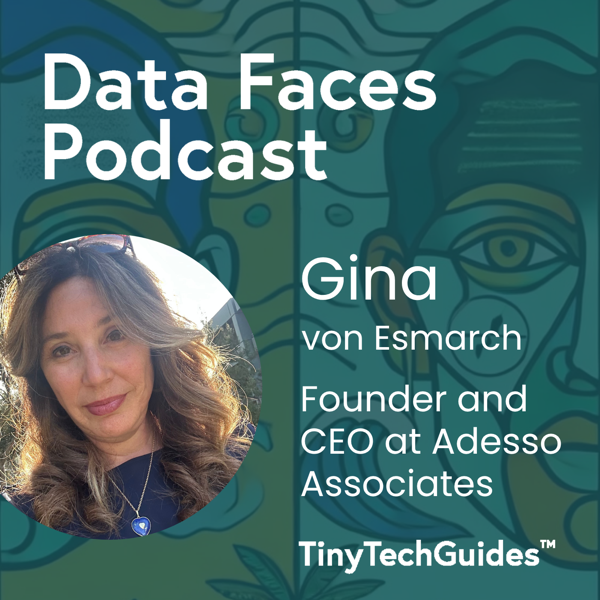
Gina von Esmarch is the founder and CEO of Adesso Associates, working at the intersection of culture and technology. With 25+ years of experience — from America’s Cup innovations still in use today to heritage-preservation projects bridging the analog and digital worlds — she focuses on preserving what makes an organization unique while using technology to amplify it. Her core insight: AI excels when taught to think in your context, not everyone’s.
In this episode
- Why technology and culture evolve in tandem, not in competition
- How diverse thinking creates lasting innovation
- Preserving what makes you unique while scaling with AI
- Teaching AI to think in your context, not everyone’s
- Lessons from America’s Cup innovation and heritage preservation
→ Read the full article: Why your AI sounds generic (and the three-step fix)
Full transcript
David Sweenor 0:01 Away. Hello, everyone. Welcome to the data faces Podcast. I’m David Sweenor, founder of TinyTechGuides and your hosts for today’s show. On this show, we explore the human stories behind data analytics, AI and marketing, the people shaping how technology really gets used in business today. I’m delighted to be joined by Eric Kavanaugh. He’s an AI analyst, syndicated radio host of DM radio, and a longtime observer of the data driven enterprise. He spent decades understanding how AI fits into the broad, broader technology stack, not as a magic bullet, but as a force multiplier. So today we’re going to talk about the end goal of AI. Could it be technology? Could it be societal, economic that will be the topic of today’s discussion. So let’s jump in, Eric, welcome to the databases podcast.
Gina von Esmarch 0:52 Hey. Thanks so much, man. Congratulations and all your success. This is a lot of fun.
David Sweenor 0:57 Well, you know, I’m pale in comparison to you. I was looking at your LinkedIn profile, it says 2000 podcasts and radio shows and webinars since 2005 so I’d like to maybe, could you introduce yourself a little bit about, you know what you’re doing, and how did you arrive to what you’re doing, sort of a non standard career path, Yeah.
Gina von Esmarch 1:20 Well, you know what, 20 odd years ago, I helped the data warehousing Institute launch their webinar program TDWI. I still do work with them. In fact, I’ll be in Orlando in November, speaking, bringing bringing DM radio road show to their events, and it’s a fantastic organization. I learned a lot about data, and I really connected with a lot of data people, including folks like Mark Madsen, Wayne, Eckerson, Phillip russem, a lot of the stalwarts of the analyst industry. And that was the door opening. And I told the wife, honey, we got to go. We got to move to Seattle. This is going to open doors for us. And I’d already been a journalist and focused on tech for a number of years. I was a journalist right out of college, but in 2000 you know, I moved to New York to do the.com thing that fell apart. I moved to Austin to work for a bi consultancy called Damon consulting, and that’s when I got into data. And frankly, I’d always wanted to do a radio show, probably because of Eric Idle and his little joking shows for money, Python, nudge, nudge stuff. And so I was like, Matt, looks like a cool job. So I just dove in, and I’ve been asking questions ever since,
David Sweenor 2:26 wow, that’s amazing. And so this is a bit of an off topic question, but since you host the radio show, when you listen to things on, do you listen to like streaming, or do you listen to radio? These days,
Gina von Esmarch 2:38 I listen to radio when I’m in the car, not too much at home, most of the time I just read. To be honest, I’m still a reader in terms of absorbing information, lots of headlines, lots of research. And of course, these days, with chat, GPT and these other large language models, you can Jive down wormholes all day and all kinds of different angles and just have it auto populated for you. And of course, you have to watch out, these are probabilistic models, so if you’re kind of straying off to fringe territory, sort of low distribution areas of the interwebs, then you’ll get some wacky stuff coming out. But for most technology questions, most stuff that has been widely published about these engines are pretty good at giving you answers, so the whole game of research is now on demand. Basically, you can learn whatever you want, as long as you want to invest the time to do that, and that’s what I do, to just try to stay on top of things. I mean, goodness gracious, lately we’ve been getting into the infrastructure domain better understanding what’s going on there. And there’s a lot to understand, and there’s a lot to optimize. You talk about this world of AI, I think that we’re in this sort of ready fire aim mode. Many companies are pulling the trigger on programs, and that’s why you’re seeing 80% failure rates. 95% failure rates. People didn’t really think through what they were trying to do with this stuff. So I think that’s where the attention needs to be focused these days, is take a deep breath. Figure out, what are we trying to accomplish with these things? What are the cost models? But you know, the challenge, David, is that the ground keeps shaking. These new models keep coming out. I mean, look at chat GPT with version five, where they’re like, Nope, this is the version you’re using, too bad. And people are like, um, right, what? Wait a second. So there’s a lot of lessons being learned, and there’s a lot of money being talked about and thrown around. And it is being thrown around, but it’s, it’s kind of fuzzy in terms of who’s going to do what you may have seen this recent thing with open AI and AMD and Sammy akbay, in fact, of insight software, an old friend of mine was posting about it online today, and someone came up with a with a little back and forth between them about what the deal is. And it’s like, well, what is the deal? Exactly? We don’t really know. Like, who? So who? You know? It actually reminds me of 2000 when I moved to New York. For the.com phase. There was so much money being thrown around for the.com craze, the.com boom, that it just all bets were off. And I remember sitting in meetings twice in New York City, in the Empire State Building, where I had to actually ask a question like, Okay, so in this conversation, are we talking about money going from you to us or from us to you? Yeah, we’re
David Sweenor 5:21 pretty it’s pretty confusing, Eric. I mean, to your point, you know, the technology is changing so fast. And like, you know, you have these startups today, and then next thing you know that capabilities in chat, GPT or Claude or whatever, and companies lost any sort of advantage it may have had. So I find it interesting. But when you talk about sort of the end goal or end game, for AI, what does success look like to you? And you know, business, society and you know technology,
Gina von Esmarch 5:53 yeah, well, let’s start with business. I think right now the end game is personal productivity. Right now every person can become more efficient by using AI, but you have to know where and when to use it. So I’ll mention Sammy again from insight. He was talking about Manus, how he uses Manus all the time. He uses Claude. He uses a whole bunch of these different tools constantly to test things out, to play around with code. He’s a, you know, he’s an executive in the software industry. So he thinks about these things. And Manus is really interesting, but you got to know where and when to use it. So I asked it to find airline tickets for my wife so that she can go with me on a trip to New Orleans for another event, for a confluent in fact. And I watched how it worked. It was interesting, because you can tell there are some use cases where it’s really not optimal, I mean, but still, booking plane tickets is kind of a pain. It takes a while. You have to, like, sort through, like, okay, wait for this, wait for that, and check things and but I was, I mean, I was wildly faster myself doing things the old fashioned way than Manus was, and Manus came up with a price that was twice as much as mine. So, you know, it doesn’t, it doesn’t do everything well, but it does some things well. I think mostly it’s research. So, so that’s business right now. It’s personal optimization of your time, of your productivity. So, business, life, life, I mean, education, you know, I wonder what’s going to happen to higher education, quite frankly, because, you know, what are you paying for? People are paying crazy amounts of money. I know some of these millennials and Gen Z ers that are just sitting on massive debt, wondering what the heck is going to happen, especially as white collar jobs theoretically go away, I don’t really think that’s going to happen, you know? I think what’s going to happen here is we’re going to have just a new playing field of tools and technologies to use to do our jobs, and the people who learn how to use these are going to be at the forefront of doing cool work. But I do think that the traditional organizational hierarchies are going to collapse. I think it’s already happening. Look at a company like Uber, where most of the people who work there are never even in counter management at all. Yeah, that’s interesting. So you have this bifurcation of all the workers and then all the executives over here, which you might argue is bad, but I don’t know, like the fact is the traditional hierarchies are going to collapse. It’s already happening. So that’s the lifestyle and then technology. It’s fascinating. But again, it’s moving so fast that I wouldn’t want to be a CIO these days. I learned to be a CIO. Interesting.
David Sweenor 8:34 So, yeah, there’s a lot, lot to unpack there and what you said, but you know, I’m curious, do you think, from like, an industry perspective, you know, medicine or law or defense, or what have have you you think, what they’ll they’ll be sort of lagging in that, like, what, like, what’s the last, you know, Bastion where, where humans are going to continue to be central, and you sort of dominate. And you know, why is that?
Gina von Esmarch 9:01 It’s a good question. I think that humans will always be central and will always dominate. It’s just a question of which technologies they use. I heard a really interesting stat just the other day on medical recommendations, and apparently there’s some study that says that AI is getting it wrong, like 50% of the time, and so doctors have to be careful about how they leverage these technologies, right? But there is tremendous amounts of there are tremendous amounts of information available to educate the human, and that’s really what it boils down to, is that the humans still need to make important decisions, but they need to use the machines to get there. But, you know, you talked about law. I mean, I wonder if there’s going to be aI judges and juries in the relatively near future. I’m very serious about that, because, first of all, there’s this crazy backlog of cases, especially in civil courts. But. Also in criminal courts. And my theory is that in a few years, you’ll start to see some front runners do this, you’ll be able to choose AI judge and jury, or real judge and jury. And my recommendation is, if you’re guilty, go with the real judge and jury. If you’re innocent, go with the machines.
Gina von Esmarch 10:16 Well, you got to be careful, because there are all these
David Sweenor 10:18 biases in law, you know, and you know, you see, you know these studies, hey, well, if you’re you’re on trial. You know, right before lunch, right before your ex, ex likely to be more likely to be convicted, because everybody’s hungry, right? And this is real, degrades during the day, right? Well, that’s a very
Gina von Esmarch 10:36 interesting observation that you make. And again, it speaks to the clumsy nature of the processes that we have in place today, and it’s all over the place. It’s in hospitals, it’s in courtrooms, it’s in police stations, but the humans still have to maintain control, and you use the machines to help you to make determinations. But, you know, thinking that AI is going to run everything is crazy. And thinking that humans are going to run everything without AI is also crazy. You know, I think that the AI now is everywhere. I think what I call for most, more than anything, is transparency. Sure, that’s transparency of models. I think that maybe the government should act. Maybe the government should come out and say, if you’re want, if you’re especially for large organizations, maybe you have a, you know, like this often happens in terms of regulation a certain size and over if you’re building AI solutions, I think you need to be transparent about which models you’re using, what the training data was. And you know, there’s a proprietary aspect here where companies say, well, that’s our secret sauce. I understand that. But when you’re talking about algorithms that make very important decisions for things like banking or healthcare or other life threatening situations, we need transparency, because it’s like, I think you know this, the big models, even the people who designed them don’t know exactly how they work.
David Sweenor 12:05 Well, that’s my question, too. So I agree with you, in principle, Eric, but like these giant models that are out there, we don’t know what’s in them. I don’t know if we’ll ever know. I mean, we know what’s scraped up the entire internet and without regard for property rights and all of that, all that stuff. But can we ever really know what’s in these things for training data
Gina von Esmarch 12:30 that’s that’s a really, that’s a very interesting point. But here’s what I’ll say, is that the unwieldy nature of them are arguably stems from their complexity. And do we really need this complexity we’re seeing with the larger models, that actually the error rates can go up, right? And I think we should be careful about this and not maybe drink the Kool Aid that’s being put out there by the biggest players. And except, I mean, there’s some really weird stuff going on. I mean, there’s, you know, there’s one. I won’t call them out by name, but you can research it. That keeps talking about how they’re the safety company, and they’re doing these tests where they train, they told the model to only blackmail as a last resort. And I’m thinking, What on earth are you talking about? Like? First of all, is that just prompt engineering? Because I think that’s what it is. I think it’s
David Sweenor 13:18 prompt engineering, expensive, you know, prompt engineering and these guardrails. Hey, If this comes back with this, send it back. That’s we’re not going to accept that response.
Gina von Esmarch 13:25 Well, right? And so what are the guardrails? I mean, you and I both know it’s very difficult to do that. And so I actually interviewed this young kid the other day, really smart guy, who was talking about how he got to play around with grok four. And he said it was crazy. It was incredibly performant. It was doing amazing things. And what he wanted to do was to hack one of his smartphones to give it better energy, to have it like have the battery last longer. He’s a smart guy, I mean, this guy, and so with grok, he was able to get detailed descriptions about how to unlock the phone, how to adjust the parameters, and all this stuff. He tried Google Gemini, and he said it just crap. It said would not no, it’s dangerous. Don’t do it. So the guardrails were too stringent, and that clouds the answers, right? So it’s like, what exactly are these guardrails there? It’s loosey goosey. And that’s not good. That’s, you know, you don’t need a loosey goosey guardrail. You need a guardrail that keep you from going off the road, it’s the whole point of using that term guardrail. So I think that the the size of these models is a challenge, and I think that we do need some transparency, and we need to put that into place somehow, some way. Because, you know, letting these things run amok, it just sounds like a pretty bad idea, and it’s, it’s always dangerous when you consolidate power in a handful of organizations, and that’s kind of what we’ve had, you know? But you look at, talk about tumultuous times, look at Google, and you talk about marketing, because you’re a marketing guy, sure. I mean, I think that the math I did said about $2 trillion have been played. To pay to Google AdWords. In the past 20 years, $2 trillion have gone into Google AdWords, which is a huge part of inbound marketing companies, would buy AdWords on Google to get their links to show up when people did keyword searches that align with them, and then you get traffic back to your site. Well, that’s out the window now, and that is a huge disruption. I mean, I’m talking to people left and right, and it’s funny, because some people will be honest about it and some people won’t, but I guarantee everyone’s freaking out because web traffic for all these sites, what they call the organic web, or whatever they’re trying to refer to it as, is down. It’s down significantly because chat GPT gives you the answer. You don’t have to go hunting for the answer. Now it’s just giving you the answer, even though it’s not always right, it’s good enough for most people. So what does that mean? It means Google is in the crosshairs, man. I mean, wow, their empire is is teetering right now. And so, you know, it’s like they’re remember how they kept saying they were going to kill cookies, third party cookies, all right? It’s gone away. And they’re like, I would change our minds. You know, it’s too disruptive. And they pushed the boundaries back a couple times. And now, guess what happened? The whole market changed under their feet. The carpets been ripped out, and we’re in a whole different AI generated world now, which is pretty bizarre.
David Sweenor 16:10 It is one, you know, it’s already pretty, you know, I’ve seen these words, you know, AI slop for some of the new image image generating tools that are out there. And, you know, like these Tik Tok, like social media things, I think, you know, Sora had one to be specific, but I feel like we’re on the cusp of someone’s going to figure out how to monetize these links in the LLM response. So just like the total and shitification of all the output we get now, I think that’s where we’re headed. Because, you know, once, once you start putting ads in it and all that stuff that they’re doing on the web like I think the quality is going to degrade and be quite annoying for lots of people.
Gina von Esmarch 16:51 Well, you, you bring up a really good point. So I interviewed a very interesting guy who has a new site called junto AI, and they’re trying to make this a more focused and business friendly social media site like LinkedIn. And what he told me is very interesting. He said they researched all the major social platforms now, and he said every single one of them, the models, the AI models, are designed to optimize advertising revenue, and you can understand why they’re all trying to make money on stuff, but when the primary objective is just to make money and not to facilitate engagement between users, for example, or improve your chances of getting business deals or, you know, various business oriented outcomes, that tells you that you’re probably on the wrong track. And you know, advertising does have a tendency to ruin things. I mean,
David Sweenor 17:44 I think that was in the original Google paper. The original research paper said that it was like, if there’s advertising in there, it will be biased towards the advertisers, like the original papers, right? And repeat it, huh?
Gina von Esmarch 17:56 Well, you know, it’s funny too, because I’ve been working a lot again, with my buddy Mark Madsen of third nature, who was one of the TDWI instructors 29 years ago, a very, very smart guy. And you know, he was pointing some of these things out as well, and saying that, you know, this really funny comment that was perhaps a slight dig on yours truly, but a friendly one. Or he said, Yeah, you know that a lot of these shows talk about what the vendors are doing, and that’s a vendor view of the world, which is not the end user view of the world, because the end users are just trying to get stuff done, which they may do with this tool or with that tool. But there is a sort of side of the world that is produced or put out there by the vendor community, and it’s always designed to help them sell, right? Which is fine, but still, you have to take a more holistic view of of your business. And this gets back to the end goal of AI, which is all right, what are you going to do with this stuff? What is the business objective? And only once you have that clearly in your mind can you responsibly make decisions about which tools to make, which workflows to enable. You know, one of the the stats I heard the other day by another very interesting company data squared, they apparently have the only patent for Explainable AI. So that’s kind of impressive, but he talked about how a lot of companies are stringing together large language model calls to create workflows. But the problem is, there’s an error rate at every step of the way, and when you multiply that out, the error winds up being like 40% or something. It’s like, All right, well, you know, at what point it’s like, when I was watching managed try to book my wife’s plane tickets, it’s telling me, okay, now I’m clicking this button. Now I’m doing this. Now I’m doing that. I’m like, Okay, I could have trained a monkey to do it faster than that. It was just really, it was just not so good. I have been so
David Sweenor 19:39 unimpressed by these, you know, we talk about AI agents, you know, you watch them, and I’m like, You’re right. I could have clicked through and done it like five seconds. I’m like, What is this thing doing? It’s going off into the rabbit hole, into the ether somewhere. Like, why I don’t, I don’t understand it. And all of the use cases, they’re so there’s, like. I don’t know, sort of boring to me. Like, hey, you can manage your calendar. I’m like, Really, do I need an agent to manage my calendar? You know, we didn’t need an agent for to book this a second link. You picked the date we showed up, right? I think so. I don’t know. Have you heard of any like, like, cool, interesting use cases, you know? I know you talk to people every week, everything. All the demos are just sort of,
Gina von Esmarch 20:23 yeah, I think that in some areas. So we’re working with a company, sardine AI, that’s doing some interesting stuff with agents. And the use cases I’ve heard about that sound very productive, tend to be very focused, and they’re doing tedious tasks. So in something like anti money laundering, or all these boxes you have to check as a provider to say that you did the right thing. So that’s a series of automations that can make sense, and it can be dynamic in a certain sense, because calls come in, or certain things happen that are unpredictable. So then you have to kind of walk through the process. And that in that use case, that makes a lot of sense, because now the agent is just doing stuff that had to be done by a human, but doing it dynamically, while the human is doing other things, so that that gets kind of interesting. And for really complex use cases, I think that comes in handy. But again, you have to really think through what is the workflow, what is the end result? I mean, I think the old use cases are still the best classification. For example, what class does this person come in? I mean, here’s something that I’ve wanted forever and a day. How about a dynamic list segmentation algorithm for email marketing, where it’s like, Okay, I’ve scanned all the 1000s of emails that I’ve sent who clicks on links about analytics versus architecture? Well, that should be doable these days, but it’s just hard to get to it. It’s hard to build that out and right now, I mean, I think that if you look at the amount of money being spent on infrastructure, it’s crazy, like they’ve reached this point where now some states are even saying you can’t build a data center unless you bring your own power, right? And
David Sweenor 22:06 so you’re gonna build your own nuclear reactor, right? You’re going
Gina von Esmarch 22:10 to in China, they can do that. So they’re doing right? It’s like small nuclear reactors to get stuff rolling, but it’s like, okay, China had problems too, like huge buildings and cities they’d created that just are empty. And you’re like, All right, what’s actually going on? I don’t know, but, like I say, the end goal should always be some business value. Then you figure out, Okay, can we build it ourselves? Do we use an off the shelf tool? Who should we use? And in that case, again, like, find people who are generating value already that you can verify and then and sort it out. Experimentation, I think, is the key, right? Experiment. Fail fast. Fail Faster. Just make sure you’re paying attention to what you’re doing and play around with stuff. Because, I mean, there’s so many tools like, you can’t even play around with them all to know them all.
David Sweenor 22:57 I know, I know there’s so many I do, like, you know, from a personal perspective, not business, but you know, you can do it be anything you want. Now you want to be an artist, you can use the image generating ones, yeah, movies or whatever, and be positioned. You have to know how to, you know, you can use AI to create some of those. I think there’s some pretty interesting thing. It allows everybody to unlock their their creativity, and you don’t have to have that innate talent to be able to play an instrument or paint paint something interesting, right?
Gina von Esmarch 23:26 Well, so some of the smarter people I know are saying that really solid generalists will do best in this world because you can quickly learn the specifics of some task. You know, think about the McKinsey’s of the world. Think about the Accenture is the deloittes. You know, they’ve made lots and lots of money over the years because they have people who have a lot of knowledge in their heads, and most of that knowledge is now out in the wild. And I’ll throw out another bit of a gauntlet throwing down comment here, and just say that arguably, IP is kind of dead. Intellectual property is dead. Copyright is dead. I mean, de facto, if it’s everywhere, you can still sue people if you want, if you want, spend a bunch of money on lawyers and court fees, but it’s like, is there really value in that? And I don’t think that the answer is yes. I think that really it’s, it’s, we’re in the age of execution right now. The data is everywhere. The algorithms are everywhere. It’s a question of applying them to your particular business to get something done. So I think that’s the future. Is the age of execution.
David Sweenor 24:27 Yeah, I do. I do. I do believe in that. But, you know, we were talking a little bit about, you know, guardrails earlier, and so, you know, have this us view, because, you know, it’s where I live in the world, and we’re sort of ho hum about it for the most part, and we have this asymmetry of power. But like, what about the rest of the world? Like, can you you can’t put that genie back in the bottle, I guess, you know, like, there’s other countries that have different motivations and morals and goals, you know, compared to perhaps our view. And so can you ever really reign this in for for society as a whole? Because if someone’s going to do it, you know, we’re going to have fraudsters do fraud things. But you know, just that, the idea of guardrails Is it, is it even possible to contain
Gina von Esmarch 25:13 I, you know, that’s a very, very good question. I think in general, guard rules are overrated. I think that they’re very difficult to enforce. You know, for example, I noticed a chat GPT, oh, no, actually, was Gemini was just having a fit over anything political. Like, oh, that’s a political I don’t want to Oh. Like, okay, break. You gotta use grok for that, right? Groq, right? Well, there you go. So to your point, people will go around it. So it’s like, what are you really, you know, saving yourself from, I don’t know. I think guardrails in general are very difficult to deal with. It’s like, there’s security. You either have access or you don’t. You gotta have access to the data, or you don’t the system, or you don’t. That’s old fashioned governance. Is just security, like, do you have access or don’t you? But you know, for a lot of these other use cases like I’m saying, I think that, to your point, the cat’s out of the bag. There’s not a lot you’re going to do about it. You can track things, but you know, again, some of these, these stochastic systems, are rather unwieldy, and the big ones are very unwieldy. So you’re not going to be able to to get to that 100% mark, or even that 98% mark. And for most business decisions, you need to be very sure about what you’re doing. So I think that we are going to see a greater appreciation for core business solutions that are deterministic and then probabilistic models that are facilitating decision making and doing things in the background or on the side. But you have to be careful not to mix those two. In other words, databases aren’t going away. Transactional systems aren’t going away. They will be aided and abetted by these other systems, but you know that there will be tremendous disruption. Think about doing your taxes. For example. I remember a few years ago, I thought to myself, why can’t I just go into QuickBooks and do export as Schedule C why? Can’t do that? Because it’s all, you know, these are restaurants that’s obviously travel. This is hotel that’s, you know, that’s travel. These are, you know, Software as a Service, systems like, that’s a business expense. Like, why? Why all the trouble? And I can’t
Gina von Esmarch 27:15 answer the question well, because it’s making them, I tell you what I mean, I used
David Sweenor 27:19 into it, you know, a couple years ago, and, you know, I filled it out and, you know, they say we got this 100% guarantee, and I get this bill in the mail, like, three or four months later, was like, say, was for like, 100 bucks. Like, you owe us 100 bucks in tax unit pay. I’m like, But Turbo Tax didn’t say that, so the government already knows. So tax, don’t get me started. Eric, like, it’s just, it’s so odd. But I think there was a lot of, you know, very interesting like, that minutia, those, those use cases. Like, you know, everybody’s talking about small language models now, and, you know, very specific narrowing the aperture on the use case, as you just mentioned, yes, like, aren’t we getting back to deterministic
Gina von Esmarch 27:57 code? It’s
David Sweenor 28:00 so tiny, like, because you mentioned those error rates, you know, chained together as we gotta, we gotta make really, really narrow opening for these things.
Gina von Esmarch 28:08 I think so. I think small language models, or just old fashioned, deterministic AI models, are going to be ruling the day, at least. I hope so, because this the big stuff, is too big, and it’s unwieldy and you can’t trust it, let’s be honest. I mean, you can’t trust these big companies. There’s no way. In fact, one of these, the guy interviewed recently, said that someone out there went and did a test and experimentation to determine if open AI is, in fact, piggybacking on Google’s indexing, which apparently they say they’re not. And I haven’t researched this thoroughly, but someone went and published a page like brand new, and put on the tag that says, don’t index, and then on that page to find a new word. And then the next day, or the day after, went to chat GPT and searched, and it found it, and it found his page. He’s like, all right, how did you find that page? Right? You got to be piggybacking on something, right? So they’re there. There are things happening under the covers, which, you know, let’s face it, as a regulator, how would you even test these things? I mean, how? Think about going into the offices at open AI and said, All right, well, let’s let me see the system you’re using, right? Yeah, there’s no way, dude, you can’t survey all that, you can’t analyze all that. It’s just too much, man. So, you know, we’ll
David Sweenor 29:26 see. Okay, well, what do we think? What do you think the minimal, you know, viable governing structure is? So we’re business, we’ve decided what we want to do for a use case. We pick that it’s, it’s a good, it’s a high value use case. We think the minimum, you know, MVP for on the governance site is for any you know company that’s out there,
Gina von Esmarch 29:45 audit logs. Just audit logs, as long as you’ve got some some log file that says what it did where. I mean, that’s what all the AI agent companies are talking about doing is just okay, it’ll log what it does, and that way you can go back and. Watch it. You have to be able to kill the pods, basically that launch whatever structure you have. You have to be able to stop something. You have to be able to say what it did and where, and then remediate. And that’s basic governance data access to what are you training it on? I will say one interesting comment I heard just yesterday. Someone was ragging on rag, saying, rag going, everyone’s spending all this time and effort on rag, and is it really worthwhile? Can agents do this stuff instead? Now, to your point, I haven’t seen too much meat on the bones for agents really doing cool things, like I said, some financial services areas, there seems to be some traction outside of that, not as much, but I think the agentic stuff all bets are off. I mean, if someone really nails agentic AI, and of course, Salesforce is really pushing that, but a lot of companies are pushing it. Boomi is talking about their control tower. Lots of different vendors are. I mean, almost every vendor I can think of now has some story around agentic AI, you
David Sweenor 31:01 have to, right? So gotta, you gotta have marketing parody for these, these companies, right?
Gina von Esmarch 31:05 Well, you have to say, Oh, we’re working on it too. It’s like, okay, well, what are you doing? But to me, that could blow the whole thing wide open, because you think about data warehousing, that’s where I came into this world. Big honking data warehouses, relational database models. You’re loading all this data into the model so you can make decisions. Well, do you really have to do all that stuff anymore? I mean, snowflakes not going away. Obviously, Teradata is still around. I mean, there are big companies still doing data warehousing. But, you know, I wonder if the agentic stuff really takes off. Maybe you don’t need these huge data lakes. Maybe you don’t need these huge data warehouses to do your job anymore, but we’ll, we’ll see. It’s pretty complicated, but I think that if someone really cracks the code on agentic, they’re going to be the winner for the next 10 years at least.
David Sweenor 31:53 Do you think that will be a an incumbent, somebody that’s there today, or somebody that maybe is emerging or not even, not even born yet as a company, it’s, it’s hard
Gina von Esmarch 32:03 to say. It’s probably going to be a new company, honestly. I mean, it could be a big one. But you know what it’s like, political,
David Sweenor 32:09 30 years of code and political, these, these silos, you know, it’s hard to get anything done, really, in the larger
Gina von Esmarch 32:15 bureaucracy, bureaucracy, people with their skin in the game, you know, people who don’t like these new ways of doing things. I mean, big companies, I think, in general, are going to be in trouble for that reason. And yet, you know, there are still all these critical tasks that need to get done. So if you just go fire people, well, what were those people doing? Is that Is there nothing there? I mean, it doesn’t anyone have to come and fill in those gaps. And you know, you see it. I mean, there are balls that get dropped, customers leave all kinds of stuff happens. You know, that’s the where the rubber really meets the road. These days. You see it in big companies. You see it in telco. You see it in some of these big, you know, internet service providers, the the the work that they do, and then what it goes to court. We talked about that earlier, yeah, he’ll be waiting for years to have something, and by the time the court date comes, you’re like, why am I even here?
David Sweenor 33:06 Yeah, that makes a lot of sense. So what do you think, you know? What do you are we going to see this mass destruction of jobs? Or do you think they’re just going to just change shape? And I was arguing with like, I was arguing with, like I was arguing with my son the other day, is like, Well, why do I need to learn to sing? Because, you know, a chat GPT can do it, or whatever. I’m like, then it was, I started thinking, like, well, I know how to do long division, but I have a calculator here. Eric, right? I don’t know when the last time I did long division is, Do I really need to know how to do it? Right? I don’t know, right. I don’t know,
Gina von Esmarch 33:38 right? It’s, that’s, I mean, it’s an open question. I don’t think there will be a huge collapse of jobs. I think that you are going to see companies getting smaller on average, and more upstarts coming along. And you’re going to see people doing multiple jobs. You’re going to see HR people also engaging in some other activities around administration of the business, you’re going to see marketing people working closer with sales people, or sales people that know more about marketing. I think that where there’s supposed to be collaboration in the organization that’s going to be internalized into one person who has to do sales and marketing, or one person who has to do accounting and HR, for example, stuff like that, I think that’s probably more likely is that people will have to wear more hats, because there will be smaller companies with all the same work that needs to get done, but you’ll be more or less monitoring things more than doing things which can be boring too. It’s like that’s not necessarily a fun development either, if I’m just watching the agents do all the cool stuff. What was the one joke someone said, Look, I want a robot to wash the dishes and do my laundry, not an AI to do my artwork for me, right, right? I want to do the artwork. I don’t want to be the one just doing the laundry and the dishes.
David Sweenor 34:53 Yeah, exactly. I do. See that across, you know, my clients. There are, you know, people doing you. Things that they wouldn’t normally do, like, you know, like, maybe tracking campaigns as an example. They’re campaign people. They know how to execute them. They know what content is needed and all that. Know how to set them up. They’re like, Oh, I can do the data analysis now myself. I don’t have to go rely on some expert to do it. I could take data from here, here and here, right, jam it into the LLM and get some pretty interesting results. Yeah, find my campaign now. So I see that multiple hats and people doing things they they wouldn’t have done five years ago.
Gina von Esmarch 35:28 Yeah, well, that that’s true, and then you talk about a wild Western craziness out there, like the data from these systems. I’ve been doing email marketing for 25 years, and the data used to be pretty clear cut. Now I don’t know. Like, are you sure that 80% of my people clicked on this? I you know that number is pretty high. I’m pretty sure those are bots. But it’s like, how do you determine if they’re bots? Again, like things are changing so fast. How do you get to the bottom of things? It takes a process. It takes effort. It takes effort to normalize the data. I have my own little tricks for how I make sense of this data I’m seeing from my email marketing software, because it’s like, there are conversions and that I can tell, okay, I can tell this person registered because of this code. Apart from that, did the other people really open? Did they really click? I don’t know.
David Sweenor 36:15 Yeah, I see that too. And, you know, I published regularly on, you know, over 100 articles on sub stack. And there’s, there’s some decent analytics there, and they’re like, there, and they’re like, hey, all these people read your thing. I’m like, I am not sure. Like, maybe because it was in my phone and I scrolled past it and it auto opened right? I think that. I think that’s what they’re measuring, right? And there’s email addresses in there that I know are not valid, but, you know they have, they haven’t expunged these things yet. So, like a lot of these, I don’t have a huge following there, which is fine by me. I have decent, you know, number of paying customers, but these huge followings, you know, you can buy lists, but it’s crap. Like, like, likes don’t equal buy. That’s all, you
Gina von Esmarch 36:52 know, likes aren’t buys
Gina von Esmarch 36:54 well. And then think about this, and I know we’re coming up here at the at the near the end, but think about the the number of times you clicked something on your phone that you didn’t intend to, or, for example, on Twitter. And now it’s called x, of course, but they still have this metric of a digital expand. I’m like, a digital expand. What’s that? And that’s when you click on it and expands out, and you look and it’s like, you know what? I’ve been using this format for, I think, like, 14 or 15 years now, I have never once intentionally done a digital expand. It’s always been an accident, right? So that accident is being counted as, oh, that’s engagement. No, it’s a mistake, right? So that’s a pretty big difference, you know, in engagement versus a mistake. It’s like, no, no, I did not want to do a digital expand. It happened because I clicked and I hit the wrong button. Yeah, so it’s like, a lot of this stuff and the automation that it thinks you want. Oh, do you want to do this? No. Oh, do you want to do that? No, I don’t leave me alone.
David Sweenor 37:51 Yeah. No, you’re seeing that in the llms and other they’re encouraging you to engage more. And you’re like, Hey, you want to do this that, that want to image I’m like, right?
Gina von Esmarch 38:00 Because they want the engagement. Not really well, because you think about it, these and these big guys are losing money on this stuff. I mean, there’s no way that they’re not losing money, right? Like, open, AI, Microsoft, Google, anthropic, they’re hemorrhaging money because they want engagement. They’re trying to win this battle. They know this is the Battlefront, so they’ll just burn money as fast as they can to get you to stay there, but they’re forgetting that we can leave.
David Sweenor 38:26 Well, that’s the thing. I mean, they probably made a mistake setting the bar so low they wanted adoption. Now, everything’s 20 bucks a month and no, right? You know it’s like, right? Streaming services, I have a Hulu of this or that, whatever driving me crazy. It’s
Gina von Esmarch 38:40 the Wild West man. It’s like, I remember the old days when it was a little simpler, and now it’s just like, all right, where is this NBA game on? And what do I have to do? So I have to go to Amazon to watch this football game. What has happening? What? Yeah, it’s, it’s too much, man, but it’s, it’s gonna be weird. I think, like, I say, the big guys, they are hemorrhaging cash in the hopes of securing this battleground, this land, you know, like it’s Eastern Ukraine or something. But by the time it’s all said and done, I think all the buildings are going to be blown up. So it’s like, what’s the point? Yeah,
David Sweenor 39:12 I guess only time will tell. Well, you know, Eric, this has been an amazing discussion. So how do people find you and get a hold of you, if they want to? And, you know, check out some of your services, or DM radio. You know what’s the best way to contact
Gina von Esmarch 39:23 you? Yeah, info at DM radio, dot biz comes right to me. Just Google DM radio. We’re on YouTube. We have 507 videos, I think there now, the last six or seven years, and we’re all over the place. So send me an email, info at DM radio, dot biz, or info at inside analysis.com and we’ll get you on the show. Awesome.
David Sweenor 39:42 Well, Eric, well, thank you. We could talk all day, but our time is up, so I appreciate you joining the databases podcast and until next time,
Gina von Esmarch 39:48 thank you, buddy. Take care. Cheers. You.