

Data Faces · Episode 43 · July 14, 2026 · 36 min
Donald Farmer on the one thing a prompt can’t replicate.
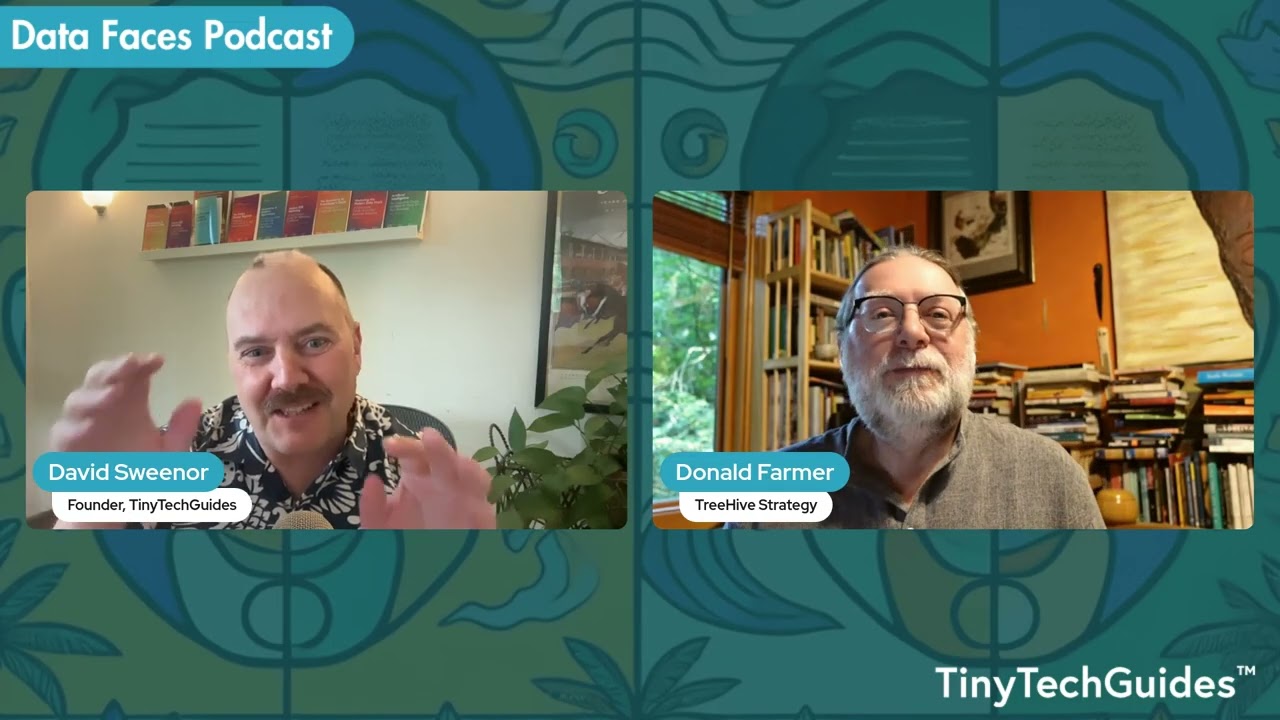
Listen: YouTube · Spotify · Apple Podcasts · Amazon Music
About Donald Farmer

Donald Farmer is the Principal of TreeHive Strategy and VP of Innovation at Nobody Studios. He has spent more than thirty years designing data and analytics products, including a long run as a design and innovation leader at Microsoft and at Qlik, where he helped build Qlik Sense. He is the author of Embedded Analytics (O’Reilly) and writes the Creative Differences newsletter on Substack.
In this episode
- Why the technical feature moat has collapsed — and what replaces it
- Practice versus process, and why a practice is sticky when features are not
- Why community and identity outlast any single feature
- “A human in the loop is a cop-out” — designing the human attitudes in on purpose
- Trust, doubt, ambition, and care — the four things AI can simulate but never feel
→ Read the full article: Practice over process: what vendors sell when AI copies every feature
Full transcript
David Sweenor 0:06 Hello, everyone, and welcome to the Data Faces podcast. I’m David Swimmer, founder of TinyTechGuides and your host for today’s show. In the show, I talk with the people who are actually making data analytics and AI work in the real world. What’s exciting, what’s messy, and what’s coming next. Today, my guest is Donald Farmer. He has spent his entire career in the data analytics and AI world. He’s led innovation and design at Microsoft and Click, and today he runs TreeHive. He’s written a few books and has an amazing newsletter on Substack called Creative Differences. Check it out. I do love it. So we had the good fortune of meeting at the Bark Data and Analytics Retreat, and he had a great idea that I want to dig into. And the premise is this. For decades, buying a data platform meant buying into a practice, a methodology, a community, a whole way of seeing the world. Now, AI is taking over that interpretation and judgment. So the question on the table for us today… is whether vendors build AI into a practice they define or get absorbed into the AI. So Donald, welcome to the Data Faces podcast.
Donald Farmer 1:11 Oh, it’s great to be here. Thanks very much. It was great to meet you at the Bark event, and I’m glad we’re following up doing this.
David Sweenor 1:16 Yeah, absolutely. So for those who may not be familiar with your work, could you just share a little bit about yourself and what you’re doing at Treehive Strategy?
Donald Farmer 1:26 Sure. Well, my background is, I mean, I’ve been a products guy my entire career. And, you know, built my first sort of data analytics products way back in the whisper in the 1980s, you know, a long time ago. As my son likes to point out, closer to the Second World War than to the present day. But, you know, it was a good time to be doing stuff then. And I worked for some startups doing all sorts of interesting analytic work. I joined Microsoft about 25 years ago and moved to the US to do that job. I was at Microsoft for about 11 years, 10, 11 years. And then I went to Qlik Technologies and I worked there developing their second generation product, Qlik Sense. And then I became independent after a while. and um i’ve been independent for about 10 years and i specialize in data and analytics technologies which means increasingly i specialize in ai technologies which i was involved in back in the 1980s so all comes back again and um i advise investors and a lot of software vendors i still do a lot of work with software vendors because primarily i’m a product guy right and um you know investors and and some enterprise work as well And I’m part of, you know, a number of kind of research and advisory groups. Enjoy that work very much.
David Sweenor 2:47 Well, that’s great. Well, thank you for sharing that. And I do love your newsletter. So I encourage everybody, all our listeners and viewers to check it out. The name of the show, Donald, is called Databases. And part of it is to get behind the person before their LinkedIn profile existed. So just let’s kick us off. What was your first job?
Donald Farmer 3:07 Yeah, my very first job, which is interesting. My very first job was working in a shoe shop. That was my first sort of part-time job. And I guess there was a couple of things I did for cash before that, but that was my first kind of real job where I had a manager and I had pay slips and things. um and that was kind of interesting looking back on it you know and it provided money which was the main thing it’s not like i it’s not like i loved selling shoes but in some ways it was fascinating because there’s a whole problem with selling shoes that is easy to forget about which is um you’ve got to have all the right sizes and you’ve got to have a range of sizes therefore there’s a statistical analysis to be done of the population Like how many of each size do you buy? Well, that’s a statistical problem. And sometimes you get it right and sometimes you get it wrong. And you would discover things like there were certain patterns, sort of this brand of shoe or this style of shoe. was more popular in some sizes than in others because different types of population, either because they’re older or younger or larger or smaller, had different preferences. And so even though I was only like a 16-year-old kid working in a shoe shop, you could actually see if you approached it with an analytic mindset, which I kind of did even at the age of 16, that tells you a lot. But there’s a lot to learn and it was kind of fascinating.
David Sweenor 4:28 Oh, that’s great. That’s great. Thank you for sharing that story. So now we know a little bit of any shoe questions, please send them to Donald and he’ll, I’m sure.
Donald Farmer 4:36 I don’t have a thing about it just to be clear.
David Sweenor 4:40 Okay. Well, at the Bark Retreat, you actually shared a pretty funny story about your first sort of week when you joined Microsoft and it evolved Bank and talking to some executives. So I’m wondering if you could maybe just share that story with the audience. I found it rather comical.
Donald Farmer 5:01 Well, this is very telling, actually. I mean, I joined Microsoft and I joined it, but… 2001 july 2001 something like that and it was summertime so actually a lot of people out and at microsoft you kind of join on a monday and you do your induction day and you get all your you know you do all your kind of um you’re signing up and onboarding and then on tuesday is really your first day so on the tuesday i kind of got into the office and as i do i’m an early starter i’ve already it’s what it’s um about eight o’clock here in the pacific time i’ve already been up since 4 30. had my shower and all those things so i’m an early starter so i get into microsoft at about o’clock there’s nobody around the office is deserted and by nine o’clock the office is still deserted and i’m beginning to wonder you know does anyone come here it turns out most of them are working you know 10 11 but they’re often working until So I’m there in the office on my own, and somebody comes and says, we really need you to come up and give a briefing to an executive team from this bank about our latest data and analytics technologies. And I said, well, I don’t really know much. I’ve only joined.
David Sweenor 6:05 Just started.
Donald Farmer 6:07 Literally, I’ve only been in the office for like a couple of hours. But I mean, I’d been a Microsoft partner before, and I did know a bit about the technologies. But they dragged me along to the Executive Briefing Center because there’s literally nobody else around. And I sit down with these bankers. from and these were the technology team from a major japanese bank and they were having their briefings and they had their introduction and the first briefing of the morning was supposed to be you know analyzing banking data with kpis and dimensional analysis and i thought well that’s okay i can do this i know the technology but that’s not what they wanted to ask me what they wanted to ask me was what kpi should we use and you know what kpi should we use to run our bank I can tell you how to build the KPIs. I can tell you how to build the dimensionality. I can tell you how to write the MDX and the scripts. But I’m not a banker. I’m not an international banker. I don’t know how even if I knew how to do that, I’d be an international banker, not an engineer. And yet that’s what they wanted to know. And it was really interesting to me. And there was two parts of this sense. It’s not that they don’t know their business. but they’re looking for advice on how to run their business. And the technology and the business process has been really, really tied together. The technology in a way is a reification and realization of the business process. And the business processes in turn is influenced by the technology. So they’re really asking me about that. And then the other thing is that they just want not even advice. oh, Microsoft says you should do that. Right. Therefore, we’re not going to get sacked if we do that sort of thing. So when we got through the briefing, I don’t know that did the bank any good, but I certainly never heard any complaints. They didn’t crash or anything. But it was fascinating. It was very revealing to me about the relationship between technology and business process.
David Sweenor 8:08 Yeah, it’s actually really interesting. And, you know, you’re surprised you’re talking to this intergalactic sized bank and they’re like, what do they want? Reassurance or what have you? And it’s like parallels like the analytics world, which both about you and I know so well in that you walk into some very large companies, you’re like, oh, boy, you’re running your business on a spreadsheet still. It’s a bit surprising on that side of it, too.
Donald Farmer 8:32 Yeah, yeah, that’s true. And when you go into companies like that and you find they’re running their business on a spreadsheet, well, why? Well, largely because, partly because it works for them and partly because the spreadsheet doesn’t impose a methodology. Either you adopt a methodology and very, so for example, you go into a company and they run their business on SAP. They don’t just run their business on SAP. SAP, to a certain extent, defines how they run their business. There’s a set of affordances, a set of capabilities that SAP give you that enable you to run your business in a particular way. So it’s not just that SAP is your system of record. many cases especially this is very very true in manufacturing and retail sap defines your business and um and it’s not just sap but other erp systems and crm systems do exactly the same thing but that’s that relationship between the technology as a way of defining your business and the way of recording your business and actually excel fills in all the gaps because it can do all of those things
David Sweenor 9:39 right yeah and so that really brings us to this this topic your i found your presentation at the the bark retreat very very interesting and you had this notion i’ll briefly set it up but a practice versus a process and you actually started out with with paper forms to to articulate the point and so i was wondering maybe if you could just tell tell our listeners and viewers What is the difference between practice and process? And why should they care even more now so maybe than in the past?
Donald Farmer 10:13 Yeah. Well, I think process is pretty easy to understand. You know, business process is the way that business practice is something a little different i think practice is a kind of special word if you think about think about your your local town and the businesses are in your local town and there’s retailers there’s builders and there’s all sorts of people there but um you would talk about the doctor the the medical practice you could talk about the lawyer perhaps having a lawyer practice you might talk about the architect having a practice the local architect has an architectural practice i’m not sure you would talk about the local builder and contractor as having a building practice or a contracting practice so so why not what’s the difference in that case between somebody having a practice and a practice actually implies a number of things first of all it implies a kind of professional standards um it implies a sort of code of practice it applies a sort of ethical approach a kind of ethical stance that you might take it it applies a certain approach to work that you might think of as being more of a lifestyle um in a way you know it actually is a definition of people identify themselves with their practice this is especially true for z lawyers right right so practice is more than just a business process that you sort of do from nine to five it’s something that that is defined yourself and in particular it’s an attitude to the world and it’s an ethical approach now that’s not to say that people who don’t have a practice don’t have an ethical approach i’m not saying that at all but i am saying that a practice encapsulates all that in a particular way in a particular mindset And I think that’s really important as opposed to process. And practices, yes, they’re very much a way of defining ourselves. They define our attitude to our work, including things like our ethical stance, but also our approach to solving problems and our way of working.
David Sweenor 12:11 Interesting. So, and I remember you had four dimensions. So practices, process, ethics, community, and I’m missing one. What is the fourth? Yeah.
Donald Farmer 12:20 Yeah, there’s certainly practice ethics, community, and yeah, I can’t actually remember my own, I can’t remember my own slide. Must have been really memorable. But I think we’ve got the elements there, okay, that there is an ethical element, there’s a community element, there’s a point of view, I think, is something that there’s a stance that you take. I can’t remember the exact word that I used, but I think that’s what we’re getting at, yeah. I want to give you an example. Can I give you an example? Yeah, please do.
David Sweenor 12:50 I’m going to double click down on that anyway.
Donald Farmer 12:52 But I can give you this example. I think many of your viewers will appreciate. When I was at Qlik and Qlik Technologies, a great company, I joined them just after Ipeal. I loved what they were doing and I’ve been watching them from the Microsoft stance quite a while, but I was really happy to get into the Qlik community. But I was still very close to other companies. I greatly liked the work that Tableau were doing. I mean, I’d known them almost since the day they started and thought they were a fantastic company. And I thought they had a fantastic approach. And not long after I joined Qlik, Tableau had their annual conference. And they released, announced and released at the annual conference, a native Mac client for Tableau. tableau running natively on a mac and that that got a standing ovation christian announced it at the conference in the keynote and he got he got a standing ovation for a mac client and i went back to click and said whenever guess what happened at the tableau conference you know because standing ovation for their apple client people kind of looked around literally the boardroom table and said you know do we know anyone who’s got a mac do we know anyone uses any of our customers need a native mac line and the answer was no that is not and that told you something very interesting because here’s two companies you think both in the data analysis space both doing self-service bi all those kind of ways in which Gartner or Forrester or Barker or anyone else would fit them into a category of work and yet actually the fundamental practices of the users were different tableau i mean who used a mac back then and see you know in 2013 or whatever it was who used a mac it was creatives these people who were artists and graphic designers and typographers and photographers and musicians used mac and so the tableau users saw themselves not just doing visualization but they saw visualization as almost like one of the creative functions you know they saw themselves as creatives and when we went back and talked to the click people how did they see themselves with their whatever the world dell latitudes and thinkpads yeah they saw themselves you know very much as business people or they saw themselves as developers building applications for business practice but they didn’t see themselves as being in that creative area they saw themselves as being sort of technical um as a sort of it on the desktop they saw themselves building applications which was a very different thing from the tableau attitude of building visualizations thinking visually and creatively Both of them, very, very powerful practices. And both companies, you know, Tableau has been absorbed by Salesforce to a certain extent that ethos has perhaps gone. But Qlik is still going and is still very much part of a kind of data platform now and still has that ethos. And so practice in that sense, even though the technologies might be categorized together, there were fundamentally different practices between what Tableau were doing and what Qlik were doing.
David Sweenor 15:56 Oh, that’s quite interesting. And so maybe that I want to circle back to this notion in a minute. But, you know, at the event we were at, we mentioned that. You know, I think the statement was you can pretty much compete, create any or recreate or clone any feature within some software with a prompt and sort of a lot of everybody was head nodding around the room. And, you know, to a large degree, I believe that’s true. So for for vendors that are out there, you know, how do they. can they compete on features anymore? Or how do they sell for, I guess, what they stand for? Because differentiation on the technical front has evaporated, I think. I got a lot of clients that are like, how are we different? I’m like, well, you’re not. They’re like, how about history?
Donald Farmer 16:50 You’re not different.
David Sweenor 16:51 I’m like, you’re competing against IBM. They’ve been around since 1911 or whatever it was. Right, yeah. They’ve been around a lot longer than you.
Donald Farmer 16:58 Yeah, I mean, you’re different today and tomorrow if somebody’s reverse engineered your prompt, very important you know the features and functions are so easily replicated now that that moat has gone the idea of a sort of technical moat um is really disappearing um why would anyone use your software when they can just kind of vibe code it And there’s lots of reasons that they might do that because you can get the vibe coding wrong. So there’s a sort of authority that a vendor might bring, but against another vendor in competition, difficult to see what the advantage would be. And if there’s an advantage today, it’s gone tomorrow. And so how would a vendor compete in this kind of world? Well, they could try to run faster than everyone else, but that’s not sustainable. But the best vendors are taking the attitude that it’s not just about features and functions. it is actually about enabling this practice and supporting that practice and giving people um not just the tool set but all the surrounding capabilities for somebody to actually understand their practice and to put their their mindset into their work And a really good example of this, I’m being a bit vague there, I know, but it’s difficult to be precise about it. But let me give you a specific example, and I think I shared this at the BARC event as well. Look at MongoDB. MongoDB is a database that XML-based database. It’s great for application developers. Application developers love it if they need to store state and things of their application. There are binary-compatible versions of MongoDB from Microsoft and Azure. How come? I mean, why wouldn’t you just go and get a free binary compatible version from Amazon and Microsoft? Because MongoDB has community. It has intentionality. It has a practice. MongoDB developers are MongoDB developers, and they’re not just interested in the binary compatibilities. This is true of many things. When I was working on SQL Server, SQL Server developers identify themselves as SQL Server developers, not just developers who happen to be working in SQL Server. An Oracle DBA is an Oracle DBA. They’re not just database administrator who happens to be working in Oracle. That’s what vendors need to be able to build. They need to be able to build that sense that there’s more to it than just features and functions. There is a community. There is a mindset. There is an attitude. And there is a practice. And that’s why I use this word practice. And if you want to see who’s doing a good job of that, I think that we’re at a kind of lucky time just now because just in the last few weeks, we’ve seen a company emerge and Golden Analytics. Have you spoken to Francois? I haven’t. Francois Agostad who used to be at a product at tableau now has this new company golden analytics and they’re very much based on this approach of they’re really establishing a practice and I think they’re going to do extremely well by getting a lot of out of that community into their community and building that sense of a community of practice and um you know the other vendors have to look at how they do the same thing and how they they build on that community and not just community in terms of you know a website and a forum but a sense of purpose that they can build around the product right it’s that shared belonging it actually brings up an interesting
David Sweenor 20:38 interesting question i mean i think that’s one of the things why open source software became so popular people would you know write code and donate their time because they believed in something they had that community they had that shared values and now ai it’s taken taking that all away right it’s sort of there’s a lot of negative sentiment now i think among open source developers because of what ai is doing Do you see that?
Donald Farmer 21:08 They’ve lost some of that for sure. And then what you see is, and I think part of the problem here is that what do you share? There’s not much to share. Something that seems to be very interesting about AI is that in the open source community, of course, people shared code and that was great. Right. what do you share when you’re building something with ai you share your prompt you share you know it’s not it’s it’s difficult to see what people share and there is a lot of good stuff out there you know there are people of course sharing um frameworks and things that they’ve built it’s a sort of alternative community building um i think we’ve yet to see emerge a real, especially in the analytics space, a real AI analytics community. I think we will see it, but we’re in this transition just now, and it’s going to take a year or so. Right, right. When that starts to emerge.
David Sweenor 22:01 Yeah. And one of the other things, you mentioned ethics a couple of times, and I always told people when I was younger, I’m like, oh, business has no friends. And it’s probably how I grew up. I was out of sight. I grew up at IBM, and when I joined, maybe they had 12,500 employees. When I left 12 years later, They had like 3,000. So like my ethos was like, hey, they’ll lay you off any time for any reason. So do you see businesses, do they have an ethical stance? I mean, I was reading like maybe Ben and Jerry’s does. And there’s some things going on with that. But I’m just curious your perspective on that because it’s a super interesting question.
Donald Farmer 22:36 So we have to be careful about the way we think about that because I’m very cynical person. I might look at businesses.
David Sweenor 22:46 There you go. Opening up the lid here.
Donald Farmer 22:49 yeah yeah exactly but but you know um part of it is what is there we sometimes talk about an ethical stance you know which implies that there’s a position that you take and yeah you could look at employees but and and do people treat their employees ethically I always say to anyone who ever asked me for career advice, especially if it ever concerns a question of loyalty. Well, there’s two pieces of career advice I would give to anyone. One is don’t choose your next job, choose your next manager, which has always turned out to be valuable, I think. But the other thing I would say is your loyalty to a company should only be reciprocal to their loyalty to you. And if you put in hours and hours of work and you commit to yourself and you say, no, I’m not going to take that other job because my team needs me here and I want to see my product shipped. You know very well that if the investors started to pull the plug or demand cuts, your ceo could be you know cutting you to moral because they can’t have that kind of reciprocity because they’re not answerable to you they’re answerable to ultimately to their investors and so they might take an ethical stance which is well ultimately our ethics are about our um our support for our investors not for employees that’s secondary and so i wouldn’t want to say that a company that that you know fired people was unethical um i would say that they’re taking an unethical position that i might not agree with i might not support i might even really dislike but that doesn’t mean they’re doesn’t mean they’re being deliberately unethical it means you’ve taken an ethical stance that um and that’s a much deeper problem that’s a problem with our society it’s a problem with the way we structure business it’s a problem with um the way in which we structure principles that you know money and capital is ultimately more important than um than workers you know workers don’t have a say but people who invest do that’s that’s a That’s a political choice that is made by society. And so the ethics are relative to that. So I’m always wary about, if you like, judging people ethically, although I do it all the time. But you have to understand their stance that they’re trying to take.
David Sweenor 25:08 Sure. Okay. Well, thank you for that.
Donald Farmer 25:11 Political rant there.
David Sweenor 25:13 Yeah, no, that’s okay. We talk about interesting topics here, and I think it is an interesting one. Back to AI, though. So we talked about this notion, you know, an analyst, data analyst, you know, they’ll get some data, compare, interpret, write, you know, all this sequence of steps they need to do to take the data, transform it to some insight that hopefully the business uses. Now, with AI, it’s seeming to take… a lot of the work from that analyst, AI, I don’t know if people are even using a lot of these BI and analytics tools. This is a whole other conversation we can have on that. Yeah, that’s right. There’s this notion of a previous guest that talked about this notion of autonomous business. I’m curious if your vision lines up with that or how do you see this playing out? Because I always hear human in the loop, human in the loop. Now when Claude asked me something today, Like, I don’t know what it’s doing. Like, don’t ask me again, too. Go, go, go. Like, I don’t know what it’s doing.
Donald Farmer 26:19 Yeah, a human in the loop is a cop-out. A human in the loop is a way of saying, we haven’t really thought about this, so we’ve just taken the easiest way of doing it and shoved a human in there, and that’s our answer to things. You know, rather than, and I see this all the time, you know, the answer to AI issues is put a human in there. And that’s… First of all, humans can’t scale. Humans are fragile.
David Sweenor 26:42 I was going to say, they can’t do that scale. Nobody said how you would actually approach this. If I’m making a zillion decisions of second, you know, like when I just click go, my numbing go, go, go.
Donald Farmer 26:52 It’s not as if human decision making is explainable. You know, it’s not as if we demand explainability from AI. Well, I’m sure you and I both have worked for managers whose decisions were utterly inexplicable, but they still have their jobs.
David Sweenor 27:04 Totally fuddling for sure.
Donald Farmer 27:07 You know, ever since the shoe shop, I’ve worked for managers. It’s why I’m now independent. But, you know, we expect this from AI, but in some ways, I say it’s kind of cop-out. It’s not really addressing the issue of what are we trying to achieve with this. um and and it is a difficult issue it’s it is you know difficult to see how you actually scale ai and make sure it is responsive and reliable and and has um you know kind of um with ethical and precise decision making that we want but we have to attach we have to tackle that problem and just saying well we put a human in the loop is not an answer
David Sweenor 27:47 Okay. Yeah, I agree with you. So another thing you mentioned in one of your talks was, you know, these four human attitudes that a system can model, but they can’t feel like trust, doubt, ambition, care. And you actually made the pivot. You turned this into sort of a design choice for vendors. So let’s talk about maybe doubt or pick whatever attribute you think. How would you think about building something like this into software?
Donald Farmer 28:17 Well, so that’s important. It’s not actually that we build it into the software. So take these very human elements. So trust out care and ambition, which are things that, in a sense, AI, it’s not that AI can’t simulate. actually quite a lot of work on um empathetic ai um especially building empathetic chatbots for people who are in emotional distress so you know the ai can simulate that care and it can do it at scale that human beings can so that’s a wonderful thing but it doesn’t actually care um and people are kind of aware about that of that but it’s but it’s it’s valuable to be able to do it so what i’m suggesting is that these attributes don’t go away they’re very human attributes and if you want to build this practice and this human element you need to essentially do you know have human beings do what the ai cannot do and building not necessarily and again it’s not features and functions necessarily because that’s easy to do and can always be done but the practices the processes the um the structures that you build around it and where are the elements that a human being can bring this can be in the process, in the loop, or just as importantly, over the loop or before the loop or after the loop. But where can the human being bring these capabilities? And that includes things like, you know, I’m very ambitious. Therefore, I’m going to move the needle on this AI further than anyone else would move it. Or I care very much. Therefore, we are going to be super cautious about this process, which we could have made very, very fast, but we’re not going to. Or I want to enable doubt and therefore i want to build a system that actually questions what i do rather than just giving me nicely formatted business reports actually challenges me with really difficult questions that i need to ask and prepares me for a board meeting for example by by grooming me or grilling me with the most difficult questions it can find to answer. And so you can build this in and create this very human approach both to analytics and to business processes by focusing on those human attributes. And I think human beings bring these attributes very naturally. And AI tends to suppress them by smoothing over all of that. And I don’t think we do ourselves any favors by that smoothing over. I think we should be raising these issues and making them part of our work.
David Sweenor 30:50 Great. Okay. Awesome. I think we have time maybe for one more question. And maybe it’s a question about… this i guess this hype out there people that that maybe are not skilled in the art as as you and i are talk about ai becoming sentient and in our overlords and this and that but you know one thing that is interesting to me is that you know as a as a you know entrepreneur i use ai pretty heavily in a lot of my my business practices maybe it’s as simple as We’ll take some video clips from here, do some descriptions and put them in YouTube and this and that. And then you can have AI help you refine and optimize that. And it gets better and better and better and better. So where does AI sort of start to become, I guess. More intelligent than me about the process, I guess, is what I’m trying to ask. I don’t know if I asked that very well, but it started with mine and it’s evolved through this collaboration. And now the process, I wouldn’t have naturally have thought of it, but it’s a well-honed machine that continuously learns.
Donald Farmer 32:00 yeah and you know um i don’t mean as an insult to you maybe it is already smarter at it you know i look at some of the work that i do with with um with claude code for example um in analytics and it does a really good job of of doing analysis and i i i studied philosophy and history at university and i i i can have philosophical discussions with claude and it can raise up tell topics that i would not have seen you know so in a sense it is showing a great deal of intelligence but the thing that lacks is purpose ambition meaning direction so you know the example i love to give is a self-driving car i i guarantee you a tesla is better at driving than i am sure but the one thing that never happens is i switch on the tesla and it says no don’t want to Don’t want to do that today. Don’t want to drive you to the office. It’s a lovely day. Why don’t we go to Whidbey Island instead? It’s never going to do that. And it doesn’t do that because it doesn’t have that intentionality. It doesn’t have that purpose. And in a sense, that’s what’s missing. The intelligence that you bring to the podcasting and the editing and the and the sharing and the posting that you do so well is the intention behind it not the practicality of doing the why but the intention by the why exactly and you know the um the ai is nowhere close to to bringing the why You know, you’ll know the AI is intelligent when one day you give it this task to do and it comes back to you and says, you know, Dave, you know, you’re a successful guy. You’ve done all this. You’ve got all these followers. Why not just give it up and go and meditate or go surfing somewhere? You know, you don’t need to do this anymore. And, you know, that’ll be the wisest thing it could ever tell you. And it’s the one thing it’ll never tell you because it doesn’t have that.
David Sweenor 33:46 I love that. I will just say one thing. This was probably a year ago, but I was listening to some some other podcast and it was when gpts were all the rave you know people still making these gpts to do things and you know we move well beyond that but someone asked the guest you know what was the best one you’ve ever designed they’re like it was the laziest gpt ever so whatever you asked it it would make an excuse as to why it didn’t want to do the full thing exactly pretty simple problem i’m trying to recreate it i can’t i couldn’t get it to do it but it would just make an excuse and it you know i don’t know it was pretty pretty comical right exactly yeah i mean i always think the most intelligent um artificial intelligence you’ve ever seen is marvin the paranoid android from a hitchhiker’s guide to the galaxy oh what’s the point that’s right well donald farmer you’ve been a Tremendous, amazing, fantastic guest. I want to thank you for joining the Data Faces podcast. Where can people find you and learn about Tree Hive Strategy if they have some questions?
Donald Farmer 34:49 Easiest way to find me is on LinkedIn. That’s it. You know, if you can’t find me on LinkedIn, then I’m not doing my job. So go find me on LinkedIn. But do look for Donald Farmer, the data guy. There’s Donald Farmer, the horror movie director from Nashville. And unless you really want to watch, you know, chainsaw cheerleaders or an erotic vampire in Paris. But, you know, his fans tend to be more disappointed when they find me than mine are when they find it. But to check out, you’re the right Donald Farmer.
David Sweenor 35:18 All right. Well, hey, I appreciate you joining at this early hour. And thanks for joining the podcast. See you out there.
Donald Farmer 35:24 Great. Thanks so much.
David Sweenor 35:25 Bye.