

Data Faces Podcast — On Location · BARC Data and Analytics Retreat 2026
Shawn Rogers, CEO of BARC US, on why AI governance is lagging adoption, how surprise token bills become a control problem, and why 2026 may be the year AI starts to grow up.
Listen: YouTube · Spotify · Apple Podcasts · Amazon Music
About Shawn Rogers

Shawn Rogers is the CEO of BARC US, where he advises data and analytics leaders on AI, governance, business intelligence, and vendor strategy. He has spent decades in the data and analytics market as an analyst, executive, and community builder, and he hosts the BARC Data and Analytics Retreat to bring vendors and practitioners into a smaller, more candid conversation about where the market is heading.
In this interview
- Why AI adoption has moved faster than governance for many companies
- How centralized AI governance can reduce risk without slowing innovation
- Why surprise token bills are a financial governance problem, not just a technical one
- How monitoring, license pullbacks, and more mature usage patterns may define the next phase of AI
→ Read the companion article: Governance now decides whether AI delivers value
→ Browse all on-location interviews: Data Faces Podcast — On Location
Full transcript
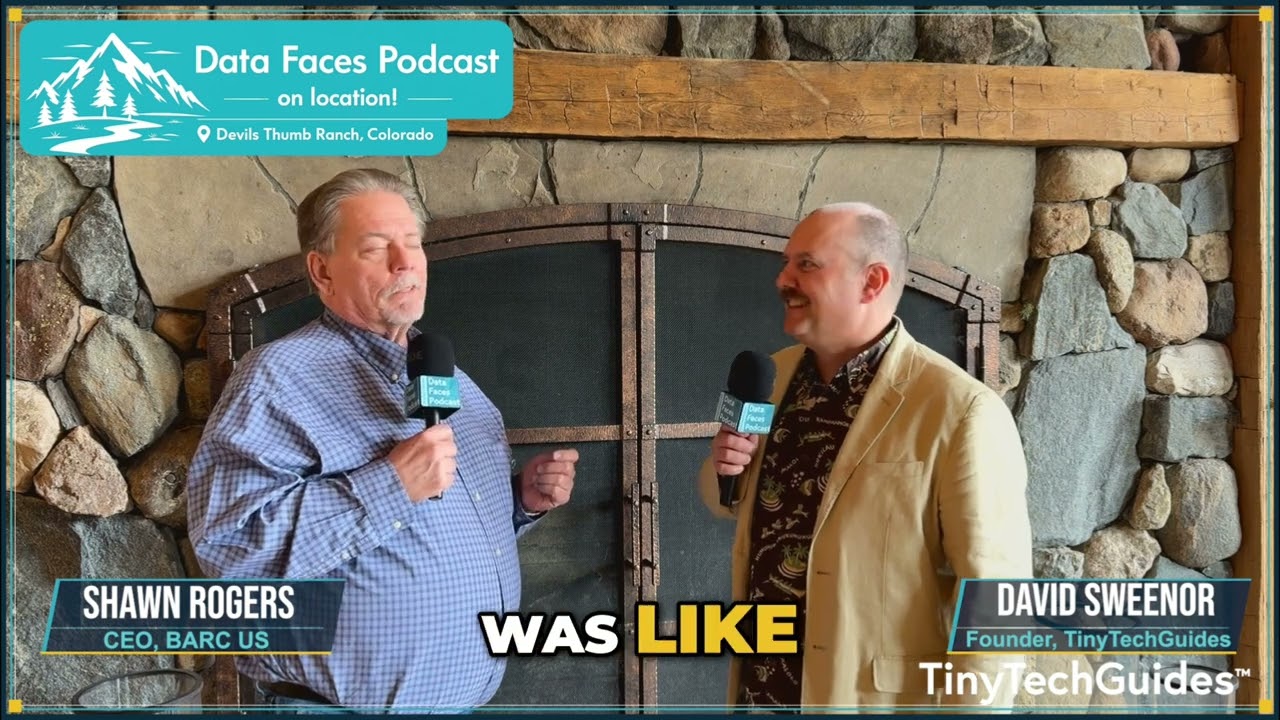
David Sweenor 0:06 Hello, and welcome to the Data Faces live podcast on location. We’re coming to you from the Devil’s Thumb Ranch in Golden, Colorado. We are at the BARC 2026 Data and Analytics Retreat. I’m joined with Shawn Rogers, CEO of BARC US. Shawn, this is a great event. Thanks for having me.
Shawn Rogers 0:24 Thank you. It’s our favorite thing every year, bringing a bunch of really smart vendors to an interesting location to talk about the hot topics of the day, and obviously data and AI are at the top of our list.
David Sweenor 0:37 Yeah, and it’s a bit of an unconventional event in that it’s intimate, and it’s the networking and the discussion that is, the content’s great too, don’t get me wrong, but the discussion, we were five minutes into the first presentation, and someone’s like, I don’t agree with that. Yeah. And you don’t get that normally.
Shawn Rogers 0:54 No, I think it’s the best thing. Analysts do a lot of public talking and presenting of our research and our opinion on the industry. When you do it in this environment, you are surrounded by people that know as much or more about the topic than we do, and that comes from the vendors. So many vendors are in the same building together at big conferences and trade shows. But they don’t get to walk around and actually network and talk to each other and share different and diverse opinions on the topics. And that’s what the BARC Retreat is about. Yeah, super amazing.
David Sweenor 1:27 And, you know, we’re getting a sneak peek to some of the research that BARC does that has been published, some hasn’t. Question on, you know, let’s talk about AI because we’re here. We have to. Governance, what’s the state of governance out there? We are in the Wild West, but tell us about AI governance.
Shawn Rogers 1:48 Yeah, the Wild West is a great word for it because I did a talk a couple of weeks ago, it was in front of a couple hundred people, and we asked everybody, have you launched an AI agent yet? And everybody’s hand went up in the room, everybody’s. And then we asked the follow-up, how many of you are comfortable with how you’re governing your agentic AI? and maybe three or four hands in the room went up. And I was compelled to look at this audience and tell the rest of them to stop it. It’s interesting how the top-down executive pressure around AI has forced companies to move forward without really having a proper version of governance, whether it’s the data or the models or the agents themselves, but all three of those things need to be governed. and we’re not seeing it hit as hard as it ought to right now. I’d say about 20% of the end users we talk to have some governance in place, and the other 80% are having a really good time hoping that they don’t break any laws or screw up.
David Sweenor 2:53 Okay. And so that was going to be my question that, you know, we’ve had data governance for a while and analytics governance, data science governance, AI governance. So it sounds like there’s still a bit of work to do for companies out there.
Shawn Rogers 3:07 Yeah, I think there is. And I think the best approach to AI governance or agentic governance, depending on which flavor we’re talking about, is it needs to be centralized and it needs to be in a platform that doesn’t hinder the innovation. you know, it doesn’t restrict you or slow down the pace of innovation, that it’s there to enable and augment it so that you can innovate without or with less risk. And I think that that’s the part that a lot of companies, end user firms are kind of turning a blind eye to right now. I do think as an analyst, I’ll get to write a couple of fun failure stories this year about companies that made pretty traumatic mistakes. We saw one in the LLM space a couple of weeks ago, a small company using one of those solutions accidentally deleted all their code and all their backups. Lovely. That was a glaring case of lack of governance. So we’re going to see more of that in 2026 because the adoption rates of things like Claude and other solutions is absolutely astronomical. And as the cost of tokens is driven down to almost nothing negligible, we’re still seeing big firms blow through their AI budgets.
David Sweenor 4:19 like yeah let’s talk about that your definition of governance is financial governance yeah a component of it and are people getting surprise bills uh these days everybody’s getting surprise bills a lot of people launch the agent with the project on friday afternoon and
Shawn Rogers 4:35 They get an alert over the weekend or they get called to their boss’s office on Monday going, why did we spend all this money to do something? And it’s because they don’t fully understand the impact of some of the work they’re doing. And we’ve seen this before with big BI queries and things of that nature. in the autonomous side or world of AI, that’s where the risk lies. And we don’t always understand that, hey, if I run this program, I’m going to spend a lot of money or burn through all my tokens. There was a big story about Uber recently has announced that they have chewed through their AI budget in half the time they expected. And there’s a handful of other companies that have been in the news recently that have gone through it. But at the same time, I met an end user company a couple of weeks ago who said, we just gave Claude to 12,000 people at our organization. And I said, oh, that’s exciting. What kind of budget did you have for it? He goes, well, the CEO didn’t want a budget. And I was like, oh, we’ll talk again. You know, it’s interesting, the decisions companies are making.
David Sweenor 5:38 You know, in that case, there’s something interesting about this notion of innovation. And so, you know, typically larger companies will have, I know a couple of top priorities, I don’t know if they’re innovative or not, but they want two or three big things they want to do each year. And now with AI, we’re giving it to everybody, every independent person is innovating in their own bubble. Little silo, right. And I’m not talking to you, you’re innovating, and I’m innovating, and our neighbor’s innovating. How do companies wrestle with this and harness the best of what’s out there?
Shawn Rogers 6:12 I think at the core of it, which I do think has merit, is this idea of the more diverse the knowledge workers are, the more interesting solutions will come from it. So I do think that there’s something to be said about giving everybody a new tool that’s pretty exciting and seeing what they come up with. But I also am starting to hear stories of companies that are doing a better job of monitoring the use, monitoring the work, pulling back licenses if they feel that things are being wasted. I think we’re going to have an adult year around AI. A more, instead of this sort of hysterical FOMO, fear of missing out, view. Right. I think 2026 will be part of a maturing cycle.
David Sweenor 6:54 So it’ll be interesting. The year AI grows up. I hope so.
Shawn Rogers 6:56 Or people using AI grow up. Yeah, maybe not until mid-2027, but yeah, we’re on that path.
David Sweenor 7:02 All right, so we’re halfway through day two. It’s been amazing so far, so I’m looking forward for the next day and a half. What do we have to look forward to in terms of the different types of presentations?
Shawn Rogers 7:14 So you touched on it. We focus on making sure that we present some unique research to our participants here, so stuff that hasn’t been published yet at BARC. So by being in the room, you get to see things early and get access to it. So that’s one of the things that we focus on. You said what I’m looking forward to, I present in a couple of hours, and I’m looking forward to the conversation with the room. So when I give a keynote speech somewhere, it’s me talking to a room. Right. Here you’re talking with the room. So the presentations are a little shorter to give time and space for the conversation we’re going to have with all the experts.
David Sweenor 7:53 We have a pretty vociferous crowd, so they’ll let you know if they don’t agree with you.
Shawn Rogers 7:57 Yes, I’ve been interrupted in very colorful ways over the years at our retreat.
David Sweenor 8:02 Awesome. And so if people want to get a hold of this research, where can they find it?
Shawn Rogers 8:06 BARC.com is the best place to go, and a certain part of our research library is available for free download. You can get your hands on it. If you’re looking for something specific, I’m on LinkedIn. Feel free to reach out to me there. And some of our other things are available by subscription, as you would expect from an analyst firm.
David Sweenor 8:22 All right, amazing. So coming to you live from the Devil’s Thumb for the BARC 2026 Data and Analytics Retreat in Colorado, Shawn Rogers, CEO of BARC US, thanks for coming to Colorado. Thanks. Cheers.