

Data Faces · Episode 26 · December 2, 2025 · 36 min
90% of production AI problems trace back to data. Tina Chace on why lineage — not hope — makes AI trustworthy.

Listen: YouTube · Spotify · Apple Podcasts · Amazon Music
About Tina Chace
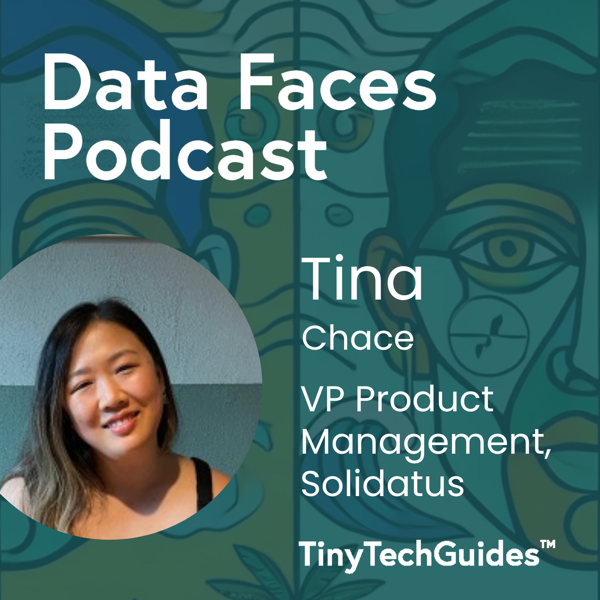
Tina Chace is Vice President of Product Management at Solidatus. She started in middle-office trade operations, moved into deploying AI models for major banks, and learned the hard way that 90% of production problems trace back to data quality. That journey shapes her approach to data lineage: track the technical details, but never lose sight of the business consequences.
In this episode
- Why 90% of production AI problems trace back to data quality
- How column-level lineage prevents cascading failures across systems
- Why business context matters as much as technical lineage
- Lessons from deploying AI and ML inside major banks
- Moving from assuming data works to proving it works
→ Read the full article: Data lineage for AI: why truth beats hope in banking
Full transcript
David Sweenor 0:06 Hello everyone, and welcome to the data faces Podcast. I’m David Sweenor, founder of TinyTechGuides, and your host for today’s show. This show I talk with people are actually making data analytics, AI and marketing work in the real world. What’s exciting, what’s messy, what’s messy, and what’s coming next. Today, I’m joined by Tina Chase. She’s Vice President of Product Management at solidatius. She has deep experience in helping customers understand and trust their data, both from a technical and business perspective. Today we’re going to talk about data lineage trust and how transparency and data flows can really transform confidence in decision making. So let’s dive in. Tina, welcome to the databases podcast. Hi David, thank you for having me. So can you just tell us a little bit about yourself, your background and what you’re up to over at solidatius?
Tina Chace 0:54 Yes, I can. So I actually started my career in middle office and booking of trades and trade data. So you know the importance of making sure that your data is absolutely correct, especially when it comes to transacting and dealing with money, was drilled into me from the start, but then I didn’t really start to appreciate the value of data and accuracy and trust in your data until I spent six years working at an AI and machine learning company, specifically rolling out machine learning models in highly regulated spaces. So transaction monitoring, know your customer for very, very large banks. So at that time, being the one responsible for deploying the model, the data that we use to tweak and train the model, and then the data that was running through the model real time, was really important. One of the first things you learn is bad data in, bad data out. So that is actually how I came upon solid datas as a data lineage company that allows you to understand and build trusted data flows, because I was continuously running into problems where someone would make a change upstream, maybe they added a new field that had sensitive data, and it would flow into the model. We wouldn’t know that, and we’d have to go back and troubleshoot and 90% of the time it ended up being a data issue. So that’s made me really passionate about the subject. Oh,
David Sweenor 2:28 that’s amazing. And so what does what does solidatus do?
Tina Chace 2:32 Yeah, so solidatus is a data lineage company, and what is data lineage? So data lineage allows you to track how your data is flowing through various systems. And you can do that from a technical perspective, just you know, understanding where a column, such as trade date, is flowing through various different applications before it gets booked in a report. But also, we believe in understanding your data from the business perspective, so not just tracking where it flows or any kind of calculations, but understanding context, such as the quality of your data as it’s flowing through systems, what kind of controls or checks are happening in various systems and who owns the data at various points of its life cycle. So solid data as a data lineage platform allows you to capture all of that information and visualize and report on
David Sweenor 3:24 it. Oh, that’s, that’s amazing. So before we get into the topic, does your you mentioned that you started out doing, you know, dealing with sort of financial data, and that has to be, right? I work in Marketing, so sending coupons to people or what have you. It’s a little bit different stakes, I think, than financial data. But one thing that stuck out to me on your LinkedIn profile is you were into competitive small boat sailing, and so before you started your work career, what did you want to be when you grew up? Was it VP of Product Management, or was it something else,
Tina Chace 4:01 actually, I when I started out my career, I was really focused in policy analysis and management, so really doing a lot of research and understanding what policy should be rolled out and making a recommendation that actually translates really well to product management, because you’re doing a lot of research and gathering a lot of data about what people want to use and purchase. And so actually, my beginnings in policy management, with a focus on like economics and finance, led me to work in product management at a finance or a FinTech company, and that’s how I ended up where I am. Okay.
David Sweenor 4:39 So you know, in FinTech, you know the data needs to be absolutely correct when you’re dealing with with transactions. So how did you, you know, I guess, what sparked your interest in data lineage and how has your perspective on trust, you know, evolved in the different roles you’ve had throughout throughout your career? Yeah.
Tina Chace 4:59 So. Really sparked my understanding, like from the very beginning, beginning of my career, the data needed to be correct. There were actual financial stakes that immediately happened at large financial institutions that were really hard to unwind if your data was not correct. But at the beginning of my career, I just assumed, like, everything is flowing through the pipelines. Things are transacting. So my assumption is that this data is of high quality, and we know what’s happening to it. But as I’ve progressed my career, I’ve learned that that is not always the fact, right? It’s actually really hard to document, like even contracts between two applications say you’re rounding to the round, like the wrong zero if you’re dealing with, like pennies on the dollar, you know, and it’s like a transaction between you and me on Venmo David, and just sending money back and forth. That’s not the biggest deal, right? When you’re dealing with large amounts of money, that rounding error becomes a huge financial burden if it is incorrect. And so I’ve learned, working a lot in the technology space of highly regulated companies, that it’s actually not that simple. It’s really important. Oh,
David Sweenor 6:15 it’s funny that rounding error reminds me of the movie Office Space. I think that was the whole premise, exactly. You know, it’s something that, you know, you mentioned that people, you know, they sort of a lot of people just sort of trust the data data. And you know, you see this a lot with like in BI system, so you see a dashboard or rapport in whatever system you’re using, and people never really question it, but who knows if it’s right? So can lineage help in that sort of situation?
Tina Chace 6:47 Absolutely, and people should and are questioning it more so with the regulatory requirements for, say, BCBS 239 which requires that you report on certain metrics and that also you ensure the data going into that report is accurate and timely and correctly calculated. This is something that data lineage can help you with. So by understanding how your data flows, you can actually introduce quality checks across every single system that it flows through, and by documenting data at the most granular level, which we call column level, in the data lineage world, you can actually document for every step and application that that data flows through. Is there a calculation? Is there a rounding Are you adding things together so that by the time it ends up in a report, you actually understand exactly what happened for it to be in that report? And if there’s a discrepancy between discrepancy between two different reports that are supposed to be the same data, you could understand, oh, you know what? Between application A and B, we rounded to this decimal between application B and C. We actually changed the rounding, and that actually ended up in, you know, our capital reporting.
David Sweenor 7:59 Okay, wow. You know, one thing I’ve noticed in my career, that I feel like people that work with data, they sort of speak different languages. So the the data engineers have one set of vernacular, and maybe analyst or people who are working on reports, they speak a different language, and business decision makers, they speak a different language. So can lineage help, sort of, you know, bridge this language barrier between the different groups within a company?
Tina Chace 8:26 Absolutely. So this is why we at solidatus think it’s important to have both technical and business lineage, because if you, from a technology standpoint, understand your data flows, but you cannot communicate the meaning of that or the implication of that, to say, your business stakeholders, or the reporting analysts who are looking at the end report, then you’ve got a gap in communication. So what we like to do at solid data is allow you to both capture the technical details, but then again communicate the implication. So by having the data quality on the system. If there’s a failure, we can tell you that actually systems downstream, this specific report field downstream, might not be accurate because the quality is incorrect. Or we can say the data governance owners have applied specific checks and policies atop the system. So you can rest assured that any data that’s flowing downstream is controlled and you have the right access or is obscured if it is sensitive information. So it really brings together all the different stakeholders, and they can view their own lens of the data flows, but it’s based on the same underlying information, so you’re working off of, like, the same set of blueprints.
David Sweenor 9:46 Okay, you know, this brings up an interesting question to me, who owns data quality, you know, with or lineage within an organization? Is it is it the data engineers? Is it people building? Models. Is it the decision makers? You know, how do you like that the customers that you talk to who sort of owns this?
Tina Chace 10:07 I think this is a very interesting topic, because in the past, it was kind of passing the buck. I have done my little part in my application, and that is all I’m responsible for. But until you can actually see the end to end flow connect together and really trust that. Again, how can you trust the reporting metrics that you’re seeing? So while previously, it might have been just you own your specific space, now within the data governance world, data governance leaders are actually being responsible for ensuring that it is documented and it is captured holistically. So this requires them to collaborate with their IT partners who actually own the applications, the reporting analysts, like maybe even the risk officers who are reviewing the final output. But it’s become more of the responsibility of a formal data governance operation and team to make sure that this happens. And I think you can see this in the trend of more and more CDOs chief data officers coming out, because it is an important function that needs to exist. And more and more organizations are building out this data organization because they need someone to oversee the fact that you need to document and ensure quality of this data.
David Sweenor 11:28 That’s very interesting. And so does a company have to be of a certain size before you have this, this sort of formal Data Governance Program? Or can it be a small company with very sensitive and important data? Or kind of, what do you see as the like, what’s what triggers the need for something like this?
Tina Chace 11:46 Yeah, we are seeing companies across the board in size, recognize that this is a need. Now you might be in bigger organization to have a whole team around this, but we work with companies that are, like 100 people, much smaller, and they still recognize the function is important. It is just rolled into their IT or risk organization. So it is still someone’s responsibility to make sure that this is documented. You know, we’re seeing data become more and more important to companies. We are much more aware that data exists around us and there’s value in data, and especially if anyone wants to use any type of AI, we need to be tracking what data goes into it so company sizes, from small to large, are recognizing that this is important, and either assigning someone within an existing organization or developing a very robust organization within their large company to make sure that this is happening.
David Sweenor 12:43 Okay, fascinating, you know. And earlier you mentioned this, this, this notion of technical lineage and business lineage. So technical lineage, I think, you know, listeners probably will get that goes from System A to B, and you’re understanding the transformations you mentioned that. Can you just give us a sort of a concrete example of what sort of this business lineage or business context is, you know, with it, you know, like, let’s make it real for for people that you know, don’t, don’t live in this world.
Tina Chace 13:12 Great. So I’m speaking about business lineage. And I really mean two things, adding business context to your technical lineage. So I mentioned, you know, documenting policies, controls, ownership, quality, any kind of sensitivity label on top of just capturing your technical data flows. But also, you can think of business lineage as almost a business process or workflow. So when you think about the process of, say, completing a KYC check at a bank, there’s business process steps
David Sweenor 13:47 that happen. Sorry. What’s a KYC check? Know
Tina Chace 13:51 Your Customer so anytime you get onboarded at a bank or an organization opens an account, you have to do a Know Your Customer check to make sure that you know you’re not sanctioned. You are a real person and or business, and things are valid. And this is a process that requires you to capture their data, and it flows through a process of automated checks. And so when you’re doing that process, you you outline a set of business process steps that need to happen right now, one of the things solidatus Does to combine business lineage and technical lineage is we actually allow you to overlay the conceptual steps of that business process over the technical systems. So you could say, step one capture customer information within our customer portal. That’s the conceptual step. Now imagine you could click into that and then see that actually uses our onboarding portal, you know, this database, this ETL, etc, so you can take the business understanding of the step and actually see what systems are doing that. So that is really layering business concepts. And then business context, like data quality, ownership, policies and standards on top of the technical information that you’re capturing.
David Sweenor 15:10 Well, that’s super interesting me, but it seems like it can get a bit unwieldy. I mean, there’s, like, lots of data systems, lots of people. How do you how do you manage the scale and complexity of this,
Tina Chace 15:23 and that is the challenge, David, that is why it’s been really hard to document at a very detailed level your data flows for various use cases, processes, etc. So in solid data is what we do, is we capture all the information, but we allow you to kind of look at different views or lenses of the information. So the business analyst who’s looking at just the process steps, probably just wants to see, in general the business process steps, but occasionally they might need to drill down into a specific system in a step. So we really try to look at the persona and how they would use that information and give them their own view, but it is still all based off the information. So you are all working off of the same, say, blueprint. So the system engineer is speaking about the same application that the business analyst is doing. It really allows you to collaborate. So we really feel that having those views is really important, but it’s all tied to the same underlying information.
David Sweenor 16:24 Yeah, I think that seems super helpful for organizations. So, you know, maybe switching gears a little bit talking a little bit about, you know, data confidence. You know, a lot of organizations, they have lineage, but I don’t know if it’s paper based lineage or it’s captured in spreadsheets. So, you know, in your view, like, what separates, sort of, the mature companies, you know, higher on the maturity scale than sort of, maybe people that are just complying with with, you know, some regulation, yeah.
Tina Chace 16:53 So I think in terms of maturity, of capturing this information, data lineage and data governance in general, there is some people who do a documentation exercise so they will document it once, but then it gets out of date, or it’s manually captured, or they don’t have complete visibility of an end to end flow for a specific scenario. Now, more mature organizations are being very intentional about this, because they recognize the data lineage can be used for many purposes, regulatory reporting being one of them, but also business continuing operations. So more mature organizations are being very thoughtful about ensuring that the data lineage that they capture is continuously refreshed, because then it becomes an asset and not just a money sink that you had to do, or the implementation, right, right, right? So like being thoughtful about what are you actually capturing and how you’re using it, because it would be impossible to document everything that you have, but if you have, like, some key processes that really need to be captured and refreshed, making sure you’re really thoughtful and how you capture it, and then ensuring it’s refreshed, and then automating the alerts and outputs and actions that you would do anytime there’s a change. So a mature organization is really thinking about operationalizing it instead of just having it and taking a box.
David Sweenor 18:16 Okay, that makes a lot of sense. And so my just sort of maybe summarize that, am I hearing that it’s probably not a best practice to say I have this universe of data. Let’s go, you know, put lineage on it. It’s really starting with the key business processes within the company, and you start there and maybe have some critical data elements. And that is that kind of how organizations should approach this
Tina Chace 18:41 exactly it, you know, it’s the dream, David, to be able to capture everything, but it’s almost too much information for me as a person to do anything with. Right? The best practices let me capture some critical processes, critical data elements, things that I actually will use this data lineage to do something. I’ll use it for business continuity, I’ll use it for reporting, and think about it that way, because otherwise you’re just documenting a bunch of things and no one’s going to look at it. So being really intentional about how you prioritize and capture and ensure is automated, that’s that’s the best way to go. Otherwise you’re trying to boil the ocean,
David Sweenor 19:21 yeah, definitely too much. So what is the sort of the biggest, you know, blind spots that companies have when it comes to understanding, you know, how their their data moves and the transformations that it undergoes to get to the final destination?
Tina Chace 19:34 Yeah, I think the biggest misconception is that this is impossible, that it is really hard to document your data lineage to a degree and keep it updated. But with the new technologies that we have, it doesn’t need to be impossible. It is actually something that can be automated and refreshed, especially stitching inter system lineage so almost approaching it without fear. To make sure that you can actually document it. Now, again, people will think like they’ll capture data lineage piecemeal as well, because, again, stitching together an end to end workflow across 20 different applications seems almost impossible, so they will capture piecemeal information, like a to b, b to c. There’s a couple steps that I’m missing, and then it goes into a report that’s not really helpful for the end reporting analyst, right? There’s still a gap. So while it’s helpful to have some of the data lineage, you really want to be able to document end to end workflows for critical systems, and we’re seeing people not know that it’s not complete, like they see a couple systems stitched together and assume that that’s it, or believe it’s impossible to complete, but it is possible, especially with the new technologies that are coming out. Why do
David Sweenor 20:48 people think it’s impossible? Tina, I mean, you know, like, and maybe there’s a view of like, Hey, you got the latest and greatest technology within a company, you know, some sort of modern, cloud based data warehouse. Pick your flavor. But maybe that’s not the reality within organizations. Maybe there’s decades of old stuff that maybe conforms to nothing, and there’s not standard connectors. Is that? What makes it challenging? Yeah,
Tina Chace 21:12 it’s really challenging because you have unconventional technology stacks, or not even unconventional, but diverse technology stacks, right? If you’re using only cloud based or you’re using, you know, a single ecosystem of tools. Say, everything you use is Azure. It’s pretty straightforward, right to reality for most companies they’re using, you know, some SAS platforms, some on premise databases, you are writing data pipelines in Python, you know, so even with like a modern tech stack where you’re using Lake houses and notebooks, you’re writing things in Python that is really hard to interpret. And to be honest, most of our customers are large, complex organizations. They have a combination of cloud, like hybrid cloud, on prem and maybe even mainframe. I know that’s kind of a dirty word in the data space, but people still use their mainframe. They’re still out there for sure, exactly. So it seems almost overwhelming when you think about all the different technologies that you would have to be able to scan to capture this data lineage. But if you allow a combination of automated scanning for well known systems and a little bit of manual tweaking for systems that are a little bit more challenging, spreadsheets written code, then you can document it and keep it relatively refreshed.
David Sweenor 22:37 So it sounds like there’s sort of this hybrid, maybe, maybe duality, like certain percentage of this can be automated, and there’s always going to be a certain percentage that you have to do manual. Maybe I wrote my own application. You know, you got to go figure that out. Is that, is that the reality that that’s out there? So if people say, hey, we capture everything automatically, should we not believe them?
Tina Chace 22:57 Well, you know what? It is feasible, but you have to be really intentional about your tech stack. 99% of the time, that is not the case. You can even think about the technology landscape between two very similar banks, right? You would think that it would be a similar tech stack or process for two very similar banks doing the same thing. No, absolutely not. There’s such a diversity in how people have set up their systems. So being able to kind of flex and capture the truth of what that system looks like is really important.
David Sweenor 23:28 Okay, you know, earlier you mentioned this, this notion of, you know, you talked about machine learning models and understanding the data that goes into them. And I certainly understand that from a I’ll say predictive analytics, or predictive AI, or whatever term it is your people are using. What does that mean in the context of generative AI, you sort of go rent, lease, buy, rarely build your own. You get this giant model that has everything in it. How does lineage play into that sort of scenario?
Tina Chace 24:05 Yeah, there’s two ways that lineage plays into the scenario of generative AI or the use of llms within your organization. The first is just ensuring whatever data is being fed or is being used as like reference information or rag data for the LLM you’re using, ensuring that that is appropriate for use. So, for example, we’ve been working with a large banking customer, and you have to permission every single data set that you would allow a LLM to use for a specific use case. Say, I want to, you know, analyze trends in our customer usage for the fall, right? You have to specifically permission it to use data sets, and that’s currently manual, like I as the user would go in and select what data sets are available and then make it available to the LLM. So just being able to control what is being used is really critical, and that is where data linear. Image plays in. So data lineage is tracking your data flows. We can track and see if the data flow gets fed into an LM or the LM has access to it. So it helps you institute some controls. There. Secondarily, more and more of our customers are using either knowledge graphs or any kind of rag data to help their generative AI work better, right? So, you know, a general purpose chat GPT that’s available commercially. I can ask it questions, and it has access to the internet’s amount of information, and it will answer the question in that context. But if I want to ask a question about my specific business, I have to give access to my business’s information, right? So being able to control where that rag data is being used appropriately is really important. Finally, you likely want to track where people are using the output. Okay? So if, for example, you’re using generative AI to, you know, write up a blog post or something, that’s not really the most critical. But if you are using generative AI to summarize a report field for you or put anything into a document that you’re putting to a customer, you want to understand what decisions or content is being generated by that AI. And again, that’s how data lineage can help you understand that. So say your gen AI created a summary and plugged it into your CRM. Okay, we can track that step, and then we can actually track where that CRM field ends up being used. So say you end up using it in your annual report. So this way, you know some of this annual report was calculated using Gen AI. Is that a good or a bad thing? Up to you, but you at least have the information, right?
David Sweenor 26:43 Yeah, it seems like it’s almost like data issues have been around since. It since we invented databases, and probably long before that, we could barely get numbers and rows and columns straight. You know, then where we’re dealing with documents seems like a whole nother set of complexity. You know, I got two PDF reports that both say, be five final on them, which, which, which one do I which one do I pick? Is that? Is it an but I guess what I’m hearing you say is that with lineage, you can know which one it accessed, and it had to be the LLM had to be specifically granted access to the specific corpus that that it’s working from. Is that that my getting that
Tina Chace 27:31 yes, and you it’s helping you document that information. So you know, I know later on that this LLM used this specific data to make the decision. So if I need to go back and look at that decision or look at that summary, I know the underlying data that flowed into it, because that could change, like, like you said, it could be a new version of a PDF. I’m like, why is this information not quite right? It’s because it used the old version, and I can explain it.
David Sweenor 27:59 Okay, and that’s super important, because I’m not a regulatory expert, but you know, people have the right to know why you were denied credit or a health care claim or whatever, for these critical things, and is that that’s where lineage plays really a crucial role, right? Exactly?
Tina Chace 28:17 So you can see exactly what information is being used and fed into whatever decision model that is helping make that recommendation. Right now, I wouldn’t say the data lineage solves the problem of, say, bias specifically, because that’s up to the decision making model, but at least you can see what data points are going into it.
David Sweenor 28:35 Okay, got it. How you mentioned CDOs earlier, and I feel like they’re primarily don’t have enough resources and, you know, data governance team to do their job. It’s like a thankless job. So how do companies, you know, measure the ROI or success of data lineage initiatives?
Tina Chace 28:55 It’s a great question, because you can measure it by, say, how much of your data estate is controlled and monitored. You can measure it in say, you know, how many checkpoints or rules or policies do I have? But realistically, I like to measure it by the use case that the data organization is helping facilitate. So for example, if you’re rolling out a new AI platform or assistant internally, and it’s going to save you and increase productivity by 60% now, to actually enable that to roll out successfully, you need help from the CDO, right, because you need to control the information that’s going in. So I would say that you can measure the ROI of that organization, because it enabled you to achieve this productivity savings of rolling out this new AI platform. There’s also just some things that have to happen. So you have to do regulatory reporting, you have to do this documentation. You can measure the CDO or ROI by before. Or it took us this much time now, with the CDO org and the processes and automations that have gone into place, we’ve actually can do something that would take us two weeks in, say, two days. And that’s huge winnings in terms of, you know, human capital time. And it means that you can potentially expand your business because it takes you less time to report.
David Sweenor 30:23 I like that. So it sounds like there’s really two views, one versus, I’m going to call it technical view, for lack of a better term. But how much coverage do I have? Rules violation, all that stuff, but, but the real proof is in the pudding. Is the business result and an output for for what you’re enabling with, with lineage,
Tina Chace 30:41 exactly, right. Okay,
David Sweenor 30:44 so, in this new world of AI and generative AI and agents and automation, how does, how does the role of lineage change and building trust?
Tina Chace 30:57 Yeah, especially with the proliferation and popularity of using AI companies, using AI within companies. I’m even more concerned about understanding the data that flows into it right again, like for about six years of my career prior to joining solid data, this is what I did, and I recognize that not having this data lineage and the understanding the data flows led to a lot of real world problems. Now you can, for example, do a demo and showcase really impressive AI results, which is great, but in reality, you’re using AI to improve a business metric, increase your productivity and automate something. So it’s kind of like at runtime. I want to be sure that everything that’s going into it is helping it make the best decision, because if I have to monitor it all the time, it actually didn’t save me any productivity at all. I’m just monitoring instead of doing it manually. So with more and more AI use within organizations, especially regulated organizations. I’m even more concerned about understanding what flows into that, because these decisions could impact your approval for a mortgage. It could impact, you know, things like the payments that are coming out. So it makes it even more
David Sweenor 32:14 important to understand that, yeah, and your earlier point, you can’t skip a system or a step, you have to have this complete coverage, or you’re really, maybe, maybe a little bit useless. You only have partial coverage, like, you can’t know what’s going on there
Tina Chace 32:32 exactly. And also, one of the big concerns about the use of AI is privacy, like, where is my information being used with data lineage, you can attest to the fact that your models are obscuring certain private information that shouldn’t be in it, or it’s not even entering the models at all, unless absolutely necessary. So it does also help with that privacy question. I certainly feel better when I know a company has proper data lineage and control. Is that I know you know my address isn’t going into this model
David Sweenor 33:03 when it shouldn’t be right? Well, I think, I think the these big model makers have have ingested everything and don’t care about that, but I get your point so, but I know we’re coming near the end of the time. But maybe one last question, do you think people trust data more or less today than they did five years ago.
Tina Chace 33:26 I think it’s the more you know, the more you almost distrust right there, that paradox, like the more educated you are, the more you are your position. So I think people are recognizing that data is important and it proliferates throughout many, many different systems. So there are a lot of steps and now regulations and recommendations that are actually improving the metrics and trust we have on the data that we’re using. So I would say people were more unaware previously, five years ago, and now there’s more visibility, but also with more visibility, there can be a bit more anxiety, because then, you know, it’s not covered.
David Sweenor 34:07 Yeah, that makes a lot of sense to me. So Tina, maybe your closing thoughts on, you know, organizations that maybe have incomplete lineage or haven’t even started their journey. You know, what’s your recommendation to them and how to get started, and where should they focus? Yeah.
Tina Chace 34:27 So my recommendation is, you know, even if you have incomplete lineage, if you’ve not quite started on this journey, very intentionally is to be very specific and deliberate on what you’re choosing to access first, because then you will have a quick, well, not a quick one, but you’ll have an immediate and tangible win by covering a specific scenario, and you can continue to expand out from there in terms of importance. So it doesn’t have to be this big, nebulous project where you’re trying to document every single system that you have. You can get ROI and value out of capturing your most critical use cases first, and kind of breaking it down piecemeal, because then you’re getting ROI in wins incrementally, rather than trying to do a boil the ocean exercise, and you won’t have an output until five years from now, right?
David Sweenor 35:18 Well, I love that. So key message, don’t boil the ocean. Be intentional about how you approach this. So Tina, this has been a fascinating discussion, so I appreciate you being on the show, like our listeners and viewers will learn a lot from this. So thanks for joining the day faces podcast.
Tina Chace 35:35 Thanks for having me, David, really excited to join.
David Sweenor 35:38 All right, talk to you later. You