

Data Faces · Episode 20 · September 9, 2025 · 39 min
95% of GenAI projects fail. Thomas Been on why governance and teamwork — not disruption — are what make AI last.
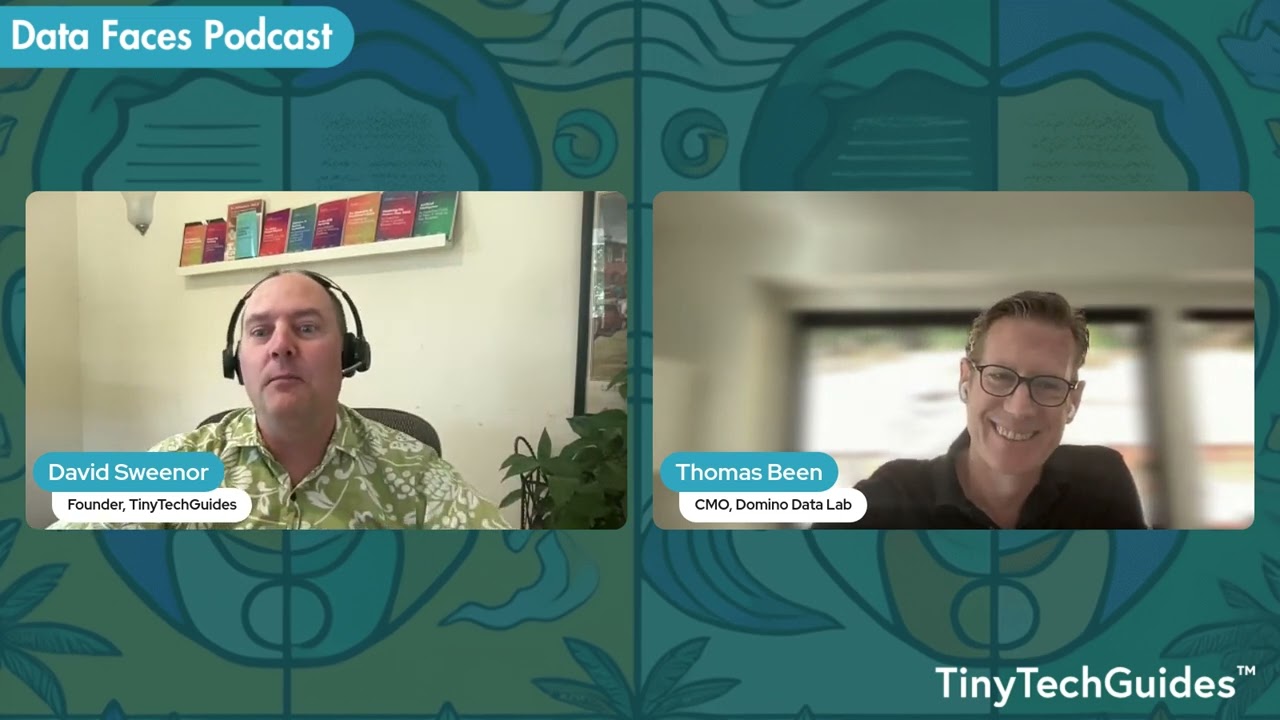
Listen: YouTube · Spotify · Apple Podcasts · Amazon Music
About Thomas Been
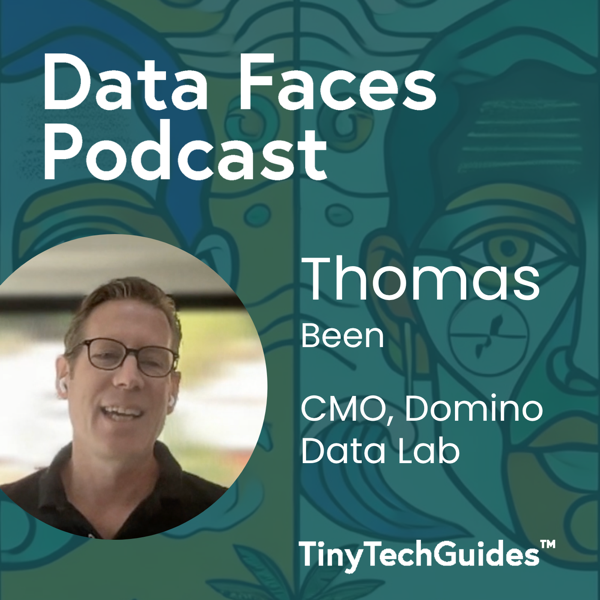
Thomas Been leads marketing at Domino Data Lab, an enterprise AI platform used by some of the most highly regulated companies in the world — organizations enabling drug discovery, safeguarding financial products, and supporting defense applications. He started in physics because he “liked to understand how stuff works,” and moved through technical, pre-sales, sales, and marketing-leadership roles.
In this episode
- Thomas’s path from physics to marketing leadership
- The 95% failure-rate reality check
- Why governance and teamwork — not disruption — sustain AI value
- How highly regulated enterprises build lasting value with AI
- The human factor in enterprise AI
→ Read the full article: Why bad AI governance kills 95% of enterprise projects
Full transcript
David Sweenor 0:00 David, Hello everyone, and welcome to the data faces podcast. This is the show that brings the human stories behind marketing, data analytics and AI to the forefront. I’m David Sweenor, founder of TinyTechGuides, and host for today’s conversation. Today, I am lucky to be joined by Thomas Bean. He is Chief Marketing Officer at domino Data Lab. He spent his career helping enterprises unlock the value of data and AI using a combination of art, science and technology. And this is a very special episode, Thomas. This is episode number 20. We’re going to talk about how enterprise AI builds on data foundations, governance and the roles humans play. So the water’s warm, let’s jump in. So Bonjour, Welcome to Data faces. It’s great to have you here.
Thomas Been 0:49 Bonjour, David, first time I hear you speaking French, but very hard to be here for 8025. Is my lucky number, so I love that we hit a multiple of
David Sweenor 0:57 it. Excellent, excellent. So can you tell us a little bit about yourself and what you’re doing over at domino data lab and what they do?
Thomas Been 1:05 Perfect? So Sure I will. Yeah, I’m I have an interesting journey. I started studying physics. I like to understand how stuff works, and then I started working into it on a more on a technical side, I fell in love with the pre sales role, working with customers and helping bring value and their vision to life. That brought me to a sales role, and eventually I ended up in marketing. Because, as the person was leading in marketing, told me, when he asked me to join and say, Hey, you can, you can have an impact at the different scale that was, that was a Tipco. And since just that’s just, I fell in love with marketing, and I love nothing more than building marketing teams, having them make an impact. And I’m very customer focused. I’m passionate about technology. I’m curious, by nature, and marketing leadership allows me to actually achieve and pursued a lot of these traits. So that’s my that’s my background. And at Domino, I run all of marketing. Domino is an enterprise AI platform that’s used by the most highly regulated enterprise in the world. And what I love about what our customers are doing is the real life outcomes. It’s really about making sure that enterprises can discover new drugs or shorten treatments. They can take drugs faster to the market. They can keep financial products safe and accessible to everybody. Or in a defense context, can keep countries safe by allowing to not allowing armies to leverage AI to make sure that the sea or the skies are are actually safe. So a lot of technology, but way beyond the hype, a lot of use cases that really impact our life or our future. So that’s what I find so fascinating about Domino and why I wake up with a spring in my step in the morning.
David Sweenor 3:00 All right, well, we’re lucky to have you here, and so let’s, let’s dive right into AI. So you’ve probably seen the report. It was came from MIT. It’s called the Gen AI divide, and it said there’s 30 to $40 billion are spent on Gen AI. But the result is 95% of the organizations that are, you know, they failed to make it to production. We’ve heard this before, Thomas, we those who don’t know, we work together at Tibco, but there were, out of nine sectors, only two showed some indication of benefit. That was technology, which I think is coding assistance in media and telecom, which is sort of on the ad side of things. So what do you make of this? It rattled the markets a little bit. Is it surprising to you that 95% of these things are failing?
Thomas Been 3:46 Yeah, I think 95% is probably fairly harsh, but it does describe the situation that we see with our customers. I think the notion of what is a genii, even experimentation and what is the use of Jenny? I is very vague, and almost serves the purpose of whoever’s speaking. Could be a vendor, could be an exec, or these kind of things, but Jenny, I think we’re only at the very beginning of the story. Just look at the past two to three years. I mean, authentic is right now, the latest wave and same thing, like very, very few companies are really doing it, but it really shows the potential. So we are at the very beginning of the story. I think there’s a lot of adoption, like in marketing or development, because it fits into the tools, but we’re only at the beginning of the story of what enterprises are going to build. So they’re discovering a lot. As I said, 95% is probably a bit harsh. But there’s also the nature of experimentation, and this is what data science has been like for the longest time, that yeah, you experiment, and sometimes it’s not always meant to go to production, not everything’s going to be a slam dunk. There. A research element to it, which I think is important. So we’re early, we haven’t fully also found the ways to make sure that we can trust genai enough that we can have it take some of the decision, or we can put in a mission critical aspects. This is what we see some of our advanced customer being able to do, but usually it’s a combination of Gen AI and other technology. So I we all believe in a potential. We see it happening, but it’s still very, very early, and almost the what’s happening is that there were so much investment, so much hype, that, of course, now everybody sees this as going down, but it’s probably a normal cycle that’s gonna that’s going to take place. Having said that nobody should wait until it gets good, because they would. The other element is the speed at which everything happens is right. It’s still, we said this six months after GPT came out, well, two years and a half, it’s still insanely fast. And a challenge actually, to to to adapt so and what we see is, is enterprise actually shaping up to leverage the space and being able to formalize the way they experiment, giving a lot of freedom to the data scientists and the developers, and having a way to identify which are the most valuable use cases and putting them to production. So I think, I think it’s shaping things. It’s but it’s a fluid situation. It’s a little bit like water. It’s fine. The picture is going to be completely different from in 12 months from now, and that’s why enterprises and everybody, I would say the same to a marketer in my team, you need to get ready, because this the change is incredibly important, and it will change everything.
David Sweenor 6:44 Right? The wave is certainly coming. And so a question for you is, I think when people talk about AI today, their mind immediately goes to Gen AI. Now we’ve had AI has been around for a long time. Some people refer to old people like me, predictive analytics. What are predictive AI? I’ve heard every permutation. Is it one or the other for companies? Or how should companies think about this? This dynamic between AI and Gen AI? Are they are the same different? You need to think about them
Thomas Been 7:16 differently. It’s an excellent question that we’re facing every day. By the way, we’re not that old. We’ve seen a few cycles, but we’re not, we’re not that old. But yes, there’s a shortcut, a huge shortcut, like, oh, AI is Jenny I? Some other people are telling Oh, no, we’re doing data science. We’re not doing AI. Kind of the two ends of the spectrum. I it is a spectrum, for sure. What I would say is that if you look at where most value is created, it’s very often in the combination of what Jenny I and other AI approaches and technologies can Can, can be if I look at what we see some of our customers do taking some of their most critical processes, like claims processing and insurance, being able to rip off both the process and the technology they used to use, which is very often legacy and such. And then looking at their, I don’t want to use arsenal, it’s too much of a fight word, but they look at the toolbox that they have with AI, and then they’re going to use, oh, they’re going to use computer vision because it helps with document. They’re going to use Gen ei to help with their the people who are advising the customers, they’re going to use more traditional machine learning, because there’s a lot of prediction they need to they need to do. And that’s where I think the combination becomes important. And I do believe agentic is actually a nice way, because it will bring this level of orchestration together. This is what will make agent together. So AI does not equal Gen AI, Jenny, I is very fascinating. I think, actually, back to the previous question. Now enterprises are starting to kind of shape in their context, what the contour, or what the limits, or Gen AI, and what is good for and what is less good for, but as it always happens in technology, it’s the composition that’s going to matter, and that’s where all the great applications are going to come from. So AI is more than Gen AI, it Jenny, I brought the spotlight on AI, but yes, and there will be probably other waves of AI coming after. So, yeah, AI is more than Jenny,
David Sweenor 9:26 okay, we’re gonna get to something,
Thomas Been 9:28 yeah. But by the way, the the I think it’s important to think about the people aspect as well. We see a lot of our customers making sure that the they have tons of AI knowledge for predictive analytics and such. And very often, these people and what they produce have been running the running the business, and now it’s the combination of these very fundamental elements and skills now combined with the latest technologies that’s very often where. Uh, where magic happens. And then you you can really see some very interesting there’s a proven way to create value or new technologies when you blend them and you bring this business knowledge on top right, that’s where you see very interesting use cases.
David Sweenor 10:12 Okay, so we’re going to talk about governance in a minute, but before we get there, you know, I like this term, you spectrum. That makes total sense to me. And so, I mean, we talk about disruption and this 95% failure rate. So is there, like, Do you have any examples of sort of, maybe an evolutionary success versus a disruptive failure or vice versa? Like, what
Thomas Been 10:39 does that if I think about what we see our customers doing, actually, the example that I was giving about claims processing is a real a real example from one of our customers, Bin paper Cardiff, which is the insurance branch, and this is a project they’ve been doing for, I think, seven years. And Jenny, I came and was added to it. So they had the the bedrock, if you want, but it’s also the beauty of these that they can, they can, they can iterate and add more of these technologies. So disruption, I think, is, is is not the it’s not the right way. Disruption is probably something you have to do if you were a bit late. What we see is actually enterprises preparing more for this evolution. And in the way, the onboard people in the way the upscale people in the way they, as I was describing, the almost industrialized the approach to have experiments to understand what a technology can really do, and then translate it and make it ready for the for the broader use cases. This is where we we see, because otherwise you get into this cycle where, oh, this is the next big thing, and then you use it for a few years, and then it becomes legacy, and then you need to either maintain the legacy or upgrade it, and such. The horizon is a way more fluid way to evolve. If you know what you’ve done, if you can evolve it easily. This is something we help, actually customers to do a lot with reproducibility and having access to all of these previous projects and and templates that have been used. This is where you have a much smoother evolution, and then you can focus your bandwidth on onboarding new ideas, new technology. So the goal, I know disruption in tech is always like, Oh, we want to disrupt our market and all of this longer term. And revolution is a term that, even though I’m French, mathematically, revolution brings you back exactly where you started. So evolution is way more interesting in terms of how you’re going to build continually. Because not only are you going to achieve more, you’re also going to build the skill, the skill of being, we see the most successful customers being super religious about identifying value early, prioritizing the projects that are proven or that have a very strong business case. This matters more than the technology actually, on the ability to create value, and then, of course, the industrialized we help a lot and such, but that’s really this aspect. So we do see the leaders, the enterprise leaders, but also the persons who lead these initiatives thinking way more in terms of fluid evolution, to be ready to see the opportunities quickly, and then being excellent at identifying the good ones and putting them into production.
David Sweenor 13:24 Yeah, I think that’s a good point. Because, you know, we mentioned earlier, the technology is changing so fast. What you think you know today, you know, these models or services that you’re using, they might not be around. Tomorrow, there might be something you know, better, faster, cheaper, what have you. So you gotta plan for that fluidity. I like that term. So, you know, with this, AI everywhere, you know, and from a personal perspective, you know, if you use it enough, you see, it makes up stuff. All the times, people call it hallucinations. I just call it BS, or, you know, Malarkey, or whatever term you want to use, it just makes up crap. And so, governance, I think, is hugely important. You know more so when you’re putting this, you know, if you’re doing claims processing or these critical business processes you’re relying on. So how does the governance framework change or need to evolve to, you know, for for Gen, AI and businesses, this
Thomas Been 14:17 is one of my favorite topic, because it’s been fascinating to see governance. I remember a few years ago, gardener had had one other data and analytics conference. They mentioned the word governance, and the whole stage turned red, and it was like alarm sounds and such. This is what governance was perceived that and has been built for for the last probably 40 years. It’s like, oh, governance, yeah. Well, I wish I don’t have to use it. It’s really selected, like your house insurance, you pay for it, but yeah, I’d rather not use it. I’d rather not be in this situation. But the world has evolved as we were talking. Technology is going way faster than it ever did. There are plenty of opportunities that come. But as you were. Saying they come with risks, and we see a lot of enterprises being stuck in the middle of the river, so to speak. They have very antiquated processes. They have governance teams that cannot have the visibility on everything that’s happening in AI. They don’t have the means of the resources to actually enforce, enforce much, but still the regulations and increasingly, the internal quality standards that enterprises want to have are not need to be applied to make sure that AI is not associated to all of the colorful words that you were using. And that’s that’s really the challenge they have. And this is something I’m not pitching Domino, but this is something we’ve heard very clearly. I remember vividly, one of our life sciences customer at one of our European Conference told us, like, well, what’s the point of creating a model in three months, when it takes something like 11 months to validate it, like, where it’s way past so that was governance, the perception of governance, and what we’ve seen is recently, vendors like us have brought different ways to work, but there’s really been an awakening about governance, and governance becoming more of a value driver, or helping with The value, instead of being like an impeding this value, and it’s all about there’s a lot of collaboration needed. There’s the ability to actually address and have visibility across all of the of the technologies. And now there are ways to actually not making it only happen in Excel and teams and and documents. But the technology has evolved greatly. So you can really put these policies at the heart of the of the of the life cycles of the projects that all of these people are doing, which again, involve data scientists. It involves it. It involves the business and all of it. So now there are ways to kind of bring everybody in the same tool, look at the same thing at the same time, and I have to say that the impact is pretty, pretty astounding. We’ve seen life cycles shortened by 70% because, guess what? Everybody’s informed, and if there’s an issue, people are told immediately, you save a ton of time. And one part of the governance that people don’t mention enough is that what happens when things go wrong. Usually it’s yet another projects to document and do audits, and very stressful, very costly. So now I think we have more and more the ability to be policy driven when it comes to AI. And again, policies can be regulation based, or can be based on what the company expects from from, from Ai initiatives and the spectrum of AI as you were, as you were saying. So I think we’re leaving at a very interesting moment where AI is going to become more trusted, but also AI, the delivery of value from AI is gonna is going to accelerate, but we will have to almost fight the perception for for some time. But we do see leading enterprises totally jumping on board and really very interesting. The words matter a lot. They talk more about quality. They talk about trust or compliance, and that, to me, is also one step towards the overall value that’s going to be provided.
David Sweenor 18:16 That’s quite interesting to me. So let’s say a majority of the companies or companies today, and I don’t know if this is true out, but they’re focused on adhering, complying with a certain set of regulations, or what have you, internal or external. So my question on governance, of course, it’s nice to say we’re pro governance. We love that. Do companies care? And do you see differences between us and EMEA or Asia PAC or are there? Are there regional differences? So we all get you need it to comply with laws, but let’s just put that aside for a minute. How much investment Do you see companies putting towards this?
Thomas Been 18:59 It’s been increasing. They care. First of all, to answer your question, they care. There’s the regulation, but also there’s also very basically the need to deliver value. So they need their own guardrail, and so that’s that’s very important them, especially given the investments that are, that are made. They do invest. We see investments in teams that are sometimes committees, sometimes dedicated teams. The challenge a lot of these teams have is that they’re given a very important mission, but not necessarily the tools yet to do it, and they need to also to contribute to value systematic unions spend, like, millions and millions on it. There’s an element which is a little bit of a it’s very traditional in technology, but there’s an element of also, there’s legacy governance that needs to be updated. And very often this legacy governance is very use case based, technology based, and this is not the way it works anymore. But the differences in comportment, I think Europe, is probably. Be a little bit more prompt in in governance, at having governance, it’s still very compliance based, but it also fits in the way they want you to organize. But the US is not far behind. We do see, we do see a little bit of difference, but it’s not major. We did a survey before user conference, and there was, there was a difference, but not major, I think not even two digit persons of a of difference. I think what’s, what’s interesting is also who’s getting interested in governance. We’ve had discussions with some of the leading enterprises that are our customers, and it interesting, he was very interested in governance, because governance is also an element of scaling the quality. In other words, I use quality. But another word that we hear very often from it is the notion of standards. How do you standardize? There’s the notion of having processes a level of automation, collaboration. We provide all of this. But very often. I remember discussion with a CIO who told us, Hey, I is something I’ve done on the developer side, which I’ve set the standard so I know exactly what’s going to come out of my development teams. And this actually accelerates my ability to to deliver he said, while data science is different and it’s a different and it’s a different type of code and such. I want to do the same. I want to apply the same philosophy. How do I standardize? It’s very different, because the technologies are different, but the idea remains the same. And this is why it teams are now like, Okay, this is interesting, and we can actually and so it becomes a vector, almost, of alignment and standardization, and that, I think that is a big this is also governance, big contribution to the way AI is going to keep on industrialized and mature and be eligible for more, even more critical use cases. And it’s also a factor where enterprises can adapt very quickly. Because the one thing that people, people, and maybe even us, in the way we speak, we tend to think, Okay, you start here, you actually deploy there, you’re done. This is not the way data science works. You iterate a ton, and if each with each iteration, you can gain 5% of efficiency. And if you can iterate very quickly, you’re gold, because the model efficiency is going to grow like crazy. That’s what success looks like. So how do you adapt this to the context of data science? This is where governance can help.
David Sweenor 22:25 You know, I love what you said there. You know, you’re sort of saying that people are viewing this. You know, you mentioned the shortened life cycles and things are moving faster. It’s really an accelerant to innovation, rather than just a pure play, compliance driven approach. So I do like that well, so let’s maybe switching gears a little bit. You know, based on what you’ve seen in your vantage point, what separates projects that make it and those that don’t? Is it technology? Is it culture? Is it processes? Is it some amalgamation of all of those things, you know? What? How do people get ahead here?
Thomas Been 23:03 Yeah, I’m always tempted to go back to the trial and true people processes and technology, but there’s an element to it, not the fact that one of them is the issue, but it’s the ability to align all of them and the ability to to help at each level. I’ll start with the people very often, and it’s because the history of data science was always that it was either in the business or some companies that centers of excellence, but you very often have organizations that are pockets of skills and such, and I’m not saying they need to be all under one roof. They need to work together, and they need to learn from each other. That’s where you can really help, because this makes your project starts the right way. It’s kind of mind blowing. How many times we still talk to prospects, it’s like, yeah, we’re kind of reinventing the wheel. Like, Oh, 2025 we still so that’s on the people side, the notion of also helping people upskill and stay up to date, the hardest thing very often for people in data scientists, especially, how do we keep up? And now there’s incredible, incredible developments with the agents helping them and such. So how do you and we see our role as being able to connect the dots and helping them on a processes side, this is a team sport, and this is way beyond data science. So how do you make sure that you can, you can have the right visibility, the right collaboration, and on this, on this aspect, which is important to streamline, but I think it’s also very important to learn. Hey, what worked well after like, six months, what are the best practices and and such, and then technology? I think, yeah, technology remains a time and issue because it’s costly, because it evolves very quickly, and we see part of our value is also. Helping customers, our customers, making sure they can have access the right technology. We can control security and all of this, but putting it into the right hands at at speed. So the that’s where we see the evolution of and once you have these elements where you can share the knowledge, you can have easy access to the technology where there are processes you can rely on. I would add to this the point I was making earlier, when you have a good framework to identify what the expected value is, it’s kind of the outcome based thinking, not always easy when you’re doing like research and such, but really having this outcome based thinking, which, by the way, is interesting common sense here, but having the ability to bring all of this in a context and make it usable by the by the people. I think that’s where you really have, not only the ability to execute these projects differently, I think you also have at the management level, you have a visibility. You can manage these projects, and you can take decisions. You don’t get into a six month tunnel where you don’t quite know what’s going to come out. And I saved the last point because you said a very important word which is very important to my heart, which is culture. I think culture sits on top of it, that when you have these then I think you can inspire. You can create a culture. You can inspire it, but then you can, you can actually when people can work together, when people have this level of visibility, when you have enough repeatability, and you can get them to be creative, I think this is where you kind of, you kind of get best of both worlds. You have the research angle to to allow people to be ambitious and never right technology, but you have a proven way to deliver value. And we, we are fortunate to work with with many enterprises that have achieved this. We do contribute, obviously, but it’s very interesting to work with these leaders who are able to put this kind of culture, and very often that’s the main thing, that this is why they hire the best talent and all of this, because there’s this they’re joined by this culture,
David Sweenor 27:05 okay, um, I was going to switch gears a little bit. So you were talking mostly about, you know, prospects and clients, you know that that are have adopted your your enterprise AI platform like to switch a little bit to your role as a CMO. And how has AI changed the nature of of marketing and marketing teams? You know? You know, is it? Do you see things that are quite different, I’m sure, than maybe five years ago? How is it? How’s it? How are you adopting it at domino for marketing?
Thomas Been 27:41 So I’ll start there actually, and I’ll get back to how you guys change things. We’re seeing any opportunity to to leverage AI, because we’re a lean team and we want to be efficient. The goal is not to use AI, and the goal is to be efficient and to be as close as possible to what our audience needs to hear and to what we want to we want to push as message. So AI is very useful for us in terms of doing analytics, doing, and I’m mostly talking about Jenny in that context, doing, doing analytics, helping, changing some of the repetitive processes, such as summarization, sometimes, maybe not quite writing content, but helping with outlines, etc. These are a lot of the things that today, with the tools we have, and by the way, we use mostly, I mean, we’re mostly using the llms from the the Googles, or the open AI and such. There’s no but it’s really about empowering our people to do more research, to be more actually effective in translating their ideas into something we can we can provide to our field, or that we can use in our audience to the creation of images is also very useful. So I think it’s really accelerated. And actually I think it has accelerated, but it’s more this notion of empowerment that a marketer now is going to spend less time doing things that are quite sometimes repetitive, important, but repetitive. But if you can do your research, you can see, if you can do your summarization, then you can spend more time working on your ideas. And I think so this is what we do from understanding, having a better understanding of our data, from doing some of the research using the great material that is available everywhere to also changing some of these processes and doing more with just the same effort. That’s how we use that’s how we use AI. And I think the change on marketing is that it’s not AI is not going to. Marketers. I think it replaces marketers. I mean, you were talking about the science and art, which is always my profile, but it’s something I understood very early, when I started working in Product Marketing, actually, and this is what I loved about them. But I do think that interesting. The AI is helping us being more efficient so we can spend more time on the creative side, on the on the idea. At the end of the day, marketing is not only about numbers and such, it’s also about what is that connection you’re going to build with your audience, in your ability to understand what they’re facing, and your ability to build that relationship, that empathy, that actually grants you the right to pitch a solution. That’s true for marketing, that’s true for sales. So we can spend more time doing and thinking about these things, because AI is helping us with our overall understanding AI cannot do all of this. I mean, if you do, I think people are now very good at identifying AI generated stuff, but I think AI is multiplying the kind of research and some of the repetitive work that marketers can do. And then, if we do the right thing as marketers, and we spend more time thinking about our audience, thinking about our customers, thinking about the outcomes that we want to have. Then you get better content, then you get better campaigns, then you get and then then you get more creative. So I think this is what has changed and and it’s really a point where I don’t even see how you could compete within, with or without AI. It’s just, uh, it’s AI. Is not everything AI used right is really creating better marketers that are spending more time on the right, on right things this is, to me, to change, and it’s a fascinating one. So, and I always say, I’ve said this quite a few times, but I do believe that AI is making marketers more human. If it works the way it should, that is the big change.
David Sweenor 32:10 I love that maybe, and we have time for maybe two more questions. But you know, speaking of that, you mentioned, you’re using AI for data analytics, research creation, brainstorming things like that. And you mentioned something I thought was quite interesting. You said important but repetitive stuff. It’s good at that. So, you know, maybe it’s doing email sequences or what have you what do you what do you think the impact is on early career professionals. You know, we all, when we all got our first job, I was doing the drudgery, probably, that nobody else wanted to do, and that’s how I learned. I’m curious your perspective on, you know, what is, what do you think the impact is on, on early career people?
Thomas Been 32:55 This is such an important point, because I think there’s a broader point, actually, about how AI is changing the way, especially the younger generations, are consuming information. I mean, we can see that happening. And all the CMOS at the moment, like, oh my god, like, okay, SEO, dead or not, right, right? But the underlying element is people are changing the way they consume information, which is an opportunity on the marketing side, but maybe a concern at a society level. People your age and my age, I’ve seen our kids using YouTube in a very different way than we were consuming information. And now there’s yet another one. So there’s an element, and as marketers, we need to take this into account and use it to our to our benefit, but for a person that that is starting his career, I think I would really advise them as a follow up to what I was saying earlier, yes, you need to be good at AI, but at stable stakes, right? This is, this is actually not even a half of what’s expected of you, what’s expect. If you want to learn really, you need to spend more time with your audience. Understand the people elements, understand what drives. Spend time with your sellers. If you’re in B to B, spend time with your audience just as a fly on a wall. The words matter immensely, but they’re going to share the way they react, listen to gun calls and such, because that’s where the true knowledge is. And if you have the ability to take your fundamentals of product marketing or marketing that you’ve been taught, you can use AI as a almost a second nature, because it develops you if you stay curious and or you become curious on where you’re starting from, I think that’s the that’s the key. You’re gonna have a great, great path in front of you. And actually, I wouldn’t be surprised that a lot of opportunities are gonna, are gonna come to you. So stay curious, learn the table stakes. Ai, is table stakes. Nowadays focus on the people, I would say, I mean, this is my philosophy, but customers I always have. I very often I’d have discussions with a team that’s and it’s not the case of domino, but sometimes I’ve seen some marketing organization who are just doing work that is reflection of the way they’re structured, or good at DG, we get this. It doesn’t matter. What matters is what the audience is experiencing. This is the only thing that matters. So what is it we put in front of us? Always start with the
David Sweenor 35:26 customers. I love that it’s making us more human. So I guess with that, we’re just about out of time. So you know, what’s your words of advice to technology leaders or business leaders today to ensure their AI success moving forward
Thomas Been 35:43 work on the first of all, first advice is, be fluid. There will be more regulations. Be ready for them. There will be other technologies, faster with faster cycles. Actually, things are going to become legacy faster than usual. So I think leaders have a few years to engineer the way they gotta, they gotta, they gotta evolve, leverage the past, be ready for the future. I think that’s going to become a very, very critical. I don’t want to call it a skill. It’s true at the people level, but it’s true also at the organization, the processes and such. I think that’s going to be key. Processes are meant to be automated, almost forgotten, like it needs to become second nature. So that’s why some of the artisanal elements probably going to become a pretty sticky point for for them in the future, see what you can do to automate, enhance the collaboration and and whatnot. And then the last thing is, I think the notion of the silver bullet is not going to exist anymore in AI. And I guess it comes back to the future proofing points. But yes, be a engineer organizations that are, I don’t know if polyglot is the right word, but that’s, uh, there’s not going to be one stop shop, and it’s not the agent that runs in Salesforce or Microsoft or whoever that’s going to make you better. Everybody has access to it. It’s actually in what you combine and compose in the middle that’s going to define your your success. So the two previous points were really about getting to this core. This is where the value is going to get created. So think about it as you establish your strategy, as you think about the value you can create, as you also establish your organization, and, of course, your architecture. That’s that’s going to be critical.
David Sweenor 37:41 That’s awesome. Well, I love that. Be fluid, stay human, be curious. I think those are great messages. And on Thomas, where should people go if they want to find out more information?
Thomas Been 37:54 Domino, yeah, we love to hear lots of information, lots of stories about what our customers have achieved. So you will see a real life, real life example of the value and impact being created out of the whole spectrum of AI,
David Sweenor 38:10 right? And the.ai is important, or else you can be ordering a pizza. I think,
Thomas Been 38:14 yes, absolutely. All right. Well, perfect. Thomas, this
David Sweenor 38:19 has been a very informative and engaging conversation. I want to thank you for sharing your experience with our listeners and and hope. Hope to have you on again. So thanks for joining. I
Thomas Been 38:30 really enjoyed it, like every one of the my conversations with you, David, so thanks for having me. It was a honor.
David Sweenor 38:37 All right. Cheers. You. You.