

Data Faces · Episode 34 · March 24, 2026 · 39 min
Stewart Bond coined “data intelligence” in 2016. Now it’s a market category — and the missing piece in most AI initiatives.

Listen: YouTube · Spotify · Apple Podcasts · Amazon Music
About Stewart Bond
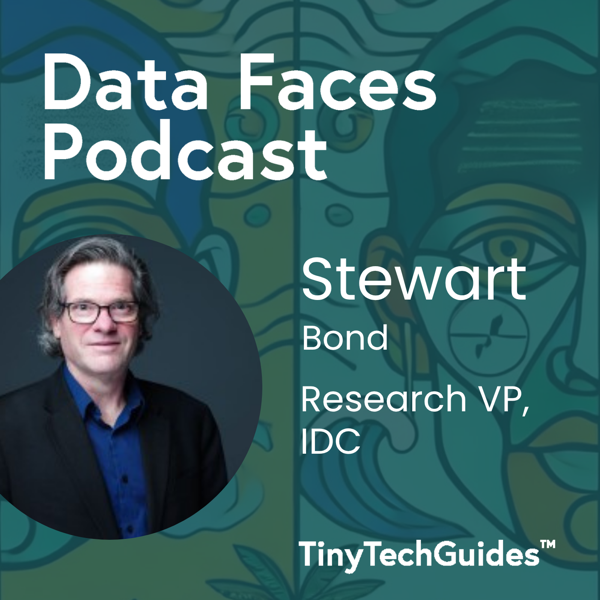
Stewart Bond is a Research VP at IDC, where he leads the data intelligence and data integration software research practice. His career spans 30+ years in IT, including a decade as a certified IT architect at IBM before moving into industry analysis in 2011. Outside of work, Stewart is a competitive curler who came within one match of representing Ontario at a Canadian national championship.
In this episode
- How Stewart coined the term “data intelligence” and watched it become a global market category
- The difference between intelligence <em>about</em> data and intelligence <em>from</em> data
- Why agentic AI demands a shift-left approach to data quality
- What CDOs are most concerned about — and where they’re under-investing
- Why organizations rank data quality as their top AI concern yet keep funding models instead
→ Read the full article: Your AI has a data intelligence problem
Full transcript
David Sweenor 0:05 Hello, everyone, and welcome to the Data Faces podcast. I’m David Sweenor, founder of TinyTechGuides, and your host for today’s show. In this show, I talk with the people who are actually making data analytics and AI work in the real world, what’s exciting, what’s messy, and what’s coming next. Today, we’re going to be discussing all things data intelligent with Stewart Bond, who is research VP at the analyst firm IDC. I think through Stewart’s research and advocacy, this term has really involved into an entire market category. So if you’ve heard the phrase data intelligence, you can thank Stewart. Let’s dive in. So Stewart, welcome to the Data Faces podcast. Yeah, thanks, David, for having me today. Really appreciate that. Appreciate the introduction. Yeah, great. And so just for those who may not be familiar with you or the work you do, can you just give us a little background?
Stewart Bond 0:52 Yeah, sure. Absolutely. So I’ve been in the IT industry for, we’ll just say over 30 years. I don’t want to tell you exactly how much, but the gray hair might give it away.
David Sweenor 1:02 At least you have hair, Stewart.
Stewart Bond 1:04 I do. It is long, but it’s also gray. So anyways, a big chunk of my career was spent as a practitioner, as a consultant, as a practitioner. I was a certified IT architect with IBM for 10 years of my career. And then I got into being an industry analyst and really, really enjoyed taking what I knew about how people were using technology because I was a user of technology and applying that in the market and helping not only end user organizations figure out how to best use technologies, but in an advisor role, but also the opportunity to work with vendors and help vendors to understand a little bit more about, okay, so what are their people doing? How are they using things? And help them with their marketing and sales efforts and messaging efforts to get that out there. So I’ve been an analyst since 2011. So I’ve actually been an analyst now almost as long, maybe longer than I was a certified IT architect for sure, but almost longer than I’ve been a practitioner. So if I keep telling people that most of America was spent as a practitioner, I might have to start saying something different.
David Sweenor 2:14 very sweet right well we both have a commonality in the the working at big blue and so you know that always uh sort of sticks with you and uh before we dive into the meat of this conversation always you know the name of this is databases so i’d like to get behind um uh maybe what you do on a day-to-day day-to-day basis so do you have any like what’s your favorite hobby or things you do outside of work store well there’s a sign behind me that says gone fishing back in time for curling season
Stewart Bond 2:45 That was given to me by a good friend who is a curler and who also spends a lot of time on the lake where I keep my boat. And so it kind of sums me up. In the summertime, I love to go fishing. I’ve got a bass boat. If I can spend as much time on the water as possible, that’s great. When I’m not on the water in the summertime, I’m usually on my road bike. putting some miles and kilometers under my feet and uh or under my seat i guess under my wheels yeah right and uh but in the winter time it’s curling i am uh i played competitively for a number of years i was very close to representing the province of ontario at a national championship oh wow back in 2014 which was really really interesting don’t know if i ever got over that but My wife will probably tell you I never did because it keeps coming up. But it’s sort of some good achievements in those days. But now I just do it recreationally.
David Sweenor 3:44 That’s great. Well, thanks for sharing that. I did not know that you were a curler. I think I knew a little bit about the fishing and the biking. But, you know, actually. The one sport on the Olympics, you know, we just went through the Olympics, right? And I think that’s the one sport everybody thinks they could do.
Stewart Bond 4:03 It’s like not cross-country.
David Sweenor 4:04 Oh, I could be a curler, no problem. I don’t know why. It’s funny.
Stewart Bond 4:08 Yeah, and quite often, because I do work with a lot of Americans, and I tell them that a curl, they don’t always take the sport that seriously. And so my answer is always, well, have you tried it? Go and try it. And then let me know if you think it’s a serious sport or not. We’re not here to talk about curling. If you ever want to do a podcast about curling, I’m happy to do that. The one thing that I will say is it’s amazing because Americans are so excited. The ones that I know always think about me when the Olympics come around. Say, hey, I watch curling in the Olympics. I thought about you. That’s fantastic. We get to watch curling like probably every other weekend or at least once a month.
David Sweenor 4:49 All the time.
Stewart Bond 4:50 Up here in Canada. Like it’s, yeah.
David Sweenor 4:52 it’s crazy all right oh very good well thanks for sharing that so let’s let’s jump into data intelligence so i think way back in um you know 2015 2016 you know i think i don’t know if you invented that term or heard of it but you know what what sort of trend were you spotting what were you trying to describe and sort of you know has has the industry you know caught up to your original definition
Stewart Bond 5:15 Yeah, absolutely. So I joined IDC in 2015. I’ve been here now for 11 years, almost to the day. And I, you know, I’d taken on a whole research area, which included data integration and data access is what we call it at the time. And there were eight different sub-markets within that market. And one of them was metadata management. And data quality was in there as well as what we called master data. Master data definition and control is what it was at the time. It wasn’t the full MDM software market. But I remember I looked back because I know this has come up before. When did you first start talking about data intelligence? And I managed to go back to a piece that I wrote in 2016. And it was around the same time that I had been speaking with ASG Technologies. ASG Technologies, I don’t know if you remember, they had this product called Roshade, which did lineage more in legacy systems, but they were expanding out into more distributed systems and more modern systems at the time as well. But they were using the term enterprise data intelligence. And somewhere along the line, I thought, well, that’s really interesting, but we don’t need enterprise. I’ll just simplify it to data intelligence. Yeah. And I really started using it even more and getting more focused on it. I’d say late 2017, moving into 2018.
David Sweenor 6:44 Okay.
Stewart Bond 6:45 Because that’s when GDPR was going to come in. And I had a lot of end user clients calling me and saying, well, where can I buy a data governance solution? And I just kind of laughed because… Data governance isn’t a technology solution. It’s an organizational discipline, right? You can’t just throw a piece of technology at data governance. In fact, I’ve spoken to a lot of organizations that tried to do that and everyone that tried to do that failed because it’s not an IT bug.
David Sweenor 7:14 Right, right, right.
Stewart Bond 7:16 so so that’s really so i was looking for so what is this thing that’s related to data governance and so i came what’s data intelligence technology it’s technology that tells you everything you need to know about your data so you can then govern it Data intelligence is really, it gives you, it helps answer what I call the five W’s of data. The who, what, where, when, why, and how. Who’s using it? How is it being used? Where is it? What does it mean? Why do we even have it? How long do we have to keep it? what are the relationships that are in that data and and as well as you know the other part of what is what does it mean business glossaries semantics that becomes really really important and even more important now we’re going to think well we’ll talk about that in a little bit but but you know you also asked me uh you know has has the market caught up and And it was interesting because I remember having a discussion with Emily Washington, who was head of marketing at InfoJix. And this is probably, again, 2018, 2019. They had this data catalog. She was talking to her team about their brainstorming about what they should call this thing. What does it actually do? And she knew that I’d been toying with this whole concept of data intelligence without even pulling it out and giving it to her team. Independently, they came up with this idea of what sounds like data intelligence. So they weren’t coached or anything. So that was the first time I heard about the term coming from someone other than ASG or than myself. And then it was interesting because you may remember that Collibra, I think they were the first software vendor to formally use the term. They became the data intelligence company. And I didn’t see… customer at the time that they did that but they had had a few conversations with me where i used the term data intelligence right we called the data governance company they became the data intelligence company Erwin was the next company to adopt it in their messaging. So Erwin is now owned by Quest. You might remember Erwin had a data modeler for years. Well, they acquired a company, I think, 2016, something around there, 2015, 2016. And it was really good, really metadata-driven process management. The first thing that they did with it was they created this really cool data catalog capability. And again, they were trying to figure out how do we market this? And they adopted the data intelligence messaging. It’s still there. It’s called Erwin Data Intelligence. That is from Quest. Alation, they were actually one of the very first briefings I had at IDC in 2015. And they started using the term in 2020, but this was after they learned from me that it wasn’t a Calibra term. right they thought they didn’t want to use it because they thought it was a clear return they didn’t realize it was more of an industry or market term which was really interesting informatic has used it kind of loosely but they’re more focused on they’ve got the intelligent data platform right right it’s it’s it’s more about the intelligence of their data platform but data intelligence is a huge part of that and they they they’ve absolutely adopted it now databricks yeah i was going to ask you about databricks a little bit of a different definition i think yeah databricks came out with a big splash about data intelligence i think 2023 Maybe the end of 2023? Somewhere around there. And Dave Kellogg, I don’t know if you know Dave.
David Sweenor 11:10 Yeah, well, I read his work. I haven’t met him formally.
Stewart Bond 11:14 Dave was actually the CMO. He was the acting CMO at Alation in 2020 when I had this discussion with him about where data intelligence came from. He reached out to me and exclaimed, think you did it i think you created a new market category because now databricks was behind it now yeah that was flattering but their definition’s a little bit different from how i or from how sort of the market first i won’t say how i defined it but how the market first embraced it and started using it and and coming from the words of an analyst at another firm at the Data and AI Summit, not long after the data intelligence messaging came out, asked their marketing team, so data intelligence, that’s kind of an established market category with the Calibras and the Alations and the Erwins and the InfoJix, all the ones that I’ve been working with. is it the right term that you should be using at Databricks? And I can’t remember how they came back, what their response was, but I mean, they are absolutely, when you talk to them about data intelligence, a lot of it at the time even sounded like how the market was defining data intelligence and how aligned with how I had defined it. But then you get into seeing how it was being applied. They’re going beyond. So I’d always treated data intelligence as intelligence about the data. And I’d say Databricks has extended it to intelligence from the data. you know, getting more in the case of you’re taking it beyond just the intelligence of the data, but you’re leveraging that intelligence about the data to make sure you’re using the data intelligently. And so that’s kind of how they position it. And the fact that you’re getting more intelligence about what you’re gonna do, you’re getting, cause they’re also, they’ve got all the AI capabilities in their platform as well. Now, you know, Databricks is also, they’re also a client. And so I think we’ve kind of gotten to the point where we agree to disagree. We have an understanding about our differences. And I know we want to talk a little bit more about this, but before I go any further, last year I sat down with some of the product leaders at IBM and they’ve taken their entire portfolio their data cataloging solutions or data quality solutions lineage solutions observability products and they’re all now being rolled into watson x dot data intelligence okay that’s interesting i was personally told by their head there that the renaming was because of all of the work they’ve seen coming from me and obviously what else is going on in the market so when you see you know what’s next data integration and what’s next data intelligence i run the data intelligence and data integration software service at idc So, all right.
David Sweenor 14:35 So our listeners just send you a thank you. Load up his LinkedIn with thanks. That’s actually must be super exciting, Stewart. Like you don’t know how many companies I’ve worked with. uh from a marketing capacity and worked for like oh we want to define a market category i just sort of like put my head down i’m like no but you’re probably one of the one of the few of that have sort of excess successfully helped help define a market category which you know must be uh super satisfying so you know the idc thing doesn’t work out you can become a marketer just to tell people you got experience in this in this defining market categories
Stewart Bond 15:18 Someone once talked to me about how they’re looking for a new CMO and how they had to find the right person. And this was the CEO of a company I was speaking to. And I’m like, he’s not talking to me, is he? I don’t think so. No.
David Sweenor 15:33 Yeah. So, you know, you mentioned this Databricks has this sort of intelligence. from data and your sort of definitions is intelligence about data um so that’s probably one of the the biggest differences but how else has the sort of the category evolved since you’re or how has your thinking evolved potentially since you you know originally started started started thinking about this yeah yeah it is it is evolving a little bit um it’s interesting i had a
Stewart Bond 16:06 I’ve had several conversations with different people, different vendors, as well as end users are asking me questions about this. And I know there’s other analyst firms that have kind of different terms for it. Active metadata, I think, is one of them. That’s always been a part of my definition of data intelligence. It’s not only… it’s not only the metadata and the traditional data catalogs and that sort of thing, it’s also capturing the insights into how that data is being accessed, the frequency at which the data is being accessed, the different data products and data databases and data tables and such that are being accessed that can help you understand kind of you know the most accessed data might be the most valuable data in the organization and so that gives you a lot of insight into what is what are the data pieces that you need to protect the most need to make sure you’ve got the highest quality and all that stuff is a part of that and and that’s kind of taking what you’re collecting in data intelligence and doing something with it, which I think is kind of what that whole metadata thing is all about. But that’s always been a part of how I’ve looked at it. It’s absolutely changing now with AI. There’s a lot of stuff, you know, I wouldn’t say it’s being expanded. There’s certainly semantics are coming into it a lot more than they did when I first… know thought about what is this thing called data intelligence business blockers was always a part of it but the semantic piece as we start to see semantic layers and semantic graphs that’s that’s interesting and and and starting to come into this space also harvesting all these intelligence about unstructured data. I’ve been focused a lot on structured data, harvesting all that metadata, the lineage, the definitions, the quality metrics. All that is a part of data intelligence over structured data. It’s starting to expand into, well, we need the same type of information about unstructured data, especially as we’re getting into all these Gen AI use cases where We have to use unstructured data with these things. We need to have a better handle on what’s in our unstructured data estate, which is, I think in the work we do at IDC, we’ve got a data sphere. I can’t remember the exact percentages, but the amount of unstructured data is, or the amount of structured data dwarfs the amount of unstructured data that organizations have. So yeah, it’s expanding into that area pretty quickly.
David Sweenor 18:52 Yeah, absolutely. And, you know, there’s this whole thing like metadata, especially with data is like, you know, super high. But let me double click a little bit on data intelligence. You know, you mentioned a few vendors. So if someone’s out there looking at this sort of category to organizations, do they. buy like a all-in-one solution or you gotta sort of assemble it as a diy you know because we got what do we got we got quality lineage catalogs data products glossaries you mentioned all that stuff so how do organizations how should they think about this if they want to have all these capabilities
Stewart Bond 19:33 Well, it kind of depends on what you, you know, as you’re looking at this, there’s a bunch of different stuff going on in the market. I will say that from the surveys that we’ve done at IDC, there are a lot of organizations that have multiple products and, you know, up to 10 products that do all these things. And so for the most part, a lot of organizations have been the integrator of these solutions and i haven’t run a survey recently but i think when i ran a survey back in 2019 2020 something around that time frame i think the spreadsheet was still the most used data catalog right there in the market which i think it always will be probably always yeah that’s right and and you know that’s that’s as up to date as as it is when you hit the save button uh maybe even maybe even you know that’s too late so uh it it’s really interesting but I think there’s kind of what we’re seeing in the market. There are the Databricks and the Snowflakes and the Clouderas and the Teradatas and the WatsonXs that are the data lake houses and warehouses that are trying to pull all these capabilities into one thing. And that’s great, but arguably… not all of your data is going to be in there. It’ll never be in there. A lot of the surveys we do, organizations don’t have one analytical repository. They have many. And so everything’s not always going to be there. For the stuff that’s there, it’s fantastic. And they are working really hard on being able to do some federation and being able to do more data virtualization, that sort of thing, so that they can zero copy, zero ET, all that sort of stuff is coming to play in those platforms. You’re not going to get the same qualities of service within that platform with that engine that you might on the data that sits outside of that platform, but you’re still going to be able to see it and have access to it and be part of the data intelligence. uh view sort of say in the organization but but there’s also you can look at the platforms the data intelligence platforms that are putting cataloging together with data quality together with observability right together with data stewardship capabilities lineage all of that stuff wrapped up together and that’s your calabras and alations and erwin’s and And, you know, IBM, what’s next, data intelligence. Who else is that? I hate to do this because there’s a lot out there that are doing this. Precisely is doing this with their product portfolio. Informatica, if I didn’t say Informatica, I’d probably hear it from my AR representative. Right, right. Which is now part of Salesforce. And honestly, I think that I wrote a piece about this. I think that’s one of the biggest reasons that Salesforce made that investment is they were missing that. And so there’s different categories of platforms. There’s the data and the metadata, or the data and the data intelligence. And then there’s just the data intelligence platforms altogether. and click sorry click if i don’t say click they’ll probably they’ll probably hound me about that as well they’re doing the same thing with with their uh click tell on cloud they’ve got all those capabilities in there as well so it’s definitely they’re coming together and and and i’ve also seen some of the vendors that are more focused on master data management expanding their thinking into doing more in data intelligence. And that’s been an interesting evolution of the space as well.
David Sweenor 23:15 Okay. Yeah, that’s super interesting to me. And so there’s a lot of movement. And I think a lot of these vendors will start out with a core set of functionality and everybody’s always trying to expand the type of functionality they have. But when we opened this conversation right after curling, um you mentioned metadata right and and that’s a term that i think you know it’s a hot topic today and you know as we get into agentic ai and things like that and you mentioned semantics you know how does the the and you mentioned unstructured data so like what does your strategy does your data intelligence strategy need to change if you have uh agents doing things, whether there’s a human in the loop or they’re making autonomous decisions? Like what are the things do you need to think about?
Stewart Bond 24:04 Yeah, no, absolutely. This is when the term context comes into play. You may have heard some vendors talking about it. And context is really interesting because some will say you need the context of the business by using the data itself. To me, that would be intelligence from the data. But are you using the right data? at the right time, with the right model, and for the right reason. For that, you need the data intelligence to give the context of the data. What’s the quality level of that data? Where did that data come from? What are the privacy and regulatory constraints on that data? What are the security issues that I need to think about? Where did that data come from? And how has it changed over time? What’s the provenance of that data, which is something kind of tied to lineage. But you need to know all of that stuff in order to have the complete context. It’s not just the context about the business, but if you’re not using the right data at the right time, you could be looking at the wrong context. So that becomes really critical. And I’ve always had this sort of idea where if you look at the intelligence about data, and you look at the intelligence about models, there’s a lot of similarities there. When you can put one plus one together, the intelligence about data plus the intelligence about the models, that can get you a long way towards AI governance. We’ve seen a lot of vendors that have come from the data intelligence space now doing a lot more with model governance and model intelligence, model cards, all these certain things and doing the things they did with data doing that with models and providing lineage of is this tracking the data that’s being used not only to train models, but also to hone those models, tune those models, but also what data is being used at the time of inference. And this is where it comes to the agents. The agents need to know that they’re using high-quality, trustworthy data that they have access to almost immediately. When we get into autonomous agents, a lot of the agents that we deal with right now, that we have right now, they’re being executed by people. People are executing a prompt. You’re helping do something. It goes away. It does something. But when we’re going to get more autonomous agents, are these digital employees that are just waiting for something to do? they’re going to be getting an event. And that event could be coming out of a change data capture service from a database that saw, hey, this business transaction just happened. An order was just placed. This event goes out. An order was just placed. There’s an agent, oh, there’s a new order there. I need to fulfill an order. And so it goes off and does its work to fulfill the order in whatever it needs to do, the application, APIs it needs to call, all that good stuff. well you better make sure the data in that order event is good and that it’s a an order event that is real and reliable so you may have heard the term shift left yep that this whole idea of shifting left so your data quality your data privacy your your uh data integrity all needs to be as close to the source as possible Because once it gets out into the AI world, which the foundation of that is data, once it gets out there, whether it’s through an event bus or whether it’s through the API or through a direct connection or what have you, it better be right. You got to make sure you’ve got all those qualities of service, again, as far back as you can. uh before it before those agents start to use or i guess wherever the source of that data is i guess in that case if the agents are working on top of a over top of a data lake house okay so you can clean it up in the data where lake house but but in the old days when we had batch processes and we had people that and maybe some batch processes that would look for um would look for anomalies in the data, the data could be corrected. But now with everything being real time, we don’t have that luxury of waiting to clean it up. It’s just going to be used before we have any chance to look at it.
David Sweenor 28:40 Yeah. So let me ask you something. So everything you said makes total sense to me. And you sort of alluded to this earlier. Has anybody cracked the nut on unstructured data? Let’s just say that’s the bulk of the data in an organization. We got reams of PDFs, whatever we got. How many versions of the same PowerPoint file do you have? This is B1 final, whatever. Like, is anybody addressing this? Or, you know, I just, I don’t, I don’t see a lot of talk about it. And that’s most of the data that these, these LLMs love to, to eat. Yeah.
Stewart Bond 29:14 There are companies that are cracking the nut on this. Shelf.io is one that I came across that has actually figured out how to determine what the quality level of an unstructured document is, which blew me away. I never could figure out, you know, if you’re looking at a word processing document, and the content in the document, how do you know if that’s high quality or not? How do you know that? And so I don’t know if they’ve fully cracked them up. They’ve been able to do some work to at least give them an indication of whether it’s good or bad. But I’ve always kind of looked at this and thought, well, maybe it’s better to think about whether or not unstructured data is safe to use rather than is it of high quality or low quality. know i’ll tell you though but you know back to what you first started out with how many different versions of this do i have and all that sort of thing that that is what we’re seeing a lot of investment in in again the vendors that have been more traditionally focused on on structured data they’re now expanding into the unstructured world they’re starting at that level of capturing those metrics and capturing that that metadata about the unstructured data that’s where they’re starting and so yes they’re making a lot of inroads there my my colleague amy machado at idc she focuses on this very specifically and she’s got a team that looks at intelligent document processing and that sort of stuff there’s a number of vendors in her space that are doing this you know i mean shelf was one of the ones that i called out and i know she works with them as well but there are others that are also doing it but maybe in a different way than what we think about in our world so yeah it’s it’s happening and these worlds are coming together
David Sweenor 31:04 Okay. Well, we’ll see. I think there’s a lot of work to be done.
Stewart Bond 31:09 There’s still a lot of work to be done.
David Sweenor 31:10 A lot of work to be done. So I know we’re getting close to the end of the time, but I got a couple more questions for you. You speak all over the world. I know you spoke at MIT Symposium. So what do you hear when you’re talking to CDOs? What are they complaining about? What’s the biggest issues that are keeping them up at night?
Stewart Bond 31:33 Well, you know what, they used to complain about being able to justify their position. OK. Because, and this kind of gets back to business value, CDOs need to understand that what they do is having an impact on the business. And so they need to be able to say, if I’m managing this data, and because of the improvements we’ve made in data, our our revenue has gone up or our efficiency has gone up or our costs have gone down they need to be able to articulate that and that’s always been really hard for them to do i think uh you know last couple weeks ago i was i saw doug laney he’s he’s done all kinds of work on on infonomics you can probably go go talk to him about that but but that is one of the things that that’s that I know CDOs struggle with a lot. Now, that being said, with the importance of data and with the importance of AI, that is shifting.
David Sweenor 32:36 Right.
Stewart Bond 32:36 We actually made a prediction not in 2025 or 2026, but in 2024, about 2025. the chief data officers would have much more influence on IT spending in the organization than they’ve ever had before. And that’s because when we survey organizations, what’s your biggest concern about AI? When you look at their biggest concerns, it’s focused on data quality. It’s focused on data correctness. It’s focused on data privacy. It’s focused on data security. It’s focused on all these things that CDOs are accountable for. So yeah, they’re having more influence on that budget. And I think at this point, they’re probably getting a lot more concern. In fact, I do a survey to the Office of the Chief Data Officer every year and if data quality isn’t their biggest concern they’re from organizationally they’re most concerned about skills do we can we find the people right to do the work that we need to do the second one is just managing the expectations of what ai can deliver not only in their own team, but I think more likely probably to their peers and to the people they report to, because all of the C-level executives are getting a lot of pressure from their boards. Can’t we just put AI in to fix that problem? the magic bullet just ai it will take care of it on its own yeah but but again i’ve done a lot of work on it recently with a lot of different uh vendors as well as you know with the surveys that we do why do organizations fail at ai i don’t think we have i don’t know if i have data that says why they fail at ai but i can tell you that consistently the things that organizations are most focused on right now in their ai initiatives data is a big part of it so data has that data foundation needs to be there for it to be good and that is how cdos are not justifying what they do okay all right so maybe the last question store um
David Sweenor 34:53 know what’s the one thing that you know as you you you have uh you talk to a large number of enterprises and advise them you know all over the world what are they under investing in right now when it comes to data intelligence it’s really interesting that you ask that because
Stewart Bond 35:11 We just did a survey and a custom project that I did. And it’s very similar to my office, the chief data officer survey that I’ve been doing for a few years now. And what I find really interesting is one of the biggest challenges that they have is managing the intelligence about data. And that includes exactly what we’ve been talking about, data catalogs, business glossaries, data lineage. All that stuff is so important now as we get into AI, as we’ve talked about. And yet… their top investment in categories are not on data catalogs. So I find it, you know, back to the spreadsheet might still be the most widely used data catalog in market. I don’t have data to prove that, but, you know, anecdotally that could be the case. So I think there’s still a lot of investment, a lot of work to do, not just on, you know, I would say just harvesting that intelligence about the data. It’s not just, the data catalogs. It’s also the data quality, right? There’s a lot of concern about data quality. That’s one of the biggest concerns for anything in AI. Want to make sure they’re using the best data possible to get the best outcomes possible. but i would also say that data quality will never be 100 correct you never score 100 in data quality if you do i’d love to hear about it but if you know how clean or dirty that data is if the score is 90 or 95 or maybe it’s 75 you know how much you can trust how much confidence you have in that data when it’s used with that agent when it’s put into that algorithm when it creates those analytics so you can have a more informed intelligent guess not guess but um you’re more informed about the analysis and if you’re going to make a decision based on that analysis you have a more of an idea of a confident level of confidence of your decision about whether or not that’s a the right decision i actually heard about this i’m going to say years ago Before I even joined IDC, when I was talking to a client that said, we finally got to the point where we realized data was never going to be 100% clean. Right. But now we know how clean or dirty it is, and we bring that number, that score into our calculations. Now it’s a life insurance company. They have actuaries. They know how to do that sort of thing. So I’d say data catalog, data intelligence, data quality. One of the other things that is a really big barrier to getting those data catalogs in place is adoption. And every time you market scape on this, the end users I talk to, that’s the biggest problem that they have. Not only is it hard for the data stewards to get all of the metadata into the catalog, but… then the other part is the more that people use them the more valuable they they become i think agentic ai is going to help a lot with that it’s already helping a lot in their agents that will go and pre-populate these catalog stewards just have to validate what’s there instead of write it from scratch so i think it’s going to get better and hopefully there’s going to be more better adoption and and that issue is going to go away in the future
David Sweenor 38:35 Wow. There is a lot to think about for organizations out there. So, Stewart, I want to say thank you for being on the Data Faces podcast. This has been an enlightening discussion. You are a fountain of knowledge. And there’s so much to learn. And we talked about structured data, unstructured data, all the attributes you need to know about your data to make AI work. So thank you for sharing that. And thanks for joining the Data Faces podcast.
Stewart Bond 39:03 My pleasure.
David Sweenor 39:04 All right. Talk to you later.
Stewart Bond 39:06 Okay. Take care.