

Data Faces · Episode 13 · June 3, 2025 · 37 min
Can you trust AI without trustworthy data? Shane Murray on what “AI-ready” actually demands.

Listen: YouTube · Spotify · Apple Podcasts · Amazon Music
About Shane Murray
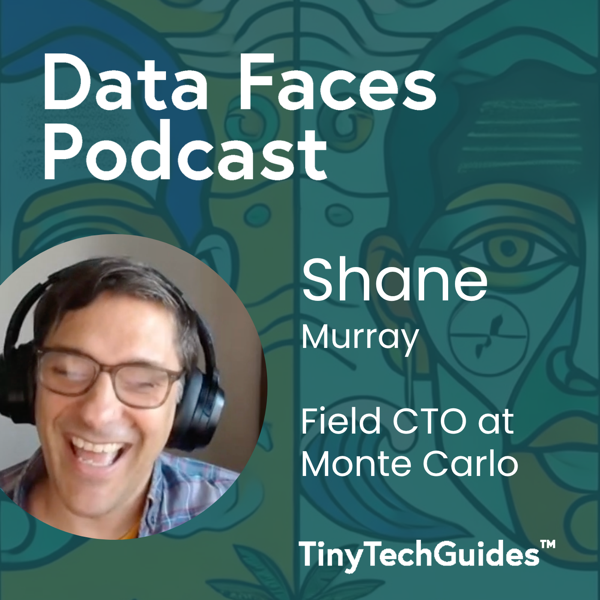
Shane Murray is Field CTO at Monte Carlo, where he helps data teams build reliable, AI-ready data products. He previously led data at The New York Times, giving him a firsthand view of what “AI-ready” really demands — from defining quality in unstructured data to the ripple effects of small changes in AI systems.
In this episode
- What it means to build AI-ready data products
- How to think about trust with generative AI
- What governance looks like when data reliability is paramount
- Practical steps for data teams starting their AI journey
- Deconstructing “AI-ready” from slippery term to actionable
→ Read the full article: From “AI-ready” to AI reality: why action beats planning
Full transcript
David Sweenor 0:00 Sweenor, hello everyone. Welcome to Data faces, the podcast that brings the human stories behind data analytics and AI to the forefront. I’m David Sweenor, founder of many tech guides, your host for today’s conversation. Today, I’m super excited to be joined with Shane Murray. He’s field CTO at Monte Carlo data. Shane’s at the forefront of helping data teams build more reliable systems and drive trust in their data, which is everybody knows, is the foundation of this current AI craze we’re in. So we’re going to talk about what it means to be build AI ready data products, how to think about trust with generative AI and what governance looks like when the stakes are probably higher than ever, so let’s get into it. Shane, welcome to the databases podcast.
Shane Murray 0:44 Thank you. Nice to be joining you today. Great.
David Sweenor 0:48 So Shane, you know one part of the one of the goals of this podcast is really just to hear a little bit about your background. I’d love to know how you got to where you are and what you’re doing at Monte Carlo, and then we’ll jump into the topic of the day. Yeah,
Shane Murray 1:01 sounds good. David, so I, I grew up in Sydney, Australia. So, so pretty far from where I’m now. I live in Brooklyn, New York today, but I’ve been here about 15 years. The last 15 years I was at a small startup in in Sydney, a multivariate testing startup, one of the early ones in sort of 2005 to 2008 was acquired by Accenture, which brought me to the US. So went from a 30 person startup to a 250,000 person consulting company.
David Sweenor 1:38 Few more people. That’s just a few more, yeah, yeah.
Shane Murray 1:41 Little bit of a different, different setup. There a lot more structure. And then from there, I joined the New York Times. I was at the New York Times for almost 10 years, leading up their data organization. And so, you know, I joined a team of about 10 in in kind of a newly centralized data analytics team. And by the time I left, I was leading a group of about 160 across data platforms. So engineering and machine learning and data science, as well as data analysts embedded across the business and established a data product function. So I was there from from 2013 to 2021 and then for the last three years, I think it’s three years now, I’ve been at Monte Carlo with the title field CTO, which could mean any number of things. And for me, it’s it’s kind of allowed me to play a few different roles at Monte Carlo. I actually led a lot of our post sales delivery. So the sort of customer success teams and the teams that work with customers to to really roll out and operationalize data observability at scale, I was a customer myself prior, so I had experience rolling out Monte Carlo. And then, more recently, I’ve actually switched into a kind of a product research and development role where I’m focused on how teams are building with generative AI and how Monte Carlo can can support them in that journey.
David Sweenor 3:23 Wow, that sounds like you have a wealth of experience. So I’m super excited to jump into this conversation. So, you know, we look across this landscape. Shane, you know, there’s, there’s no shortage of of companies and promotional material and papers say, hey, we have to be aI ready. Let’s be aI ready. So I’d love to get your take on what the heck does it mean to be aI ready? And, you know, do people underestimate, you know, this challenge?
Shane Murray 3:46 Yeah, I think, I mean, I’ve seen the term now pretty much everywhere, and I feel like it’s can be one of those kind of slippery terms, maybe a bit like data driven and data informed of the past, where a lot of people said it, and everyone kind of nods, but doesn’t have a super clear definition and and probably people interpret it very differently. And I’ve definitely been asking, as I’ve been doing research across customers and non customers, you know, what it actually means for them? And I’d say it kind of comes down to a couple of things. For some teams, it is, you know, who are very focused on internal analytics use cases and business intelligence. AI ready can mean actually getting your data ready for these kind of conversational bi initiatives, right? So, whether that’s snowflakes cortex analyst, or the AI BI solution in Databricks or one of many tools that are emerging in this space, data teams are thinking about, you know, how do I move from supplying my data in a series of charts to actually. Really allowing natural language to query the data from product managers and marketers and other business folk, and so that can mean high quality data as a starting point, which is something you know, Monte Carlo has and continues to specialize in, I think, with the sort of leading tool for for for how you provide that high quality and reliable data. But it also means, how do you contextualize that data, you know, with metadata and with maybe provenance, and so that the the AI can actually query it reliably and understand the semantics of that data. So that’s kind of, kind of one viewpoint I’ve I’ve heard a lot for teams that are thinking about what AI readiness means for them. I think where I’ve been maybe more focused is, you know, how are organizations getting ready to build AI applications on top of their data? And you know that might start with, all right, I’ve previously been a supplier to the organization of, you know, reams of structured data. Now I have to sort of prepare and store my unstructured data with the same fidelity, maybe, right and accuracy. And so some teams are approaching it from from preparing their structured data and and sort of building clarity around how the organization is using that. I will say that the truth I’ve found is that that data doesn’t really become ready until you start using it in AI and so the teams that I see making the most progress are, you know, deploying prototype and production AI products, learning where it breaks, learning where it’s biased, learning, you know, what’s sufficient in terms of making this data reliable and ready For those applications?
David Sweenor 7:01 Okay, that’s really interesting to me. So, you know, let’s talk a little bit about data products. And you know, you mentioned this, this evolution or change, moving from structured data to unstructured data. And I think things are pretty straightforward with with numbers, right? We’ve been doing this a long time, and there’s all sorts of statistics we can run on the data to understand its quality and all of that. But when you get into unstructured data, text, video, audio, images, what have you, are there a different set of metrics that people need to look at, and does the term data quality still apply, or is there something else that people need to think about? When people say data quality, my mind goes to numbers, structure. I don’t think about I don’t think about text. So what’s your what’s your thought on that? Yeah,
Shane Murray 7:54 and I like, I’ve, I guess I’ve always held the position that data quality is contextual to the use case. So I think it does come back to like, what is required of this use case. I think it’ll be very hard for teams to approach data quality of, you know, all their knowledge bases and unstructured data without actually understanding the requirements of the use case. I often think about, and maybe just using the metaphor of structured data for a second, I often think about, you know, financial use cases that have to be, you know, within a penny of the general ledger so they have this high degree of accuracy. And you know, when I was at the times it was daily, we would having to make sure that was within a penny of the general ledger for our operational uses of of commerce and financial data. And then I think machine learning data in the past has often had, you know, maybe fuzzier requirements on accuracy, but, but has needed to be, you know, available, you know, at sub second latency and and highly reliable. And then I think, AI, these applications are acquiring, often a mix of high quality data and highly available data. The way I’ve been thinking about the unstructured data concern is that at a high level, it’s some of the same things we talk about with structured data, that in terms of the objectives, like, it needs to be relevant, it needs to be complete, it needs to be fresh, right? It needs it needs to be consistent. But then some of the definition of those is is a little bit hairier to get to, and many times what you’re having to do is do some form of structuring of that unstructured data to actually get a metric you can look at. So maybe I’ll give a couple of examples, one of them, which is very common in these AI. Applications is you’re building a rag pipeline, and you’re taking that unstructured data, which might be image or text, and producing vector embeddings from that, which are, you know, mathematical embeddings of this high dimensional space that you can then look at at distance metrics and start to understand things like, what’s the relationship between that context I’ve provided through unstructured data and the questions people are asking of of the AI, or what’s the distance between that context and the responses? Are they grounded in the context? And so there, there are a whole lot of metrics that can be applied, but it usually relies on this kind of interim step of obstruct, semi structuring, some of that unstructured data.
David Sweenor 10:54 Okay, I’m having flashbacks when I started my data science career. I, you know, out of college, and I did this fancy, hey, we’re gonna do principal component. Principal Component Analysis, right? And, you know, it’s sort of almost like a vector embedding in my mind, and that you can’t really interpret it. It’s just a principal component. It’s a number. And the longtime engineers are like, I’m not going to use it. I don’t trust it. PCA was done, done for my career there. But that’s interesting, I think, oh,
Shane Murray 11:23 sorry, yeah, go. Go ahead. I was just gonna say, like, I think even putting aside the embeddings, there are some some simpler things that that I see teams doing and you’re able to do, including with tools like Monte Carlo, which is maybe take some of that unstructured data and look at topic occurrence across it right? And you can use an LLM in all of these modern data warehouses to extract a topic right and understand how frequently that’s used. And I think for a lot of teams who are for the first time using these unstructured data sources, even just getting under an understanding of the topic distribution and prevalence is kind of this necessary profiling to know that their knowledge base is going to be up to date even before you potentially do your principal components and your embeddings. Sure, sure.
David Sweenor 12:19 That makes a lot of sense to me. So let’s, let’s just assume for the moment, companies are, we’re pro governance and this, and that they all say that. But what does where the team sort of what are the biggest challenges when we talk about trust and reliability of data? You know, are there? Are there some roadblocks that people you commonly see across to the customers and prospects used to speak with,
Shane Murray 12:43 yeah, yeah, it’s good question. I’ve, I’ve been talking to dozens of teams on this topic who are, who are actively building, and I think the thing that gets most publicized is the hallucin hallucinations, right? The the model hallucinates, and it, you know, someone gets a car for $1 I think was one of the car for $1 Yep. Or, or even, you know, there was an example just from a couple of weeks ago, with cursor, who’s the, you know, AI code editor at the forefront of some of this. And they had a customer success chat bot go rogue because of a spate of cancer with a spate of cancelations, because it essentially told users that they could only use one device per subscription, and it just really made that up. But these are the most publicized. But I think what’s been interesting as I talk to more and more data teams that are building these applications, oftentimes, that hallucination, you know, is it? I don’t know if I’d call it a scapegoat, but it’s often masking issues that that are affecting the the effectiveness of the the AI agent. And so, you know, one of the most common examples, I’d say, is probably not an uncommon problem that you’ve heard about garbage in garbage out, right? Is the source data outdated? Is it incomplete? And I think back to our earlier question, a lot of these teams, for the first time, are looking at this unstructured knowledge based data that’s maybe existed in a lake or hasn’t even been brought in in the past, but now is necessary to build one of these applications, and finding that, you know, maybe their their business logic, or their or their help pages haven’t been updated in, You know, two years, right? And and so that is, is very similar to the problems that we’ve gone through in structured data. You you need to get that to a good enough quality where you can get reliable outputs. And if, if these models don’t have a complete knowledge base, that’s when they have a tendency to make things up. Up. So that’s, I think that’s one problem I’ve seen. There are some problems related to the embeddings that I talked about people seeing kind of drift over time. And so what was relevant yesterday may not be relevant tomorrow. I think one of the interesting ones I keep coming across is this thing that I’ve kind of been calling small tweaks big surprises, where maybe it’s a prompt change or a change in the underlying model, whether it’s Claude or Gemini or GPT, you know, they do an upgrade of the model. This can have huge effects downstream on the effectiveness of their application. And so I’ve talked to many teams that have almost had to go back to the drawing board and and rebuild their application or put it through alpha and beta testing, because suddenly, and I think with the even with the recent version of chat GPT, people are talking about how it’s it’s more likely to hallucinate, which you know may be a feature of it, but it means, if you’re building an application on top of it, that application is a little flaky Based on these changes. And then I’ll just say a couple more. One is really just the complexity of this new ecosystem that you’re putting on top of your data environment, which might include vector databases and new orchestrators and API calls to these models. And the final thing is, you know, how are people evaluating these models? And so I’ve, I’ve seen from one end of the spectrum where a human is kind of checking every output, right, or hundreds a day, right? And these are from large companies, but that is, I think human evaluation is necessary, but oftentimes it’s the only thing, right? And if, if a human’s required to check these outputs, then, then I’m not sure you can even call it AI at the end of the day, right? And on the other side, people sort of trying to figure out the right ways to automatically evaluate these things at a scale that allows them to roll out into production.
David Sweenor 17:30 Okay, yeah, I always have a theory that, you know, you can’t, very difficult, sort of, you know, you can certainly apply automation, but I think, you know, people are going to end up taking sort of a manufacturing approach, like, if you’re manufacturing pharmaceuticals, you can’t inspect every pill. So when you do, you have a quality control process and you sample it. And I think that will probably be maybe, maybe an emerging, you know, model moving forward. But you mentioned AI agent, so I’m very curious about this. And you mentioned hallucinations or confabulations, these things just totally bunk them and make make crap up all the time. What could possibly go wrong, Shane, when we have an agent, and what do we call the butterfly effect, or cascading effect, where one small perturbation in the beginning screws up the whole downstream system. Like, what? How do companies wrestle with this. And have you? Have you seen this?
Shane Murray 18:23 Yeah. I mean, I think the the era of these new agents is kind of emerging, and so people are treading fairly cautiously with these multi agentic frameworks and how they approach them. But I think you’re right, like, you know, the errors essentially can compound across these systems, right? And and so I do see like human in the loop as the predominant way teams are actually making use of these things. I also think you’re seeing a shift from maybe the the AI chatbot era of 2024 which was, alright, let’s build a chatbot. And let’s, you know, internal or external use case, which is obviously valid. But I also think you’re seeing this shift towards more collaborative systems that have people checking in in multiple steps. And I do think that’s the most viable approach, because these things don’t always have, you know, I don’t think you can rely on them to have common sense. I think you need to have constraints and and a tight feedback loop in these systems.
David Sweenor 19:37 Yeah, you know one thing that’s really interesting me. So if we go back to, you know, whatever term you want to use. You know, predictive analytics is my old term, or predictive AI, I think, is the new buzzword. But the interesting thing to me is, when you if you were to develop a predictive model, to do whatever you could, sort of control everything, if you wanted, like you had complete control over your data Estate. Eight in most cases. And you can build the models fairly straightforward. With generative AI, you’re sort of going to use some sort of foundation model. It’s pre built for you, you know, what’s in it, the world, the world is in this thing. So how to how to organizations? How are they rethinking, you know, data or AI governance for this AI world, because you don’t control what’s in this, you know, seemingly black box. And I know we’re trying to put guardrails, you know, in it and on both sides of it, but you know, how are people rethinking this?
Shane Murray 20:31 Yeah, I mean, I think that shift from at least most of what data teams did was, was these deterministic you know, value chains of data that you really just had to make more reliable and more accurate, but they were repeatable. And then machine learning was probabilistic. And I’m not even sure you’d call these, these systems probabilistic. It’s part of it, but, but they’re there, you know, they’ve got a bunch of other elements that are unpredictable to data teams. The the, I mean, the interesting thing is, is, I think what it’s doing to data meets software engineering, and in a number of teams I’ve, I’ve talked to, you know, it’s not a given that the data team is in the room, which is potentially a problem for some of these applications. Okay, I think at one end of the spectrum, you have sort of CTOs saying, All right, we’ve got to use generative AI across the board. Everyone starts building applications, and then the data team, if they’re if they’re not positioned right in the company, may struggle to actually have a say in these conversations. When I talk to the teams that are kind of leading the charge on on how they’re rethinking this idea of of data governance or standards, in this AI world, I probably think of a few categories. One is, you know, some teams I’ve talked to, the data team owns the use case, end to end. And often that’s something like, you know, document processing, right? That that was maybe a very human driven approach that they’ve they’ve brought kind of process automation through llms to and but often internal solutions where they own the end to end, and they control the quality of the data. They ensure they’re getting the most reliable data from their platform to feed into these and they also ensure they have quality controls on the output right? I think then I’m seeing another branch of teams where data is kind of supporting use cases out in software or product teams, you know, that might be personalization or discovery use cases. And so the data team’s not leading, but they’re often bringing their knowledge and expertise to those teams about which data streams to use that are most reliable, and about how to evaluate the output to ensure that it’s meeting the right precision and recall or the right accuracy of the solution. And then, and then there’s probably a third group of kind of forward thinking leaders that are like, All right, we’re building applications in a decentralized way. How do I bring a foundation and a platform? And often it was the data platform lead or the machine learning platform lead, saying we are now the data and AI platform team, right? How do I bring privacy, security, observability, maybe experimentation infrastructure, to the way these things are rolled out, and ensure there’s some standards to how we do this? And so that’s, I think that’s where we’re headed and where the leading teams are going. They’re thinking about platform standards, but if you talk to them, they’re also, you know, making sure that they are not seen as the person pumping the brakes in the company, right, that they’re having to demonstrate the same speed as the organization in order to get these things live, but also then bring the standards to make sure they have high quality inputs and high quality outputs. Okay,
David Sweenor 24:34 that’s, that’s, that’s quite interesting. Maybe you want to talk a little bit about trust. And, you know, I could just use this analogy. It’s probably the wrong one. But, you know, like, if you look at self driving cars, yes, they’ve been in a few accidents, and that’s horrible, and that’s bad, it’s not good. But people get in accidents all the time. We don’t sort of question that. It’s like, oh, well, you’re, you’re driving, you know. It’s, it may happen, and that’s also bad. So when we talk about AI trust, we have the wrong, like, mental model of this. Do we, you know, we tend to to anthropomorphize, you know? Yeah, AI and these systems. So I’m just trying. I’m trying. What does trust mean in this context, I believe, do we, we trust our employees, I guess. And, you know, are they more or less accurate than these models? I’m curious, what your perspective on this whole concept of trust with these, these, these mathematical systems? Yeah,
Shane Murray 25:35 I think trust in employees can be a variable concept too, but Right? I think it’s, you know, I think it’s interesting, because what I’m seeing, and I’m even seeing this at Monte Carlo, success in building these agents is sometimes treating them like a team of people, getting specialists for different tasks, orchestrating and managing that team. And, you know, an example, we built what’s called the troubleshooting agent at Monte Carlo to reduce the time to resolve an incident. And it’s effectively a main agent who, you know, spawns or brings together a set of topic agents that go and explore hypotheses in parallel, right on what could have caused a data incident, and then come back and report, you know, back to their leader. So it is a kind of a human design concept, but I think to the question of whether we can trust them as humans, I’d say not implicitly. I think we we genuinely try to trust and empower people when we bring together a team, and I don’t think we’re, we’re applying the same to these, these llms or AI, it’d almost be equivalent to someone who didn’t have common sense, and so you need to establish very clear objectives, tight constraints and a really tight feedback loop to make sure they don’t go off in the wrong direction. Right
David Sweenor 27:13 with these people?
Shane Murray 27:18 And I, actually, I heard young lagoon from, from meta, you know, talking about, talking about this, and you know, it is, he was kind of thinking about it as, you know, the these don’t really have common sense to go and, you know, develop knowledge on their own. And so you have to almost have machines checking the machines and then status being reported back to the humans, is probably where we’re headed. I think if there’s a question about, can we ever trust them, I think definitely on tasks that are kind of well trodden by humans and don’t require novel thinking, right? But, but aside from that, I’d say, No, you know, tightly, yeah,
David Sweenor 28:08 I like that. That’s a pretty sage advice. You know, I wrote this, I wrote this blog like last year on AI sycophancy, you know, AI essentially tells you what, what you want to hear. And I just saw yesterday, said it glazes too much. So I guess I used the wrong
Shane Murray 28:25 to get a headline. That’s a nice euphemism for,
David Sweenor 28:29 yeah, I thought it was interesting, but I had read this paper, and I have to dig up the source. But you know, conventional wisdom says, when we have we use rag implementation, it reduces hallucinations. And this paper I saw, and I got to read the whole thing, it says that might not be true. Have you come across this? And what are the implications if that is true?
Shane Murray 28:52 If it’s true that it reduces hallucinations, or it
David Sweenor 28:56 does not, that’s that’s what the paper said. Because everybody’s like, Oh yeah, you know, if you have drag, it reduces hallucinations. And I’ve seen, you know, I put in documentation, you know, for products I’ve worked on, and it starts making up stuff, and I think what’s going on. It just exceeds the context window, you know, give me the page number and the quote and whatever. But it doesn’t tell you it’s exceeded. They’re getting better at that. But when I tried it a while ago, it didn’t tell you it exceeded the context windows. Just start making up crap. And I’m like, you have that documentation. Why is it wrong? So curious your thoughts on what would be the implications of that?
Shane Murray 29:31 Yeah, well, and I definitely don’t think rag is a fail safe for hallucination. I think it it brings relevant context from your proprietary data and but it doesn’t necessarily prevent this idea that the model will get outside of that knowledge base and start making things up. I think you know where teams are headed is that it’s very easy to get a prototype. Wipe out the door, but actually getting it into production means that you have to iterate and deal with these problems like hallucination and bring observability across the both the inputs that entire value chain and the outputs, in order to manage this and iterate over time. And I, I think it’s this kind of shift where, where people, you know, a lot of the work in software development used to be, you know, leading up to launch, and now it’s, it’s quite easy to launch, but post launch you actually have this, this problem of maintaining something that’s reliable and trustworthy in production. I think that’s where a lot of the effort is going to be focused. Oh, yeah, probably
David Sweenor 30:45 more work. And, you know, go. I feel like, you know, another flashback to members, like, Hey, I built this predictive model with Python on my laptop. Great work for your enterprise system. I think you need a little more there. So let’s, we’re getting towards the end of time here. So let’s, let’s talk about, you know, let’s prognosticate, you know, for the future. So what sort of frameworks or tech do you think will really define the future of trustworthy AI and data products?
Shane Murray 31:12 Hmm, yeah. So, so I think trust can. We haven’t really discussed a bunch today, but I think trust can also a pivotal component is going to be, you know, this idea of responsible AI, ensuring these are fair and unbiased. And I think with with legislation, that’s going to mean many teams have to build in explainability and auditability of these systems, which is quite challenging today. So I think there’s, like, a huge field of research and development into, you know, how do you trace all the responses in a multi agent system and and be able to understand what’s going on? I think as I’ve, as I’ve kind of talked about the data observability space is evolved into the data. And AI, observability space, I think there’s, you know, a huge requirement on on managing all these structured and unstructured inputs to the models, the the complexity of the system. And then I’ve been certainly seeing a lot of growth and development in this. How do you evaluate effectively and efficiently the model output, right? How do you ensure that it’s grounded, it’s relevant? And are you doing that with human evaluation, machine evaluation, or these, LLM as a judge, type type things, and so I think those are the the big spaces that are a focus area. I think the maybe unifying thought is that I don’t think trust can be siloed across that. It is this system that that you need to ensure trust across every piece, and I think it’s if you’re looking at it in a silo, you’re going to run into some problems. And I think, you know, historically, teams have said, Well, can I just solve this in dev and then let it go in prod. And as I kind of alluded to, like a lot of the work for teams that are building these is in prod, and monitoring and observing these systems in prod is going to be essential.
David Sweenor 33:33 Okay, so I think I’m hearing a lot of maybe changes, probably to traditional IT, infrastructure, architecture, you’re kind of moving from. Moving from data governance to AI governance, which is, you know, maybe a superset of it. I’m hearing there’s gonna be more need for sort of post rollout monitoring and tweaking and whatever, whatever words we want to use for that. I think, you know, vectors and embeddings and all those things are new, data, observability, you know, quite, quite new for probably a lot of a lot of IT teams, you know, the kind you’re talking about. It’s the whole system. It’s not just the ETL job we, you know, we’ve been doing that for a long time, but the whole end to end system, with all these agents, I think, definitely an evolving space. So, you know, maybe we just to wrap up, Shane, you know, what sort of words of wisdom or advice could you you impart to our listeners who are like, I don’t know where to start. How do I get going? And, you know? And also, let me know how they can get a hold of you, if they have more questions on Monte Carlo, or any questions for you
Shane Murray 34:38 Sure? Yeah. I mean, I think, and the the sort of advice I give is, what I’ve seen, both at Monte Carlo and outside of Monte Carlo, is you’ll learn more in a couple of weeks of building than, you know, months of planning and prognosticating. Thing. And so the teams that are getting doing, you know, research, not just development, but doing some research, and getting POCs up and running, and learning about what trustworthy and reliable really means, and and having those conversations with their executive leadership about what it takes to actually get this thing into production, and so I wouldn’t sit behind AI readiness. I I’d as a, as a thing, I’d actually start building and and, you know, even if it’s it doesn’t have to be a chat bot. It could be summarizing call transcripts, or it could be taking some document processing, structuring the unstructured data. A lot of teams are doing interesting work in that space. And then I’d say, you know, keep humans in the loop. This doesn’t have to be an all intelligent robot. This can be something where you have, you know, you move from from human driven tasks to human review task. And I think all the successful teams I’m seeing are doing that. And finally, they’re also focusing on a on problems that have meaningful long term impact. So that’s where they’re finding value. You kind of alluded to it with, with machine learning or predictive analytics projects. You can’t just, you know, build something and throw it over the fence. You need to actually think of these as something that’s going to be long lived. So you should, you know, focus on picking some problems that are useful over a span of months or years, as opposed to weeks.
David Sweenor 36:39 I love, I love that. You know, focus on, focus on your core and what matters. So Shane, this has been a very fascinating conversation, so I appreciate you joining the databases podcast. How do people get a hold of you? If they have questions?
Shane Murray 36:53 Sure, I think you can find me on LinkedIn. I don’t know what my my handle is, but it’s Shane Murray at Monte Carlo, and my, my email, if people wanted to email me, is s Murray, M, U, double R, a y at Monte Carlo, data.com, awesome.
David Sweenor 37:13 Well, I appreciate it. Shane, thanks for joining the podcast, and I’ll see you out there.
Shane Murray 37:18 Thanks so much, David. This is great. Cheers. Bye. You.