

Data Faces · Episode 35 · April 7, 2026 · 36 min
Data leaders have pitched “data quality” for decades and it keeps falling flat. Scott Taylor’s fix is three words.

Listen: YouTube · Spotify · Apple Podcasts · Amazon Music
About Scott Taylor
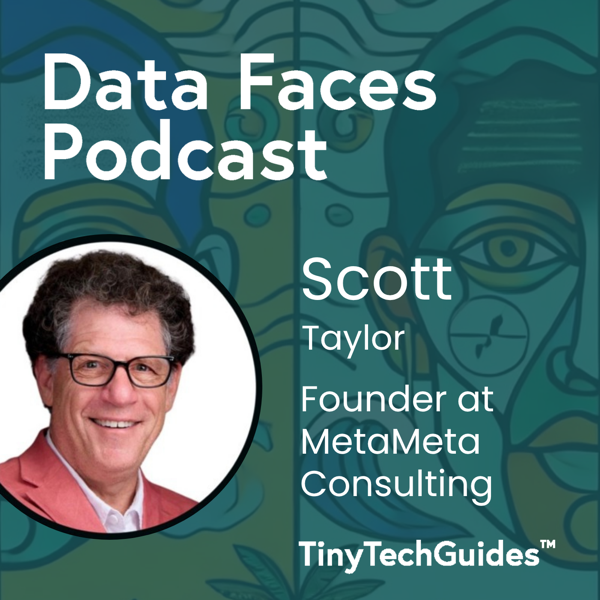
Scott Taylor is the founder of MetaMeta Consulting and is known across the data industry as “the Data Whisperer.” He has spent 30 years in the data space — 25 in corporate roles before becoming a full-time content creator, speaker, and consultant — helping organizations craft business-accessible narratives about data management. He is also the creator of the Data Puppets.
In this episode
- Why “truth before meaning” is the foundational principle for every data initiative
- How data leaders can craft a one-sentence pitch that resonates with a skeptical CFO
- The 3V framework for data storytelling: Vocabulary, Voice, and Vision
- Why the vendor landscape at Gartner D&A looked “horrifyingly consistent”
- How Data Puppets uses satire to expose dysfunction executives resist hearing
→ Read the full article: Truth before meaning — the three-word fix for data management
Full transcript
David Sweenor 0:06 Hello everyone, and welcome to the data faces Podcast. I’m David Sweenor, founder of your host for today’s show. Today I’m sitting down with Scott Taylor. He is known as the data whisperer. Scott is the founder of meta. Meta consulting a long time data management evangelist. He’s the creator of data puppets. We’re going to talk about data storytelling, why data management keeps getting sidelined in the boardroom, and yes, we’re going to have, might have a special guest appearance from one of Scott’s puppets later. So let’s dive in, Scott, welcome to the databases podcast. Speaker 1 0:37 Great to see you, David, thanks for having me on the databases podcast.
David Sweenor 0:41 You know, I love the shirt. Before we get into this, I love the shirt. It looks like you’re the second person on the show to wear the Hawaiian shirt. And it’s like one of the themes here, you Speaker 1 0:51 gave me the tip off, and especially when you said only one other person’s done it. That was the gauntlet. And I just got this shirt at Universal Studios a couple weeks ago, these are all eyes.
Scott Taylor 1:03 Oh, okay, there we go. Speaker 1 1:05 So you know, I have a eyes everywhere, including all over my shirt.
David Sweenor 1:10 Well, there we go. I appreciate the support, and it looks great on you. So can you tell us for how people weren’t familiar with with you and your work? You know what you’re all about and your background, sure. Speaker 1 1:22 Scott Taylor data whisperer, but I’m out there trying to help people craft a business accessible narrative about data management so they can get executive support and stakeholder engagement and funding for all the data work they do. I am 30 years in the data space, so I go back to pre 2k when we were talking about, actually, thematically, a lot of things we’re talking about today, and we can touch on how everything’s changed, but at that sort of foundational level, not a lot has changed. And I’m full time content creator now, after spending, you know, 30 years or 25 years in corporate, and I go out to shows. I do webinars, podcasts, content for brands, data, puppets, speaking, I’m living the dream. David at this point,
David Sweenor 2:11 Hey, that’s my line.
Scott Taylor 2:12 I love it. There we go.
David Sweenor 2:15 I love it. Hey. So the data Whisperer is an interesting name, and most people shout out their data from my experiences. So tell us about your path of becoming the data whisperer. How did you get started in this Speaker 1 2:29 line of work? Well, you know, the data whisperer, the idea is kind of like the horse whisperer or the dog whisperer. You know, I’m out there trying to help people calm data down, sure, but, and we all have to do that in this space here. We got to calm data down. It’s unruly, it’s corrupt, it’s disparate, it’s fragmented, it’s unstructured. We got to calm it down. But anybody who’s seen me for more than two minutes knows, you know, big spoiler alert here, I don’t do a whole lot of whispering. I’m out there selling, telling and yelling about the power and value of data management, and we got to keep that volume up when we compete with all these other much sexier sounding
David Sweenor 3:06 initiatives, okay, but no, no. Like brand. Rebranding to the data shelter. It just doesn’t, it doesn’t Speaker 1 3:12 roll off the top. I put it on a badge. Maybe it was about 10 years ago, 710 years ago, just as a goof, and I got so much positive reaction that I just never went away from it. I thought this was, this was kind of a fun moniker. And there’s been data whispers, you know, there’s, there’s other data whispers out there, in LinkedIn. I like to call myself the data whisperer, the,
David Sweenor 3:35 it’s like the Ohio State. You are the Speaker 1 3:36 data whisperer. That’s it, yeah, so I’ll leave it there.
David Sweenor 3:40 Okay, there we go. So for those joining us, you know, there’s gonna be a special guest probably later on the show. So stay tuned. Let’s jump in. Scott. So you know, you advocate for truth before meaning. So often the organization skip truth and, you know, go straight to the meaning and what’s measurable and what’s the cost of doing that Speaker 1 3:59 almost always. And back it up a little bit. I can boil my entire data philosophy down to those three words, truth before meaning, and to elaborate on it, it means you got to determine the truth in your data before you derive any kind of meaning out of it. It’s not chicken or egg here. This is egg and omelet. If you don’t have truth in your data, you’re not going to get the meaning that you expect, and people skip that all the time. They go right to the meaning part. And you know when I say truth, it’s things like master data, reference, data, metadata, MDM, RDM, Pam, RAM, dam, all those foundational activities you and I know you need to execute at an organization to get curated, truthful, foundational, trusted data. Before you get into, you know, bi AI, analytics, visualization, agentic AI, Gen AI agents, all the derivations of that, but all that, you know, the cool, hot, super sexy stuff that gets a disproportion. Amount of the attention and funding, frankly, given how dependent it is on the truth part and so keep hounding that along, is part of what I what I try to do, and truth before meaning for me is also an exercise that I give folks when I try and help them craft their story about why data management is so important to perform that’s the fewest number of words I could use, and I couldn’t if you were words than that. And that’s an exercise that I suggest people take. What’s the fewest number of words you can use to explain something, to create a headline, to get attention. It becomes very powerful when you use less sometimes,
David Sweenor 5:42 right, right? Well, so this, this notion of truth, data truth and get, getting it right? Is it a mirage? We’ve been talking about data quality, probably since data has been around and written on clay tablets or wherever they’ve been written down and now computers. But is it a mirage? Is it? Is it possible? I think it’s Speaker 1 6:04 absolutely possible. And it’s, you know, to you want to get the emotional side of the truth thing, you know, we’re not talking about politics, we’re not talking about somebody’s personal philosophical journey. We’re talking about business and commercial activity, and you can have the truth around what your customer master is, what what entities are in there that you engage with. You can have truth about a standard hierarchical structure. So when you roll things up in your organization, they are fit for purpose, for finance or for operations or for marketing or for all the different departments that want to use that, then you can have truth about taxonomies. You can have truth about identification. Does this thing exist or not? And so I don’t go too far on the truth idea to get people to whacked out on like, you know what is truth?
David Sweenor 6:54 It’s not philosophical. It’s more more practical. Speaker 1 6:58 You know what truth there’s truth. Truth happens every time in a supermarket when you take a bottle or a can or a box or a jar or a bag and run it across a cash register and it goes beep, that little beep goes yes, that system knows that this product is this and it’s priced this way, and it can be tracked this way, and that is probably one of the most tangible, recognizable examples of truth in data.
David Sweenor 7:24 Okay, I love that. That’s a great example. So one of your you know, mentioned it earlier, but you do a lot about storytelling, and why is it? Why is that important? You sort of take a, maybe a non conventional approach to most consultants and advisors and people that are in this are sort of plain and corporate and boring, but you bring sort of an energy, an energy to it, and humor. So tell us why storytelling is important. Speaker 1 7:56 Yeah, I’ve been at storytelling since it was two words. You know, it’s a hot topic now, but we all tell stories, and if I look back at my career through the eyes of what I do today, I realized everywhere I was a success, it was because I helped craft the story and the messaging from that particular, you know, servicer or offering that I was Representing, and you want to be able to convey the benefits of what you have to offer. The reason I think it’s so important, and the reason I have such fun, and I think I’ve carved a wonderful niche out for myself in the data technology space, is because it’s not inherent in data and technology practitioner training to be great at data you don’t start with Okay, can I articulate this? Can I, you know, you don’t start with the soft skills. You start with the hard skills. And there’s always that irony that the hard you know, the soft skills are pretty hard to master, but you need to be able to communicate. And if you want to be a leader in an organization, you have to be able to communicate. And as data leaders struggle, as they often do in enterprises, to get attention, to get support, to get funding for things that are difficult to understand if you’re not in the data space, right. Data people love to get technical. They love to explain how it’s going to get done. First we did this, and then we did this, and then we tried this algorithm and, oh, look at me, and you just lose the business. Folks, right away, I advise folks, you know, you’re great at the how, but a CEO, if you want money from them, they don’t care how it’s done until they understand why it’s important to the organization. So focusing on that, why and that? Why doesn’t you know that? Why comes from being able to tell a story, sit somebody down. How do you grab their attention? How do you develop their interest? How do you get them to desire what you’re looking for and then take action on it that comes from storytelling. And last point I’ll make about this is you’re up against as a data leader, up against much. Better storytellers in your organization. In other departments, marketing knows how to tell stories for a living. Sales, if they don’t tell stories, they don’t make Quora, right? You know, CEOs usually can spin the vision and understand the overall strategy and be very articulate. So you’ve got to step up on the storytelling aspect and be able to share the reason what you’re doing is important to the whole organization. Do you
David Sweenor 10:27 I so I wholeheartedly agree with you. But do you see this sort of shifting with with you know, it’s aI everywhere. We’ll talk about the show we were just at in a minute, but it’s the light bulb gone off with Gen AI and agentic AI. Or is that where all the money is going, you know, still going there. And forget about the data. I’m just curious if you’re seeing a shift in, oh, we better get our data squared away before we invest in this. Or is it same old, Speaker 1 10:56 yeah, that part of the story has driven a new urgency for data management. Data management’s been around since there was, you know, the second file, whenever that was, and it’s always been there. When I thought, what I think is hilarious is, have seen people talk about how there’s a resurgence. It’s always been there. If you go back to every major trend that’s happened in the data space, you know, before this, it was, you know, mesh and fabric. And before that, it was everybody running into covid with trying to do e commerce. And before that, it was big data. And before that, it was enterprise systems that people were trying to implement back in the 90s. You know, I probably skipped a couple of trends, but at some point, somewhere, somehow, people start to go, oh, you know what? This really cool, wonderful thing that we all want to do doesn’t work unless the data is good, right? It’s just like, that’s always been there. But I will, you know, I’ll take whatever we get. I’ll take it. I’ll take the fact that people are thinking, Okay, now we have a refreshed view of data management, data governance. We need to be doing that even more to drive these AI initiatives. You know, the answer is yes, yes, yes, yes, yes. You’re still going to have to explain it. You’re still going to have to explain that. You don’t get AI unless you’ve got good data. And to get good data doesn’t happen by just adding AI. There’s that fallacy out there. You know, some people think AI is the ozempic for data management. Just say, AI will do it right, doesn’t it? Just yeah, it does kind of, but it doesn’t really. So, you know, I hate to finally say it, but garbage in, garbage out, is still natural law of science. It’s as sure as gravity. You know what goes the first time I’ve heard that
David Sweenor 12:35 phrase. I have not heard that one before. Speaker 1 12:39 Yes, and I try to elevate that idea to the golden rule of data. It’s like, you know, do under your data as you would have it do unto
David Sweenor 12:49 you. No, there we go. Whatever Speaker 1 12:50 way you want to articulate. Sure, I’m not, I’m not locked in any particular way, because it depends on the enterprise in the situation. But the story is going to be the same story. We’ve got to have our data’s got to be trusted. We got to have truth and data before we try to derive any meaning out of it.
David Sweenor 13:08 Always, I like that. And so we actually just met in real life for the first time at the Gartner data and analytics summit in Orlando. It’s wonderful to meet you. And I wanted to ask, How do you think the vendors did there? Without naming anybody specifically, we don’t want to get in trouble. How did they do with their storytelling on the show floor? Speaker 1 13:31 I saw probably this year, more than any other year, a similar story being told, you know, and if you the buzzword bingo was okay. Agents, context, AI ready. We got it all right. And there were all it was. It was really consistent, you know, sort of horrifyingly consistent, in a way, because everybody’s just leaping on it. And, you know, three years ago, it was, we all got data mesh or fabric, whatever flavor you want. So there’s just always that, that that trend in the in the vendor space, trying to catch up with the latest things that are going on. You know, I thought that the keynote probably took a step. I thought the keynote was better than, than than many years in the past. But the message, you know, what was the message, oh, you got to get your
David Sweenor 14:26 foundation ready. Yeah, yeah. And, you know, always partner, so focusing on business outcomes, you know, it’s been a sort of a recurring theme for them. Speaker 1 14:35 And they also kind of, I kind of bristle a little bit when they said, Okay, what you need is a CD, you know, a C, AIO. I mean that the the the idea that something important comes up in an organization and that suddenly needs to be a C level role, I don’t think, helps our cause.
David Sweenor 14:55 Well, we do need more titles, more, you know, just new and, you know, titles and things. Put in the org chart. Speaker 1 15:01 Why not open up? Yeah, but you got to open up your, you know, your ERP system, and be able to extend the C level title field to more than three characters.
David Sweenor 15:11 That’s true. So we’re going to run into a, yeah. Speaker 1 15:13 That’s going to take some cobalt programming that nobody wants to do.
David Sweenor 15:16 Yeah. Well, you know what is weird, Scott says walking around the floor. And, you know, I wrote a little little, just a little thing on on LinkedIn. And it did remind me sort of the big data. Everybody had big data. So I’m going around talking to these different vendors, like, Oh, what do you do? Well, we have an agentic AI thing of a bobber that does this. I go, Oh, well, how are you different than you know, the booth next to you? Oh, well, we’re AI native. Every booth said the same they had the same talk. Check, we have an agentic AI thingamajig that does this. How are you different that we’re AI native. So every vendor said this, and what I found was scratching my head, was I didn’t actually know what market category that these vendors were in. Were they a database? Were they a data science platform. Were they something? I didn’t even get that from any of the conversations there. I only knew that they had a AI agentic, AI native continuum, trans function, or something like that. You know, I just, I can’t, I don’t know if you had that experience, but it was just odd to be it was my first time being there, not with a vendor, and it was just totally confusing. So I can’t imagine buyers could decipher all of that. Speaker 1 16:27 You know, my attitude tends to be a little bit tongue in cheek. So people were posting about stuff at Gartner, and they inevitably mentioned context. And I just started something, I put on a whole bunch of posts. Was context is the new oil, and some of the, some of the, some of the people who posted were just like, oh, boy, oh, you know, here we go. Just trying to try to shed a little light on what can be interpreted as a little bit of ridiculousness in this. And, you know, you and I think that this stuff is getting out. Imagine if you’re a business person, and you’re trying to hear what’s important for you to do, in and support, in data, and this is the latest greatest thing that’s happening. And you know, we, I don’t know if it’s totally crying wolf is probably not the best way to do it, but you know, you can go back three years ago, and we’re, here’s the thing we got to do, and back two years after that. No, no, no. This is and we just, I don’t know how we break this cycle, but it’s, it’s something I, you know, after all my decades in the space, you absolutely start to see the cycle and the patterns and the consistency of, you know, new thing is great, we’ll fix everything. Oh, but it won’t, because you don’t have this, well, we need this, which is data management, and then it’ll fix the new thing is great, but it’ll fix everything. And just the hyperbole just goes, it gets in our own way. It gets in our own way in a lot of cases. And I don’t think it serves the whole I don’t think it serves us well. Yeah, I
David Sweenor 18:03 tend to agree with you. And, you know, like, last or a couple years ago was the last one I was at, I think, two years ago. And, you know, it’s all about metadata, and now it’s all about semantics and context. Are we just, like, inventing new terms for the hell of it? Like, I mean, like, I can see these sort of philosophical, what we call things debate. Oh, well, no. It’s, you know, you could look at not AI agents, it’s agentic AI. Or it’s, it’s not metadata, it’s, it’s the context layer. No, no, it’s the semantic layer. Or, no, no, no, whatever. I’m like, like, what is it? I think, different things Scott, at Speaker 1 18:42 their core, they’re not, I mean, semantic, layer, context, layer, metadata. You know, that’s all about structural stuff.
David Sweenor 18:48 Yeah, he’s added information about it. So see the AI can help understand it better. I’m like, I’m like, I feel like we’re inventing new terms to a degree. Yeah, I don’t know Speaker 1 18:57 if you’ve had Malcolm Hawker on the show yet, but if you do, you should talk about what he calls this the pedette, the semantic pedantic cycle. You got to have him on there. You can cut this, this reference, if you want, and that anybody, you got to have him on there to explain. It’s brilliant. He’s wonderful. He kind of gives the sort of a formal rationale around how that stuff happens, having been, you know, at the enterprise analyst for a while, at a vendor, so he’s kind of seen all sides, but, but enough about Malcolm. This is my show. I’ll talk about That’s right,
David Sweenor 19:32 that’s right, all right. Well, hey, let’s have another question for you. So talk about storytelling and data management. So we have a skeptical CFO, right? You want their money. So if you had a defined data management story for them in one sentence, you know, because everybody’s got wax attention these days, what is that one sentence and why? I think I Speaker 1 19:54 elaborate on, you know, truth before meaning, and that we’ve got, you know, we’ve got all these initiatives you want to try and. Do, around customer, around product, around markets, around all these defined areas of our business and the structure of our data won’t hold up the initiatives we’re trying to execute. And that starts, you know, we need to set a standard in our organization for XYZ parties and connections and hierarchies, we need to build a foundation. We need to, you know, use whatever language in their business to explain it back to them. That’s not one sentence answer, as you asked, but those are the things that go into that one sentence. And I agree with you and anybody listening who really gets into that conversation should create that one sentence pitch. You know, here is why we need to do this. Because we’re trying to do this or flip it around, we know that we’re trying to do X, Y, Z, get, you know, closer to our customer leverage AI for a better customer experience. Well, guess what? The ingredients that go into that aren’t satisfactory enough aren’t strong enough, you know, I like to use words like, you know, strength and structure and foundation rather than quality. And because quality can be very emotional, very subjective, or she kind of thing, you know, and like, it doesn’t really go anywhere. I mean, if, if, if, you know, if, if the pitch that we need better data quality worked, then I wouldn’t be on your show, because people would be doing it would have been done. It wouldn’t be something that we’re still talking about, fresh from Gartner two weeks ago, that everybody’s still saying you got to get the quality right. We’ve been droning on about this since, again, since data was data right. So there’s got to be a better way to break through. And a lot of the techniques I use are from the success I had at organizations trying to break through to the business side to explain why the services that we were representing were important for them to use in their data initiatives. And a lot of times, you know, the again, the CFO will go, why do I need this? And you’ve got to be able to to speak in the I got this little framework here called the 3v of data storytelling, for data management. And they are really obviously a little knowing way to the 3v of big data. But mine are vocabulary, voice and vision, and so vocabulary, you got to get the words right voice, you got to harmonize to a common voice. Everybody’s got to be singing the same kind of tune around why it’s important. And vision, everything you do in data, has got to enable the strategic intentions of the enterprise. Where’s the company going and why is data going to help you get there? That’s, you know, short, encapsulated view of it. But that structure helps people sort, the sort, the, you know, the hype from, from from reality, and the, you know, the buzz from the from the real stuff they need to get done. And, you know, help you break through.
David Sweenor 22:59 You know what? I think it’s super interesting. You said it early on to the CFO. It’s like, what are you trying to do as a business? You know, get closer your customer, or, Hey, maybe have a want to have a bigger order basket? Well, you can’t do that. You can’t deliver a personalized offer if you don’t know anything about the customer. And I think it’s tying that to the that business outcome, right? Because far too often we get into the weeds, and we use this jargon that techies love, but CFOs, like, I have no idea what you’re talking about. Speaker 1 23:30 Yeah, I’ve no and that’s what you have to I mean, you have to get people from I have no idea what you’re talking about too. How do we live without this? Because you and I know and data leaders know, companies can’t live anymore or succeed anymore without the strong data and analytics activities that they’re trying to to enable in their organization. So the, you know, the the reality is there, you need to have it, especially today, you know, do you want to scale? Do you want to go into new markets? Do you want to cross sell, upsell? Do you want, you know, name a thing, but starting with and often curious by these long conversations going on LinkedIn about like, you know, yes, we have to find the business benefits. And what are the they’re they’re heading in plain sight for you. If you go and listen to what your leaders, business leaders, say that they want to do with their business, you will find the data opportunities. They will be in there. They will they’re not going to talk about data quality, you know, they got these objectives.
David Sweenor 24:27 They want to do. They want to sell more, make more, be faster, be more efficient. Whatever it is, it’s minimized risk. Speaker 1 24:33 I mean, bingo, bingo, you know. And so it’s the two or three degrees below that that the data activity sits that. But you’ve got to connect those dots between, okay, why we need, you know, metadata management in the context layer to the CEOs initiative of, you know, expanding to new markets, and, you know, becoming better partners with our customers, or whatever that statement is. And if they if. It. They won’t talk about data quality, but they will talk about things like customers and brands and markets and those all have a data element to them.
David Sweenor 25:10 Yep, absolutely. So let’s talk about humor. And I actually was one of the keynotes at Gartner. Was Was it was about humor in the workplace, which I thought was interesting, so I did too. I thought that was fun. It was data puppets uses a lot of humor, right? Scott, so which puppet, which puppet character sketch reveals the real dysfunction you see in data teams today? And can we see is the puppet here, or do we have to wait to the next segment when there’s Speaker 1 25:37 a couple of pups? So a couple of questions in there. So just starting with the data puppets. Those of you don’t know data puppets, just Google Data puppets, you’ll find my stuff. It’s I’m that confident Google has never seen the words data and puppet together outside of me or related to me. So I’m like, I’m like, totally above the floor. You don’t have to
David Sweenor 25:55 do any any keyword optimization. Yeah, you’re already at the top 100% organic. Speaker 1 26:01 Yeah, it was, it was quite inspiring for me. And actually, when I did that, it made me take a leap to even work more on this stuff, because it was like, Wow, I’m onto something here, if I want to come up. So it starts the CDO, the chief dog officer, that is a completely relatable character to a lot of different data folks out there, he’s got a sidekick to ITB who speaks pretty much only in buzzwords. They hire a cat Sultan from the Al Kinsey who gets a lot of a lot of reaction. He’s sort of the villain in the in the in the script, because he’s, you know, the his main initiative is to do more billing. And that’s the classic Yeah, so meow, Kinsey and but the the initial reaction I had, I posted this first, what ended up being the first episode, or one of the first thing, when the first thing I did with these data puppets a couple years ago, it could be four years ago by now, and it was just filled with data jokes, like every data joke I had, creatively, it was really a discipline. Was like, every line is either a setup or a punch line. It just goes on and on three characters. And I did the three voices myself of ITB, the CDO, Chief dog officer, and then the business monkey, who’s just another puppet I happen to have. And the number one reaction I got was, this is just like my organization, right? Which startled me, because it was like, this is really funny. And I know it’s but people were really taking it seriously, almost, of like, I showed this to my team to show this is how we sound to the business side. I’m I want to use this in a presentation I’m doing to illustrate, you know, the craziness we have to deal with, and people just loved it. So I don’t know if there’s a single character that necessarily has the most support, but this whole menagerie that I built since then is definitely kind of catching on, and I’m going full bore on the puppets this year, creating a multi episode series. I’ve got a couple of them, and already I’ve published some of them and shown some of them in bits and pieces. But there is a there’s a real plot in this story. The title is journey to the center of the single version of the truth, the greatest data story ever told? And it’s about this CDO who’s trying to solve typical enterprise data problems and runs into every kind of thing and is, you know, going the wrong way. He talks in all kinds of gobbledygook, and people don’t understand him. But the characterizations were super fun. The the CEO is an elephant, the CFO is a fish, CMOs, a mouse. I’m like, How did nobody ever think of this before? And and I got, I have this kind of Simpsons, like casting approach, where I’ve cast a whole bunch of other data stars as celebrity voices. Kate stretchy plays the elephant. Bernard Marv, you know Bernard? You know he’s he plays a duck named canard star. And he has this ridiculous monolog that he just executes in the beautiful he’s got this great European accent. He’s just wonderful speaker, and he’s just saying this most ridiculous stuff. And we can leave some links in the show notes if you want, because I’ve got a bunch of these little Absolutely, but it’s just been, it’s been an absolute ball. And again, back to my first statement. I mean, this is, you know, this is the kind of stuff
David Sweenor 29:26 I’m working on. It’s just great, yeah, I think, I think it’s a welcome, welcome relief. Can we see one now? Or do we have to? We have to, I can show I didn’t Speaker 1 29:35 pack everybody. So I have my character that I brought to Gardner, which is a, i, it was there. And what I did was I went around and I interviewed the swag animals. That’s another thing i Yes,
David Sweenor 29:51 you had the biggest bag of swag I ever seen. Speaker 1 29:57 I’ve improved my workflow. So what I used to I’ve done. This maybe four or five times in a bunch of different shows with different characters that I come up with. I was at sale at a sales forge show, and I had a fork, sales fork, and I went around, and that was the first one I did. It was just totally spontaneous, and I had such fun. And now I’m a much more organized like day one, I got all the characters, I lined up the booth numbers so I knew who I was going to talk to. So day three, I usually go, like, at the end of the show to do these bits, because, you know, it’s a little more chill, and there were people around and they don’t mind, you know, goofing off with me. But I got a lot of fun interviews. And I think I did 20 of them at this show with all these different animals. And I asked, like, you know, why are you a bear? You know, what’s the brand relationship? What do you guys do in AI and and got a lot of the same answers, which is going to be a humorous, super cut when I pull all that together, but it’s just such a ball, and it’s unique, you know, I’m trying to stand out. I’m trying to do different stuff. There’s a lot more people doing what I’m doing today than there was, you know, five years ago, seven years ago, when I started. So what can I do? You know, I used to write white papers. Now I do puppet shows. Well, this is
David Sweenor 31:16 more fun, I mean. And you know, you see it on some of the like the late night talk shows. I know a few of them have, you know, the puppets. They’ll go around to different, different events and interview people. One of one of them drinks and smokes and, Speaker 1 31:27 yeah, mine’s kind of, you know, a little bit of combination of, you know, triumph, the insult dog and the Muppets and whatever else. But I’m it’s the reaction has been pretty well, you know, pretty, pretty union, uniformly support for folks. Every once in while, somebody’s like, No, I don’t want to do that.
David Sweenor 31:48 But, yeah, it’s a ball. I love it. I love it. So humor gets attention, maybe, maybe the last question we’re running up on time here. But you know what sort of there any like organizational truth, Scott, that you know, humor helps uncover the executives need to hear. But you know what would sort of dismiss it if you just told them that. So you have to have this clever storytelling, you know, using humor to get them to sort of realize, you know, Speaker 1 32:14 you know the purpose of satire, and you know, even you know, in literature, is to try and expose flaws or bring to mind something that’s happening that people have to recognize, that could be very serious, but using humor opens up people’s minds. Kind of review it and look at it in a different way. I think I’m doing, you know, I’m certainly doing so. I’m poking all kinds of fun at everything in the data space, and yet, it’s it, you know, I think if I did it, just as me as a stand up, it might come off a little harsh or a little insulting, or wouldn’t always play. But once you take the separation, you’ve got, you know, a dog, Chief dog officer, of course, of course, of course, it’s a dog. And people just, you know, they, they seem to relate to it more, and
David Sweenor 33:04 maybe a cartoon series too, like, like a Dilbert, like, you know, little films, you know, cartoon strip could go on. I did puppets Speaker 1 33:10 because I couldn’t draw. So originally, when I tried the I can’t draw, I can’t draw either, like, I can’t do cartoons, but I can work a pup. I always did puppets when I was a kid. I was a kid, I did all kind of, you know, so a little bit of background there, just goofing around. But it’s like, oh, I can manage this. I can, you know, I can do the whole character, and I can have it do what I want and say what I want. And then I realized, too, as I expanded it, I didn’t, you know, I’m not. Mel Blanc here, Charles Martin, I don’t have enough voice range to do 30 characters. That’s gonna ask you, how many places you do, yeah, so I do, you know, I’ve got a couple characters that I always do. But then I went, Oh, let me get some friends of mine to do some characters, and David will try and get you into season two, somehow, some way.
David Sweenor 33:52 Well, all right, forward to that. Speaker 1 33:54 And, and then people just, you know, immediately were like, jumping on it. And it’s just been so fun, especially to to just hear them really, really jump into these characters. And then I do all the puppetry myself, so I get their voices, and then I do the puppetry at home, and then I edit it all together. It is creatively the most intense, laborious, time consuming thing I’ve ever I’ve ever tried, but it is just so satisfying. It’s so much fun. It’s so much fun to do.
David Sweenor 34:24 That is super awesome. Well, Scott Taylor the data whisperer, data puppets, Scott, where can people find you? They can Speaker 1 34:33 find me all over LinkedIn. Scott to data whisper just find me there. I’ve got a website, meta, Meta consulting.com, if you want to find that, or just google me for you know, speaking opportunities, content opportunities and the data puppets don’t have a website yet, but they have a LinkedIn page. So please follow the data puppets on LinkedIn. There is a YouTube channel as well. And like I said, just Google Data puppets and you’ll find them all. And I’m fairly easy to. To get a hold of in the data space. So if there’s anything you want to reach out to me, let me know my books on Amazon as well, telling your data, story data story, telling your data management, and I’m appearing in a couple of shows this year, and just keep doing this stuff until it’s not fun anymore, and it doesn’t look like it’s it’s not going to be not fun anymore for a long time. So I’m
David Sweenor 35:18 having a ball. Well, there we go. Well, I appreciate joining the databases podcast been a very engaging and fun conversation, so thanks for joining, and I’ll see see you out there. Cheers. You.