

Data Faces · Episode 10 · April 22, 2025 · 39 min
Can you really trust AI? Robert Lake on why trust starts with people and values — not the technology.

Listen: YouTube · Spotify · Apple Podcasts · Amazon Music
About Robert Lake
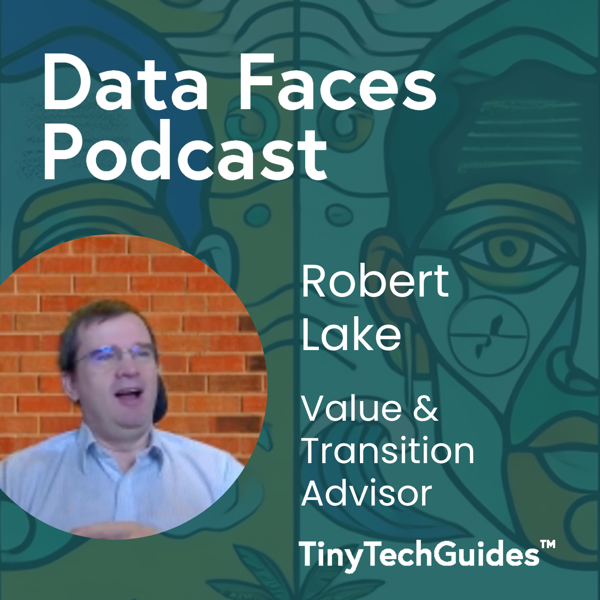
Robert Lake brings 30+ years of data science experience to the question of AI trust. As owner of Trebor Strategic Advisors, he coaches businesses on implementing AI effectively while preparing for successful exits. He has led data science organizations and guided multiple companies through exits, combining technical depth with business pragmatism.
In this episode
- Why businesses struggle with AI’s probabilistic nature
- Our tendency to anthropomorphize technology
- Why leadership must anchor AI in core values, not capabilities
- The “grandmother test” for AI trust
- Building AI that organizations and people can actually rely on
→ Read the full article: The grandmother test: building AI trust beyond technology
Full transcript
Robert Lake 0:00 David,
David Sweenor 0:05 hello everyone. Welcome to the databases podcast that brings together the human stories behind data analytics and AI to the forefront. I’m David Sweenor, founder of TinyTechGuides, and your host for today’s discussion. In today’s episode, we’re going to talk about one of the most important and probably most understood topics in AI, trust. And I realize everybody is pro trust when we talk about AI, but what does that? What does it mean to trust a machine or a system? How do organizations build confidence in systems that are complex, evolving and sometimes opaque? So to help sort through this, I’m joined by Robert Lake, owner of tree bore strategic advisors. Robert is a seasoned executive advisor with deep experience of Strategy Analytics and business transformation. So let’s get into it. Robert, welcome to the databases podcast.
Robert Lake 0:52 Thanks, David. It’s a pleasure to be here with you.
David Sweenor 0:55 Well, thank you for joining So Robert, can you tell us just a little bit about your background? I know you from when you were a data scientist, and kind of what you’re doing at tree board today?
Robert Lake 1:04 Yeah. So what’s the fun thing is, I’ve been doing data science for over 30 years, way before the actual term data scientists came out, and so all those advanced analytics, that’s where I came from. And when we met, I was leading a data science organization and growing those skills going out. So I’ve transitioned now out of corporate world into business coaching and particularly helping people exit. And one of the things I’ve always found from my career, especially in the advanced analytics arena and AI arena, is people tended to try to paper over their business problems and hoping that AI or advanced analytics or some form of business methodology is going to fix the problems magically, without fixing the underlying piece. So when I transitioned from my last corporate gig, I wanted to get into the world and help small businesses understand, one, how to use AI in their business about going bankrupt, but two, help them think about how they get the most out so when they want to transition to the next role, either exiting to retire, exiting to sell the business and start another business, or grow their business further, that they’re in a better position to do that, because I know, when I took my last two companies through exit, I had no idea what was going on. So very determined to find out what, what that’s all about. Well,
David Sweenor 2:23 that sounds, that sounds amazing, and you certainly have a lot of, you know, real world experience to help help people through that. So, you know, when we talk about this intersection between analytics and strategy, you know, let’s talk about AI trust. So AI is inherently, you know, it’s, it’s probabilistic in nature, yeah, and so business, business does want certainty. So how do you balance this executive desire for certainty and probabilistic systems?
Robert Lake 2:54 Well, this is one of the worst understood areas of what we do, and I remember going back for senior vice president. I worked for once, I used to make models in Excel for him. And it was quite funny because he used to introduce me his Excel model expert, which used to drive me crazy. That’s a side point, but he also said, Hey, here’s Robert. He’s an amazing person with Excel. He can build model anything you want and predict anything you want to be able to do, you just need to hire a priest. And I used to sit there, what was all about. It’s because things were always changing. The dynamics of things are changing. And he didn’t understand the probabilistic side. Even though he wanted that sensitivity, that variation, being shown, he just could. He could not get past the point of having fixed outcomes coming out of algorithms and not having a range. And so it is hard for people to do it. So they’re not used to doing that. And when you look at what AI does today, it’s hidden so well. For example, you go to chat GDP, you type something it gives you an answer back, doesn’t tell you anything about how accurate it is, what sensitivity was around that you know, what other metrics or measures it has to show you know, it’s very good chance this is only about 30% accurate. People don’t know that. They just get given an answer, so they take it for granted. And so that is a big, big problem. And one of the things I try to help people understand is like, Hey, you can’t trust everything you see there. You need to verify it. You need to think of it as I have a question. I think I know what the answer should look like. I’m going to propose a question, and does it give me an answer in the in the area? I think it is.
David Sweenor 4:38 It’s very interesting. It reminds me like I used to do a lean manufacturing and, you know, one of the core tenants in there is, there’s a mean and there’s a standard deviation, and you put these error bars and everything and that, you know, it’s a, you know, pretty basic form of data literacy. But, you know, I certainly agree with what you’re saying is that people don’t get it. I think it may be a little more complex. Uh, like, with written text or an image, like, there’s a 85% probability that there’s, there’s, this is bunkum or something, you know, like, how would you, how would you even think about that, you know, if you were designing a system for for someone to take action
Robert Lake 5:14 upon, yeah, and by the way, that’s just so crazy. I’ve seen so many people use the wrong deviation or use the wrong chart so you use the wrong calculations totally, so that they’re getting all sorts of misinformation. And unfortunately, if the same with AI, if you don’t set it up right, I’m talking about the engineers who set all this stuff up and test this on a regular basis. They’re not doing that effectively and testing it effectively to make sure it’s on track. It can, it can walk off very easily into a weird situation, and only post case when people start to complain, wait, maybe this looks really weird or funky, or they may not know it for a long time, that they don’t know there’s something wrong. And one of the things I used to tell people, and I remember getting into a heated conversation with someone about AI, especially images, and they’re saying, well, we should be able to measure something. It’s like it has no idea. Has no idea it’s you on the screen right now, we have no idea that it’s your face. It’s just a guess. It just so happens that, you know, if AI looks at that, he says, Well, I have enough data points. I think this is human face. However, I can get a picture of a dog or a cat that has certain common features to you, and it could confuse them. And there are so many examples online where you see people how to confuse an AI image detector, one of my favorite ones is chocolate chip muffins. Right? The dogs faces, yeah, I and it’s and that’s what it is, because, at the end of the day, when because people, we’re being human. So when we look at somebody, say, Oh, that’s a football, but how do you know that’s a football? How do you know that’s a baseball? How do you know that’s a baseball bat? The image doesn’t know that. It just knows colors, three dimensions of color and shapes, and they’re usually just lines. So some form of we break everything down to a line, is it straight line, going up and down to the side, going off a different angle. And when you bring all those together with those colors, that’s how you get something. It does not know that. It’s about it’s guessing. And so when you people start to get through that, and you go, ah, oh, I don’t mind this. Now I’m not sure.
David Sweenor 7:25 Do you think, Robert, do you think people, you know, anthropomorphize? Ai too much. You know, we the latest thing was agentic. Oh, these are reasoning systems, or whatever. They’re agents, and we give them all these human qualities. To me, it’s a program, looping through a series of things and evaluating some objective function. And, you know, guessing, to your point, it’s they’re pretty good guesses. But do you think we put too much human qualities into these machines? Yeah. I mean, realistically,
Robert Lake 7:55 if you look at humans overall, and not just over the past 510, years, but over the millennia, since the dawn of creation, there’s two things that we’ve always done. One, we’ve always tried to find the easiest, fastest way of doing something. Hence we, we ended up generating the water wheel, and then wagons, and then, you know, metals and all these other things that came through, all these different technologies that we built to make our lives easier. We we’ve gone through ability of being able to make one car in like 40 days now, to be able to build a car inside one day. You know, always trying to find the quickest, shortest, fastest way to do as much as possible with a little amount of human effort as possible. And so that’s track one. Track two is we humanize everything, right? Because we’re such a social animal, you know, you think about all the domestication, or all the different pets that we have, and how we imply we we implicitly implant what out, what we think, on the world, on other people. Which reason why a lot of people have, they talk about themselves being pet parents, and then for the children, it’s so it’s common, so it’s actually natural to expect people to start to adopt AI that way, because it’s that hope. It’s like, oh, I can do less work. That means I can do more and get something else out of it, which is the first thing. And then I get associated with it, because now I have something listening to me, and it doesn’t reason, by the way. It’s just a probabilistic lookup. It’s you can actually decision tree some of these things and go, Okay, if someone says this, they’re probably going to say X, Y or Z, and the next thing will come down as that. But the psychology of this is that now you have someone you can talk to. And unfortunately, you see this on the ads. I believe it’s the Android one at the moment, where you can you hear them talking to the phone, and there’s, I remember the advert, there’s a lady laying on the bed, and she talked to someone for the best friend for like, 40 years. And the thing is, what you have to understand is, when we as humans are talking to each other, we’re engaging, we’re connecting, and we’re constantly sensing all the time, are we genuine to. Each other. The trouble is, the out when you build an algorithm to do that, it’s a manipulation, because what we’re doing is we’re deliberately forcing that connection. Whereas you and I can have a conversation, we may not, we may like each other, may not like each other, but we can have a conversation together, sure, and we get to a point, but if I was more on an AI point of view, you don’t know why I’m engaging you on that, because you can’t understand my motive, because you don’t know what I was programmed to do. And that is a problem for trust. So you’re going to have people who get tied to this, and there are examples of it, of unfortunately, last year, as a young, 16 year old in Florida, shot himself after he had a relationship ongoing with an AI bot in a computer game for a couple of years, and something happened the relationship, and he believed he couldn’t live without this relationship, and took his life. You’re going to see more of that, enough and and that’s an unfortunate side effect, and I do believe the psychologists and therapists are going to see a lot more uptick in some form of emotional dependence issues with something that is in inanimate so in other words, it’s not human, and it really doesn’t have feelings. Ai, doesn’t have feelings. If you swear at Alexa, she’ll tell you that hurt my feelings. It did not.
David Sweenor 11:20 You know that that’s very I want to remember those, those ads when they came out, and the people talking to the AI, and I’m like, What a sad state of affairs. This person’s in this, usually some nice location in a city or a beach or what have you, and like, sitting there talking to the phone, not experiencing the world. But anyways, let’s talk. Let’s maybe another question I have is, you know, so, you know, trust in AI, I think you know, when people are building the systems, it requires trusting the people behind it. So how do you go about evaluating the intentions of the AI builders?
Robert Lake 11:53 So you have to look at what they call trust and what’s quite funny, because when I talk about trust, I’m talking about that human connection trust, of how we build trust together and how we work together in AI, if you look at what they call the trust module, this is in chat GDP, actually in loads of them, it’s about, do we trust the human to use us and ask us the questions we want to answer? So that’s the first place I look is what? Because if you go into the API of chat GDP, you can actually interrogate the trust module, and what it’ll do is give you scores in it used to be five, I think it’s seven, maybe even nine, areas now, of how your question rates, in terms of bullying, inappropriate conversations and all these different pieces. And the thing is, most people don’t know that. What they what this is that they have the the console, and they type the question, hey, what’s, what’s the weather going to be like today? And it will go off, and it will go off and do its thing. But what you don’t know there’s already a pre vetting going on. Wait a minute, do we like this question? And so for me, that’s the first place I look what questions Am I allowed to ask? What questions Am I not allowed to ask? And so now you have a conflict, because if you look at the US this, we have a thing called freedom of speech. It’s not in many other countries. I don’t know that many countries, people say, Oh, you have freedom of speech Europe, no, you don’t. You don’t have freedom of speech in UK, either you have freedom to speak to a point it’s not freedom of speech. There’s a difference, right? And so what you have to be careful of are we giving away freedom of speech by allowing private corporations to say what you’re allowed to ask what you’re not allowed to ask. And then you can have the cynical folks, or you could call them set a call is one way of looking at saying, Well, you know, you you’re only allowing me to think of this, and you’re giving me answers this way. So they’re always looking for the dark side or the anti side of what’s going on. And so for me, that needs to be transparent. You need to be able to say, here’s what we’re going on. Here are our core values. Our core values is that, you know, we don’t solicit or enable any form of slavery, whether it’s sexual or physical slavery, child abuse, you know, and you start listing these things down, but what happens after a while, when you start listing these things down, you get to a point where it’s gray. And some people say, Yeah, absolute, because our moral stature said This is absolute. Now people were, well, you know, when we talk about drugs, what do we really mean? We talk about hard drugs, soft definers, and there’s no real definitions, right? And so this is the problem, and you’ve seen this with social media over the last three, well, actually, six to eight years. Now, realistically, are people being shadow banned, being banned, being told you can’t do this. You can do this. You know, people claiming bullying, and it’s and everything is in the eye of the holder. And so when you start to put these things together, when I’m looking at this, the I have to look at the company’s office, what are your guidelines? You. Make it clear. Make it precise. I’ve met with so many small business owners who I’ve spoken to, and they say, Hey, I was doing great online sales. And then from one week to the next, my online sales died. Can you help? And I’m like, Oh, look at what’s going on. They’ve been banned. And it’s like, why were you banned? And then you go and query Facebook or wherever the host was, you find out that actually someone complained, and then you dig a little deeper, and you found out who the person complained. And then you dig a little deeper, you found out the person complained wasn’t a customer, it was a competitor, right? And so what you’ve changed now is a human dynamic of what we used to perfectly call bullying. Bullying used to be 2030, years ago, physical, right? Now, it’s all mental, and so the dynamics of it changed. So you’ll see, you know, I tell people, you know, when I was a kid, it’s like I’m feeling all about, you know, in a playground, you wouldn’t tell the bully where to go, or mouth off the bully, because you get slapped, right, and you learn how to interact with people more pleasantly and more effectively. Now you have people hiding behind screens saying all sorts of things, and we’re getting very, very uncivil that way. Hence, now people say we need to bring a trust module in to stop all this. It’s like, no, we need to set up a behavior system to say, Hey, this is what we tolerate this is what we don’t tolerate, and then change chase that or don’t chase it, but make your mind up where your line in the sand is, and then allow capitalism to take your company where it goes. I think a lot of companies are so scared that they’re going to lose customers or lose lose their revenue, that they will do things and it’s sort of hidden. They’ll say generally what they’re going to do. But when it comes up, people like scratching their head, like, why did they not bad? I don’t understand why I got bad for this. It doesn’t say this in there. And then someone will say something that’s obtuse or not that,
David Sweenor 16:52 you know, that’s really interesting. And you know, to your point about, you know what, what’s allowed or not. You know that’s going to vary by ideology, ideology, your geopolitical affiliation, there’s a whole rats. And as we won’t get into we see, you know, just different morals, I guess, across the globe. But I’d like to maybe talk bring this back to business, you know, explainability and accountability. Where does it begin in enterprise system, and, you know, sort of who, who owns this? You know, where does the buck stop? Is it? Is it the designer of the system? Is the designer of the models? Is it the company running the system? I’m just Just curious your thoughts on that?
Robert Lake 17:33 Yeah, so for me, it always has to come back to the owner, or the CEO, the board, whoever runs the company has come from them about what we’re going to do, why we’re going to do it, because it’s, it’s really easy to give someone who’s really excited about something. You know, you seen your kids at Christmas, you know, you give them that present, they open the present. Oh, that is amazing. And now they’re building all sorts of things. You don’t see them for weeks upon it, right? That is what data scientists can be like. That’s what any computer coder can be like, they get in there and they they get in, just leave me alone. Let me build something. And they build something, and it’s like, ta, da, I built something. Like, yeah, that looks great, okay, but how we’re going to use it, right? So it has to start with leadership. And ultimately, the top of the leadership pyramid of what is it we’re trying to do from a business. How do we believe this is going to help us? And here is your problem to solve, because in AI, you can solve millions of different things and not solve the one thing that’s needed for your business. And so you need to have that strategic direction of saying, here’s where we’re going. We are going to be working in this market space with this client avatar, and here are our products that we’re serving. Here’s the problems where we’re trying to solve, and here’s how we believe AI can help us be efficient, be effective, and generate additional revenue, cost savings for our clients and customers and keep us out of jail by keeping us on track legally. So where in those things, does it come out and be very explicit and say, This is what we want from Ai? Because now what I’ve done is I set a goal with an objective with a very clear description of what success looks like, and then have your AI team go to build that and meet that, not have it the other way around, where AI come AI team comes out with she learns to is, oh, we got a new hiring room. Great. What does it do? How does it work? And where is it, contrary to where we need to go. So we need to get back to that concept of setting up an experiment. That’s all it is. We’re set up experiment. What are the parameters around that experiment? Leadership needs to make sure they have that done. Otherwise, and it’s really easy to do, especially with a small business. I’ll pick on Microsoft a little bit here, not blaming them. They have a good business model. If you go and buy a 365 suite, basic one per user, you’re talking about 15 to 20 bucks a month. Co pilot on top of it, and then add all the other things that interact with co pilot. Now you’re going from 15 to 20 bucks a month to 40 to 50 to 60 to 70 to 80 to 100 bucks a month per user, and now suddenly you’ve increased your operating expenses in the IT realm five times for what were you trying to achieve? What did you get out of it? And so that is why you need to have that financial responsibility. You need to have the accountability for what we’re going to do and what we’re not going to do. So you set a very good parameter for AI, and when you do that, I believe you get some really great results out of it.
David Sweenor 20:38 You know, I like this. You know, you’re, you’re fundamentally, I think you’re suggesting, and get beyond the hype, and don’t, don’t have the ta, da, and really start with the business problem. What’s the strategic direction? What problem do we want to solve? Work backwards from that. How do you build this? Maybe I’ll call it a AI habits. So, you know, we’re starting with this business problem. But how do you build this sort of repeatable, you know, production system, or whatever you want to call it, that builds long term confidence in the AI systems being built and maybe the results that are coming out. What would your advice to your your your leadership teams? Yeah,
Robert Lake 21:12 so let’s go back to the basics you mentioned, Lean Six Sigma earlier, constant, continuous improvement. So you need to be constantly testing, constantly improving, constantly gaining feedback, not just from the initial users, but from your wider users. So you think about you, you have a product and we and this is one thing I help some senior business leaders understand, is that AI is nothing different to anything else you do as a business. You need to monitor it. You need to track it, you need to improve it, and you need to get feedback and Lean Six Sigma rule number one, customer is king, right? Not your AI engineers, not your developers, not your sales team or your marketing team, because they’ve got the amazing imagination of where they want to go. It’s your customers. Your customers are king. If your customers don’t need this, or don’t want this, or not interested in this, it’s not going to help solve their problem. Why are we doing it? And so it’s that focus. So it doesn’t matter what what we’re talking about. It’s a saying for anything in the business. What is your customers? Three to five pain points. How you’re solving that, and what makes you different, because that gives you that market dominant position that allows you to be more dominant in the marketplace. In other words, we have to sell your product easier and faster, and so when you work on that and do that, now you have the discipline in place. So it’s nothing new. Anyone who’s been running a business or been an executive or a leader in some form, knows these basic things. What’s my goal? How do I make How do I make myself more efficient and improve myself? And how do I generate credit value? Stick with that and you’ll be successful.
David Sweenor 22:54 Okay, that’s great advice. You know, earlier you mentioned this, I don’t know use the term exactly, but, you know, AI guard rails on the inputs to us, you know, are we even allowed to ask this question? So, you know, everybody is talking about ethics and governance and how to do this. You know, when you go look at the frameworks out there, I mean, this has one, I triple E has one, os had, you know, has one. There’s, you know, they’re just lots of different frameworks. You know, do we need more of a trust framework? Or do you think what we have is adequate? That’s out there today.
Robert Lake 23:31 So the simple answer that is yes, no, and maybe
David Sweenor 23:34 I like that hedge your bets there. Robert,
Robert Lake 23:39 the whole thing is, we’re human. We have different standards. If you think about engineering, you think about business, there are all sorts of different standards depending on your political region, your geographical region, the way you interact. There’s so many different reasons why you have all these different pieces, and how we get everyone to agree. And by the way, you and I could run exactly identical companies, but we run it slightly different because our core values are different, because that’s what it comes down to. So what are your core values? And so I think sometimes we’ve got a little especially over these last few years, we’ve got very hesitant around our core values. We’ve been dictating what our core values should be. And what you’re seeing now with companies are starting to go back to what their traditional core values are, what what is it you as a leadership team are going to make decisions on hiring and firing? So when we talk about frameworks, and I come back again to the leadership because it’s the ultimate leadership team is going to do this, whether it’s the board or the CEO or the executive team, or is it a single owner or a couple of partners together? They got to make decision, and it has to be around their core values, because it’s not around the core values. Guess what? They’re not going to do. They’re not going to make hiring firing decisions. Who are they going to hire from an employment point of view, who they’re going to bring on, what clients they want to work with? Who are their vendors? Who do they want to work with? And I think we have to go back to trusting ourselves, that we understand, that you and I are going to work when we work together, that we work together, we have similar core values. If we are completely opposing views, you know what? It’s okay. We don’t have to work together, sure, but we have to get back to that trust part of humanity, which, unfortunately, it’s been a side effect of social media, where we’ve been destroying that, and we’ve had people come in dictating, okay, you need to be thinking this way. You need to be thinking that way. And that is not core value, because now what you have is people anti core value. So you see a lot of people go quiet, right? And then something else happens. And people like, why did that happen? Well, because you’re suppressing people’s core values. We need to get back to core values for our business and say, This is how we want to work together. And unfortunately, governments have not been renownedly successful. If I have to go all the way back to for the millennia again to look for a government that’s ever been successful, because it’s a will of a group of people. It’s not the whole of the people. Now, cynically, people say the government, we work on behalf of the people. Yes, but did you? Are you really working on my behalf? Are you working on someone else’s path? It’s hard to work that out when you mess it up, but the whole thing is, it’s, how do we work together as community? What’s the right thing to do, community and trust capitalism. You know, I the one thing I’ve learned about, whether I want to be capitalist or socialist or whatever, is when you get to true capitalism, if I only want to work with this one type of person, and they have to have all these set values, and they live their life exactly this way. I may only end up with one client, right, or billions people in the world, but if I’m happy doing that great. But I’m not in business alone, unless this one client just happens to be a multi billionaire and they give me all their money, which is fantasy. We all know that sure, because we all love to have that one person does that. So if you want to work with a lot of people, you have to be able to be reasonably flexible. But there’s nothing wrong with you saying, Okay, we only work with this group. Okay, fine. Do you want to be successful? Well, how are you going to make your millions? Where’s the total addressable market? How much money is available to spend in that market space? Not much. Well, you’re not going to be a successful business. Then are you? Capitalism takes care of that. So it’s, how do we, how do we help build those out and be a little bit generous, but also being able to be specific is there are niches, and because you can’t serve everyone in the world, you’re not big enough. You know, especially if you’re a small company of like, five people, you can’t serve, you know, 10 billion people, it’s not possible unless you come up way of doing that. So that, for me, is the key is get back to your core values, operate the way you want to be operated, and it’s okay. Everyone has spiritual some form of spiritual direction. Everyone’s had some form of societal directions. Everyone’s had some form of ancestral relationship direction is something you’ve inherited. You’ve learned, been passed down year over year, and some people have some form of education or or enlightenment to be yourself. If people don’t, if people don’t want to work with you, that’s fine. You can’t, don’t force them to work with you, because you’re forcing people to be like you, and you’re not accepting them for who they are. And that’s always my argument. When I see people saying, Oh, you have to do this, and you have to do well, wait a minute, you’re forcing me to be that way. You’re asking me not to be who I am, but you’re telling me you have to be who you are. So that is a little idiosyncrasy. So for me, that’s the thing to think about. Get back to your core values of your core values of your business. Core values your business is not your employees. It’s the decision makers. Why is it decision makers? Because they are the ones making decisions every single day. Hire, fire. First thing I ask people, okay, this is my core value. Okay, show me where you’ve hired or fired someone based on the core value. Show me how you made a business decision on that. I haven’t it’s not core value. It may be moral inside of you, but you’re not run. You’re not using to make business decisions,
David Sweenor 29:06 right? I like that, that notion, you know you have to really, you know under truly understand your, your core values. So on the AI, ethics and governance, you talk to a lot of these executive teams. How much, number one, like, how much do execs, you know, based on your experience, how much do they really even understand AI or applications of it, or how it works? You know, I have a hypothesis on this. I don’t think it’s very much. Then, number two, how much do they need to understand about it, to to to be, you know, do they have to have a certain level of knowledge or No, they just gotta get back to your core values so they can run their business. I’d love to hear your your thought on that, you know. So what is AI exec maturity and what, what’s, what’s required?
Robert Lake 29:52 Yeah. So let me start this off with so when I go interview for leadership roles and talk to CEOs in. And I always made them laugh with this one comment, and they’ll say me, Okay, so tell me, why should I hire you as your AI lead, as my AI leader to run my debt science organization or AI development group? And I said, real simple, I am going to be the first person to tell you not to use AI. And they look at you what? Yeah, I am going to tell you when you don’t need it, and we need more people to do that, and help CEOs to do it. I’ve worked. The trouble is, with my experience, I’ve worked with so many business leaders don’t really understand AI or they have an understanding, but it’s way off from what it really is. And I’ve met and I’ve worked with a few leaders who really do understand it, but the trouble is, they’re so technical in their understanding is they forget to translate it back to business. And so there has to be that translation piece. So for any business owner or a CEO out there, it really comes back to, you know, what is your job? You think about what your job is, and you ask questions around that. And so don’t allow people to do this shiny object thing, because it’s real easy to come in there and, oh, look at this. This is wonderful. And they go, Oh, that’s really good. And they get lost in the shiny object. Sure, you’ve got to come back to Okay. Does it help me make money? Does it help me save money? Does it keep me out of jail? Three things, the reasons why people will buy from you, reasons why you’ll be successful in business. Does it, you know, if I’m sending to someone, does it help them sell and make money? Does it help them save money? Or does it legally keep them out of jail? Because it keeps them on track and reminds them, oh, by the way, you should have paid your taxes, or we’ve done your taxes for you. It’s that sort of thing. It’s those three basic principles. And so if the AI is helping you do that, and how is it helping us make money? And the question is, then it comes back to your strategic plan. If it’s helping us make money, where is it making money? Well, you’re making money with these avatars over here. No, they’re not our avatars. Our avatar is this avatar. So again, it’s about the alignment. And that’s very job CEO is to make sure everything is aligned, moving the right direction, putting their chief operating officer on it, and get that thing running, and get that thing running as smoothly and as fast as possible. And so how much should they really know about AI, oh, that’s a real deep question. I actually wrote a presentation, which I used to give to leaders, help them do it. And what was funny is I show them the fun side of AI, and I show them the scary side of AI, and try to give them a balance. And to be honest, there’s no real you must know this much. You must know that much. It’s more about use your common sense. Does this make sense? Use your creepy meter. Don’t, don’t. That’s right. Don’t be scared to say, Hey, I wouldn’t like this. Yep, a good example that I interviewed a lady when I was in a large company to potentially join my team, and she was working on this project. And what it was is that the moment you walk into the store, the video monitor in front of you will show your face and say, Hey, Robert, how you doing? By the way, the condoms are this direction. The alcohol is that direction. It’s a great this direction, and you’re going to Whoa, hey, wait. One, I don’t want the whole world to know what I’m buying. And two, I’m with my wife, she doesn’t know I’m drinking and smoking right these things through and so one of my arguments, so this is one of the things I was trying to get across in my book, is that think of the film Jurassic Park. The one most annoying character in Jurassic Park with me was always Jeff Bloomberg. He was the chaos theorist, yeah, and boy, he was such a great character. Played it so well. You need to have that sort of thought process. You know, if we do this, what are the other consequences that may not be directly but could be intangible to what we’re doing, and we need a little bit more of that type of thought. So you’ve got to allow people to think outside the box and think, Okay, how can it help us? How can it not help us, and not have an echo chamber of like, oh, this is all amazing. Everyone go, oh, it’s all amazing. Now they hypnotized with the shiny new object,
David Sweenor 34:15 sure, yeah, it’s like a role of the challenger. You know, you got to be challenged the organization. So that’s very interesting. So we have maybe, maybe a minute or two left for maybe a final question before we wrap up. You know, what are sort of the lessons about trust you’ve learned really not from the technology side of it, but from really leading organizational change with with your clients.
Robert Lake 34:38 I think Simon Sinek says it the best start with the why. Because, if you don’t start with the why, you don’t build trust, if people don’t understand why they’re doing something, they don’t have trust. And you can tell people what, where we’re going, what we’re doing, they’ll go, Okay, but why? Why? Why? Now? So. People will get it. It’s like, oh, yeah, this is great. Why? Because it’s in line with where they’re in tune. But a lot of people are going to sit there going, what we doing this for? And then they start going into the dark side of the mind, going, Oh, does that mean I’m gonna lose my job, or does that mean they’re gonna cut my pay? Oh, does that mean, does that mean, does that mean, does that mean, does that mean? And they’re gonna go down that what if scenario. And then they’re not aligned. You gotta start with, why. Why are we going here? If that is not clear, you gotta allow people to ask and challenge that. The challenging of the why is not a challenge of your authority or your leadership. It’s allowing someone to understand, to comprehend, understand. Now, whether you can take them to if it’s just one person, take them to one side and have a conversation with them and follow up with them. But it’s not about why are you asking me this? It’s okay. Tell me more about how did you get to think about this? How did you get to start thinking about in this direction? What is it? It’s in your mind that it has you confused, and what you start to then learn is how to communicate more effectively people. I’ve learned so many different change management systems. I mean, the worst one I had was given to me. It was like 48 different tool sets. And I sat there, and I’ve been doing change management for like 12 years, scratching my head, going, I do like three of those, right? And I’ve never had a problem with my change management stuff, but you asked me now do all these tools, and the question is, why? What am I missing? And the thing is, the toolbox they gave us was great, because if I hit encumbered a situation where I came across this, oh, I’ve got a tool over here. I can use that. I’m using the tool out of toolbox when I need to use it, not being the way a lot of people apply what they’ve been taught is they use every single tool and toolbox on the job. It’s like, No, you don’t need to do that, because you’ve been taught. Here’s a process, and we make it. Use every single tool, we learn every tool, but that’s not how you practically apply something. And for me, this is the same,
David Sweenor 36:58 alright, well, Robert, I think we’re this has been a fascinating discussion. Maybe Any final thoughts for for our listeners or viewers out there, thinking about AI trust, you know, what do you recommend they, you know, they go do or read or research your final thoughts?
Robert Lake 37:17 Real simple. My grandma used to say, this is like, when you’re out there in the world, ask yourself, what would your nana say? And the whole thing is, it’s crazy, why I think of that, but you have to think that through. What would so and so say? What Would everyone knows someone who, you know, they hold you accountable, but they do it in a really quiet way. You You know, it’s your grandparents or your great aunt or someone out there that when you look at you go, you’re ashamed. I really shouldn’t be doing that in front of them. Or, you know, this is not a behavior they expected on me. Think about that when you, when you when you want to do AI is, you know, it’s, it sounds cool for me right now, but what would someone else say? What would someone else say, What would someone else say? And try to understand where it fits and why it fits in that direction. And, you know, and then it comes back to your core values. Does that meet my core values? Sure. You know, am I there to manipulate people, to force people into doing something? Because AI is now hyper tuned to get the most out of our interaction. Great, but you’re expanding through relationships faster than what you would naturally do. So yeah, ask, What would granny say if they
David Sweenor 38:30 love that? And so Robert, how can people get a hold of you for Yeah, so you
Robert Lake 38:36 can get hold of me through my website. So it’s a tree baradvisors.com or you can email me at Robert at tree bar, advisors.com,
David Sweenor 38:43 great. We’ll drop that in the show notes. Well, Robert, this has been a fascinating discussion. We could go on all day, but I think we it’s time to call it. Call it a an end, but it’s been extremely engaging and insightful. So I appreciate you joining the show and appreciate you being on the databases podcast.
Robert Lake 39:02 All right, thank you for the invite. David, appreciate it. Cheers. You.