

Data Faces · Episode 30 · January 27, 2026 · 35 min
In Randy Bean’s 2026 benchmark, 94% of Fortune 1000 executives named culture — not technology — as the top barrier to AI.

Listen: YouTube · Spotify · Apple Podcasts · Amazon Music
About Randy Bean
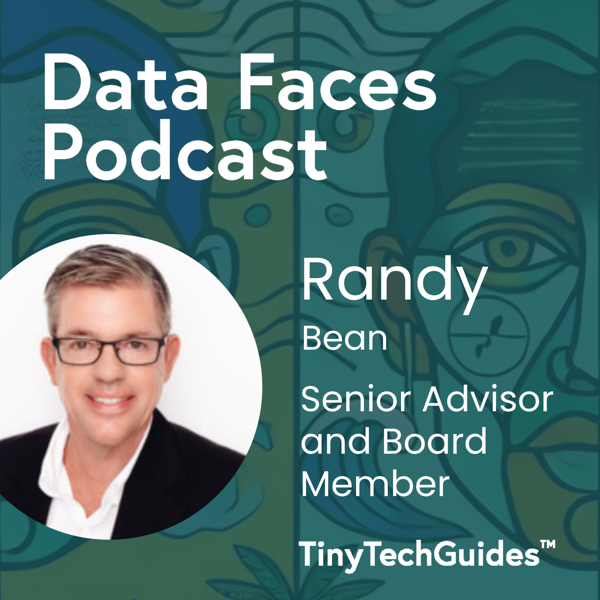
Randy Bean is a senior advisor, board member, and author who has spent four and a half decades in data and analytics leadership. He founded the data-and-AI consultancy NewVantage Partners (later acquired by Wavestone) and runs the annual AI and Data Leadership Executive Benchmark Survey of Fortune 1000 executives. He is the author of Fail Fast, Learn Faster.
In this episode
- Why 94% of AI challenges are cultural rather than technical
- The “readiness test” that predicts whether organizations will succeed or stall
- Why legacy companies should stop benchmarking against digital disruptors
- The case for unifying the CDO, CAO, and CAIO roles
- Why the best Chief Data Officers aren’t data geeks
→ Read the full article: Culture eats AI for breakfast
Full transcript
David Sweenor 0:06 Hello everyone. Welcome to the data faces Podcast. I’m David Sweenor, founder of TinyTechGuides, and your host for today’s show. Today we’re lucky to have Randy being on the show. Randy’s a senior advisor and board member who has spent decades working with executives at large enterprise on data analytics and AI leadership. He’s known for his right perspective on why so many data initiatives struggle to deliver value and what strong leadership looks like. So today we’re going to talk about AI and data leadership, what organizations get wrong, what they get right, and how can we turn data into better decisions. So let’s dive in. Randy, welcome to the data faces podcast.
Randy Bean 0:41 It’s great to join you. David
David Sweenor 0:43 Randy, for those who don’t aren’t familiar with the work, you just tell us a little bit about yourself and how you got into the data and analytics market. And you know what you’re up to these days?
Randy Bean 0:53 Well, I’ve been in the data space for four and a half decades now, and it wasn’t by design. You know, when I was back in school, I studied things like English and History and Art History and things of that kind, but when I needed to get a job, what they were looking for was technical expertise. So I was trained as a COBOL and assembler programmer, okay, and but my interest wasn’t really in the programming, it was in the stuff that you moved around, which was the data. And, you know, I saw an opportunity for organizations, really, to learn from their data that they had and to gain insights. I remember early on, I said to one of the managers I worked for a major bank, part of Bank of America at the time, and I said, Wow, you capture all this information on your customers, their transactions, their preference, their history. What do you do with this information? And they said, Oh, you know, the regulators make us hold on to it for six years, and then we put it in the furnace and wow, what a lost opportunity. So it was really from that point going forward, and I, after some number of years at the bank, I went to work for a company that was a pioneer in what was known as the time as database marketing, and I came to lead their North American Financial Services practice, and then startup practices and other industries. And my favorite story to tell there was in 1996 I happened to make a proposal to Microsoft, and I got a call, and it was the folks at Microsoft, and they said, We’d like the proposal. Would like you to come out to Redmond, Washington to meet with our team. And I said, Okay. And I said, flipping through my paper calendar, and I said, Yeah, you know, I have some time, you know, two weeks out, three weeks out. And they said, No, we’d like you to come this afternoon. So I had two young children, and my wife was working, but I called her and I said, You know what? Normally I wouldn’t do this, but for some reason I think I should, you know, I think it might be an interesting opportunity. So I booked the flight. Flew off to Seattle. There was a car took me up to Redmond. I walk into the room and it was Steve Palmer, you know, I’m going to be the person that you’re working with. So, you know, I think in a way that highlights how important data has come to be seen by organizations. And I think that organizations like Microsoft and Steve Ballmer a little bit of head of where others have come along in the subsequent decades?
David Sweenor 3:24 Yeah, absolutely. And you know, I, I’ve been following your work for for quite some time, and you know, you’ve been running this, I think it’s the AI and data leadership benchmark survey, probably since 2012 or thereabouts. But I would probably argue that’s one of the most influential survey out there for Fortune, 1000 firms and and on the vendor side, I’ve worked for a number of them in every corporate pitch deck I’ve done has had some stat or has referenced that survey. How did that come about? It’s, you know, still hugely popular.
Randy Bean 3:55 Yeah, it was during the big data era. 2012 as you mentioned. And what I’ve been doing for a number of years was hosting see executive round tables with the people that are responsible for data. And for many years, that was the CIO. So in 2012 I had a number of CIOs in the room, and it happened to be the CIO from JP Morgan, and he said, you know, this thing, big data, you know, don’t really understand if this is something real and we should be paying attention to or not. It would be great if we could kind of do a survey of other Fortune, 1000 executives, and see what they’re thinking. So that was really the impetus. And as mentioned, this year will be the 15th survey that have did. And there’s, you know, over 100 fortune, 1000 Chief Data offices, AI offices, the chief analytics offices that participate in the survey from, from one over 100 fortune, 1000 companies. Wow.
David Sweenor 4:54 It’s amazing. It’s hugely influential. So thank you for continuing that so you know, when you look over the past, you know. All 10 years or so for CD, you know, Chief Data Officer, roles, where’s progress been made? What sort of stayed the same?
Randy Bean 5:08 Yeah, you know, it’s the we published the this year’s survey next week, as a matter of fact.
David Sweenor 5:16 Oh, well, we should have done this next week.
Randy Bean 5:19 So all the data is really out there, but, you know, it’s officially published next week, sure, but, but in any event, so, so I can share this data with you. So in 2012 only 12% of organizations had appointed a chief data officer. It was still a relatively new role, and largely came out of the Financial Services crisis at 2008 2009 where American banks were mandated to do something about their data. And it was only by 2017 that more than half of organizations, in that case, 55% had appointed a chief data officer. This year, it was 90% okay. So on the one hand, the jobs become ubiquitous, but on the other hand, there’s still been challenges in terms of the success of the role, and in many respects, that shouldn’t be entirely surprising, because the the old joke generation ago, when the chief, a Chief, Chief Information Officer role was first established that CIOs stood for, career is over. You know, I told that I used that line about a year ago in an event that I participated in London to a group of chief data officers, and somebody raised their hand and they said, I know what Chief CDO stands for. And I said, Well, what’s that? And they said, career is definitely over. Things have improved. So in 2020 when we asked the question of whether the CDO role was successful and well established within your organization, only 28% said yes. And as recently as 2023 you know, it was only 35% that said the role was successful and well established, but this year, it jumped to 70% and I think that so much of that has to do with the focus on AI and the recognition that AI is dependent upon great data, and as a consequence of that, organizations really paying attention to What it takes to get their data in shape and providing support for the chief data officers and those in data leadership roles. So, you know, in part, it’s a natural evolution, but I think that the rapid acceleration of AI adoption over the past three years has really fueled attention, a refocus on data and its importance.
David Sweenor 7:44 Yeah, it’s always been hugely important, and we’re always going to have issues with it. You know, one question, I’ve always had many debates on this, but do you see a difference between sort of the Chief Data Officer role or the chief analytics Officer role, or do you sort of lump them all together.
Randy Bean 8:04 You know, it’s funny, because there’s some questions that you might ask me, that I might say, like next question, but this is a topic I could kind of opine on for hours and hours. So I’ll give you kind of the short version. You know, when the chief data officer role was first established. It was established, really, as a defensive role, regulatory and compliance, but there was that hunger within organizations to leverage the data that they had for more ambitious goals, such as building the business, introducing new products and services. So there was a push to move into more offensive capabilities in terms of using data, and a natural fit for that was to integrate analytics into that role really focused on all of the potential uses of the data, as opposed to risk and compliance. So, you know, I have some data in here, for example, in 2020, only 55% of organizations said that they were focusing on offensive activities. Still, 45% were focused on regulatory and compliance. But this year, it’s 86% focused offensive activities. So there’s really been a natural evolution as analytics. Analytics has been integrated into the role and now AI, you know, there was a panel that I moderated a few years ago, and there was five Chief Data Officers. Four of them were from financial services, and one of them was from consumer packaged goods. And I asked the question about, How much time do you spend on offensive versus defensive activities? And at that time, the Financial Services chief data officers were saying, Well, you know, we’re up to maybe 40% 35% of our time on offensive related activities. At some said, you know, we’ve surpassed half of our time. I’m in office. And then the consumer packaged goods chief data officer, Diana schulthaus from Colgate Palmolive, she said, Well, I spend 100% of my time on offense. There we go. The audience applauded and but that’s really the direction that things have taken, and it’s become more widely adopted across industries,
David Sweenor 10:22 sure, sure. You know, so on this, this theme of AI, you know, leadership or lack thereof. You know, you’ve seen these, these different, you know, each year you do the survey different, you know, leadership traits or or things like, is there something that are holding companies back from a leadership perspective. I’ve just, I’m always, I struggle with that because, you know, we always talk about people process and technology, and rarely a technology issue. So like, what? What’s going on?
Randy Bean 10:51 Yeah, I think there’s a few issues. And, you know, I’ll just give one additional piece of data to set the stage. Question that we ask every year is, what is the principal challenge to data and AI adoption within your organization, and the answers in very and we we structured in a binary fashion, so there’s two choices, culture and people are technology, right? And it’s always culture and people this year was 90 94% said culture and people, and only 6% said it was because of technology. So there’s an abundance of technology, but the ability of organizations to change and transform. In other words, you know, people never, regardless of what they say, they never really love to most people don’t really love to change or too quickly, and organizations are made up of people, so that compounds the issues. So organizations really need to be highly sensitive to and realistic about what the pace of transformation right in their firms. You know, there’s the so if you look at the Fortune, 1,090% of the Fortune, 1000 are legacy companies, meaning that for more than a generation, only 10% are, you know, what you call the move fast and break things crowd. So you know those 10% you know, they can pioneer new things, but for the other 90% they don’t need to compete against that other 10% they just need to compete against one another. So for example, during the pandemic about four years ago, the Chief Digital Officer of the nation’s largest insurance company said to me, you know, Randy, we’ve done more to execute on our digital transformation strategy in the past six months than we did in the previous 20 years. And you know, that’s not surprising, because then they did it out of necessity. They couldn’t meet with customers face to face. They really had to have their online channels in place. So it’s often for most organizations, it’s not until it becomes an existential threat that they really need to go fully in on adopting new technologies. In other words, there’s a difference between nice to have and the big difference with you know, you really need to have it to keep, continue to operate and preserve your customer franchise.
David Sweenor 13:19 That’s actually funny. You mentioned that you’re that quote. You mentioned the we’ve done more in six months, one of the books I wrote there, so I definitely use that statistic. So thanks for bringing it up. Yeah, absolutely. That’s pretty cool. Okay, so let’s talk a little bit more about, you know, Gen AI is, you know, undoubtedly cast the limelight, I think, back on, you know, data and things, you know, it’s made it more approachable, but we’re still read a lot about that. Ai fails to deliver real business outcomes, you know, you I see these demos. Hey, we got, like, last year was like, agentic. AI was like maximum hype cycle. It was sort of ho hum for me. I don’t think anything really happened. So like, what’s going on about the business outcome side of things?
Randy Bean 14:08 Yeah, I’ll share a couple things. And again, looking at the data, the newly released data, so you’re among the very first well,
David Sweenor 14:19 this will air after that comes out. So people have seen that?
Randy Bean 14:22 Yeah, well, it’ll still be early for a lot of folks in terms of catching it. But you know, one of the things we asked was about the state of AI implementation efforts, particularly around generative AI and agentic AI. And in 2024 we asked organizations where they were at, were they at an early stage? Are they implemented in limited production, or that? Were they in production at scale and in 2024 71% of organizations were still at an early stage. Only 5% said they had implemented. In production at scale, last year that jumped from 5% to 24% so if you look at that, that’s what a 500% increase. This year it jumped to 40% so there’s been a tremendous progress in terms of organizations implementing AI in some form or another at scale. So in terms of progress that organizations have made over the past two years, it’s pretty substantial. If you look at things from a longer perspective, you know, what I encourage organizations to do is to really have a long term plan. In other words, not chase the Chinese shiny object or not off the height, but really think in terms of how AI can benefit your business, how it can most be most effectively leverage within your organization, where and how it can be most successfully adopted, because what’s important is where you wind up in three years or five years or 10 years, and in the long run, as opposed to necessarily you know what’s happening overnight. So I think it’s really important for organizations to at this time, you know, forget about the FOMO, the fear of missing out. But step back a little and think about, you know, where are we going as a business? Where do we need to be? What capabilities do we need to have? How can AI augment those capabilities? You know, what is going to be the impact on our workforce? How do we do this in a responsible fashion, with the necessary guardrails and safeguards in place and approach it in that regard. And I think the companies that think from a long term perspective will be most successful in the long term.
David Sweenor 16:55 Yeah, no, I definitely like that. That’s sage advice for sure. You know, don’t chase the shiny object. You know, when you mentioned that jump from was, I think, you know, by 24% to 40% of production usage. Is that mostly driven by generative AI, or is it a mix of, you know, I don’t know what we’re calling it predictive AI, or traditional, traditional AI, pre Gen AI stuff. Or is it a mix? Or is it sort of just mostly Gen AI capability.
Randy Bean 17:23 Yeah, I can answer that in a couple of ways. So that is mostly due to the generative AI and because it’s dealing with language and capabilities there. You know, one of the questions that ask in the survey, and you know, I have to kind of flip through to find the answers to these questions is I asked organizations about how long they were using AI because, you know, having been around this space for, you know, many decades, as mentioned, AI is nothing new As an act, people say to me, oh, they’ll ask about various things in AI, like, for example, natural language. And I’ll say, you know, I was doing that, and you know, 1988 so Exactly. And you know, I was at an event three years ago, and the first day was billed as the, you know, the 10th of the 12th Chief Data Officer forum, and the second day was billed as the first chief AI officer forum. And I said to the audience, I said, Really, this is the first one. I thought the first one was in 1964 three people like laughed and gutted. The others all kind of looked at each other, mystified. So, you know, it’s been around a long time. You know, I just make two other comments. One is that to your original focus and your original question, I think one of the most important things is that, you know, AI has led to a greater focus on data, and that’s one of the questions that I’ve asked in the survey. And 93% of companies respondents said that it had so in many respects, this is the golden age of data, or at least the latest golden age of data. I remind folks that I don’t know how many times I’ve heard over the decades, when somebody talked about, you know, data quality or data trust or data fabric or data ledger architecture, whatever the case may be, you’d hear this groan, and somebody would say, oh, no, not another data project. So, you know, data professionals should be happy that there is this renewed interest in the quality and importance of data. But you know, there, there’s also backlashes too. And I remember in the financial crisis of 2008 2009 and the previous years, we’re working with all these data science groups, data architecture, data engineering groups, and. They say, wow, you know, the organization’s finally appreciating the importance of data. And then when the financial crisis hit, and, you know, major banks laid off 2030, 40,000 employees, a lot of those groups were entirely wiped out. So, you know, right now, things happen to be going good, but things change.
David Sweenor 20:20 Yeah, I’m curious your perspective. And, you know, you mentioned this emphasis on data, and it’s always been a problem for organizations. We can never seem to get it right. Does generative AI impose new things that people need to consider, versus, you know, pre pre Gen AI, like, Are there additional things, or is it sort of the same old, same old, what we’ve always struggled with?
Randy Bean 20:47 I would just say, you know, there’s a greater focus on unstructured data. There’s been a focus for many years on unstructured data, but, you know, words and texts and documents and things of that kind. So it’s kind of very, you know, there’s been an accelerated, or a high ramp up in terms of attention on those things as a consequence of generative AI. So all
David Sweenor 21:12 the stuff we used to ignore because we couldn’t put it into a database, now we got to think about it,
Randy Bean 21:18 columns and roads. You know, it’s, yeah, about that?
David Sweenor 21:22 Yes, okay, that’s, that’s awesome. Okay, so let’s get back to the sort of the leadership angle here. So, you know, there’s, you know, if you were to take the cdao or CDO role, you know, what sort of separates sort of leaders from laggards? Or, you know, one that moves the needle, or one who sort of fails to justify the role.
Randy Bean 21:43 Yeah, you know, just wrote an article published December 1 in Harvard Business Review. I collaborated with Vipin Gopal, who was a former Chief Data Officer at Eli Lilly and at Walgreens, and Tom Davenport, who I co author a number of pieces with and in that we advocate for the creation of unified Chief Data Analytics and AI Officer role. It’s not that that’s a perfect solution, but we’ve seen, I believe this year, we saw roughly well 39% of organizations said that they’d appointed a chief AI officer, or equivalent, in addition to the chief data officer, and in total, 50% said they thought some type of Chief AI officer should be appointed. So you know, we were concerned about this proliferation of roles where you had Chief Data Officers and Chief Data and Analytics officers and chief AI officers and various combinations of these. So what we argued in the article was, why not have a single Chief Data Analytics and AI officer that focuses on all of these data and AI issues? And it was, it turned out to be the most read article that I’ve written in the past five or six years, and there was fierce debate, and probably about 70 to 80% you know, agreed with the premise, and about 30% disagreed, but for very good reasons, which were thoughtful reasons, and all made sense. But nothing’s perfect. So for example, there were statements about, well, AI should be very federated across the organization, and data should be centralized, so you can’t necessarily have the same leadership. And then there was questions about, well, AI is ultimately application oriented, and data is the infrastructure and foundation that provides that, and it’s more around engineering and architecture. So, you know, there’s different thought processes. You know, we get all that. You know, we were just trying to create some level of sanity and clarity in the C suite, so that you didn’t have all these kind of competing and redundant functions, but rather came up with a unified mindset around how you manage data analytics and AI and does that doesn’t mean that the person in that role has to be an expert in All things. We also advocated that the role be business role, as opposed to a technology role, and report into business leadership of the organization. Now it differs a little bit from industry to industry. In other words, more traditional industries, you can definitely make the case that should be more of a business role if you’re more of a manufacturing or technology industry or industry that technology is core to the heart of the business. Maybe you can argue the case that technology is one of the most central business roles, but the main point being in our case was that, you know, you don’t need data architect or. Data engineers, a data model is to be the chief data officer, you need a business leader that understands how data is going to be used so that the organization can be more effective. I wrote recently during the summer, and had this person on a panel that I that I held the chief data officer from JP Morgan Chase, and she sits on the 14 person operating committee, reports to Jamie Dimon, and her previous job was a global chief investment officer within JP Morgan. So she’s not, you know, a data geek. She’s not an analytics geek. She’s a business person, but she recognizes the importance of data and AI to the organization, and she’s asking the questions of, you know, what are the most complex business problems that we’re trying to solve, and how can AI and data be used to solve those problems? So I think that that’s the way you know, from from our vantage point, that organizations should be thinking about data and AI as assets to be most effective. But, you know, I tell the story sometimes that, you know, I mentioned I started my career as a COBOL and assembler programmer, and I loved the colleagues that I worked with, but when we met with the business users, they’d come out of those meetings and they’d say, Wow, those business people are so stupid. You know, they can’t articulate their right, right, want, etc, etc. And I could appreciate all of that, but I heard this over and over and over again, and one day I said to them, I said, you know, I said, they’re the people that employ us. They’re the people that were here. They’re the reason why we’re here. They’re the people that go out and get the customers. They’re the people that do the business. You know, we wouldn’t even be exist. We wouldn’t even be employed, if it wasn’t for these people. So maybe we should give them some credit and figure out how to speak their language and figure out how to help them and to make them successful. So I think that’s often the challenge, and I’ve seen that over the years, where people that are, you know, data engineers, data architects, people that are very astute at the mechanics of using data, you know, they may be disconnected from the key business questions that the organization’s trying to answer. So the more that organizations bring those functions and capabilities together, I think it increases the probabilities of success.
David Sweenor 27:24 That’s super interesting. So maybe it’s kind of related to the next question I had. But I think what I’m hearing you say, if you had a, if you’re, if you’re a CEO or whomever, and you’re, you’re selecting someone for this role, do you bias it more towards sort of the business issues or the technology issues. Like, how do you, how do you go about five. I mean, because you’re right, nobody’s nobody’s, like, has every attribute that you need. You could certainly put a team together. But like, which way do you bias this, this, this role?
Randy Bean 27:59 Well, I bias it hugely towards an understanding of the business and knowing what you need to do to be successful as a business. But I will provide one caveat to that, and that is, you know, I started off on the technology side, as mentioned, programming, and then I moved into business activities. So there’s instances these days where I will speak at an event, for example, and somebody will say, Oh, you know, here’s Randy, and you know, he’s an expert in AI and so forth. And I’ll kind of wince and maybe give a few disclaimers to say, Sure, not an expert on AI. And then somewhere along the line, somebody say, oh, AI will do this and that and make up all this stuff. And I’m like, No, that’s not how computers work. Right, right, right, on, off, binary, yes, no, etc, sure. So it does help to have some level of underpinnings so that you can separate the, you know, just the nonsensical from from the realities.
David Sweenor 29:02 Yeah, actually, I like that. You gotta, I always say you gotta know enough to call BS when someone’s trying to be giving you a pitch. So, yeah, you don’t have to be an expert. You gotta know enough, though, when they when it’s capabilities, right?
Randy Bean 29:13 Yeah. I mean, I would say it’s funny. That’s maybe one of the benefits of having been around a long time, is that, you know, I can’t keep track of all. Like somebody will say, you know, here, here’s the things we’re doing with AI, and here’s, like, you know, data fabrics, data meshes, all these different type of things. I don’t know. I’m still back with the data warehouses or whatever. Sure, then they’ll say various other things. And just having worked with data over so many years, it’ll be like, Yeah, you know, it’s not that easy. No, you can’t really just do it like that. So sometimes, just with the benefit of experience, you know, enough, you actually surprised yourself. It’s like, yeah, I guess I do understand this.
David Sweenor 29:53 Yeah, that’s awesome. Well, you know, I think a lot of times, and I we’re getting close to the end of our time. Same here, but, you know, we see a lot of times where, you know, there’ll be some data or analytic or AI initiative, and they’re like, oh, we need a dashboard or something to represent the output, or what model should we pick? And just pretty heavy emphasis on that a lot of times. But you talk about, you know, value first. So what does a value first strategy look like versus here are the technical capabilities we need to solve our business challenge.
Randy Bean 30:27 Yeah, there’s not one simple answer. But you know what I always said to organizations is understand what the most important business questions that you need to ask are, and not like 1000 but like five or 10, and then what are the key elements of data that you need to add answer those business questions? Because, you know, not all data is created equal, and sometimes 5% of the data is all that it takes to answer at 95% of the questions. So I was always irritated by the boil the ocean approach is what we have. Every piece of data perfect where, you know, I was saying, like, nobody cares about, you know, 90, necessarily, about 95% of this data. So, you know, that’s why I think it needs to start from the business questions, because then you can understand what data you really need to have to answer those questions.
David Sweenor 31:24 And on that business question, are you seeing, you know, organizations, are they sort of re imagining their business processes, or are they sort of just automating with some smart, crappy processes like, sort of what? What’s the scale of change that that these organizations are thinking about.
Randy Bean 31:44 Well, you know, something sticks in my mind, because I was in some I was at some event a few weeks ago when they said that what AI is doing is enabling organizations to re engineer all of their processes, and I hadn’t really thought about it from that perspective, but it’s something that has not stuck in my mind, that I’m going to continue to think more about that, because fundamentally, that’s one of the things that AI can do. It presents a different, potentially much more efficient way of doing some things. You know, there has to be the necessary safeguards in place, but there is the opportunity to re engineer and reinvent a lot of processes with AI, but again, probably doing that from a thoughtful and longer term in terms of where you’re going to as an organization in terms of what’s just, you know, I know some places that just said, you know, we’re putting down a mandate that everybody must be trained in AI and journalism and so forth. And, you know, I’m always concerned about what I call is the readiness, the readiness qualification that is, is that people in organizations tend to move at the pace that suits them and suits them culturally. So you can I mean, historically in my career, I go into meetings with organizations, and sometimes my colleagues would see me, like, fold up my notebook, pack up my stuff. It’s like 10 minutes into the meeting, and then I just sat through the rest of me like this, and they’re all about and I said they weren’t ready, you know, you could tell it. Yeah, they said, we’ve got everything all figured out. So, you know, you get this sense of organizational readiness. I think that’s one of the most important things that people need to gage, because not all organizations at all are in the same place, and it’s really a cultural thing within those organizations. Alright?
David Sweenor 33:51 Ai ready. I love that as a theme. And well, Randy, I think we’re at the end of our time, but you know, this has been a very engaging conversation. I appreciate you being on the show. Maybe just lastly, if people want to get a hold of you or find your survey, you know where, where can they? Where can they go to find that?
Randy Bean 34:08 Yeah, if you go to it’s a mouthful. Randy bean data.com, it has all the surveys, all my articles, roughly 300 articles between Forbes, Harvard Business Review, MIT Sloan review and the Wall Street Journal, and as well as speaking activities,
David Sweenor 34:31 okay, well, perfect. Well, I appreciate being on I’ll make sure to put that link in the show notes. And thanks for joining Randy.
Randy Bean 34:37 Thank you. David pleasure,
David Sweenor 34:38 Happy New Year. Happy New Year. Cheers. You.