

Data Faces · Episode 21 · September 23, 2025 · 38 min
Great insights don’t drive pipeline on their own. Rajeev Kozhikkattuthodi on closing the gap between analysis and action.

Listen: YouTube · Spotify · Apple Podcasts · Amazon Music
About Rajeev Kozhikkattuthodi
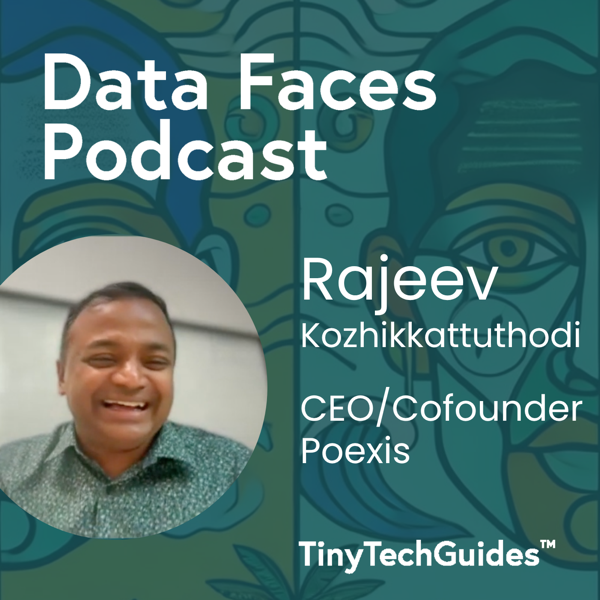
Rajeev Kozhikkattuthodi is the co-founder and CEO of Poexis, where he builds agentic AI for growth marketing across events, ABM, and inbound. He brings a practitioner’s bias to action, focused on where agentic AI actually delivers marketing ROI rather than just more analysis.
In this episode
- How B2B marketing leaders move beyond endless analysis to measurable 30–90 day outcomes
- Why most AI projects stall at the pilot stage
- How to turn events from awareness plays into pipeline generators
- What leadership skills matter most in an AI-augmented world
- Why emoji-heavy writing now reads as “bot”
→ Read the full article: Escape the marketing twilight zone: the agentic AI playbook for B2B marketers
Full transcript
Rajeev Kozhikkattuthodi 0:00 David,
David Sweenor 0:05 Hello everyone, and welcome to the data faces Podcast. I’m David Sweenor, founder of tiny tech guys, and your host for today’s discussion this show, I talk with the real people. We’re actually making data analytics and AI work in the real world. What’s exciting, what’s Messy, messy and what’s coming next. Today, my guest is Rajiv poetic cardi, a co founder and CEO at Plexus. He’s helping growth marketers figure out how agentic AI can change how we run events to ABM and scale inbound. So today we’re gonna get on the opportunities risk and what leaders need to do right now. So let’s get into it. Rajeev, welcome to the data face podcast.
Rajeev Kozhikkattuthodi 0:44 Awesome to be here. Good to see you again. David, thank you.
David Sweenor 0:48 Good to see you. And so can you just tell us a little bit about yourself and what you’re doing over at coexist?
Rajeev Kozhikkattuthodi 0:54 Awesome. So I’m the CEO and co founder at a company called coexist, my buddy co founder, Matt, and I started on this journey couple of years ago when we started looking at just the rise of generative AI, specifically, and models. We started this company in full owners last year. In a nutshell, we built agentic AI to really accelerate gold market. That’s that’s really where it is from, anything from events to ABM to inbound demand generation. We work with GTM leaders to kind of accelerate their work. Myself, I’ve been in this space for little over. I think 20 coming over, perhaps more like 24 years been around the block, if you will, in terms of product engineering, sales, and I like how you introduce it, the messy bits. That’s where, just like you, I learned a lot of lessons over the years. And I said, Hey, this is a fantastic time to build so here I am. Well,
David Sweenor 2:00 excellent. We certainly appreciate having you here. And thank you for wearing sort of the Aloha shirt. You’re the first guest that has ventured out there. I always wear one, and I hope I encourage everybody to do so. So appreciate that we’re matching too. So it’s great.
Rajeev Kozhikkattuthodi 2:13 Thank you. I asked my AISs and hey, what would fit the theme of the show? And Leo came back and said, This sounds to be a pretty fun place, and this might actually be the best fit. And my wife agreed, so
David Sweenor 2:28 that’s all you really need. So so you’re deep into agentic AI, and you know, if you look at all the headlines, it’s going to do everything for everybody. It’s going to solve world hunger, cure cure society’s ills or create them, I’m not sure. And a bunch of other things I’ve seen some some people say that, you know, these are totally autonomous. And sometimes when you appear under the covers, it’s really just pre scripted automations, in my mind. So you’re deep into this. How do you define it for B to B marketers and how is it different from plain old regular
Rajeev Kozhikkattuthodi 3:04 AI? Yeah, yeah, that the great question. So I think what better place to begin? Really, to me, I think that the crux of the difference that agentic AI brings to the table is the ability to take action, to do something, right? And I think that’s really the sort of pivotal point where AI becomes a lot more than what helps you sort of predict, what helps you analyze, perhaps even generate content to really fundamentally taking actions. And if you are taking actions, you got to do that with a sense of not just agency that entails a level of trust, a level of autonomy, but also, quite importantly, a level of learning, learning from mistakes. As you said, Perhaps things are not perfect the first time around, and how do you quickly sort of learn from it? And that, to me, is fundamentally the definition of agency and agentic, AI,
David Sweenor 4:05 alright, yeah. So, so it could take action on its own, without, without sort of being pretty sure, you sort of figure things
Rajeev Kozhikkattuthodi 4:11 out. A degree of autonomy is where we we really put it. And I think it’s really important to kind of decide to what degree do you want to grant autonomy on how narrowly you want to deliver and to what kind of sort of supervisory controls, how much of human sort of control in the loop and supervision Do you want to instrument it? And I’m pretty sort of non dogmatic about it, whatever really drives outcomes and works at scale, is what we work with customers on
David Sweenor 4:41 enabling right? And so what I’m hearing then is really depending on the use case. You can set those thresholds however you want them. So maybe, if you’re sending in a coupon to somebody low risk, you let it maybe do it itself. If you’re making more important decisions like credit or health or legal matters, maybe you want to always. A human in the loop, is that what I’m hearing
Rajeev Kozhikkattuthodi 5:01 Absolutely, absolutely, and I think it’s really important to sort of look at this as this notion of sort of leveling up on that right in terms of leveling up in terms of what you’re driving, leveling up in terms of autonomy, leveling up in terms of the sort of controls structures you put in place, the guardrails you put in place, the analytics you put in place so that we can continually sort of learn and level up from what perhaps is a very sort of, you know, sort of starting, easy starting point to really driving outcomes that matter, at the PnL level, at the board level, okay, I
David Sweenor 5:37 love this idea of leveling up so, you know, the martech stack. You know, you look at these maps, it’s, it’s completely, it’s crazy. It’s like, Where’s Waldo? I don’t even know all the technology out there, but what sort of mental shift Do you know growth marketers need to be making to, you know, use agentic AI in their business?
Rajeev Kozhikkattuthodi 5:58 No, I think you touch upon a very important point there, and I think in terms of mindset and look, I’ve been in this space I grew up with, sort of my early days were enterprise software. Then we saw the impact that cloud drove right and it completely transformed the way we look at GTM, the way we look at product and everything. Fundamentally, I think the number one mindset shift that marketeers and sellers and really sort of revenue leaders have to look at this is, how do I move from just analysis to agency, right? And I think that’s really is the sort of, as I said, kind of briefly earlier, the pivotal shift in terms of leveraging AI, leveraging analytics for just, not for analysis sake. And as you said, quite frankly, the GTM landscape, especially the martech sort of landscape, is you could, you could literally spend the next five years analyzing little tool. And sometimes the market landscape looks like the patterns on my shirt. It’s right, you got to really zoom in, like 10x to even look at what that function is, let alone the players in that space. To have that shift from I’m going to use, let’s say, 100 tools, maybe 1000 tools, to solve very discrete problems, to step back, look at the big picture, identify what can really drive outcomes, and then to take action on it. And that’s, I think, the pivotal sort of sort of shift there. Now, obviously, that can only happen if you, as I said, Look at the big picture, but also really think in terms of, how can I drive value in the next 30 days, 90 days, right? And if you say, Hey, I’m going to take on a little segment of the big puzzle, and then I’m going to look at what, how I can effectively drive results in the next 3060, 90 days, not just the next two years or three years, that’s that’s the big culture shift, that bias to agency.
David Sweenor 8:05 Okay? And so when you use the term, we’re going to get to challenges in a minute, because I think there’s a bunch of them. But when you use the term analysis and agency, you know what? What’s like? What’s the difference? Like? Is analysis like summarization? Is it mathematical analysis? Is it all the above? Like, like, how do you define these terms?
Rajeev Kozhikkattuthodi 8:26 Yeah, yeah. I mean, it’s, as I said, I’ve got a very pragmatic approach to some of these things. I do think that agency, fundamentally is what it does, not what it is. So in that sense, I’m a very pragmatic sort of you what it enables is, quite frankly, what is definitional about it. And I think what really analysis fundamentally to really dumb it down and look at the very core of it is it provides insights. Right now? Are those insights actionable? Right? Can they be acted on using some sense of effort, whether there is manual effort or automated effort, and whether that really augments, accelerates or just automates, right? Most people look at automation as the as the be all, end all of AI. And the reality is, automation is table stakes, like to a to any new technology. It does involve as the outcomes of the analysis come clear, automating certain aspects of what needs to be done, but then now we look at augmenting it, and then look at accelerating it. And that’s where really agency in the form of, hey, I’m going to do something about it as analyzing it really comes through and really to think about it. I think in the past, let’s say five to 10 years, I’ve seen the culture of just being data driven, which is phenomenal, right? Those analytical. Muscles have really been worked on by marketeers and revenue leaders, but sometimes analysis, to the extent that it’s constantly just providing insights that you’re not necessarily in a position to act on, can lead to paralysis and Right, right? That’s where we really have to draw the line between analysis and driving actions out of it, in terms of agency.
David Sweenor 10:27 So in terms of and as a human Rajiv, are we ready to cede control to the bots and let me, let me just share a little story. So I used to work in yield analysis and semiconductors, and you know, the routing through the FAB, there’s lots of tools. It’s very sophisticated, and we’re starting up a new fab, and they put a total automation of how these they call them lots these weight boxes of wafers will go from tool to tool, but they put it in an override function. So, like, the humans could override because they know better, and it actually slowed things down. They’ll fast forward a year, they turn that thing off, and the fab performed much better, because the this isn’t gonna figure it out. So as a human, are we ready to give up that the doing part of it to the robot?
Rajeev Kozhikkattuthodi 11:14 Yeah, it really depends, right? Like the to me, there is no sort of, if you will, cut and dry response to yes or no, it really is the answer that we all hate. We just It depends. It depends on the level of the task. Right? For instance, am I ready to give up my sense of individual agency on running a, on a factorial calculation or a or a linear regression or a correlation. Yes, we all open up our favorite calculator or spreadsheet or analytical tool and run that right. We don’t really think right. But am I ready to give up my sense of individual and collective agency on deciding where my marketing strategy should be or what, for instance, at a personal level, what? What should be my priorities in terms of learning priorities for the next year? No, and I don’t think that the framing of AI or AGI, in some ways, as this big, monolithic blob of intelligence that takes on a life of its own is not just wrong, but extremely counterproductive. And I think when you deflate that blob of inflated expectations around you know, oh, my god, AGI is going to take over agency as we know it. And we really look at this as augmenting human agency, augmenting your team’s ability to execute on it, all of a sudden, you are unlocking extreme value. And I think that, again, goes back to some of these things where we see there is a ton of value that could be acted on today and in the next 90 days. And look, we’re all on this journey to kind of learn how this all can be effectively leveraged in the next three years, five years, right? Technologies like this take a little bit of time to kind of fully sort of come to life and drive results. You know, I love that, and
David Sweenor 13:17 I thought that was a great way to put it. You know, you started out with the calculations. You know, I have my calculator here, so I’m not going to do long debate. I’m not going to do long division anymore. So that’s something I’m perfectly okay with, outsourcing,
Rajeev Kozhikkattuthodi 13:28 exactly. And I think I took one of the scariest classes that I took back in grad school was around safety systems and systems engineering, and it’s really important to kind of understand like what we take as natural today is really the outcome of several layers of abstraction, right, right? I think humans are incredible in our ability to kind of build these social, organizational cultural systems that provide effective outcomes with controls put in place. And AI is no different. And I think we really have to kind of forget about the the deflate, the hype bubble a little bit, and really sort of look at what can realistically drive results.
David Sweenor 14:16 Yeah, I like how you put it earlier, the the deflate, the inflated explanation, expectation, blob, I think you put it so I love that. So we can’t talk about AI without, without bringing up a report that just came out from MIT talk about, you know, AI fails to scale. I think the report it was quoted as, the headline is, hey, 95% of these things fail. So what are the top reasons that you see, why do these projects stall?
Rajeev Kozhikkattuthodi 14:45 Yeah, look, it’s funny. I looked at the report and a joke came to mind because I went to grad school there, and we used to joke that the Institute only makes one mistake, and they never admit it, right? You know, it’s a. It’s a insider joke, but, you know, in my case, I certainly did not admit it, but I think there’s a lot that that report is really a sort of sort of validates what we are seeing out here. Right? Of course, it does a fantastic job in summarizing these early findings, what we really see is that, whether you call it the trough of disillusionment or sort of the inflated blob of expectations around AI, we see a lot of these pilots around AI just stalling. And I think the biggest sort of reason so far has been, quite frankly, the ability to look at ROI right. The number one reason that most of these sort of pilots are on AI, whether it is a, whether it is a, starts off with everyone starts off with Chatbot. And I’m using incredible adoption. One of the key things that most people get wrong from the report is, oh, my god, AI is not getting adopted. No, it’s actually the opposite. There is, we are. If you look at the numbers, anywhere from 60% to 80% of the workforce or even higher, is actually on a day to day basis, using
David Sweenor 16:13 it. Yeah, everybody’s using it, whether, whether your company bought the subscription to GPT or whatever service, that’s a different question. You’re using it anyway.
Rajeev Kozhikkattuthodi 16:21 There’s a cloud, shadow it right? And now shadow AI is absolutely a real thing, unfortunately, in a lot of organizations cases. But then are you driving outcomes at the individual level, at the at the team level, or the job function level, or are you really driving transformational sort of outcomes of the business level, right? And that’s where really the report looks at in more detail. And I think that, as I said, the lack of being able to articulate ROI at the PnL level, top line, bottom line outcomes, is absolutely the number one reason. The number two reason, quite frankly, again, goes back to some of the things that we opened up our conversation on, which is great now I’m able to generate 10 times content, 100 times content, I’m, let’s say, 50% more productive in writing copy.
Rajeev Kozhikkattuthodi 17:14 What am I going to do about it? Right? You see that
Rajeev Kozhikkattuthodi 17:18 all this incredible power and the ability that automation in the form of generative AI has opened up, unfortunately, gets deployed in perhaps counterproductive ways that kill ROI. If you basically take 10 times 100 times more content and just spray and pray that a lot of work that prey is going to take on in that right, right, right. Praying gets easier. Praying gets you know, hopefully a lot more work is involved, because it’s simply not going to yield those dividends. And I think that thoughtful application of what you put AI to work for and on, I think, is extremely important. And last but not the least, goes back to look you can spend the next just like you can spend the next two years analyzing every marketing tech technology out there. You can also spend the rest of certainly this year and perhaps many years to come, analyzing every single AI model, like every single week there is, there’s almost an amazing sort of announcement or advancement in the state of the art. All that analysis for many teams can lead to what am I going to do in the next 3060, 90 days, and avoiding that. So it really tallies, in that sense, with the with the study findings, obviously I’m working off perhaps a smaller anecdotal set of early adopters for us. But it does, it does ring a bell in terms of, in terms of those top reasons,
David Sweenor 18:55 okay, that’s, that’s super interesting me. And you know, I think what I’m hearing from you is, you know, don’t get stuck analysis paralysis. Start doing you know, I have this philosophy, and everybody’s like, if you talk to people in the data world, Hey, is your data? Is it AI ready? Is it AI ready? It’s never going to be aI ready. We’ve been talking about this for 25 years now. I’m not saying it’s not important, and you can, you can certainly improve upon its quality. But what I think you’d recommend that you can’t do is sit and wait for it to be perfect and pristine, because that that day is never going to happen. Things shift and things change, and you’re always going to have issues with the
Rajeev Kozhikkattuthodi 19:30 data, especially as leaders, as you rightly pointed out. Look, it’s happening today, right? Not only are your competitors using it, your partners are expecting you to use it, but your employees, the people on the front lines in the trenches, are using it today. Now, are you going to be able to effectively leverage it to do more than individual level performance, right? And that’s really the question that, in my opinion, most leaders really have to grapple with, and that’s a fundamental. Culture shift from I’m going to be data driven and analytical to be to also being, I’m going to take action, and there’s going to be a bias to action and enable my team with whether it is agentic, AI, or aspects of analytics or aspects of other fundamental investments you have to make to enable them with it. Okay, yeah, yeah,
David Sweenor 20:23 alright, let’s, let’s, let’s dig down now. So we got, we got, sort of the, the high level, what’s going on in the market. Let’s talk about events. Let’s talk about ABM. Let’s talk about, yes, inbound, you know, the, you know, the the sort of the keystone of, of any you know, B to B marketing or you know function, you know, for events, you know, where do you see the most, I guess, untapped potential for agentic to drive attendance and engagement?
Rajeev Kozhikkattuthodi 20:51 Yeah, no, so, so look, it’s taking a step back. If you look into as you rightly call them, they really the Congress don’t try the bread and butter of every marketing organization, certainly, every sort of demand function. I always like to look at this as, what’s my 90 day horizon, what’s my, you know, the end of quarter. Everyone loves that, right? We all need to drive numbers towards the end of quarter to the end of year and the next sort of, let’s say, three to five years, right? And when I look at something like events, look having had a lot of scars on my back from running events with, let’s just say, somewhat questionable pipeline outcomes, but event, incredible awareness, incredible top of funnel sort of activity. What’s a 30 day, 90 day plan to kind of hit this quarter’s numbers? And I think what is ironic, David, is that with all this digital noise, especially around ai, ai generated content, guess what’s absolutely rising to the top for most of our customers, in person, experiences, human touch, high touch, right? So what we’re seeing, somewhat ironically, is that buyers are really tuning out of all this sort of digital, the traditional digital outbound, oh, I’m gonna, I’m gonna just blast an email that’s quote, unquote personalized to 10s of 1000s of attendees. I’m going to have, like, a single digit open rate. I’m going to have even a more pathetic reply rate buyers are tuning out of that. What they are preferring is really super relevant, personalized and oftentimes in person experiences. And I think most event marketers get it right. We’ve all been part of events where we thought, Oh, my God, the conversation there and the engagement there with the right people on the right topic is so valuable. But at the same time, how do I use AI to kind of really sort of make it more valuable, right? Because rightly so. CROs and CFOs and boards are asking, Hey, are those events just awareness place, or are they also pipeline place, right? And marketers typically have struggled to do both, and certainly do both at scale. And I think AI is fundamentally changing the game there. We work with a lot of sort of early adopters in terms of, and again, this is really sort of people usually use AI for, quote, unquote, lead scoring or content generation, not so much in terms of augmenting and making these, especially in person experiences better. We work with a lot of teams. So a simple objective is, hey, in the next 90 days, I’m gonna double my pipeline coming out of these events. That’s it. That’s the goal that I’m gonna set for myself my next event, and my team. How can you help? Right? With agentic AI, with models, with all these capabilities, and that’s been a super interesting learning for us, and very excited for us to partner with really sort of forward looking practitioners out there. Yeah,
David Sweenor 24:09 that’s fascinating. Actually, the one of my previous podcast guests almost said the same thing in terms of, hey, in person, events are coming back almost verbatim of what you said. So Well, definitely something there. So how does but, like, if I just dig down a little bit, how does agentic AI help with it? Is it driving attendance? Is it designing the event itself? Is it designing experiences at the event? Is helping with follow up? Like, how does we just, like, couple examples of how it plays out?
Rajeev Kozhikkattuthodi 24:38 Great question. All of that, right? So what the number one thing that we say is, hey, identify an event that’s on a, let’s say, 90 day horizon, right? Sure, a lot of the impact that you can drive today, right, literally within just minutes, if you will, is to drive all the pre event research. Now the reality is, look, it could be a dinner. Or, you know, sort of, let’s say, a CXO dinner or a customer roundtable. That you’re just getting customers in a local region, getting them to come over and share best practices learning to drive research and intelligence on those attendees. Right? Not just intelligence that’s available in your CRM, but Intel that’s can be sourced from several dozen sources out on the out on the internet, but also people right to be able to reach out to your sellers, your partners, and understand the intel on them, and to really make it relevant for it, because that’s obviously the first thing Hey, for a customer, for a CXO, to be able to even show up at the event. You really should put some thought into making it relevant. So that’s number one driving attendance with in terms of research analysis on those attendees and targets that you want to look at. And that’s something that you could literally do in minutes today, right for your next event. Now, once you drive analysis, how do you make that really not just a topical relevance, but of experiential relevance, right? How do you design these pathways? The number one thing I ask most event marketers is, Hey, how is your prevent sort of meeting orchestration coming in, right? How many, if especially, let’s take the example of a trade show, right? We all love trade shows. You know, there’s a lot of work that goes in behind the scenes, and then people just walk past the booth, or maybe even attend one of the breakout sessions, maybe one of the demos, and then they walk away. Right? How do you make that experience at the event really personalized? And one metric you could absolutely look at that is, how effectively Am I driving one on one or limited sort of experiences there? Number two, how personalized is that experience? Whether it is a demo at your at your booth, or perhaps just a executive conversation, are you equipping the stakeholders with the right personalization? Right? Right? You all been there where you know you you have this, no, you got 1000s of leads coming out of these events, and they all look the same. They all watch the same demo, the same breakout session, maybe look at the same, took away the same swag. But you really do not have, not just pre event, but also active end experiences that lead to it. And then you send over that scan badge, dot, XLS
David Sweenor 27:27 to a hot lead
Rajeev Kozhikkattuthodi 27:32 to this, to this poor SDR, perhaps several time zones away from you. And I think that’s where we really as event marketers, you can take control of it and then say, Look, I’m going to set myself an objective that for an event, whether it is a dinner in person, sort of exec round table, to a trade show, to a major user conference, I was talking to a vendor who literally spent upwards of a million dollars on One of the major summits earlier this year, and my basic conversation with the with the marketing leader, was around, hey, so surely you’re looking at about 10x that in terms of pipeline, right? Because the rule of thumb is somewhere between eight to 12x of every dollar that goes into demand. Gen your board is expecting to see outcomes from it, right? That’s That’s what is driving PNL. And I think what we’re fundamentally excited about is to partner with event marketers to drive that all the way from small events to trade shows to major sort of quote, unquote awareness place that can also now yield pipeline. So we think you can start simple and then scale. And I personally think it’s a good thing that in person, more relational, personalized experiences are bad, as opposed to spraying and paying and praying that your, you know, 100,000 emails hit the inboxes of the people who you really care about.
David Sweenor 29:01 I love that. It sounds like, you know, it’s really can be applied to every, you know, pre, during and post event. So that’s cool. So that brings up a related question, you know, similar for, like, you know, inbound, yeah, how can we use it for, for creation, content creation that maybe still feels human. You know, we’ve all seen the the ever elongated LinkedIn posts that have even more and more emojis every day that nobody reads. So how do we stay stay human and use this for inbound
Rajeev Kozhikkattuthodi 29:33 sometimes I feel guilty because maybe I’m one of the one of the one of the outliers. But I used to use emojis all the time prior to active Gen AI models getting and maybe I contributed in some teeny way to the training set that these models were trained on. I’m not a huge fan of M dash, but the Oxford comma and emojis were totally my thing, right, right? And then this came along, and. It became this sniff test of, yeah, you
David Sweenor 30:02 gotta, like, ban it from your writing now gone, and I’m like, oh
Rajeev Kozhikkattuthodi 30:06 my god, I really have to pull back on my emoji usage, even in text, because it sounds too, too sloppy. But jokes aside, look, it’s really some of the numbers that we’re seeing are just incredible, right? And scary, like, if you’re looking at top of funnel awareness, and HubSpot famously, sort of pioneered this, this whole genre of sure and really the religion around inbound marketing, right? I was at MIT when I remember Dharmesh walked into the into the digital innovation sort of guest lecture, and talked about Inbound Marketing. And Brian was there as well, and I was like, Oh, my God, this is like, revolutionary, right? You create inbound engines at scale that are really relevant to people, and then they come to you, except they don’t come to you. No more or increasingly, 50% of, or trending to 50% of of searches are zero click so as a marketeer, as a content marketeer, as a digital marketing expert, you’re actually seeing a precipitous fall in that, right? Yep, that’s obviously a problem. Now, is this something that is a good thing or a bad thing for the internet at large? For all of that, that’s all a debate that’s saved for a later day. What are you going to do about it? What are you going to do about it in the again, as I said, the 90 day horizon, the end of your sort of, you know, horizon, and how you going to drive meaningful value. My usual rule of thumb is, look, the reality is, like it or not, agents are taking on a lot more of that inbound traffic, or in some cases, zero click traffic. It’s your responsibility as an inbound marketing engineer or a growth marketeer to look at how to effectively use that as a channel. And what we typically work with is, let’s identify like a tiered content model and then use these sort of, let’s turn really sort of this agentic experience on the the evergreen content apps, because let’s face it, you might have 10,000 assets on your corporate, on your corporate.com the reality is, the freshness, the relevance, the personalization on all those things rarely meet the mark for most agents, whether it’s chat GPT Gemini or custom bio research agents, to hit that. So we typically tier the content into a into a layered sort of layer cake or a pyramid, and then hit that. Okay, let’s actually drive up agentic experiences and scale the top the pyramid right. And these are probably about sort of content hubs, or agentic experience hubs that you build out and then instrument it right. Put in your evals to see, because you are not going to see traffic as much as a leading indicator. You really have to evaluate how you are being cited in chatgpt, how you are being referred to as a source in your deep research report by Gemini or copilot or whatever. And then that’s a good 90 day exercise. And then you look at, okay, now let’s actually double click and look at the personas the ICPs that we actually cater to and then we write content to your point. How do we sound human, right? And I think that’s of course, technology can again help or be counterproductive, right? We also always recommend this look, especially when you look at agentic experiences. Provide deep context, right? Yep, in copywriting to contextual sort of engagement creation. Unlike humans, agents have a very different definition of context, and we always encourage customers to be not just data driven. For instance, that usual tip that we use for our agents to create a more effective content needs to be data driven, provide lots of lots of numbers, quantitative sort of aspects to it, but also make it conversational, right? Turns out, one of the most human ways to communicate, necessarily as copy, but in terms of conversations, is one of the best tips that you can use to drive inbound traffic, especially via agentic sources. So if you want better citations and better authority score in chatgpt sound more human, right? Fantastic way to go about doing it and perspective of your customer, not from your perspective,
David Sweenor 34:44 right? Right? Yeah, a lot of people make make that mistake. So we’re nearing the end of our time. I think we have time for maybe one more quick question. Well, let’s talk about leadership. You know, what do marketing leaders need to do to get ahead with with agentic AI,
Rajeev Kozhikkattuthodi 34:59 great. Question. So I think ironically, as as the as somebody with two engineering degrees, I’m going to sound very non and sharing on this, I think as leaders, especially as a marketing leader, what really matters, I think in the next couple of years is going to be more taste, less the hard skills, because I think in general, as a community, marketers have gotten really, really, much, much better at the hard skills around data driven analysis and all that to cultivate taste is very human and is surprisingly uncommon. Cultivate taste as a marketeer. Encourage your teams to really build that deep expertise. Number two, to really look at what could, how do I drive relationships? Right? Relationships matter as humans, and it’s very human thing to do that agents are great at take over. Right those relationships with sales, with your customers, with your partners, with your leadership team right, to really sort of build value. I think that’s, again, something that’s honestly evergreen advice that I think is going to be super relevant in the next few years, and last but not the least, I think goes back to that notion of that bias to agency, right, that bias to action. Great, fantastic. That’s a good hypothesis made out of available data. You’ve talked to the right people. You actually have a sense of taste that informs what your hypothesis is. Let’s go do it right. Let’s go do it. Let’s experiment. Let’s roll it out in the next 30 days, observe the results. 90 days, we come back, re adjust what your hypothesis was, and then iterate on it. And I think those are, quite frankly, those sort of human skills that I think, I think, really are going to matter a lot, especially in this stage, day and age.
David Sweenor 36:53 All right, well, stay human. I love that advice. So very, very wise words. Appreciate you being on the show. Rajiv, how do people find you? How do they get a hold of you? If they want to know want to know more
Rajeev Kozhikkattuthodi 37:03 about coexist? Po access.com we take a lot of, sort of really sort of actionable advice out there. Check out the Insights section on coexist.com for really, sort of more insightful content in terms of, especially that appeals to marketeers, demand engineers and sellers, that’s probably the best way to reach us
David Sweenor 37:27 all right. Well, fantastic. Thanks for joining the databases podcast. You’ve been an amazing guest. Appreciate you being here, and hope to have you on in the future. So thanks,
Rajeev Kozhikkattuthodi 37:35 wonderful. Thank you likewise as well. Cheers. You you.