

Data Faces · Episode 9 · April 8, 2025 · 38 min
Is Gen AI revolutionizing product marketing, or just flooding the market with generic content? Melissa Burroughs on the real shift.

Listen: YouTube · Spotify · Apple Podcasts · Amazon Music
About Melissa Burroughs
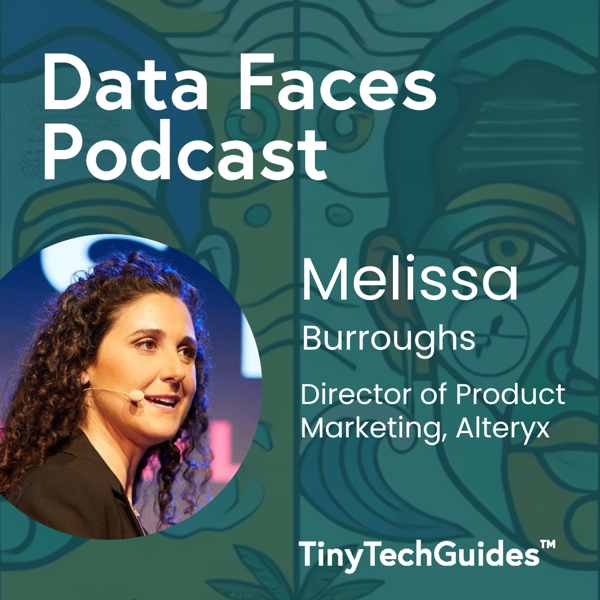
Melissa Burroughs is Product Marketing Director at Alteryx, where she leads teams at the intersection of analytics and marketing. Her background includes an MS in Applied Physics and research in accelerator physics before she moved into software and analytics. She has built product marketing organizations from scratch and led high-performing teams.
In this episode
- How generative AI is transforming the PMM role
- Redefining the balance between technology and human judgment
- Boosting productivity without flooding the market with generic content
- The ethical questions GenAI raises for marketers
- Advice for PMMs navigating the GenAI shift
→ Read the full article: The Gen AI shift: how product marketing managers are adapting
Full transcript
David Sweenor 0:00 David, welcome to the databases podcast that explores the human stories behind data analytics and AI, I’m your host. David Sweenor, founder of TinyTechGuides, today we’re going to discuss something that’s top of mind for just about everybody out there. How is generative AI reshaping the role for product marketing managers. To explore this, we’re extremely lucky to have the talented Melissa burrows. She’s Product Marketing Director at Alteryx. Melissa spent years at the intersection of analytics and marketing. She helps translate business data into action. So with generative AI, automating task, influencing strategy and sparking debates about ethics and authenticity. How should PMMs respond? What parts of the job become more valuable, and how do we balance AI’s power with the need for trust and creativity? So Melissa, welcome to the databases podcast. Oh David,
Melissa Burroughs 0:56 thank you so much for having me. It’s a delight to be here.
David Sweenor 1:00 I’m so, so excited to hear just a little bit about your background. I looked at your LinkedIn. You happen to have an MS in Applied Physics. There’s words about particles and muds and lasers and things like that. And now you are Director of Product Marketing. So tell us a little bit about how your journey to become the PMM
Melissa Burroughs 1:23 Thank you, David, I knew I wasn’t going to get away with not not covering this on on your show. So yes, beyond my work in technology product marketing, I do have experience with a few weird things that include accelerator physics, research, medical data analytics and the short explanation, I like to quote JRR Tolkien, which is not all those who wander are lost. So always had a curious mind really love the natural world. Felt like a great deal of awe towards all the sophisticated activities around us, in terms of mechanics and electricity, and I just wouldn’t quit school. So I basically stuck with it. Like I said, Did accelerator research. Did a few papers related to plasma afterburners and photonic band gap particle accelerators, the Holy Grail, tabletop particle accelerator. Yeah, I was a big fan of theoretical physics, but I like to joke I didn’t understand enough math to do theory, so I was an experimentalist. It was a lot of fun. It was a lot of fun. But that curiosity, that desire to create value in the world, really continued to drive me forward in my career, and over the last, gosh, let’s just look at the last 15 or so years. I’ve worn so many hats in the software industry. I really went from science to analytics into just pure software. I was in engineering, I was in product management. I started building product marketing organizations from scratch, and it’s led me to leading top performing teams today. It’s really all been about bringing together technology and inspiration, and that inspiration quickly became storytelling for me. That’s what really drives me, whether it’s creating a compelling marketing program or delivering an asset that drives customer engagement, I thrive when it’s about translating technical capabilities into clear benefits.
David Sweenor 3:30 Okay, that’s great. That’s great background. Thank you for that. So let’s just jump into this. I don’t know if you’ve heard of this term out there in industry called generative AI. Apparently, it’s a big deal. And so how does this How is it like transforming your work as as a PMM, oh
Melissa Burroughs 3:49 my gosh, such a good question. I would say Gen AI is definitely having a big impact on product marketers. And I’d say I’m seeing it change the way we work in three key ways, first and probably most obviously, Gen AI is super charging. PMM productivity like we can we can draft content faster. We can research and develop a point of view on a topic much more quickly and efficiently. We can even do things like create visuals without always needing a designer, and I have no esthetic sense, so that’s pretty magical for me, like in my own role, things that used to take hours, like drafting a long form asset, you know, or exploring a market trend to really understand it that now takes minutes. It’s not a whole day of research, it’s, it’s part of a day at most. Now that’s a huge win, but it raises the expectation for what a PMM can and should deliver, so the bar, as a result, is getting higher. Okay? And there’s a couple other things I feel like I’m going to go on a bit. So. Interrupt me, please. You know me, David. So I’d say something when I think about how Gen AI is impacting PNMs is the PMM role transformation, the amount of change you’re going to see will vary depending on the organization that you’re in, like a larger, more established company that’s going to move slower with Gen AI right, governance concerns, internal processes, the cruise ships, they’re slow to turn right. Sure. You know, for a while, my own company even frowned on using Gen AI tools because of their concern about data security. And over time, we did transition to adopting a control, generative AI solution, and that completely shifted the way that I could use these tools. Gen AI for me, went from something that I maybe like used only like quietly in the corner, now it’s more central as part of my workflow. And so that’s bigger companies. I’m in a mid sized organization myself, but if you’re at a small startup, I mean, startups are jumping in full throttle. They expect PMMs to use Gen AI for nearly everything, whether you’re creating materials, you’re analyzing customer data. So my, I guess my point number two here about the Gen AI kind of impacting the world of the PMM is, your mileage may vary. Has that been your experience? David,
David Sweenor 6:27 yeah, it’s, I’ve seen different PMMs, you know, some are hesitant to use it. Some are very, you know, liberal. Use it for everything. But I think there’s maybe a point to be made about gotta be careful how you use it, because you don’t want to sound like a robot. But we could talk a little bit a little bit later. I want to curious question for you then, you know, with AI, is automating all these tasks? What part of the PMMs job become, you know, maybe more valuable and human centric, you know. So we know this thing can summarize content at scale. We know it can create mediocre, long form content that that everybody regresses to the mean. But you know what? How does the human part of this, you know, come through? Oh,
Melissa Burroughs 7:15 gosh, yeah, that’s, I think that’s probably a question on the mind of many PMMs or aspiring PMMs today, I think just from where I said, I believe we’re going to see three aspects of the PMM role become even more critical. On the human side, there’s the collaborative element, there’s the depth of expertise, and what I would refer to as sort of the in person side of the role. So I can, I can double click on those, those three
Melissa Burroughs 7:47 ideas, if you’d like David, yeah, tell us about the collaboration. About that. Yeah, the collaborative element,
Melissa Burroughs 7:52 the cat herding elements, right of of the PMM job, I think are really going to elevate right, to quote you. David, I have learned so much from you, sir, we are the glue team, right? We’re the glue between development teams and go to market teams. PMM, highly cross functional role, and that means that influencing and aligning our stakeholders has always been key, but now it’s going to be critical with Gen AI, right? Not just creating a strategy, but also being able to bring together different, smart and diverse people to actively agree on it, push it forward. AI is not going to do that. That’s where PMMs are going to shine. You know, the soft skills, the building relationships, the gaining consensus that is going to become absolute table stakes to succeed or even get hired as a PMS, that’s
David Sweenor 8:50 an interesting comment there, and I agree with you. I think these soft skills are going to become more important. I think there’s a lot of people, and I talked to a lot of people who’ve done interviews. I’ve done a fair number of interviews, and no one really asked questions about the soft skills. They’re like, mechanics. How do you tell me about a time when you were struggled with something? And I’m like, every day is a struggle at my job? Like, where it starts? Like, like, if you like hiring manager, like, I’m just, how do people, you know, suss that out of the candidates, they’re all the interviews I’ve been to are more about the mechanics of the role. And have you done this before? And can you do it? You know better here bring us to the next level?
Melissa Burroughs 9:32 Yeah, I think that’s just a reflection of the latency, and people need to catch up and understand that the expectations for success are going to shift, and so your hiring profile, the skills and competencies you’re looking for, need to evolve as well. I’m not at all surprised that you’re still talking to people who are evaluating for the same skills they were looking for five or 10 years ago. It’s disappointing, but I think those organizations are put at a. Manage because of it.
David Sweenor 10:01 Okay, so let me, let me ask maybe the reverse of this question. Are there surprising ways that AI is making PMMs less effective?
Melissa Burroughs 10:12 Oh, goodness. I think that AI can make you less effective as a PMM if you are not thoughtful about the way in which you apply it, I’d say the number one mistake I observe PMMs make, and I’m not saying that this is happening to the colleagues that I work with. PMMs I know is outsourcing inappropriate tasks or just abdicating responsibility for the output. As a PMM, we are stewards of the message, no matter what tools created it, no matter how it came to be. We need to own it before, especially before it leaves the house, ideally before it leaves our desk, right? And that that lack like not not understanding and not taking that ownership that leads to issues, whether it’s a blog post that reads like gobbledygook that you didn’t even prove carefully, you know, timelines and strategies that don’t make sense, analysis that’s done incorrectly, it’s the sloppy application and the thoughtless application of the tool that gets PMMs in trouble. What have you seen? David,
David Sweenor 11:19 oh, you can’t ask me questions in my own show. I agree. I agree. You know, I, you know, I did a, one of my most popular blog posts was, you know, spotting AI junk words. And, you know, we’re delving into the situation and game changing. And you know, all these, all these words that are out there that, you know, they’re just repetitive. If you read enough AI and use it enough, you see the same things, actually, across the board, coming out of all the different services, whether it’s open AI, Claude, Mistral, you know, pick one and sort of the same. So the sloppy application, we want to stay away from that. So how does your like subject matter, expertise? How does that play into this. I’ve seen a lot of fails. It makes up stuff all the time. People call it hallucinations, fabulations, whatever word you want to use. I call it BS. But you know, how does your subject matter expertise play into this?
Melissa Burroughs 12:16 Oh, gosh, yeah. This is, this is definitely another element of the the PMMs job evolving and getting more more focused on the human side, PMMs are going to need even deeper expertise about their product, their market and their audience. Right? To your point. Gen AI, you might be able to produce a lot it scales tasks like content creation really well, but Gen AI doesn’t know anything, right? Like, like, you made the point about hallucinating facts. Gen AI makes silly mistakes. And you know, I I see this all the time, even in simple and personal use cases. Like, recently, I was trying to find out if a certain food was gluten free, and the Gen AI tool associated with the site claimed that it was simply because there were some unrelated keywords in, like a product description. And so I have found, no matter where you’re applying Gen AI, it can be misleading if you don’t check the sources and you called it David PMS will need to act as a BS filter for AI, right? Like you’ve got to ensure that what the AI is suggesting is correct and is relevant. And if you don’t have that expertise, if you don’t know your market better than the gobbledygook that the AI mixed up for you, you and really, your whole team is at risk, at risk of putting out bad content, at risk of making poor decisions, you name it. So for sure, the expertise side of the PMM role is going to get more pressure put on it as a result of Gen AI. So
David Sweenor 13:48 here’s a question. So I feel like that the organizations, the marketing teams, are becoming reduced. So you’re you’re expected as a PMM to do, to do more. And I think I use the term skeleton crew all the time, and so you have to do more with less. And we have all these doing more and more things that maybe we historically haven’t done. Where do you find the time to become an expert in your product, your field, your partners, whatever it is, your competitors? Where’s the time? If you’re just sitting there, you know, pumping out, you know, pasting things in there to create more emails that that, you know, I don’t think a PMM should do a lot of that, but we’re being forced to these days.
Melissa Burroughs 14:32 Yeah, it is. It is definitely an efficiency oriented market, and having to do more with less. Is something that not just PMMs are experiencing, but for sure, I agree, many PMM teams have been cut down to the bone. It is. I don’t have an easy, glib answer. I haven’t like figured out that one trick, you know, that one cheap trick that no one wants you to to know about. I think that. For me, personally, what has worked best has been ruthless prioritization, and I’m at the point in my career where I’ve developed sufficient professional judgment that I can be selective about who I need to satisfy and who I might be able to disappoint, at least in the near term, which cans can be kicked down the road just a little bit, and so I’m not advocate advocating anyone in the audience actively disappoint or anger their stakeholders. But you’re right, David, we are not set up to win here. We’re not being given luxurious time to research and deeply understand our market in the context of our highly production oriented roles, and what that means is that you have to reclaim the cycles to be able to do that which is going to foster your career, whether it’s about the expertise you’re going to need to make it in a Gen AI oriented world, or really anything having to do with your professional needs and development, it means being thoughtful about what’s going to move the needle right, what’s actually going to satisfy the business, and what perhaps might be extra. How can you Tetris it differently? It’s not an easy answer. It’s not a glib answer. And the reason that I offered this answer, the fierce prioritization and disappointing people, sure is, and I don’t want to be too gendered about this, but a lot of the young women, especially that I talk to, feel like the answer is working, evenings, weekends, early in the morning, always be working. Oh, if I can just find more time to answer email in the evening, and maybe I’ll do this research on a Saturday. I’m not a big believer of sacrificing your whole personhood on the altar of work. I do believe in boundaries and priorities, and I think the people who succeed are the ones who don’t burn their candle at both ends. So I advocate strategic disappointment. How does that sound? I
David Sweenor 16:53 love it, and ruthless prioritization. No, that’s a good thing. I think you know people earlier in their career, regardless of gender, they know they want to make an impression, and maybe it’s their first job, or what I want to impress their boss. They I did it when I was early in career. You know, I worked too much, and I remember very distinctly, like I did all this work, and I was working my butt off, and I wanted a promotion. And fast forward, I didn’t get the promotion that year, and the next year, I’m just like, Okay, I’m not working 12 hour days. And what happened was, I got a promotion that year. The manager’s like, oh, did you do anything differently? I go, Yeah, I worked about half the time. And the only difference was, you were involved in the project that was on, like you were unaware of the work I was doing. So there’s a lot of people doing, you know, sort of invisible work. And so you gotta be whatever you do be impactful with that and focus on the right things. So I like that strategic disappointment, and that’s okay,
Melissa Burroughs 17:49 yeah, that and you’re right. The mechanism is that input doesn’t always directly correlate to output, right? What you’ve put into something doesn’t necessarily create a big impact, right? If you’ve thrown everything into it, it may not make a difference, or it may not make a difference where it counts.
David Sweenor 18:05 Sure. So we talked about efficiency gains, and I don’t know if efficiency and productivity is the best measure of a human being, but okay, we’re here, and that’s how that’s how companies are. But how do you balance this with you know, if you’re a brand person, you might say brand authenticity as a PM, we’re gonna say, how do you stay on message? So how do you balance this efficiency gain, productivity gains with brand being on message and customer trust?
Melissa Burroughs 18:31 Oh, yeah, really, there’s Wow. So quite the tension, I think, related to our previous discussion, it is about being deliberate at every step. And I’m a big fan of lists of three, so I’ll, I’ll name three things power
David Sweenor 18:47 of three. There’s a whole thing out there, right?
Melissa Burroughs 18:50 The human mind loves three things. It’s true. I would say the way in which you want me to be deliberate breaks down into three main dimensions. First, like you made the point. Ai makes it really easy to sound like everyone else, so vigilance against that regression to the mean the second. And especially, I love that you brought up customer trust, being careful around interactions, becoming impersonal with your customers, and then finally, when we think about customers and customer trust, that can also be damaged by misleading information. So if you’re deliberate and vigilant against these three threats, you’ll be able to maximize efficiency leveraging AI without compromising the brand voice and the customer relationship and with all things, I’m happy to double click on any or all of those ideas. What what sounds interesting to you? David,
David Sweenor 19:50 well, I think the misleading info is very interesting to me, because if you’re using AI to generate content at scale. It will dutifully cite sources which may or may not exist. How do you even physically go check all those sources? And sometimes you go check them, and maybe they exist, but the content that you’re looking for that doesn’t exist, or it’s an AI generated detritus, you know, an article that you wouldn’t want anybody to read. So I guess, how to how you protect against that?
Melissa Burroughs 20:23 Oh, so true. Sometimes. What is it? Turtles all the way down. Is that the expression, I have not heard that one get into it, but yeah, yeah, the so the challenge of misleading information, right? Inaccuracies, as you’ve said. And AI generated content. Gen AI can create really convincing even on brand statements that might be completely wrong. Yeah, it makes
David Sweenor 20:50 up quotes from customer things that don’t exist. I’m like, that looks like a great quote. You go read the case study, like, Oh, darn, that’s not even there.
Melissa Burroughs 20:56 That person doesn’t work there, yeah? Or it gets the product details wrong. It makes incorrect claims about the services your business offers. So yes, double checking everything is key. And like, I know you’ve asked about like, hey, how do you really get down to the the foundation truth that AI might be building a case on? I would argue that that is one type of issue that we can talk about, AI inserting, but one very pernicious, pernicious that’s a hard word issue AI, I’ve seen create is about the details right, like One wrong word, and again, your efficiency oriented. You’re scanning. It looks kind of okay. Like, think about the difference between complimentary than I versus complementary with an E, you use the wrong version in some of your materials, and suddenly you’ve created confusion or frustration or mistrust with your customer, right like so, I would argue there are two ways in which AI can mislead you, absolute fabrication of of data that you’re not able to get down to the source material from, or laying traps for you in the language itself. Like, literally, if you say a product is complimentary, you’re saying it’s free, if you mean, it compliments another product. And I know this is like a little, it sounds like a little nitpicky Nancy here, sure, but small errors like that, they add up to impact trust big time. Imagine a website fraught with these things. It is a small leap for that reader to go from they don’t seem to know words to what else Don’t they know. Right? It just can really erode a brand these little sloppy right? That area
David Sweenor 22:47 is a problem too, yeah, hopefully it doesn’t get you any legal trouble, too. You know, I’m like, sometimes these things could bind you to sales and whatever. But let’s move on to ethics. Let’s talk about ethics here. Like, what does a PMM need to care about? There’s lots of discussions on, on ethics, you know what? What’s what’s important, what do you what do you think about, you know, when you’re using Gen AI,
Melissa Burroughs 23:13 who, this is big stuff. And, I mean, honestly, I’ve got some big opinions here. David, so, oh no, interrupt me. You know me, please, like, like, chime in, because I’m a lots of words, lots of words on this much ink will be spilled the way that I think about ethical concerns for PMMs that need to like, they need to navigate carefully consider, in the context of implementing generative AI, for whether it’s, you know, asset creation, messaging, you name it, there are four big areas to think about. Wait a minute.
David Sweenor 23:52 Wait, you ruined your power of three here, Melissa, but I know that’s why I warned you. It’s a long. Hold on, continue on.
Melissa Burroughs 24:00 I know this is, this is why it’s heavy duty stuff. There’s definitely more than three dimensions to consider here. So, so the Big Four for me are transparency, accountability, privacy and bias, right? Each of these elements, they play an essential role in you know, not only you know, executing communication ethically, but also, like you were talking about before, David, maintaining that trust with your audience, and I’d argue, even trust with your own organization. So I can talk about all four of these items, if you’d like. Does any of them stand out? What
David Sweenor 24:38 do you mean? Let’s double click on transparency. What do you mean by that? Yeah,
Melissa Burroughs 24:42 transparency for PMMs in especially in my experience, that means being clear, at least internally, about when and how you’ve used Gen AI in your work, like we’re talking about citing sources before it is exactly the right. To think of it is like citing a source. If Gen AI has helped you develop a particular piece of messaging, you need to note that in the internal documentation something like, you know, created with assistance from chat GBT, that that’s simple. Now that doesn’t necessarily have to go into public facing content, but that kind of internal transparency ensures that your team or your leadership understands what tools went into creating that message. That kind of transparency shows professionalism and it builds trust within the organization. How does that land with you? Well,
David Sweenor 25:37 I feel like if everybody’s using Gen AI in some fashion, won’t every document have this disclaimer in it? And that’s my question one. Question two is, if you use you write a blog or use generate gen of AI assisted blog, should it be external as well? I know some companies do most don’t. I would say vast majority of them don’t. And I read these blogs, and I know they’re written by AI, so you know how what’s your take on that? Yeah,
Melissa Burroughs 26:08 the external side, I asked myself the question of, does the stakeholder care about how does it matter to the stakeholder, how this was created? If I’m reading a vendor’s website, I’m not particularly concerned whether it was a full time w2 employee who wrote it, or contract content marketer, or some AI bot that generated the content. I care about the impact of it. Did I get what I needed? Did I learn what I want? Right? Did I gather new ideas from it. But if I’m inside the organization and I’m getting content out of my team, and I don’t know how that content was developed, I don’t know what went into it and in what ratio, it makes it hard for me to navigate things like performance management, resource allocation and more. I agree with you, though, David, it is something that is going to proliferate, if it hasn’t already, throughout entire businesses, that the moves you could make without generative AI over time will get smaller and smaller. Are we there today? Not necessarily. I think we’re still earlier in the adoption of generative AI, particularly in product marketing, it is really helpful to maintain that high transparency once it’s in the footer of every document. I agree with you, it may no longer be as important to call out, but as a PMM like I said before, we are stewards of the message no matter how it was created, and that actually, I’ve kind of been sliding into the other one of the other concepts here of accountability, right? Like having that transparency relates to being responsible and accountable for the results of what you created. You can’t be accountable if you completely obfuscate where it came from. You know, very
David Sweenor 28:00 interesting, and that, that transparency, I think we’re going to see that evolve. You know that footer used Gen AI to create this. It’s like, the you’re in California, this material is known to cause cancer in the state of California, only, like, does anybody care anymore? Because it’s on every freaking product out there. I don’t know. It’s interesting to me.
Melissa Burroughs 28:19 Yeah, it’s, it’s very true. I see that messages, and I interpret it as, don’t eat this. But then it’s on my coffee. It’s on Starbucks coffee, like, while I’m eating this,
David Sweenor 28:32 everywhere it’s everywhere. It
Melissa Burroughs 28:33 really is. It really is. All right, let’s, let’s talk
David Sweenor 28:37 a little bit about how does the PMM role evolve? And I’m not going to be so bold as five years, because I think Gen, we don’t know. I think generative AI is, is evolving so quickly next year, maybe two years out, how does this How does our world look different?
Melissa Burroughs 28:56 Oh, goodness, yeah. Prognostication is. It’s a toughie from where I said I see Gen AI reshaping the PMM function. I guess I’ll return back to my rule of three in three big ways. I think that, you know, strategy is going to take center stage in the coming years for PMMs. I think AI is going to drive a shift in how much is expected from each PMM. And then, sort of the flip side to that, and this is sort of a sad result. This could lead to fewer entry level PMM roles. How does that? How does that land with you? You want to double click on any Yes, double
David Sweenor 29:41 click on that one right there. Why do you what? Like, I don’t know. I’m like, I think businesses are, you know, they’re scented by money, right? That they’re in most of them, you know, we’ll, we’ll say, and, um, I feel like maybe they’ll only want to hire junior employees to get rid of all the old. Great bearded people like me to too expensive. They think maybe a younger employee could do it just as as well. Maybe a little counterpoint to push, push back on your your prognostication there.
Melissa Burroughs 30:13 That’s interesting. So, so I sort of see the the strategic element of being a product marketer becoming more important rather than less important. I see what you’re saying is, will AI will decide the go to market strategy, and we just need someone to push the buttons. I don’t think that’s I don’t think that’s likely. I think that strategy is the harder part of the role, and the harder part, to outsource effectively, to AI, right to ensure, and that’s that’s a high value activity. Sure who’s going to QA that that strategy makes sense? Who’s going to be able to defend that expenditure of budget to the CMO, the AI is not going to do it. So I would argue that things like in the past that used to give PMMs an edge, like being a content machine, right? Grind and grind that with AI doing content Gen that is no longer going to be much of a differentiator for professionals. And I think those that will be sought out, those are going to that are going to thrive professionally, are those who are able to think critically and solve complex problems. We’re not just whipping up marketing copy in moments. So I don’t see, I don’t see organizations, by writ large, removing all of their senior staff in favor of junior staff. I feel like the challenge when we look longer term, and why I think that entry level roles will be less valuable is that, you know, think of a new grad coming into an organization, especially you know, someone who’s becoming a PMM, they often cut their teeth on tasks like maybe they’re writing social posts or blog copy, Right, but AI does that faster and, frankly, often better than junior employees, and that actually robs people of hands on learning opportunities in the content creation, creative field, which I see as a loss right without that foundation, I think the future PMMs out there have fewer chances to develop their creative voice, to home their own point of view. So I actually think there are negative knock on effects for the field. We don’t have enough entry level roles, but I think it’s very quick to discover, if you remove the strategic thinkers from the house, hire a bunch of junior folks and have the AI tell them what to do, you’re going to very quickly run into the same issues with strategy that we discussed with content. It’s going to be the obvious, look alike, sound alike. It’s going to be inefficiently produced, and it’s not going to be very explainable as to what rational went behind it. If people can figure it out, more power to them. But I don’t see the AI being there today.
David Sweenor 32:59 You know, interesting comment on strategy, and I was listening to this podcast this morning, and we’re going to go to a Vilfredo Pareto, you know the 8020 rule. And most people right now are essentially using Gen AI for the 80% of their tasks that maybe don’t have the biggest impact, writing, email, copy, social, whatever. And this the speaker in this other podcast I was listening to, they said, Maybe you should flip that. Maybe you should use Gen AI only for the strategic thing, the 20% that actually delivers the 80% of the results to the organization, which I thought was interesting. A flip because I use it for content generation, summarization, maybe I should use it for more strategic things. Do you have any thoughts on that?
Melissa Burroughs 33:44 Yeah, absolutely, I do. I see one of the roles that Gen AI can perform for a professional, or really for any person, is one of brainstorming partner, having an infinitely patient, resourceful individual there to talk out ideas with you. So I think on those high value strategic tasks, AI is a wonderful sounding board to help you clarify your ideas, pressure test them potentially, start to validate them with public knowledge. But again, I don’t see it as an outsourced task. You are leading the AI is supporting you. You’re not asking AI to figure it out for you. Great.
David Sweenor 34:25 That’s a great perspective. Well, I think we have time for one more question. Melissa, for PMMs that are just starting to get out there, and you know, what advice do you have for them? How can AI help with their marketing strategy. And what are you going to recommend to the PMMs who maybe haven’t looked at Gen AI yet?
Melissa Burroughs 34:46 Oh, yeah, this is, this is a really important question. You know, if you’re a PMM and you’re exploring AI for the first time, it can be a little overwhelming. I’d say I have four big pieces of advice for
David Sweenor 34:59 you. Four. Four, not three. I’m going
Melissa Burroughs 35:01 I again touch
David Sweenor 35:03 all over the map today. Melissa,
Melissa Burroughs 35:08 well, I I’d say, you know, like to your point about Pareto law and thinking about impact, we have to balance that with your your comfort, your psychologic comfort, and your knowledge of the tool. So I would say number one would be, start small and improve your work life. Number two would be to think about AI’s professional potential. Number three, this is gonna harken back to ethics, but protect your data, very important, getting short of AI trying again trouble. And I’d say number four is there’s this very helpful new TinyTechGuides out there on this very topic that you should check out to get started. So those are my four high level pieces of advice. What would you like to discuss further? Oh,
David Sweenor 35:56 my God, just talk a little bit about data, the data, the data, the privacy. Let’s talk a little bit about that. I think that’s, yeah,
Melissa Burroughs 36:06 like protecting data, I think is there’s an ethical and privacy element to it. But if you’re someone who’s just trying to get started, can consider the criticality of protecting the data that you’re going to use with Gen AI. So before you start, here’s here’s an easy tip, check your company’s AI policy. Do they have one? Are there data points that you potentially want to work with that are proprietary, that are confidential, do not share this data with a public AI tool. So if you’re out there on chat GBT or working with Google, Gemini or Claude, do not feed those AIS your company’s private data. It could jeopardize your business, right, let alone getting you in trouble. You can actually get your whole organization in hot water, and that, for some PMMs could potentially mean that their use cases at work today might feel a bit limited, right? And if that’s the case for you, just hold tight. A lot of organizations are actively, you know, building or licensing the private Gen AI solutions to safely unlock AI’s full potential for their own teams. So I would say, if you’re enthused and excited to get going and you’re just chomping at the bit, but the data that you want to talk to the AI about is confidential, hold off. It’s just honestly better to hold off, have you? How have you seen people navigating that tension between privacy and productivity with AI? David, oh, I
David Sweenor 37:39 don’t even think they care. I think they just put in everything.
Melissa Burroughs 37:45 But anyway, be careful. Yes,
David Sweenor 37:47 I know we’ll get you in the hot soup. Well, Melissa, as always, this has been an enlightening, illuminating conversation. I want to thank you for being on the databases podcast. I think there’s a lot of sage advice in there from a very wise person. So I hope our listeners sure they’ll gain value from that. So the Melissa burrows, thank you for joining the databases podcast.
Melissa Burroughs 38:09 Such a pleasure to be here, David, thank you for having me. And just a final thought I want to leave you and everyone from me on the subject is AI is here to make our lives easier. It’s not here to replace us. Lean on it for what feels natural and explore as you go. I’m excited about the future.
David Sweenor 38:28 Excellent. Thank you. Talk to you later. Bye, bye. You.