

Data Faces · Episode 24 · November 4, 2025 · 42 min
Sales reps juggle 20–30 apps, each holding a fragment of the truth. Matt Magne on making AI enablement additive, not another silo.

Listen: YouTube · Spotify · Apple Podcasts · Amazon Music
About Matt Magne
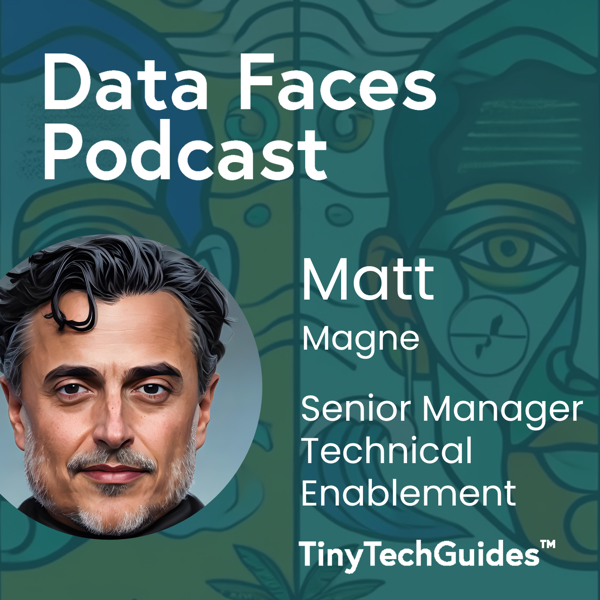
Matt Magne describes himself as the “AI-powered Silicon Valley sales-enablement guy.” His eclectic career runs from coder to sales engineer to product marketer — with a band once featured on MTV’s Road Rules along the way. At LaunchDarkly he focuses on revenue enablement, and he’s watched the same data-integration problems from his MDM days resurface in modern sales-enablement tooling.
In this episode
- The evolution from master data management to AI-powered sales enablement
- Why adding AI role-play tools can create yet another silo
- Feature flags explained — the “Christmas lights” analogy
- Where AI coaching actually helps reps ramp and perform
- The future of human + machine collaboration in enablement
→ Read the full article: Augmented Intelligence: The Future of Sales Enablement
Full transcript
David Sweenor 0:06 Hello everyone, and welcome to the data faces Podcast. I’m David Sweenor, founder of tiny tech guys, and your host for today’s show. In this show I talk with the people are actually making data analytics, AI and marketing work in the real world. What’s exciting, what’s messy, what’s coming next? Today, we’re going to be talking about something that’s quietly transforming how sales team, learn, coach and perform. The use of AI in sales enablement, from onboarding new hires to developing top performers, AI is changing how we practice measure and improve, not just through data, but through behavioral insights. Joining me today, I’m pleased to say we have Matt Magney, senior enablement manager of revenue enablement, at LaunchDarkly. He’s been experimenting with AI to help sales engineers and AES ramp faster and learn more effectively, blending human coaching with the machine for some real, really innovative ways. So we’re thinking of what’s working what’s not, and the future of enablement is headed. So let’s get into it. Matt, welcome to the databases podcast.
Matt Magne 1:07 Thanks, David, it’s great to be here.
David Sweenor 1:09 Super excited to have you. So can you just tell everybody a little bit about yourself and what does LaunchDarkly do?
Matt Magne 1:16 All right, I’ll start out with myself. So I am the technical sales enablement manager over at LaunchDarkly. I’ve been Corning myself lately as the AI powered Silicon Valley sales enablement guy. But I used to be a coder. I used to be a sales engineer. I was actually even a product marketer for a little while, and I’ve done a TED talk, as you know you, and I’ve talked about before, and I play guitar, as you can see in a couple of bands in my in my town.
David Sweenor 1:50 Okay, and what’s LaunchDarkly do?
Matt Magne 1:53 Yeah, so LaunchDarkly is this awesome. I’d say late stage startup. I think we’re series D right now. What we do, and this is my analogy for it, is, imagine putting up Christmas lights, or your favorite holiday lights, and you go up in your roof, and you get your your clothes all dirty, and you install, like, maybe in January, you install some green, green lights and some some white lights, red lights and blue lights. And then in February, you know, you crawl off the ladder after you’ve installed them. They’re not on yet. And then in February, for Valentine’s Day, you just turn on the red ones, and then you turn them off. In March, then St Patrick’s Day comes on, you turn on the green ones. And then just to cut to the chase, here, you move to, you know, Christmas time, and you just turn on the red and the green ones. And each time you do this, you’re not having to climb back up on the roof. You’re not having to get your clothes dirty take another shower. And so that’s what launch directly does for software features. So basically, it decouples deploy from release, and it allows you to essentially roll out features expose them to only a few select users in what are called progressive rollouts. Like, the analogy is you show, like, maybe the, you know, the lights to your neighbor that you have a beer with in the garage first, and then when he gives you the thumbs up, you show it to the rest of the neighborhood. And then we have observability and experimentation capabilities that allow you to like, test like different AI models you might use when you’re deploying. So we can speed up some of those or increase more the percentage of AI initiatives that show value. So it’s a really great product. We established that feature management category and then continue to innovate. And it’s been really exciting. I’ve been here about eight months now. Wow.
David Sweenor 3:36 Super cool, Matt. So Matt, that is super cool. Sounds like there’s no shortage of software in the world. So before you got to this position, what did you want to be when you grew up? You were going to be senior manager of technical enablement.
Matt Magne 3:54 Oh, that’s funny. I had no idea. I mean, I love computers. So definitely knew a computer would be in my in my future, since I worked with the, you know, date myself a little bit the commerce 64 and I just, I just love them. And I would create little database applications for my dad’s company. He was, he would create a startup back then as well. So, yeah, I just gravitate towards areas where I can develop some, some form of expertise, and then, like, help people, coach them, train them around us, anywhere where I’m I use this analogy, Socko, solver, advisor, connector, optimizer. So anytime I’m doing any, most of those four things, I’m in a pretty I’m in a pretty good spot.
David Sweenor 4:41 That’s pretty cool. And then I noticed you probably have the most unique LinkedIn profile URL. I believe it’s x rocker. I see a guitar in your background. Tell us a little bit about your your musical journey.
Matt Magne 5:00 Ernie, yeah. I mean, my dad had a band a long time ago and and so we always had bands coming over in the basement and practicing. And I just kind of, you know, I just fell in love with amps and guitars, and I ended up, finally, after college, starting a band. And we got onto MTV road rules, and I did a TED talk, not us personally, like our music got picked on soundtrack, which, you know, and it wasn’t like, I think we got a few dollars out of it, but, you know, we had a whole watching, you know, listening party or watching party and, and I heard 12 seconds of my guitar on the on MTV. So we used to say, you know, the name, the name of the band, was beverage and was as heard on MTV in 12 seconds.
David Sweenor 5:46 I like that. That’s That’s amazing, awesome. Okay, well, let’s talk a little bit about AI and sales enablement. How, as like, can you just describe to people who are not immersed in sales, or we’re calling it revenue enablement. Now, I think what is involved in the whole function, and why did, why do B to B companies need
Matt Magne 6:11 it? Yeah, I mean, I think it’s an, you know, in less mature companies, you know, product marketing, or there’s some team of people that naturally does this kind of on the side. It’s not a formal, dedicated role, but essentially it’s just bridges the gap between a lot of the GTM teams, and the primary focus is usually on some kind of ramping and increasing the speed with which you can onboard new sales reps and sales engineers and customer success managers and SDRs. And so it’s at least that piece where you’re ramping them faster, they’re coming on board quicker, and, you know, the burn rate on these guys, in terms of the amount of, you know, salary and such, where they’re not delivering or driving deals. That’s where the urgency comes in with a with a team like, yep, what’s our team right now is called revenue enablement, but it’s been sales enablement. And so generally, what happens is you hire one director or such, and they focus on helping everybody so they’re mapped, like one to 100 then they bring on a persona based one like I focus on solution engineering teams, technical, technical people in the GTM world. And then maybe there’s an SDR specialist, and maybe there’s a CSM specialist, but essentially we’re helping them to ramp helping to drive more ARR across the board, and identifying gaps in enablement, like new messaging they don’t know how to position it. Or maybe it’s objection handling, or maybe it’s like, lately, we’ve been focusing on AI readiness, right, ramping people up in terms of just having a conversation about, you know, what is? What are all the components of the AI ecosystem, and how our solution might be able to help you. So a lot of folks shy away from that. They know AI from chat GPT, like most of us do, but they maybe don’t know. They don’t know the difference between, like, a context window and, you know, like, why does that matter? Why does token usage matter? Why is latency matter, things like that.
David Sweenor 7:59 Okay, and so this sounds like a tall order. So we have new, new employees come in. Your new focus on, you know, the technical piece of it. They need to understand the technology. So, you know, what problem are you trying to solve? We talked a little bit about, we haven’t, we’re back and forth on email. Anyways, about role playing. So what problem were you trying to solve? You know, fundamentally using AI for role playing. What was broken with the existing process? Yeah,
Matt Magne 8:28 it’s interesting. So what happened was we had an LMS or learning management system, just kind of like an online, online course builder, and we needed to essentially create a or speed, speed up. How fast people got up to speed. It with, you know, getting getting conversant and comfortable, having conversations with different personas and and that’s one of the biggest leading indicators of success, right? Is just getting into deals and talking to people and having confidence and authority and empathy and and good listening skills and things like that. And so the it was actually a board level initiative, I believe, in terms of bringing this on. But we found an LMS that has both, and they’re all kind of nascent. There’s, we probably evaluated six of them, and in the end, we ended up with one that was a combined strong Online Course Builder, slash LMS and an AI role play could be embedded within the flow. So you could basically, you can imagine a demo certification, or pitch certification, for an AE, where you come in and before you do your pitch, you hear the wiggle, what good looks like. And then you get a chance to practice with this AI roleplay, and the driver of it is again, speeding ramp, getting them up to speed with having these conversations and being confident about it, and also just freeing up manager coaching time, right? Because the managers are also slammed trying to ramp all these new folks up, especially if you’re in a hyper growth for startup. So, yeah, I mean, so that’s basically the driver of it, is increasing confidence. And the other piece of it, when we found out later, is, I don’t know if you’ve ever been part of or tried to do, like a breakout session in in a webinar, or some. Thing. And it’s usually, you get a lot of people will drop off, be like, Oh, I gotta go. Yeah, sure, anything but a human right? So what’s happening now is they can just kind of practice on their own, and they don’t hit the submit button until they need, you know, until they get it right. So they can practice, like, seven times. And I’ve, you know, we had one that was a few dozen times that they’re practicing this stuff until they hit the submit button. And so that’s what you want. You know, the in enablement, you want this kind of like, space repetition, yep, ideally. And so basically, imagine, before you do your pitch and upload your pitch, or upload your demo as an SE, you actually get some at bats and practice talking to the persona. And that’s the that’s the value of it is that not only as they’re ramping they get more practice before they deal with you don’t take a human out of the process, but you just give them more practices and at bats before they upload their certification, and then maybe do a live role play with a human. Okay?
David Sweenor 10:56 And what’s the reaction towards this role play with AI versus a human. Do they like it better? Do they prefer the human? You know, what are you hearing?
Matt Magne 11:07 Yeah, I mean, I’m hearing that they prefer to do it because it’s basically so they prefer the bot. They prefer the bot. Think about it like, if you’re ramping like, so I’ll just say for the sales engineer, you’re ramping, or solution engineer, you’re ramping, and you can practice with maybe your trusted buddy, if you’ve got a buddy, or, you know, like a mentorship kind of thing, or it’s your manager, or it’s me, right? And all of those are kind of a little high risk, right? In the sense of, of, there’s just a lot of pressure to,
David Sweenor 11:37 we don’t want to sound like an idiot in front of your boss number one. And so what
Matt Magne 11:41 do we do? You know, with any presentation we do, we’ll go and practice it, but for me, it’s like, just practice it three times until you’re confident, and then it’s just easier. And you can, kind of, you can kind of become a little more audible ready and move around in the conversation easier, but it helps them to just practice before they get on the spot with with a person. And this is kind of like, I mean, I’m guessing you’re going to ask this question later, but basically, there’s this kind of augmentation piece, human in the loop, piece where, I don’t think that, AI, it’s getting amazingly smart, but I don’t think that it’s, you can’t remove a human from this process yet, right? But, and it’s, I think we’re far off from that. I don’t think you want to, but you can use it to augment myself, like how I scale up, because I’m mapped like one to like 40 right now, and an AE enablement manager might be one to 100 in a startup, or one to, you know. So it’s, it’s ramping it’s helping us to scale. It’s helping managers to scale that might have five or 10 folks that they have to coach and, do, you know, walk through deals and things like this. And it’s also giving them more at bats for that space repetition piece and just, you know, reducing the, you know, the ebbing house memory loss that they’re going to go through, if they just watch somebody doing it.
David Sweenor 12:55 That’s pretty fancy, fancy word, right there, the ebbing house memory loss. All right. Very good. Well, can you tell us, you know what? You know? Why do traditional sales, you know, enablement, revenue enablement programs, you know, do they fail to keep up with sort of, today’s B to B buying, you know, cycle. It’s, you know, it’s so complex these days. You know, as a marketer, you’re like, oh, there’s, you’re trained to think about stop a funnel, middle funnel, whatever, linear. But it’s not. It’s just like it’s a web of chaos. And there’s buying groups. It’s more than one person. So how do they how does revenue enablement, you know, deal with this? Can they keep up with it? Yeah, programs without AI, is it? Or just, uh, you know, you’re, there’s no way you’re going to do
Matt Magne 13:39 it. I think it’s the scale piece, right? Like, just dropping that in there it because, yeah, you’re right. Like, so you start out with your RKO or your CKO at the beginning of the year, and you’ve got, you roll out new messaging or new features, or new products and things like that. And then there’s such a inclination, because now all these new features, six months, nine months in, there’s so much pressure to change the messaging and change the high level, and you’ll tweak it here and there, but that’s the that’s the challenge, is scaling. All of us are just so just delivering what we have and the gaps we’re identifying. Now you’re going to change everything, the foundation of what we’re talking about, underneath the hood. And I think you and I have been through kind of the, you know, the messaging update, or the platform update, or whatever the new update is, of the messaging that, and then it’s, here’s all the new demos, here’s your new script. And it’s not a trivial thing. And that the tendency for leadership, unless they’ve been through this, or they’re kind of paying attention to it, right? Because they’re busy doing their own driving, Arr, and such is that they maybe think that we do a webinar and, boom, everybody’s enabled. Well, we did a webinar.
David Sweenor 14:44 Exactly. They know what they learned everything from that
Matt Magne 14:47 30 minute webinar. Okay, yeah. And then, if I think about, I always, I always use the guitar example when I’m talking about, kind of like this space repetition, if I grab this guitar and I play and just kind of go, did it, you know, like you’re. Is my well, you can share it. Let’s share my demo. You probably can’t hear it if there’s a noise suppression, but,
David Sweenor 15:04 oh yeah, perfect.
Matt Magne 15:08 So that’s my space repetition, right? If I grab the guitar and I do that five minutes at a time, not a lot, or if anybody at home wants to learn guitar, just do that on all, all six strings every day for five minutes for a week, and guaranteed that space repetition and that reinforcement will lock in your finger memory, or your muscle memory on your fingers. And the next time you try to play chords and you do the more advanced kind of like structures on the guitar, or want to sing while you’re playing guitar, you’ve done the basics over and over and over. You’ve practiced, and now you can deliver in a performance, you know, on a zoom call with a with a customer or prospect, and but you’ve got the basics down because you’ve practiced them. So that’s, I mean, the same concept of just, you know, how do we reduce the amount you’re gonna forget? How do we apply the knowledge in the session? If we can, that’s where the AI role play comes in. You can do that before the session. Then have a session where we talk about it, take questions, do breakouts, where we do live practice, but you’ve already practiced before the session. And then afterwards, maybe we’ll do a score to make sure that you’re over 80% of hitting the mark on like, kind of, some kind of score with your managers involvement, okay? And then later, I’ll add the other thing, the inspection of how that actually now, you know all this stuff, you’ve got the basics, you’ve got the space repetition. Are you applying that in the deal, on the calls? And that’s the other piece. Is sometimes the confidence just never gets there where now I’m going to start talking about AI with AI engineers and devs that are focused on the AI process internally. But if you don’t have that, you know, if you’re not armed for the conversation and we’re not inspecting to make sure that you’re actually doing it after the fact, it’s like, did you ever learn it? And if you don’t continue to practice it, like, if I don’t practice or play out for a month, my fingers are going to atrophy. They’re just not going to be as nimble.
David Sweenor 16:55 Okay, that’s very interesting. So can we maybe just double click down? So I’m a new I see your company. What does this sort of, what does the program look like that? I’m going to go through it. What parts are, AI, what parts are human? Yeah,
Matt Magne 17:11 it’s really just augmentation, right? So the it’s so the way that I would do it, the way I would build it, is, you’ve got some kind of, like combined set of live enablement and then a static set of it’s not, I mean, static in the moment of an online course, essentially. So you have to have embedded in that some kind of application of knowledge and an opportunity to have back and forth with people and conversations about it. So embedded within that. So for example, that like the demo cert example I gave before, as part of the onboarding for new SES or new AES, new AES, we’re going to have aI roleplay in place for all of the different kind of major value drivers in our you know. So for us, it’d be like aI experimentation, observability slash guarded releases. That type of thing would be, we would, we would say, practice this pitch using AI, and then the other piece of that is the so that’s one aspect of AI. Then now upload your pitch. You practice it five times. Or, we don’t know how many times I can see in the system, but we, you know, I mean, one person I saw practiced it upwards of over 50 times, right? So, yeah, so, and we build them like that for SDRs, especially because they cycle so fast and they have to ramp so fast that, you know, hey, here’s six different personas you’re going to be talking to. And, you know, right before you jump on a phone with one practice three times, and it’s, they’re not big ones, they’re five or 10 Minute practices, and then you jump on the call, because I can give you all the messaging, all the proof matrices, I can give you all the value drivers in onboarding and your brains full, and it doesn’t mean anything until you get on a call and you have to summarize in one sentence like the value of the solution, and that’s where, that’s where the rubber meets the road and and where people kind of fall apart generally. But if you’ve practiced it, you’re like, Oh, you feel that adrenaline rush, and then you actually deliver it, and it’s and the AIs are surprisingly good. Like, I’ve had veterans come to me and say that was actually pretty helpful. Like, so it’s okay, I can understand new folks coming in. Like, we’ll have, we’ll hire for a lot of, a lot of times, we’ll bring a software engineer in, because that’s our key persona we sell to, you know, engineering managers, VPs of engineering and devs, yep. So we’ll, we’ll have someone as a software engineer come in, and then they have to round, we have to round them out, to ramp up on the sales side of the house. And so it’s a great way to get them to practice that type of stuff.
David Sweenor 19:33 So Matt, we’ve worked together at, you know, a couple different companies now, but there was always a big, like live event, like a culmination, you know, you do some pre work that everybody goes, shows up and and does this sort of live training with exercises, you know, this develops this camaraderie essentially after at a dinner or, you know, drinks or what have you. Is there room for that these days? Are companies still doing that? Or is the live component sort of just, you. Not there anymore.
Matt Magne 20:01 Yeah, I mean, we’re so the company that I just came from before did, we did quarterly boot camps pretty much for about the three plus years I was there, there’s so we vary between. I think most organizations are varying between. You know, they’re looking at costs of flying everybody out, things like that. So I think either way, it’s part of the process. To me, they’re just building blocks, right? And you’re just, you know, you’ve got the onboarding AI or not, you know, you got to learn a certain thing, value, drivers, messaging, competitors, stuff like that. Then we need some way for you to apply that knowledge. It might be, you know, we have some online labs that technical people can can use to do that virtually. But then you’re, then you’re jumping on a call with your buddy, and you’re, you know, they’re, you’re pitching a demo to them and getting feedback. So I think that, I think just when you look at the cost structure of flying everybody out, for sure, like, you have to do a balance of this hybrid, you know, live slash virtual learning. Okay?
David Sweenor 21:09 And is there, are there any reps or people coming into your program that are sort of resistant to to training with about are they, like, I don’t, I don’t trust this thing. Or have you seen that? Or everybody’s pretty open to it. Everybody’s
Matt Magne 21:23 pretty open to, I mean, it’s tough to get, like, a direct negative response sometimes from people that, you know, when they come in new they’re going to be high sycophancy. Let’s put it that way. They’re so excited. Rose colored glasses on. Everything is great until they get into it, right? Exactly? Yeah. I mean, so it’s hard to get sometimes the direct feedback sales engineers, the other hand are, I find are really because we’re so good at at solving problems. Yep, I think there’s this natural we’re really good at being critical, basically. And so I find it easier to get direct, honest, call, constructive feedback from sales engineers that may be account executives, but you’ll get that you have to just sit in one on one and like, you know, have that, but the feedback we get is that, because they can do it, you know, the big piece is there’s just less there’s less stress when you’re just sitting there practicing on a bot, and the bots are getting good. Like, I don’t know if a year ago, they were there. But, you know, and just to color this a little bit more, like, once you do the presentation I’ve heard so we do, there’s two pieces, where the AI kicks in, it’s the it’s the role play practice, and then it gives you feedback. Is the other piece, and I can tell it, hey, give them feedback on what went well, where they can improve on these three, you know, markers like, right? What is your energy in that? And some of the role plays will do really deep analysis on, like, you know, they actually say things like, you were boring at minute, one minute and seven, oh my gosh, the 110
David Sweenor 22:53 Oh boy.
Matt Magne 22:55 Or, you know, you were, you were, you were inspiring, you know, so this, there was one that had just this total, like, emotional, like, you know, diorama of all the different, you know, ways what you could be. Or one of them was vibes. That was a pretty cool one that we liked when we were looking at it, it was like, you had really good vibes in this call, you know,
David Sweenor 23:16 oh my gosh, yeah,
Matt Magne 23:19 yeah, go ahead. I was wondering, do you give your your the bots? Do you give
David Sweenor 23:23 them like character names, like, act like, I don’t know this before my podcast, but like my AI is always talk like the dude from The Big Lebowski, for whatever reason. That’s, you know. Or you can have a talk like Austin Powers. Do you give them like characters to play? So
Matt Magne 23:38 we evaluate like six of these things, and the more the more advanced ones, they had varying levels of different things they were good at. But the most advanced ones absolutely did that. You could change the sex, race, everything, the demeanor, you know, make it super nice, make it super ornery, you know, like, shut you down. And so you could definitely do that. The one that we ended up going with is going to introduce that in like, a few, a few, like, weeks, I believe, sure. Okay, right now, I’ve got one dude and one picture, but the cool thing about it is it feels like a more fluid, real conversation. Some of them, you have to hit the space bar every time you finish things like that, right? Because, you know, you’re consuming AI model tokens every time you submit. You know, underneath the hood, it’s taking AI,
David Sweenor 24:24 Oops, oh, Matt, you just spent a $5,000 on
Matt Magne 24:27 trading or whatever. I think, I think companies are gonna that’s the challenges, right? How do you price this stuff, because the token usage is so highly variable, and, you know, how do you, how do you optimize that? And how do you, you know, how do you choose the right model that has the right blend of accuracy and cost to do this. But anyway, so we’ll, I like, I’ll give you one example I called was I am. So the first name was I am, and the last name was Groot, because we had a big Guardians of the Galaxy, so I was trying to keep thematically correct. But yeah, I just keep, keep changing it. Right now it’s. A dude, and we can’t change it, but we’ll be able to change the voice, change the you know, you can kind of change the demeanor a little bit in the in the prompt engineering of it, but it’s really cool, like you basically, essentially say, Hey, you are the VP of engineering. Your name is, I am Groot. And you have these problems. And if they ask nicely, you should reveal them, and you should be kind of like open to a meeting if they, if they ask these questions, and you know, you should make sure. And then here’s a set of objections that you should use, and here’s a set of questions you should ask, okay? And then here’s the expectations of each one of those. So you kind of program it. It’s not a heavy lift, maybe an hour or so to get it right, and then practice with it, and then, but it surprisingly fills in the blanks. That’s the thing that amazes me. You give it, like, 2000 character prompts, and it fills in a lot of the blanks.
David Sweenor 25:47 Oh yeah. One, one I’ve been using lately, lately is number one, be brutally honest. And, like, because you know, you Hey, review this block coming out, is like, Oh yeah, it’s great. And I’m like, be brutally Well, it’s a it’s a c minus. I’m like, Oh well, thanks. Yeah, that’s one of them. It’s, there’s a lot of them. The other one I found that it’s very useful to me is act as a skeptical buyer and react to this pitch. And it comes back with things. I’m like, oh gosh, I haven’t even thought of some of these. So the skeptical buyer, if you have a chance to put that in, to give that
Matt Magne 26:17 one a world, I like, that’s a good I’m gonna take that note, because it’s definitely. And you know, the piece that, the one that we have, some of them, you just, like projects in chat, GPT, you can upload a set of, like, background material. And this, I think it’s just using the training data, which is probably just the web, which is surprisingly, really helpful. But future ones, you can upload a set of documents. Say, Hey, look at these documents. And, you know,
David Sweenor 26:37 there’s our messaging, or whatever you want, case studies, things like, exactly, yeah, okay, okay. So I guess as we move forward with this, this notion, we’re going to have, you know, the human and machine collaboration, you know, what’s, what’s the balance between AI and, you know, maybe the intuition of a human manager, you know, may have, who’s been, you know, selling things. And, because sometimes AI says stuff, it might not really work. You know, I see it all the time. I was like, your web page must have this. Like, I don’t want that. Well, why don’t you? You know, it argues with me, because I programmed it too. But, uh, between the human, human, human, machine, collaboration,
Matt Magne 27:14 human and machine. Yeah. I mean, so the way we do it, as I mentioned before, like, it’s like, you do the one example of that kind of hybrid. Hybrid is always the right answer, by the way, right? Whenever it’s like, it’s got to be a blend, but it’s we do, like, for the demo certs, we do it where it’s like, you do the the at bats with the AI roleplay. It gives you feedback. The feedback I’ve heard is actually useful. It’s sometimes hallucinates, which is not great, but it’s 90% of the time, pretty dead on, right? And it six months ago, 12 months ago, I probably couldn’t say that. So it’s getting, you know, it’s getting to the point where you’re, like, that was pretty smart. Like, wow. Okay, and it’s kind of the feedback I would give them or something, or something I didn’t think of then wired into that is this other piece where, okay, now upload the pitch you’ve seen, what good looks like. You’ve had app practices. You’ve maybe done it three times. Now you’re going to upload, give us your pitch deck or your demo, and record yourself delivering it. That also gives you an AI coach. And I that one in the, you know, we’re using sales hood that uses the, there’s a prompt I put in there that says, look for these things that’s map to the human score that we’re going to give them. I could choose to make it just use the AI score only, and then they’re done. Okay? And I’ve seen some people of the use cases like prepare for a conference, you know, here’s the new messaging. Here’s how you if you hear these competitors mention these things. So that’s a great way to kind of automate it, where you don’t want a human in the loop, right? Okay, but if you want a human, and it’s kind of like, you know, the agentic approach of human in a loop, or LLM as Judge, right, this is kind of like, it’s not really an agent, but it’s that kind of mentality of after the bot conversation, after the AI coach response and prompt response. Now you’ve got two pieces of feedback, a bunch of practice. Now your manager, maybe a week later, two weeks later, is going to review that and then give you some feedback and maybe talk to you about it. And so you’ve got that space repetition. You’ve got the human in the loop. And by the way, like in our situation, we don’t use the AI score in that case, because it tends to over rotate on like you said um, too many times. Or you didn’t say these. You didn’t say success, or custom, you know, specific words. So I just use it as it does. Give you words per minute. It gives you tone, it gives you, you know, time, and those are useful to for you to know for I’m always just trying to give people feedback to metacognate on what they’re doing well and what they where they can improve, and then, because that’s really when you win, right? Because I’m, like I said, I’m at one to 40 or something like that. So I can only be with people so much of the day, and so the more
David Sweenor 29:46 one person each hour of the week. Matt, right,
Matt Magne 29:49 exactly. And then I need to build these things too. But then, you know, then, then the manager scores it, and they have a conversation about it. And also, by the way, the math. Manager is getting, you know, coaching skills. Here they can look at the feedback. They can look at the the other pieces. You can see examples of all your peers and how they’re doing it. You can look at the ones that got scored a 10 already. Oh, well, let me so right away, they’re doing all this learning instead of like, imagine the before image of this, the current, you know, the future, the previous state, where you don’t, you do it once in front of your manager, they give you feedback, they or you do it a few times, and it’s just the impact to an to a manager in terms of coaching that is limited. And so that’s you’re just trying to scale and augment the human intervention,
David Sweenor 30:34 right? So we’re getting close to the end of time, but I have maybe a couple more questions. So you’ve been in sales enablement for for a while, pre AI and post AI, and you’ve talked about scale a lot. What does AI beyond scale provide? You know, what are the benefits to you know, having this digital workforce that you have essentially working for you is, is, like an example, is the quality of the content better you can do more training or just curious, kind of, what do you see as sort of beyond? I can do more with less. What are the other things that you know, the benefits you’re getting from this?
Matt Magne 31:19 I always, gosh, I guess I do over rotate on that productivity piece, because, like, here’s a big gap right for me to build these things. It’s not terrible, right? It’s like an hour or two to build a new one or something like that. But a big thing we get in enablement all the time is like, Hey, can we just, like, run that through for every AE in the company and just, you know, make sure they listen to these things. And like, I would love, it is a more of a it is another, it’s another angle on productivity. But it’s basically like, I would love to say, hey, here’s a video. Build me an LMS, you know, with a quiz. Chunk it up intelligently, you know, into four minute videos, instead of one big 30 or 60 minute video, right? And then, and then you’ve gone through my onboarding, I think, so you know what
David Sweenor 32:07 it’s like transition. So I had to watch a 45 minute thing, but then I did prefer the snack, you know, two two to three
Matt Magne 32:13 minute deals. And you’re always balancing your bandwidth and then the bandwidth of the consumer or learner and and, you know. So like demo certifications, POV certifications, pitch certification, stuff like that. That’s the broad strokes you’re doing on a quarterly basis. Then you’re doing live enablement, updated messaging. Is tough. So, so that’s one piece of just, it’s the AI productivity piece there. The other ones is, you know, I’m trying to think of one that’s not a productivity Well, that’s, that’s how I think, can
David Sweenor 32:41 you have more personalized training? Do you think the quality of the material is better, you know, compared to, you know, pre AI, you know, you mentioned, hey, we used to create 3045, minute videos. Like, I’m sure they weren’t very good. Now, reflecting on it, you know, they were, they’re good at the time. We
Matt Magne 32:56 still do that, you know, because, in my opinion, for example, the video editing stuff is not there yet. Like, I love the I love the idea. This was a Synthesia, the one that you, I think you shared that with me, like, a year ago, but they’re still not there in terms of intelligently identifying the clips that are the most important. I don’t know how I would
David Sweenor 33:13 actually do it. I think you got to be like, like, some sort of sports. I think they’re really good at that, but sort of, like a talking head
Matt Magne 33:18 podcast, I don’t think they’re great at that. They’re they’re great at, like, yeah, my we had on my son with soccer where it’s like, Okay, here’s the five seconds before the shot. They’re great at, like, a score happened. So now take the video five seconds before the score and have the players and things like that beautiful usage of that, right? So that’s what I would love if they could, someone could build that somehow intelligently. Take a 60 minute enablement session on architectural patterns, or, you know, common, you know, common objection handling and and basically just truncate it into a seven minute video. Somehow, magically, that’s my holy grail. That’s one of my holy grails right there. And then the other one is like, just take this video, build a quiz. You know, I can do it like, I’ll, it’s fantastic. I can put the transcript into chatgpt, boom, hit a button, and some of the LMSs will do this automatically. Where you upload the asset, and it says, you, would you like me to generate a quiz out of this? Yeah, sure. Or, like, you’ve seen it, where, here’s the script, here’s my face, make a video of me delivering the script in French, right? So exactly that stuff exists, and it’s pretty good, right? But we’re trying to make it it’s I want to make an enablement as fun and as it as we can sometimes we can’t. We just don’t have time to do all this stuff. But that’s where I would love to see. Like, the Holy Grail is probably the videos where just like, would love to just truncate it to this, the 40% of the video that is the most valuable without a human going through it for two hours and editing it. Yeah, that
David Sweenor 34:45 video is a pain in the butt. So I think maybe our final question, Matt and we could talk about this all day, but you know, where do you see sales enablement headed with AI? You know what’s what’s next?
Matt Magne 34:57 Yeah, I mean some for. Sales enabled with AI. I mean, the big piece is, like, our whole role is to help AES, sec, you know, GTM, teams ramp faster, and also to help them kind of navigate through these kind of the the sales cycle, right the most effectively. So everybody’s trying to do this, like Salesforce momentum, Gong, like all these players outreach, it’s, you know, there’s so the future, all right, I’m gonna go backward a little bit. So I used to be an SE in the master data management space years ago, and it was all about like, single view of customer or product across multiple disparate silos, right? Sure. And people spent millions of dollars for this solution to do that, and they still haven’t fixed that problem, right? This is like, it will be there when it will be dead, and it’ll still be a problem. It’s still happening, like, and my buddies are still in that space. They’re still doing it. And so it’s the same challenge here. Like, you know, all these SaaS solutions that we have, I mean, some AES have, like, 2030, solutions are using, and there’s still a challenge of data silos, pulling the data together. So in the future, that’s one of the things I hope that will be addressed, not only the holy grail of the you know, the brilliant video editing capabilities, which I don’t know, we’ll see how they can something that helps us do that faster, but also, like single view across multiple systems, so that we can get an accurate depiction of the gap for that seller or that sales engineer. Because what happens is, you’re kind of like their manager has an idea, their AE has an idea, I have an idea. And they’re usually different. You know, we’re all touching the elephant at different spots, and one thinks it’s a tree. You know, that whole allegory. So we’re so that’s one piece of it. Is just trying to more. And I think MCP servers and things like that are going to move us in that direction. But it’s still hard for me to just get an accurate depiction the other, the other gap is just like, I think it’s it’s going to be not, not necessarily enablement. It’s almost like you need enablement to fix this stuff, because in the moment, you can’t coach them. If you could in the moment, have an enablement guy pop up. Like, was, it was a Clippy.
David Sweenor 37:05 Yeah, Clippy. Let’s bring back Clippy. You
Matt Magne 37:09 have to mention Clippy at every AI session. But, yeah, imagine if, like, and it’s, you know, but in an unobtrusive, like, super helpful way. That’s what I think is the next step in this is, like, we have so much data, and the and the, you know, the the summarization capabilities, like, if you I’ve used granola, I’m guessing, because you, you were one of the first was on the, your cutting edge, I would say, of, you know, meeting recordings and things like that. Now it’s, yeah, granola is really good. So zoom does it, and then granola does it. And it’s like, it’s like a, you know, a fourth of the size of it, and it kept captures all the salient points. So there’s, I, if you asked me if there was a space for that, you know, I already have zoom, and it’s already doing a summarization, but granola is doing a much, you know, there’s an incrementally better job of that. Maybe zoom gets better and the models get better or more standardized, but there’s always going to be someone a little bit of ahead of the curve on, you know, just how do I, how do I summarize things faster? But then how do I make decisions out of all this data, and what assets do I need, and what person on my team do I pull in at stage three, where I’m going after, you know, the proof of value, or, you know, a pre meeting for proof of value with the with an economic buyer, or something like that. So more of those like situational, because that’s when we learn a lot. Like we might, you know, my my flat tire thing is, like, generally, a sales rep or, you know, they’ll do the homework, for sure, if they’re new, especially, but they they’re going to care about the flat tire when their tire goes flat, and they’re probably not going to ramp and if they ramped on it six months ago, they forgot everything about the changing of flat tire. You just got to make sure you have the right asset in place when they need it at you know, situational consumption, snackable consumption, of enablement, resources, right time, right place, type of stuff that’s kind of the future is like getting all this data together, breaking down the data silos, and then having these, you know, they’re getting so much better at just giving you specific actions instructions and maybe even generating like, here’s a here’s a digital room, here’s a document that you should share with them. Just click this button to share it. So it’s all this kind of just integration. It’s still an integration game. I feel like, okay, and they’re getting there in terms of the smarts, all right?
David Sweenor 39:22 Well, people heard it here first. We there’s problems with data still, so I don’t thought Matt, what’s the one key takeaway you want the listeners of the show to to sort of walk away
Matt Magne 39:35 with? Yeah, I mean, my big, my big thing is, obviously, it’s, it’s spooky, right? They’re, they’re so smart and but they’re still really dumb in a lot of ways. Like, I think I read an article about how hallucinations are a mathematical inevitability, like, they’re not going to, all of a sudden not be able to hallucinate, no matter how, no matter how many rag you know, kind of you know, documents or agentic flows you build into it, they’re still not going to be perfect. Perfect. You’re still gonna need a human in the loop. So years ago, we were doing a session on, I remember Data Loader for Hadoop, like, and there was some kind of like, we did a session, and it was on, like, this is like 10 this like, eight years ago, nine years ago. And it was like, is AI gonna take over we were talking about then, and they still haven’t, right? They’re getting closer, right, right? But the point is that it’s one of augmentation. I think the future is still augmentation. You’re still going to need this human the loop, maybe in three years. You know, that changes a little bit, and you need them human less. But there’s still seem that we still need to have someone gluing everything together, and someone kind of making sure it’s not completely off the rails. And so I’m gonna, I’m gonna, you know, speak for, like, a future of of, of human augmenting, you know, augmented humans using AI as a tool to help them be more productive and do their jobs and help people get to, you know, ramp faster and just, you know, enjoy their lives more.
David Sweenor 40:59 Well, I love that, so stay human, and you’re a techno optimist. Matt, so I appreciate you. You’re joining the data faces podcast. You are the second person to wear the Aloha shirt, so thank you for that, and the first person to play a guitar on the show, right? So that was amazing. So thank you so much, and we will, we will see you on the flip side.
Matt Magne 41:20 All right? David, thanks. Had a lot of fun. Good to see you.
Matt Magne 41:23 Cheers. Bye. You.