

Data Faces · Episode 2 · December 11, 2024 · 30 min
AI hype and fear are nothing new. Kevin Petrie on what history’s technology revolutions tell us about AI’s future.

Listen: YouTube · Spotify · Apple Podcasts · Amazon Music
About Kevin Petrie
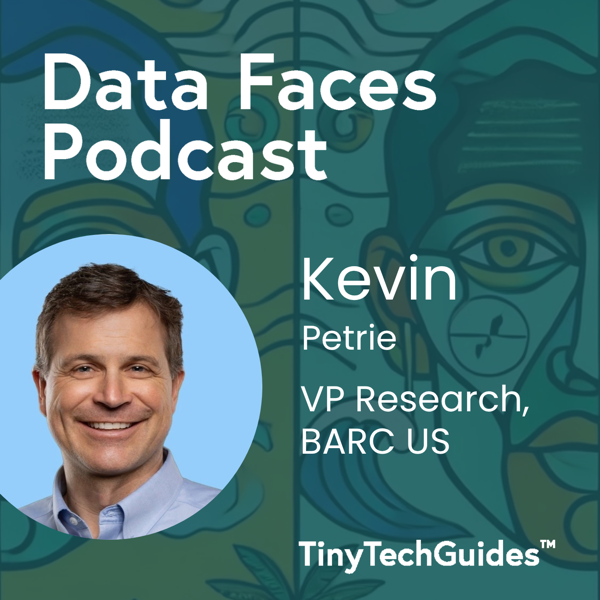
Kevin Petrie is VP of Research at BARC US, with decades of experience in data and analytics. He studies how past technological revolutions mirror today’s AI boom, bringing a historian’s eye to the hype, risks, and opportunities of enterprise AI.
In this episode
- What history’s technology revolutions teach us about AI
- Why AI hype and fear are nothing new
- Parallels between the Industrial Revolution and AI
- How organizations balance cautious risk management with bold experimentation
- What happens when jobs are disrupted — and how societies adapt
→ Read the full article: Past as prologue: what history tells us about the future of AI
Full transcript
David Sweenor 0:00 So welcome to the data faces Podcast. I’m David Sweenor In today’s podcast, we’re going to connect the dots between the lessons of yesterday and the challenges of today, all through the lens of data and technology. Today. I’m thrilled to be joined by Kevin Petrie, the VP of research at BARC us, where he helps businesses navigate the ever all evolving landscape of data analytics and AI, Kevin is a fellow northeaster of a racist reader in a history buff. Kevin, Welcome to Data faces. It’s great to have you here.
Kevin Petrie 0:29 David, I’m glad to be here.
David Sweenor 0:31 So Kevin, tell us a little bit about your background, your current role at BARC, and what bark does, and what you’re doing over there. Yeah,
Kevin Petrie 0:39 I have an unusual background for tech. I was an English major, and I’m a huge bookworm. I still like to read printed books. I was an English major and also Spanish major, a minor in economics, and I was a financial journalist for five years when I first got out of college, then I went back to business school and started a career that was right within tech, and so I was on the marketing side for a while, working for vendors such as EMC. I also ran an analytics services team for EMC, pivotal for about four years, and I’ve been an industry analyst for about five years, having a ton of fun using my writing analytical skills and trying to navigate our fast changing world of tech. Yeah, it’s
David Sweenor 1:27 pretty scary out there. I’ve been reading or listening to an audible a couple books. One was is from evolve, Noah Harari Nexus, so it’s about information networks, and the other one was by Mustafa Suleiman’s book, you know, the coming wave, and they’re both a bit depressing. What’s your mood? I mean, what are you reading today that people might be interested in?
Kevin Petrie 1:47 So I think, I think we’re going to be okay. I think that we’re actually in an exciting age, and there is a lot that’s that’s going on. There’s a lot for us to look forward to. I read a book recently, invention and innovation. I’m looking at it right now, by Bucha of smile, and it’s a brief history of hype and failure. So he’s a skeptic about a lot of the groundbreaking earth shaking predictions related to AI, and would assert that, yeah, we’re in an age of innovation. It’s fun. But you know what? The 1880s are pretty innovative too. We had things like bicycles and cars and all sorts of advances in medicine. So as a human species, we’ve been innovating for a while, and some things will change, but some things won’t, won’t. So it’s a very interesting time. It is quite so let’s maybe we’re
David Sweenor 2:37 going to talk about the elephant in the room. You know, I’m always wondering, is AI going to take my job, and is there anything we can do about it? So let’s take a look at, so maybe some of the technological precedents there. So you mentioned history. We’ve got the wheel, the printing press, industrial revolution, what have you. And it often, you know, starts with the disruption, but, you know, it changes society in pretty profound ways, and I think mostly for the better. So my question to you is, really, what parallels, you know, do you think we can draw from these, these past revolutions? I suppose,
Kevin Petrie 3:08 well, so, so I’m a history geek and certainly not an expert. I’m more of a dabbler in all types of history, but I’d say that there are three things that history seems to tell us, one is that human nature doesn’t change, and I think that that can kind of guide what we think is going to happen in the future. Humans will continue to want to provide for themselves and their families. They’ll want to procreate. They’ll want security, and they’ll want, you know, some level of financial security tied to that. So I think there’s certain aspects about human beings that are not going to change. We’re very competitive as well. One another thing is that some of the big changes in society that have happened, if we put on our economics hat, are if you have a big change in supply or big change in demand, that’s that can create disruptions. And so you had the printing press. You mentioned Gutenberg figured out how to create little letters and make them interchangeable. That was the big the big step forward, and suddenly you had a surplus of reading material, the Bible, starting with the Bible and others. And that led to more education, more consumption and an increase in demand, pretty cool stuff. What I think is interesting about AI right now is that there’s an extraordinary surplus right now of cognitive power. Chatgpt is done this, and we’re trying to figure out what that means. But I haven’t seen a huge demand for the AI, it’s it’s creating some pretty cool opportunities for companies to innovate, some pretty cool opportunities for companies to have writing assistants or editors. I use chat. GPT is more of an editor than a writer, but I haven’t seen this ground shaking increase in demand because. Not sure we’ve figured out what Gen AI in particular, how it’s fundamentally going to give us what we want as human beings, which is security, the ability to provide for our families and the ability to compete with each other. It has created a lot of fear and a lot of fear of missing out, so it’s helping us indulge our competitive instincts. And companies are investing in AI hugely, as they should, because they want to compete more effectively. But we haven’t quite figured out what the fundamental, huge, voracious demand will be that’s related to AI. There probably will be some.
David Sweenor 5:31 Apparently, Kevin, apparently, it’s summarization. As far as I can tell, people don’t want to read anymore,
Kevin Petrie 5:37 yes, or right? Yeah. You know it’s funny, because I like to write in value writing, and I found that it’s pretty good at editing stuff, or even just coaching, not line editing. But just, did you think of this? Did you think of that? So it’s a good assistant in that sense. Yeah,
David Sweenor 5:52 absolutely. And I think I remember something from business school, like, you know, this notion of Schumpeterian destruction, or whatever it was, and, and, you know, he’s the professor. He was a lecturer, and he said, you know, you know, change is inevitable. It always happens, and then sometimes it chews up a generation, but you know, it’s for the better. And I always, always that stuck with me for whatever reason. I’m like, Well, what if you’re in that generation that’s chewed up, you know, that’s, that’s, that’s probably not good, so I hope we’re not there, but that’s interesting, yeah,
Kevin Petrie 6:25 but, well, I was gonna say I think it also takes time too. There was a great generative AI world event that the GAA NCS team has had last couple years of Austin. I went to the first one. Unfortunately, I was traveling because I missed the second one. But a Harvard professor, and I’m not remembering his name, but I’ll give you can search for the title termites, not tornadoes. And his idea was that, yes, there are fundamental changes that are taking place, but the effect on business models will be more gradual. You won’t be leveled by a tornado, but you’ll have incremental weakening each year. So you need to adapt
David Sweenor 7:02 interesting. So let me, let’s talk about, let’s shift maybe a little bit to, you know, sort of labor and automation. And, you know, there’s always, we’re talking about the Luddites and mechanical looms or industrial robots that are helping us, you know, build cars and things like that. So this, this cycle of destruction and creation. You know, do you think is this different? Because it’s can, you know, change, you know, do cognitive tasks, or, you know, we see all these, these models and these statistics and metrics to say, hey, they can help a graduate level reasoning on whatever pick, pick, a domain you know, is, this is different because it’s not mechanical and it’s more of the knowledge worker type, type stuff.
Kevin Petrie 7:46 Yeah, it is. It’s definitely gotten the attention of white collar workers in a way that prior automation waves have not. And that’s good. We had to come in, I think, if we look at so I’m an eternal optimist, and I’ll just, I’ll just offer that caveat to begin with. But ATM machines are pretty interesting. Historical example, ATM machines came out in the 80s, and everyone worried, or a lot of people, worried, that it would lead to destruction of teller jobs. But it was interesting, the opposite happened, because suddenly you had the average banking branch that needed 30 people to run, and that had a certain revenue that was required to cover those costs. ATM machines brought it, I think, down in half, maybe to 13 or so. So now you could have banking branches that could be open more cost effectively in more locations, and that actually led to a net increase in tellers. So that’s an interesting case where it’s a surprise consequence, and it’s a good one, Robo investors. A few years ago, everyone worried that algorithmic investors would replace financial advisors, and that hasn’t happened. I think the reason there is that, yes, the the core skill of investing in index funds, if that’s what you’re doing, to invest for retirement, is, is, is a numerical exercise, in my view. I believe in efficient markets, but what you do need is a human to be your shrink when the markets go down.
David Sweenor 9:23 Need that companionship. That’s a big use case, actually, with the robotics and especially with aging populations,
Kevin Petrie 9:28 you need humans to help you through this. That’s right, yeah. So in a similar way, nurses are actually better shape than doctors, because nurses give you human empathy doctors do too, but, but, you know, as you, as you automate some of the cognitive tasks, the human relationship building becomes more important.
David Sweenor 9:49 But, you know, people can, can be fooled by this, right? I mean, there’s time like there’s a jumping around a little bit here, Kevin, but, you know, and. I remember that movie Ex Machina back in back in 2014 where the robot, you know, tricked, tricked the designers. And you know, as fast it was surprising to me. But you know, in 2022 we had a Google engineer who’s working on the lambda model. And you thought AI was sentient, and you know, he’s no longer with Google. They, they, they sacked him. But you know, it’s real. Some smart people being like, well, you know, this is sentient, so, like, I don’t know is just, it’s a little bit concerning. Yeah,
Kevin Petrie 10:27 I think so. Um, I, I’m definitely not an AI Doomer. It can be used for ill, ill intent, no question. And so states or bad guys, more likely states, because they have the resources governments can use it and in destructive ways. And so AI drones, swarms of AI drones, will be an interesting aspect of warfare going forward, but I don’t know. I think that fundamentally, if there’s one thing we learned from COVID, it’s that people don’t really like living through screens. You and I are doing it right now, but it’s really would rather. We’ll have to have a beer sometime. Well, that’s true.
David Sweenor 11:07 It’s like the bubble boy episode with Seinfeld. You know, it just didn’t
Kevin Petrie 11:10 work out exactly. People like to interact with people. They like to do business with people. They like to live and learn and teach people. And I don’t think robots in a fundamental, massive way, are going to change that dynamic?
David Sweenor 11:25 Yeah, I sort of agree with you. I’m an optimist too. I’m a positivist on that. I think AI can be used for tremendous good. Let’s jump back to the Luddites, though, a little bit. You know, I don’t know if we’re going to be, you know, smashing looms with these giant hammers anymore. But, you know, is there any like historical, you know, I think the in the end, there were sphere, right? And they were maybe over exaggerated, in some cases, probably, but not, maybe not totally unwarranted. So I guess, you know, how do we separate this? I’ll call it maybe productive caution from our unwarranted, you know, panic. Are there? Is there anything we can look to in history that could could help us there?
Kevin Petrie 12:07 Yeah, I guess what I would say is that when one industry or pocket of jobs declines, others often go up. And in my view, what’s really happening with AI right now is that it can perform cognitive tasks in in a somewhat reliable way. Hallucinations are coming down. We still have some work to do, but you still need human ingenuity to string together tasks. You still need human ingenuity to figure out how to integrate all this, how to feed it the right inputs. So AI, in my view, is kind of like really powerful Legos right now, but you still need to build the Lego structures yourself. And so, you know, there are historical parallels in the sense that we’ve had massive increases in capabilities, but it created new pockets of jobs. You know, cars coming around was disruptive to the horse industry. Put a lot of horses faster, which is right, but it also, it also impacted a lot of people who created those things? It impacted people who created the wagons that enabled all the settlers to move across the United States and so forth, but it created new jobs, arguably higher paying jobs in the form of factories and so forth. So it’s a question of humans being adaptable and figuring out new ways to meet their fundamental needs of financial security, the ability to nurture each other, raise families and so forth. Yeah. And,
David Sweenor 13:48 you know, if we look at the second revolution, you know, industrial revolution, or what have you, you know, some of these jobs, you know, they were unsafe, they were dirty, they were bad for your health. I mean, I used to work in a I used to work in a paper bill, Kevin, and literally, logs. Logs would come into this factory. It was like one of the only ones where raw logs come in and paper comes out the other side of it. But part of this thing is these logs get jammed up. So you have people by the conveyor with these giant hooks, and you’re trying to get them and write them so they can go through the machines properly, but extremely dangerous. And, you know, it’s, you know, you can imagine people get hurt if you fall in, or whatever. Someone’s got to keep an eye on that and like, so that wasn’t a great job. It was high paying because it was dangerous. But I think that could, you could have used some robotic automation at the time. So I think a lot of these jobs that were dangerous, you know, I think AI is going to help it, or you’re just, you know, monotonous and robotic. But you know, I do, I do wonder what happens to the people who are displaced, you know, and how quickly new jobs become available. Because I agree with you, we didn’t have iPhone texts back in the day. Now you need them, or if you can fix an iPhone, I’m not sure. But you know, we have jobs like that that didn’t exist. So you. Question is like, how fast does this transformation happen? Yeah,
Kevin Petrie 15:03 it’ll be interesting to see. It does look like adoption of AI is happening, but it’s more. I think we found about a fifth of companies are taking a programmatic, comprehensive way approach to deploying AI. Others are kicking the tires, experimenting or wondering what they should do. So it’s gonna take time. It took a long time for companies to get a productivity booth from adopting computers. It wasn’t really until the late 90s that productivity benefits came around. So it takes time to deploy these things, use them and get advantages from it. But yeah, I don’t know. I think a lot of the jobs that change. It’s not necessarily a bad thing. You still need people to figure out what these robots are going to do, and you need people to figure out how to to string them together. I saw that Amazon is opening its most advanced warehouse yet with a lot more robotics, a lot more automation than ever before, and a lot more people. They need people to manage these robots so they’re higher paying jobs. So part of the challenge gets to education, preparing people for more software oriented jobs, and in some cases less less manual jobs.
David Sweenor 16:17 Yeah, yeah. I totally, totally agree with you. So maybe let’s talk a little bit about unintended consequences. So, you know, when the internet came out, you know, it’s gonna, it was gonna save the world. It was, you know, but it had a lot of, you know, misinformation, surveillance at scale for nation states, you know, you mentioned early. So you know, how do you anticipate the risk and, you know, maximize the benefits? You know, if you look at anything about social media today, have some pretty deleterious effects. You know, people have body dysmorphia, depression, anxiety, loneliness, etc, but it all also has some, some great use cases, where you can talk to people far away and on video that you might not see, and companionship and things like that. So I’m curious what your thoughts were on the balance of that, it
Kevin Petrie 17:04 really is hard, because it’s hard to predict where, yes, Human Nature doesn’t change, but there are always disruptions that you can’t quite predict, and there are new sources of profit from an economic perspective that you can’t really that you wouldn’t otherwise predict. It’s interesting, in the 1800s hundreds of 1000s of people during decades, or even a year, were moving across the soon to be united states and and they were doing so because there was this perceived surplus of land, obviously, that was being taken from prior attendance, which is not something we should beat our chest about, but it did create this extraordinary demand for wagons. And so you had the first major manufacturing giants, including John Deere and others that got started because they were using interchangeable parts to make all the wagons that carry the settlers across the country. And I think that a lot of the people who started out on that journey in order to find gold or find land or find other sources of their dreams, didn’t think they’d be creating this whole contributing to the industrial revolution with interchangeable parts and the creation of wagons. So I guess the answer is, unintended consequences. Unintended consequences can be good too, and they’re really hard to predict. Yeah, well, yeah,
David Sweenor 18:29 it was interesting. I was reading about, there was an article in The Rockefeller Institute, you know, a while ago. But, you know, they, they commented in there about, you know, the Google, Google’s co founders, you know, Larry Page and Sir G Brinn, and they were talking about search and, you know, advertising and mixed motives. And they it’s fundamentally said that if you have advertising funded type search, you could be biased towards the advertisers and way away from the needs of the consumers. So I think there’s some of this, this commercial in here, right? Because these, these algorithms, right? They’re reward based, and then the reward for the people designing them. They want that engagement. So I’m wondering how, if you see any ways or parallels on how like, like, we should think about this, because you know that the companies get paid when you, you clicked or engaged with there, and they that’s, they’re designed to do that. And, you know, there’s been some pretty, pretty horrible consequences from that. But I don’t want to be negative here, but when a commercial entity is there, how do we deal with this?
Kevin Petrie 19:29 Yeah, I don’t, I don’t know what the key answer is in terms of navigating unintended consequences or creating adverse incentives. There’s an interesting example right now with Google, which is that, in order to keep up with open AI, they’ve released, I think it’s Gemini driven. You search for something at Google now, and often it’s not, you’ll get a an AI generated summary flag and such. And I always check fact check what’s below with the real. Link, but it’s it’s getting pretty good, so Google’s doing a good job offering that for free, but if they’re summarizing it for you right there, you don’t need to click on the link. And so their ad, their their search, volume of people clicking through is going down. So they’ve developed a new, cool, disruptive product for free that’s undermining their core advertising link business, and so it’s hard. You got to be creative, careful what kind of incentives you’re creating for the people that you want to do business with.
David Sweenor 20:31 Yeah, I think they’re, you know, they’re realizing that perplexity, AI, I use that almost exclusively now for such and it does that same thing. It gives you the links. But what I’ve noticed is sometimes the links, you go look at them, and it’s just AI generated dribble. So they’re not, they’re not reputable links, but they look authoritative, because, you know, not, not very many people go look at the footnotes, and I don’t think they’ve cracked the nut on the the monetization of it, you know, it’s gonna be more than your $20 a month subscription, or whatever these things are costing these days. So I’m curious of your perspective on the, you know, what’s gonna happen with we? They figure out, figure out how to monetize it. You know, are we each gonna be in our own AI echo chamber? I mean, kind of now, are now and social media, but just, just curious, yeah,
Kevin Petrie 21:19 I don’t know it’s, it’s one of those things you don’t have a Chris crystal ball for, excuse me, it does seem to me that ultimately the value of AI will need to help us with our core desire to interact with humans, rather than interacting with screens or bots, to help us provide for ourselves and so forth, and so I don’t see, I don’t know. I’m just not as worried about AI supplanting human relationships. I do worry a little bit with children, because you could have aI nannies that never get tired of reading to the kids that always know how to discipline them, or, you know, chastise them there, or coach them, or things like that. So busy parents, two worker parent, families could have just sort of an AI nanny that they let do some of the child bearing. And that’s kind of a creepy thing, because that child has not grown up in a normal human environment, and therefore might have some dystopian tendencies. Yeah,
David Sweenor 22:29 definitely agree that it used to be, used to be Saturday morning cartoons, get away from the TV, that it was like the iPad, and now you have something else to worry about. Worry
Kevin Petrie 22:39 about it being too violent to watch the road runner fall off the cliff. But that’s the only beginning. That’s right, that’s right. So let’s talk about
David Sweenor 22:47 a little bit about maybe global competition. You know, we’ve had space race and, you know, we see AIs. You know, there’s economics involved. There’s national security. So, you know, how do you, how do you think AI is going to, you know, maybe potentially reshape or rekindle old international Riley rivalries, create new ones, you know, what? What lessons can we learn on that front?
Kevin Petrie 23:11 Yeah, well, we’re it. Ukraine is a great crucible right now for extraordinary demand, which is survival, creating innovation. And there’s a whole robust cottage industry of drone making out of people’s garages and so forth, and they’re making pretty smart, often AI driven drones that can fight back against the Russians. That’s pretty inspiring. And so it’s one example of how, and they’re creating a level of innovation, a type of warfare that an asset that the United States needs to get behind and figure out how to have ready too, because AI driven swarms, swarms of drones can really disarm some of the conventional weapons. So that’s that’s one thought, you know, you need. There’s a new imperative to innovate when it comes to warfare and defense. And Silicon Valley is actually getting involved there. More and more open. AI and others are starting to work with the federal government. Palantir has been doing a fair amount already, but yeah, there are definitely unintended consequences, because the US is is restricting the GPUs that can go to China in order to throttle its AI innovation in the race for for general intelligence. But that’s created a new demand within China, which is that Chinese are getting pretty innovative about skirting those rules, not skirting skirting rules, yes, but actually innovating with less powerful chips so they’re able to more efficiently devise created uses of software and more efficiently experiment with small language models, which I think we all agree have a real future globally. So there are definitely ways in which. Need to Be careful messing with the free market in terms of government policies,
David Sweenor 25:04 right? So do we, I mean, you know, some people will talk about, you know, this global AI ethics framework, you know, is, is there hope? You know, maybe, maybe we could look to maybe the closest thing, it’d be some sort of nuclear Non Proliferation, or something like that. Yeah, maybe that’s a bit tenuous, but what do you think the chances are on that global, global framework?
Kevin Petrie 25:25 I hope so. The European Union’s done a good job on leading the charge on this. They did it with GP, GDPR, that’s five, six years ago, and we followed with sort of a patchwork of imitation rules related to privacy, digital privacy here in the States, and they’ve already come out with an AI act that kind of scales the permissibility of different types of AI. I think it’s sort of a crude measure, but we definitely need to all get on the same page. Governments need to and and the private sector as well about what’s permissible and what aligns with their human values. Ultimately, I think, from a private market perspective, hopefully the open market forces will guide that companies will not want to be perceived as predatory. My hope is that companies like meta or the future metas will aim to demonstrate goodwill towards towards their users. Yeah, I
David Sweenor 26:33 think so. I am hopeful, obviously, though they’ll be making, you know, lots of money, but I hope there’ll be a backlash, because there’s so many alternatives now, right? There’s not like, just one game in town, so there’s the commercial makers of these things. There’s a bunch of open source models out there, and, to your point, small language models, more tasks specific. So I don’t think we’re just locked into a couple, you know, big vendors. I think there’s a lot more opportunity and alternatives out there, so that will help that along. Yeah, you know, you mentioned this sort of been made the last you know question here, and this has been a recurring theme, and I’m happy you brought it up. You know, it’s this human, human adaptability. And, yeah, we have changed. We’ve always been resilient. So, you know, as AI continues to to evolve at a pace we probably have never seen in the history of humankind, what historical patterns can we look at? And you know what, what might be. You know, different this
Kevin Petrie 27:36 time. So, as a history buff, I read a lot about war, and which is a little gloomy, but I guess what I’d say is, yes, we’re in rapidly changing times, but fortunately, a lot of us, and this isn’t true of Israel, this isn’t true of Ukraine, this isn’t true of Syria, but we live in peaceful environments, and I think that it’s important to put doomsday speculation and fears about AI in perspective. We’re not talking about global war. We’re not talking about global depression or famine or things like that. So we’re living, a lot of us, not all of us, in pretty comfortable times across history, we’ve really never lived in better times. So that’s one thing to kind of keep in mind.
David Sweenor 28:27 Yeah, yeah. I mean, Bill Gates talks a lot about that, you know, by every, every metric, you know, we are better off today than we were, you know, whatever, 150 50 years ago. So totally agree with you. So I guess, yeah. The final question, Kevin, there’s all this talk about productivity improvements. So my question to you is, is there hope for the four day work week I’ve been promised?
Kevin Petrie 28:52 Yeah, there might be, there might be
David Sweenor 28:55 an optimist. There a techno optimist. I love it.
Kevin Petrie 28:59 Well, you know part of its culture, where I’m American, I have German colleagues who I think have a healthier sense of work life balance. They’re working five days a week, but I think that part of it’s just, I think Americans getting over themselves and letting themselves not work five days a week. I know a lot of jobs would would dictate otherwise, but yeah, you know, we could make the bots. We could create digital twins of ourselves with Gen AI knowledge workers. That’ll increase productivity that 20% you need. Who knows? Yeah,
David Sweenor 29:31 you know what is interesting. I was on a meeting the other day. There were more bots on the call than humans, so I found that. I found that interesting, like, Why? Why do I even need to be there? We’ll let the bots do all the talking for us. Oh my gosh. All right, Kevin, well, hey, this is it’s been great to have you on I really enjoyed the discussion and conversation. So thank you for being guest number two on the databases podcast.
Kevin Petrie 29:52 I really enjoyed it. Thank you very much.
David Sweenor 29:54 Thanks. You.