

Data Faces · Episode 38 · May 5, 2026 · 37 min
LinkedIn has a “rewrite with AI” button. Kate Strachnyi is betting a whole media company on authentic human voices.

Listen: YouTube · Spotify · Apple Podcasts · Amazon Music
About Kate Strachnyi
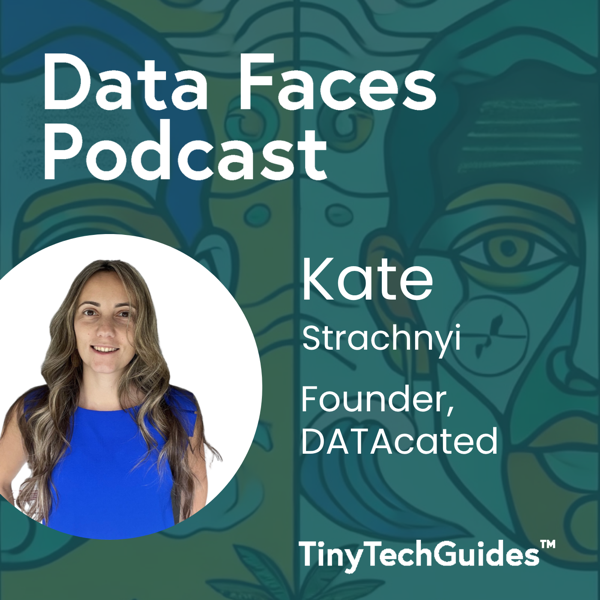
Kate Strachnyi is the founder of DATAcated, an influencer agency with 40+ creators in the data community. She began her career in finance and risk-management consulting before pivoting to data visualization 12 years ago, and has since grown DATAcated from a one-person experiment into a media business. She is a prolific author, speaker, and content creator.
In this episode
- How Kate followed the revenue data from courses and books to a focused media business
- The DATAcated Plus model and how influencer campaigns work behind the scenes
- Why she’s shifting from “Kate = DATAcated” to an agency brand
- The flood of AI-generated content on LinkedIn and her “non-GMO” content philosophy
- What happens to expertise when today’s experts retire and AI fills the void
→ Read the full article: Bots need not apply
Full transcript
David Sweenor 0:05 Hello everyone, and welcome to the data faces Podcast. I’m David Sweenor, founder of TinyTechGuides, and your host for today’s show. In this show, I talk with people are actually making data analytics, AI and marketing work in the real world. What’s exciting, what’s messy, and what’s coming next. So today, I’m super excited to have a chat with Kate strachny, who has turned a passion for data storytelling into a full blown media company, and she has one of the most connected networks of data and AI professionals in the world. So let’s dive in, Kate. Welcome to the data faces podcast. Speaker 1 0:37 Well, thank you so much, David. It’s a pleasure to be here.
David Sweenor 0:40 Super excited to have you. So can you just for people who may be living under a rock, tell us a little bit about yourself, and you know what your company does? Speaker 1 0:49 I wonder how many people are living under a rock actually, you know, we use that term a lot. I didn’t know anyone personally.
David Sweenor 0:56 Well, they might be that’s why you haven’t seen them. Speaker 1 0:59 Kate, okay, so for you people living under a rock there. Let’s start with so I run a company called dedicated it is now a media company. So essentially, we partner with brands in data analytics and AI and of course, focused on agents now as well, to help them reach their audience. So think of it as helping them with brand awareness, message amplification, getting more leads, in some cases, getting the right audience to learn about you and maybe sign up for a webinar, download an ebook, lots of different things. We do things virtually, remotely. We do things on site, and then we also have over 40 other influencers in the program who can be engaged on an as needed basis.
David Sweenor 1:41 Okay, well, that’s fantastic. And I’ve had the pleasure of working with you across a few of my former employers. And you run a you run a great program. This name of the show is data phases. So I’d like to get behind you know the sort of what you do. So I want to talk a little bit about your journey. Yeah, you went to school for finance. Yes, before that, pre finance, when you were a young Kate, what did you want to be when you grew up? Did you always want to be a media mogul? Speaker 1 2:10 No, no, I don’t even think I wanted to do finance really. I just didn’t really know. So started college and and I think I think I wanted to study accounting, just because that was like the safe thing to do. But took a few accounting classes, and switchley Quickly pivoted to finance because it seemed more interesting, and it was, but I still, at that point, had no clue what I really wanted to do. I just knew I wanted to work in finance, which, now that I’m no longer the younger me. I can hear how crazy that sounds. It’s kind of like some someone saying I want to work in data. And it’s like, okay, yeah, keep going. Yeah, go out there.
David Sweenor 2:51 I agree with you on the accounting, though, because I went out to when I went to school and, like, it was just, so just a set of rules you got to learn. It wasn’t, wasn’t all Speaker 1 2:58 that that interesting. Well, now AI could do it for us, right? So I’m glad I didn’t go that route. True. Fill out your spreadsheet.
David Sweenor 3:05 Lickety split. So you know, speaking of finance, so that’s sort of an interesting career pivot, moving from finance and risk management to building dedicated it’s not really obvious. So you know, what, what? What triggered that? And then what was the moment you realized you had, you had something going, Speaker 1 3:27 you know, I think the trigger is not something that most people would expect. It was actually the fact that we were starting a family, and I no longer wanted to travel for work, which meant Monday through Thursday, you know, I was at a different location. So when I was working in financial services, risk management, it was for a large consulting company, and that required a lot of on site work, sure. So I remember looking internally, waiting for my first child to arrive, looking for any job that let me work remotely. And this was before remote work was a thing, before it was cool. Yes, exactly. So someone, somewhere, after about eight months of searching, said there’s some kind of data role where you use Tableau and you visualize and analyze data and create pretty pictures. I’m like, Yeah, I’ll do anything, as long as it keeps me at home. And then when I started working in the tool, I just fell in love with data, data visualization, data storytelling, visual best practices. And this was about 12 years ago, and it’s just evolved and iterated through a lot of different scenarios ever since.
David Sweenor 4:30 Okay, well, so now you mentioned, you know, when we opened, that you’re, you know, you run a media company, and so, you know, I think a lot of people may know you from, you know, you’ve got courses community, but your core business is really brand application, I guess, for data and AI and agentic companies. How do you explain that to people you know, to people who think you know you’re doing sort of data and. AIS or training, or things like that. Yeah, it Speaker 1 5:03 is a little bit different. And, you know, it has. I used to do training, so when I just started, I did a lot of different things. I wrote books, I had an academy, the dedicated Academy. I created content, I ran my own conferences. I had a community, dedicated circle. I sort of let myself because when you’re a business of one and no one to stop you, you can sort of play around and experiment with anything that comes your way. And so I had a few experimental years, and I am a data person, right? So I would look at the numbers and see what is driving more revenue and what is allowing me to have more time to myself and also have more time to be creative and actually enjoy the work I’m doing. So all the roads led to media, and then eventually I brought in the additional influencers and turning it more into an agency, because I couldn’t handle the work, and I had some really great friends who are also content creators. And it just, it just made sense for everybody.
David Sweenor 5:57 That’s great. And I don’t want to, you know, you mentioned, you know, a book. I just want to ask you, what surprised you about the writing process, the process of writing a book, you know, I have written several with co authors, and once people get into it, they’re like, Oh, my God, what did I do is Speaker 1 6:15 that 10 books behind you? I just tried to Yeah, 10 or 11. What surprised me is, you know, most people complain about writing a book and how it was the worst time of their life and they’ll never do it again. I have the opposite experience. I think it was one of the easiest things to do, and I would actually have a call later today about writing another book. I don’t, I don’t think it’s that complicated. It’s, if you’ve ever written an article, I see it as writing, you know, 12 really strong articles that are cohesive on one topic. Instead of thinking it of it as like, oh my god, I’m gonna write this whole book. It’s, yeah, I didn’t that was surprising to me, because most people have the opposite view, yeah.
David Sweenor 6:57 I mean, you got to sort of have this plan and architecture of and I always tell people I was writing before AI made it cool now, everybody’s writing these very long things that nobody, nobody, they’re not writing it anymore. They’re just nobody’s writing anything. Yeah, so let’s talk a little bit about this, this influencer business model. You know you mentioned you have a whole cast of characters in there, all really great people. How does that work behind the scenes? Speaker 1 7:27 Yeah, so I’ll give you an example. So let’s say a client, like a big client, who maybe already has a well known brand, but wants to make sure that they’re capturing more of the conversation, market share on social media, just capturing more air. I don’t know. I don’t know how to phrase it, but basically they’re the topic of the conversation on, let’s say agentic AI right now, so many of them are competing for that community space. So they come to me and they say, here’s our messaging, here’s what we want to share, or, you know, here’s a product launch that we really want amplification around. What I do is I obviously, we set a budget, we set the timelines, and I look through the roster of influencers that I have. Most of them, I know that I’ve met in person several times, or at least I’ve had conversations with, so I know they’re not bots. I know they’re real. I know they’re authentic. They’re real humans. They’re real humans. They have real thoughts. They’re not just, you know, driven by agents writing their content for them, and I decide which ones I think will be a match for this client based on what success metrics that they’re going after. Then once that’s all said and done, I act as kind of a project manager between all of these moving pieces, so the client sends me UTM links and calls to actions, and I funnel them through to the influencers, get them started on creating their content, review it myself, and then send it to the client. Make sure they review it, they approve it, and then I make sure it comes out. So it’s a lot of just chasing people like, Hey, did you do this yet? That’s the non glamorous work, but it really doesn’t take too much time if you can be organized.
David Sweenor 9:05 Well, there’s a lot that people don’t know. You know, I run my own business, as you’re aware, and there’s just a lot of this minutia and tedium that that people don’t know. And a lot of it’s like, hey, cutting paste, cutting and pasting from System A to B, or uploading YouTube things, and yes, help automate some of that. But, you know, there’s Speaker 1 9:24 all day yesterday, David on in Claude code and CO work and all that stuff. So very soon, very soon, we can have a whole conversation about that.
David Sweenor 9:33 Well, I’ve automated, actually, quite a bit of my business using using Claude code. Okay, good. It’s phenomenal. Speaker 1 9:40 We should chat. This is, this is interesting. What was the best automation that you’ve did recently?
David Sweenor 9:47 Well, you know, I hate uploading videos to YouTube. That’s wonderful. I’m like, just, here’s the description. Create the descriptions from me, from a transcript or a clip snippet or whatever it automatically update them and schedule them and. YouTube, you know. So now I don’t have to go, like, drag the file, like, download it, put it in Google Drive, drag it back up there, paste in the description. It just it does it in like, you know, like, a minute. Speaker 1 10:10 It’s great. Wow, that’s actually a really good use case. I mean, there’s just so much we can do. It’s, yeah, yeah, little finicky deals, things, things can things can break. So you got to be careful. You have to be very clear with the process, is what I’m learning. Like, very
David Sweenor 10:25 clear it’s right, yeah, you can automate a crappy process to make it even crappier. So for sure, you’ll be
Kate Strachnyi 10:30 crappy and fast, you know,
David Sweenor 10:33 fast, crappy. So back to the influencer thing, you know, seems like you need to walk a fine line. You know this this terms of the vendors are promoting something, right? And you want to keep your street cred. So how do you, how do you balance that so it doesn’t become, like, I don’t know, like, like, a commercial on, like, spammy, I get your commercial on TV that you would just ignore Speaker 1 11:01 Yes, and that’s actually something I’m very glad that my my clients, my customers, are very well aware they don’t want to create a spammy commercial. They’re actually want to hire content creators to create thought leadership papers and have sessions, kind of like what we’re doing here, where we’re having a conversation, and use that to kind of join the community, versus saying, go ahead and buy our product like no people will unfollow instantly if we just kept promoting things, right? So I think it’s more of letting my audience, and like all of these content creators in the space, they’re very good at just letting their audience know about here’s a product that exists, and here’s what it does, in case you need it like it’s not shoving it down their throat and saying, go ahead and get a demo. So we’re very careful, because we don’t want to be boring either. So the more, the more we can keep things interesting, the better for everybody. Well, you are,
David Sweenor 11:55 you’re pushing the limit. I mean, I have no, like, creative skill, and, like, some of the things I’ve seen you on LinkedIn as an example. You know, just very creative, very clever ways of doing that. And I’ve seen you do like Jeopardy games. And I’ve seen you, I’ve seen you, seen you cooking and talking about things so you, I’ve seen you ride motorcycles. So you do a lot of Speaker 1 12:16 I like to have fun with it. Yes, that’s true. Yes, anything that can help my audience understand concepts. Like, yeah, we did a cooking show to talk about data governance. I built sand castles to talk about strong foundations like it. I think it sticks more, right? You probably don’t remember some of the boring content, because it didn’t really stick. So, right? As long as you’re having fun with it, it should work. I think that is
David Sweenor 12:41 definitely the key. You got it. You got to have fun. Yeah, fun making it and make it fun for people, people to consume. Yeah, for sure. So, okay, let’s talk about this, this dedicated Plus program. What is it? Tell us about it. Yeah. So the Speaker 1 12:58 dedicated Plus Program is that group of influencers, content creators, and recently, I’ve actually added speakers and experts. So for companies that want to, let’s say, hire an author like like David Sweenor, for example, yeah, author of like, 11 million books at this point, they can do that through the speaker program. I’ve placed people for keynotes and panels and webinars and thought leadership, papers, webinars and moderators, all of that. So that encompasses all of that. And then we also do on site stuff. So you know, you might have seen some of us at Gartner, for example, where we had a group of us on site, and we do interviews with sponsors or with analysts, and we amplify what’s happening at the event. We call it FOMO inducing content. So it’s like, if you’re not here, maybe you should be next year, and but really also sharing the key messages that we’re hearing. So creating other types of video content, some of it where we have too much fun. Like, I don’t know if you saw that at some point, the group of us went to big data London, and we got fake tattoos. Yeah, tattoos. I was
David Sweenor 14:11 very, very, very well produced. I had Speaker 1 14:19 my neighbors because I posted this on Facebook, they actually told me, like, Oh, I saw your video. Like, congrats on the tattoo. And I’m like, just proof it’s not real. No, it was not real. You had me going on that one as well. So we did go to a tattoo parlor for that one.
David Sweenor 14:33 So, yeah, you know someone, so someone that’s part of that group, the data whisperer Scott Taylor, so we just, we just recorded a podcast with him. It’s not aired yet. But you know, how did this whole dedicated plus idea come together? And you know, how would you describe it as the difference between, you know, the the cast of characters you work with and like in. Analyst typical analyst firm? Speaker 1 15:03 Yeah, I think analyst firms, you know, they do lots of research, and with us as content creators, I think we have more flexibility, and you can also sort of guide our messaging a little bit, right? Because this is something that a client would be paying for, for example, to bring us to an event. So you can, you can kind of guide us, like, okay, focus on this specific messaging, versus an analyst might just focus on what they think is important. So a lot of times that would be the same there. There is definitely overlap. Lots of engagements I’ve been in, they put me in the same room with the analysts and treat us equally, right? So it depends, and in some cases it’s very separate, so it’s kind of on a client by client basis. But the way this whole thing started was I had more work than I could put up with, right? So it was, it was great. And I instead of just raising pricing and, you know, just taking one client at a month or something, I decided to just let my my friends in on it and say, Hey, like, I have a gig here. Do you want to post? Do you want to post? And it sort of grew and grew and is still growing, because now, in addition to, like the regular data analytics, AI content, we’re also expanding into AI infrastructure, so like data centers, GPUs and just going broader still in that same space, but expanding. And what helps me with these dedicated plus members is I don’t have to be an expert in any one of these areas, so
David Sweenor 16:36 you go find one, right? Speaker 1 16:37 Yeah, exactly. Data engineering experts. We have data visualization experts. There’s just so many different and now lots of AI right? So that’s really in demand. Everybody’s an AI expert these days. Kate, oh, yeah, but I need, I need the real experts.
David Sweenor 16:51 So okay, then how about, you know? You just, you know. So we ran into each other at at Gartner in Orlando, and you had a session on personal branding. Can you tell us a little bit about about that and how that that came to be? Speaker 1 17:14 Yeah, for sure. So, so Gartner is one of my clients as well. And you know, they, send me to their event, and I one of my very favorite events ever. This was my third year in a row attending the data and analytics Summit. So this year they had an idea of like, hey, what if you did a panel? And I was like, Yeah, well, that’s Sure. Why not? I normally don’t enjoy being on stage. I’ll do it. Maybe a queen doesn’t want to be on stage, David, that’s why I have a speaker program, because people would ask me to speak. I’m like, wait, I know someone else who could do this. Okay, that’s how that idea was born. Yeah, I’ll do it. I just don’t like volunteer for it. But anyways, when they said we can have more panelists, and that we kind of get to pick and I, you know, asked if Scott can do this, and Scott was willing to participate, and they said yes. Then I knew it was going to be just so much fun, because he’s he’s not, he’s known as the data whisperer, but he does not whisper, and he just brings a good energy. So that’s how the idea came about. And we decided personal branding would just be something unique that we can bring to Gartner, because it’s, it’s not going to be, you know, similar to the other talks, right? This was more of like kind of a workshop session, but also like getting people thinking about their own personal brand. And plus, it was a breakfast. So that was, that was great. We sold out immediately. So that was, that was good.
David Sweenor 18:40 No, I couldn’t get in. I tried to get in, and it was bounced. I should have been a little more, more forceful, I suppose.
Kate Strachnyi 18:46 Yeah, you should have just showed up. We would have let you in.
David Sweenor 18:53 So this, I mean, was the session, and like helping executives at companies build their brand. And do you see that as is that separate from the company they’re working with? You know, how should, how should people think about that? Speaker 1 19:10 Yeah, our conversation, we talked about both, right? So we talked about, one is building your own personal brand, like Scott and myself and yourself do on social media, right? The whole island theme going, you gotta, you gotta have a uniform Yes, yes, of course. So we talked about how to, you know, make your first post and what to look out for and how many times to post, how to actually grow a social media personal brand. But then we also talked about how to navigate personal branding internally at a company, right? If you want to be known for something that you’re currently not known for, and the steps that you should take to get there. And then we did have questions from the audience of like, well, I want to post but my company said no, right? So navigating those kinds of politics and rules, and you know, you should just follow your. Company rules, but a lot of times they do have leeway. So you’ll talk about things that are outside of your direct job. So don’t talk about, you know, how much work you did in your project. But you could talk about different Don’t, don’t tell them every tool you use, then post your code on on social media. But you could talk about your thoughts, you know, on different topics, it does get a little tricky for some, and in those cases, just grow your brand internally and don’t get in trouble online. Because I recommend to them,
David Sweenor 20:30 they just go find a new company to work for. I mean, I’ve had some leaders that that I worked for, you know, personally, and some are very like, yeah, you know, they’re they’re, they care about you and your career development, and they want you to help build that brand. And I’ve had others, you know, completely opposite, right? They’re like, No, I’ve seen both sides, yeah, and it’s my recommendation is go, no job. Speaker 1 20:58 Yeah, where they where they let you do that because it is, it is so powerful to have a strong personal brand. It opens up so many doors, so many opportunities.
David Sweenor 21:07 Like, it’s well for the company too, though, because people want authentic voice, like, there’s like, there’s only so much corporate, corporate speak that a company can push, Speaker 1 21:17 that it’s just a risk, right? Because some people are more opinionated, opinionated than others, and controversial. So if those people start posting their thoughts, sure on social media, that can get a little hairy for like, Did you see what the person at this company just said? And yeah, on
David Sweenor 21:34 politics or religion and all the things you’re not supposed to talk about at dinner, yeah, or Speaker 1 21:39 even on a party basis, saying, like, this one is better than the other, and then the competitors, well, yeah, you there’s lots of ways you can go wrong. So I get why they do that.
David Sweenor 21:49 Yeah, no, I hear you. I hear you. So you know, on this branding when, when a client hires dedicated Are they hiring Kate? Are they hiring like, like, like, what’s the perception there? Because you’re sort of the face of dedicated. I know you got all these these people you work with, but how do you think about this distinction as your business grows and scales? Speaker 1 22:15 It used to be that dedicated and Kate were one in the same. So it has evolved, and it actually took me some time to so if you, if you saw my media kit, and that’s, you know, just a document that I share with clients that shows all my offerings, and I have some old ones somewhere, yeah, you probably do. If you noticed, on my old media kids, the front page was like, a big picture of me and about me and what I can do. And then the next page is like, and here are the influencers you can also hire. If you look at my media kit now, it is all about the other influencers. So I am slowly starting to move myself away from the spotlight. Even though I love doing all this work, the perception is some of the clients have is like, Oh, well, but we want you there. I’m like, well, this person is also really great. There is none of that, but we need you there on site. And I’m like, Well, you don’t, but it’s taking me some time to not have Kate equals dedicated, and dedicated equals Kate because and the new company, the new companies I’m working with, they get it because I position it now as an agency. But yeah. I mean, it’s nice to be wanted, but it’s it, there’s always to that, you know, it doesn’t, it doesn’t scale, right? Yeah, exactly, exactly.
David Sweenor 23:30 Okay. So it’s very interesting. So you’ve done a switch a little bit to LinkedIn. So, you know, a lot of the BDB companies, you know, we both work with that’s one of the primary channels that are probably the primary channel that they’re pushing things on, and you’ve been a top voice there. LinkedIn is completely changed, in my mind. So you know what works now? That didn’t work five years ago, and vice versa? Speaker 1 24:02 Yeah, you know, when I started posting on LinkedIn, it was there were very few content creators, right? It was mostly used as a job searching site or job application or, you know, connect in messaging if you meet someone. But now so many people are creating content. So when I was starting out, creating a piece of content meant you’re going to get so many views, right? There was almost no competition. It was like one and a half percent of all LinkedIn users were creating content, which, I don’t know what that percentage is now, but it feels much higher if you open up your feed and you just see so many, not not all, real people, but they’re still content creators, even if they’re agents. So what worked before, you know, and it keeps it keeps evolving. What worked before, like the Bernard Mar and Lillian Pearson and a couple of others, was long form articles. So if you had an article and newsletter that people can subscribe to, you were the IT person on on the platform, then it evolved to. To Text plus image posts. And those did really, really well. Polls came in at some point and had lots of impressions and views. Now it’s short form video, right? So it has. It’s been evolving, and LinkedIn live was really big at some point. Now I think it’s sort of calmed down. But those short form videos, the Tik Tok style reels, YouTube short style videos are doing really well on the platform, and who knows what’s next, right? Maybe some kind of for the glasses experience. I don’t know what the future holds, but I think the the advice I would have is to not get stuck on Well, this used to work, so I’m going to keep doing it. Just keep, keep evolving your own materials to see what people are actually watching like we’re going to have a 30 minute conversation here, but chances are people are going to watch the short clips and consume data with like a 3045, second clip, just to get insights if we end up sharing those. Because now memories are not, as you know, short term memories, like we just want to move on to the next thing. We don’t want to commit. And there’ll be still some people who want to consume the long form content, like, if they’re on a long walk and they just want to focus on one conversation. So it’s going to keep changing.
David Sweenor 26:17 Okay? It definitely changed. And it’s, it’s hard to get anything in my mind authentic anymore from LinkedIn, like, so now let’s just say you connect with somebody not like, Hey, you wanted to subscribe to my newsletter. So I probably get like, 50 subscribe to my newsletter, things a day of like, what’s going on with this? And you can see it. You can see the posts are clearly, you know, almost all 100, 100% AI driven. You know that because you can tell they’re they’re super long, they’re like, they’re longer than some of these tiny tech guide books I have there. It’s tough to like. I don’t know if it’s losing its I think for me, it’s losing its appeal a little bit, because it’s just, there’s a lot of crap out there. Speaker 1 27:01 I think, I think it’s going to change. I’m hoping the algorithm will pick up and detect because, you know, it’s pretty simple, like, we can detect it very quickly. I’m sure you can get an algorithm
David Sweenor 27:13 exactly how it’s written, like, ai, ai, and I just stop and close it. I don’t, I don’t read Speaker 1 27:17 those things. Yeah, it’s very clear. It’s very especially if you know the person well and you know that they’ve never used that word or this is so inauthentic. And I do call them out, like, Hey, I could tell you used AI. And they’re like, Yeah, but these are my thoughts. I’m like, keep them your thoughts. Don’t put them through. I think it’s called AI washing, right? Don’t, yeah, yeah. Keep it non GMO. Don’t modify your content, just leave it as is. But I also contradictory. I also see LinkedIn, when you post something, or you draft it and it says there’s a big button that says, rewrite with AI, yeah, why? Just leave it.
David Sweenor 27:57 They don’t want it, but they have the rewrite with AI function built into their platform. It’s, it’s a little Speaker 1 28:04 counter, yeah, the business strategy is there. Yeah, it is changing, and we’ll see what happens with that one.
David Sweenor 28:11 I mean, I guess you know, one of the things I think about is, I’ve told a bunch of my clients, I think there’s two things that will, will, I think, be more true for a little bit longer, is the human authenticity. That’s why I started this podcast. I wanted the real conversations. And, you know, that’s, that’s sort of the content. And the other is probably survey data. People want original research. And so those are the two things, I think that people, people want, and you know, still gravitate towards they want. They want the video. You know, we’re humans. We’re your audio visual type people. Speaker 1 28:51 Yes, yes. And I’m doubling down with my business, just on focusing on the authentic voices, the thought leaders, the people with thoughts.
David Sweenor 28:59 That’s people with thoughts, some don’t have any. Speaker 1 29:04 Yeah, yeah, for sure. And I was actually at an event recently and someone said something really interesting, definitely going to turn this into a post eventually. But you know how right now, we have subject matter experts that, you know, they see an AI output, and they’re like, Okay, no, this looks wrong, like I’ve been doing this for 20 years. What are we going to do 20 years from now, when we don’t have those subject matter experts, like, they’re retired or, you know, not not working anymore, because if you don’t work with this stuff, whatever that might be in the medical field, in construction, right?
David Sweenor 29:36 Or learning how to do accounting or finance, Speaker 1 29:38 exactly, exactly, how are you going to, like, fact check it so that it’s interesting future. So are you worried? Kate, am I worried? No, I think I’m optimistic, but it is like, the more I learn and the more I explore with Claude, the more like, like, oh my god, if it can do this, or if it can do that, like, wow, what do we. Really need all of these other people, including myself, for you know, so it is, it is a little bit scary.
David Sweenor 30:07 Have you, have you made a AI version of yourself? I tried. I had deep fake Dave, and I actually have a T shirt that says deep fake Dave. So if you, if you see that, it’s digital Dave, it’s not the real me. But, you know, I have not barely, barely labeled deep fake Speaker 1 30:20 Dave, I think because you know yourself so well that you can see it’s not you. I don’t know. I can’t I have not gotten around to it. I tried with, like, Synthesia and other stuff, and it’s, I didn’t like it. I don’t know. Maybe it’s not, I mean, I was just experimenting and, yeah, but some people like use that in their content, and I authentic, right? That’s the main, main word for this conversation, is, I plan to remain authentic.
David Sweenor 30:47 Okay, maybe back to, you know, running dedicated. When did you sort of realize you couldn’t do it all yourself? Like, there’s, you know, we had a conversation of, like, I hate editing videos. You just go hire somebody and, like, you can’t physically do everything because there’s not enough time in the day, as it was, it sort of just like, Screw it. Or you’re just like, I don’t like that, so I’m not going to do that. Like, kind of like, how did, how did that evolution have? Because a lot of founder entrepreneurs, they have trouble letting go. Speaker 1 31:24 Oh yeah, that’s me guilty. I did hire someone briefly, but I’m still a business of one, so I did do, still do everything myself, including editing and posting and cutting and pasting like we’re all doing, but now Claude is going to help me. So I, for some reason, I am able to let go. For this reason, it’s because I believe this will be around. I know it’s repeatable. I think my worry with letting go to a single human is that human might get a different job, and then I feel like all of that effort, you know, time, investment, emotional investment, will be a waste. And with agentic AI, it’s like you teach it how to do a thing. And I’m starting with, like, very small tasks, like create an invoice. Here’s my agreement, Doc, and it’s puts out an invoice and creates an email draft. And it’s like magic, okay? And, and it’s great. I never have to teach it again.
David Sweenor 32:24 So that’s my project for today, actually, is to go automate my invoicing process. Because I’m like, I just hated that yesterday. I make mistakes. I’m too cheap to buy a tool, so I’m just like, whatever. Speaker 1 32:35 It’s not even cheap. I don’t want to, I don’t want to rely on a tool again. It’s kind of like a person. Yes, I know Claude is also a tool. But I feel like because I’ve established a clear process, and I documented it and I made it like idiot proof that now it’s repeatable, even if I use another agent in the future, I now have those assets to just say, okay, here is how I want it done, and then it just does it so very, very satisfying to just like, sit back and watch it, do it. It’s really cool. Even recorded. And I was so excited I was recording my
David Sweenor 33:07 screen, I got a little worried, though, because, like everybody and a lot of my clients, most of them are orienting around Claude and Claude code right now. You know what six months ago was? Was chat GPT, and then there was a point where it was Gemini. I’m like, Well, what’s it going to be three months from now? Who knows is this? Is this engine? Dave’s tiny Tech Guide, advisor engine? Is it going to work with the next cool thing? I don’t know. I guess we’ll see. Speaker 1 33:36 Well, it, it will keep evolving, right? And, you know, maybe open AI comes up with something even better and then, but you’ll at least have thought through the process, and you’re further along than other people who are too scared to try it, right? Sure. So I think, yeah, just, just do, do one of them, like pick one and just do something with it. That’s right, all right.
David Sweenor 33:57 Well, great. And one last, last question, yes, you know, they say, AI, you know, it’s gonna 100x your productivity. And I think, you know, we live in this world, and we can see that, but I find myself working more, not less, like what’s going on? Speaker 1 34:18 Kate, well, I mean, it took me all day to automate a process that takes me about two minutes to do right, right? But at least now I don’t have to do it every time. I don’t. I don’t know if I feel like I’m working more. I think technically I’m working more because we are just getting much busier
David Sweenor 34:35 on you can scale like the number of clients you have for sure. Speaker 1 34:38 Yeah, you can work more if you wanted to, but personally, I don’t think I work that much. I have a very strict efficiency policy where I only take calls on Tuesdays, for example. Like I made that rule for myself a few years ago, and I try to stick to it as much as I can. Today’s a Tuesday. Today is a two. Is that you’re catching on even I mean, for things like this, I do make myself available for other days, like podcasts and events and stuff like that, but client calls and work calls, I try to keep it to one day a week, because then I just know this day I’m home, this day I’m going to be on, and don’t plan anything, but it just keeps me flexible for the rest of the days. So yes, we’re going to be as busy as we want to be, and I think with tools like Claude, that suck up all my time, because it’s so exciting and new, and we just want to see, like, what else can it do? I think same with chat GPT, when that came out, I was just asking it all sorts of things like, Okay, now do this. Now do this. Like, give me a recipe. Here’s a picture. What’s in my fridge? Right? It’s so exciting. I think that excitement will wear off, right? And I think it’s there’s going to be a curve of eventually it will get better, it will start automating processes, and it will just open us up for more opportunities, right? You’ll be writing more books. I’m assuming that’s what you want to be doing. You’ll be building another shelf to hold more books. I don’t know. I have
David Sweenor 36:07 a theory. People don’t read anymore. That’s why I’m doing the videos. May have to make a movie or something. Speaker 1 36:11 You could turn all your videos into a book or a Netflix series. You know the databases. I’d watch it,
David Sweenor 36:19 all right. Well, on that note, Kate, it’s been a pleasure having you on the data faces podcast. If people where can people find you and get ahold of you they want to want to learn more. Yeah, just Speaker 1 36:31 look me up on LinkedIn or datacated.com. Is also another great place. And David, thank you so much for having me. All right. Appreciate it. See you out there. Bye, thank.