

Data Faces · Episode 15 · July 1, 2025 · 39 min
Endava trained 12,000 employees on AI and runs 3,000+ custom GPTs. Judit Szabo on “survival of the nimblest.”

Listen: YouTube · Spotify · Apple Podcasts · Amazon Music
About Judit Szabo
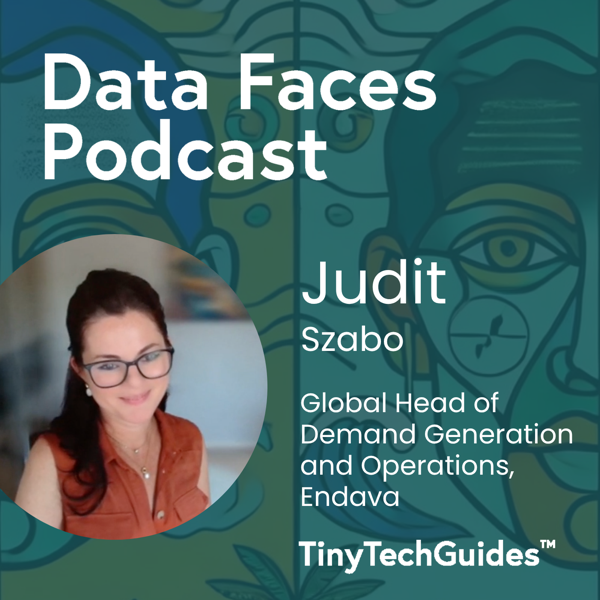
Judit Szabo is Global Head of Demand Generation and Operations at Endava, where she led one of the largest AI rollouts around — training all 12,000 employees on AI tools, with the company now running over 3,000 custom GPTs. She came to tech from a background in English and French studies and a near-PhD, bringing a pragmatic, human-centered lens to AI adoption.
In this episode
- How Endava trained all 12,000 employees on AI tools
- Why lead automation took months to reach proof-of-concept
- The “survival of the nimblest” strategy for AI marketing
- Running 3,000+ custom GPTs across the organization
- Why AI demands stronger critical thinking, not less
→ Read the full article: The “survival of the nimblest” strategy for AI marketing success
Full transcript
David Sweenor 0:00 Sweenor, hello everyone, and welcome back to the data faces podcast that brings the human stories behind data analytics, AI and marketing to the forefront. I’m David Sweenor, founder of TinyTechGuides and your host for today’s conversation. So today’s guest, we have a rare treat. We have unit Sabo, Head of Global demand gen and operations at andaba. She’s got deep experience across a wide variety of B to B SAS and IT services company. She got a sharp mind and a thoughtful perspective on how AI is reshipping the way we, you know, think work and lead. So we’re going to talk about this thing people may have heard of. It’s called AI. It’s not a tool, and it’s a wake up call. So, Judith, Judith, welcome to the show.
Judit Szabo 0:44 Thanks, David, thanks for having me. It’s a pleasure.
David Sweenor 0:49 Um, I’m glad thank you for joining. So can you tell us just a little bit about yourself and your company?
Judit Szabo 0:56 Amazing. So, um, I’ve been in B to B tech marketing for 15 plus years before that, I started in PR and media, but really got into tech marketing, and my sweet spot is demand, generation, marketing operations, everything, automation, in terms of lead gen and lead nurturing. Currently at andavo, which is an IT services and consultant, consultancy firm serving enterprise customers in the B to B space, selling across a variety of industries. And yeah, I guess we are exposed to the market volatility that is so prevalent in the tech, tech space, and yes, we’ve been heavily experimenting with AI, not just in the marketing organization, but across across the board. It’s 12,000 people company. We’ve been known for custom software development and agile development. So it’s right in the sweet spot of how AI can be disruptive for an IT services company.
David Sweenor 2:05 Well, fantastic. And so you to, I want to just maybe part of this show is to really bring the human stories behind, you know, folks in marketing and AI together. So when you were young, did you aspire to grow up to be the global head of demand, Gen and operations? Or, how did you, you know, get on this path? I didn’t know anything about marketing myself, so just curious how you got into it and what, what maybe, what other career path could have you jumped into? So,
Judit Szabo 2:33 yeah, my career path was not linear at all, and I graduated way back then in English and French studies. I stayed at the university to do PhD in English. And it was, it was quite possible that I would have spent my my life in the academia. But then, luckily, by the end of my PhD studies, I I had a moment of reflection where I thought, I’m maybe a little bit more pragmatic than than this domain. So I thought big. And was thinking, all right, fine. So if not this, then what I just wasted eight years of my life in, oh no, studying all of those. And anyhow, I thought, fine. I want to use the language. So that was a given for me. I’m Hungarian by birth, so I used to be still living in in Bucha at that time. So I went to the big black book of PR agencies back then, and that’s 2004 and looked up all the PR agencies that were owned by British or American companies, and I wrote a lovely cover letter saying, I have nothing to do with PR, but I speak good English, I have good communication skills, and I love to work in PR. And I think that was so so bold that a week later, I worked at the PR agency, so I really learned PR and media. I didn’t study it at the beginning, and then from PR, I got into from agency, I went in house, and I was a marketing communications lead for a really cool art design school. Anyhow, fast forward eight years, I thought I should really have a marketing degree now that I’ve been doing it for a couple years. So that’s when I did a post grad MA in strategic marketing. And then I had my first child in 2009 which was a slap in the face because I couldn’t go back to my workplace unless I went back full time and so well, I always looked at these, these points in time, as you know, that’s always brings you opportunities, rather than like a full on, you know, challenge. So what I happen to be doing again, reconsidering. What am I going to do now? And I had the chance to join a startup that was selling Microsoft cloud solutions to telcos in Central Eastern Europe, and that was a time when I had no idea what Cloud meant. I remember working at that company as market lead and was sitting in all of these leadership meetings where the founders of that company were ex Cisco people. They were all very technical, and they were, you know, throwing these words around on demand and cloud and all of that. And then so I said, Can you stop here? And someone explained me what Cloud means. So that was 2009 and quite embarrassed that I had to ask that question. But I guess that was my task, to translate all of the technical verbiage into consumable messaging. And anyhow, that’s that’s how I got into marketing and tech marketing, and that was the first assignment. And then I moved to the UK and worked at a cloud hosting company, and then typical software where, of course, the two of us had the great pleasure and and, yeah, after director
David Sweenor 6:14 got into andava, yeah, the rest is history. So Well, that’s that’s a fabulous story of how you arrive there. And I don’t think anybody’s career is really linear. It zigs and it Zags, and you adapt and but you mentioned cover letter. Now brings us to the topic of today’s conversation. I don’t think anybody’s actually writing anything anymore. So if we can remember way back to 2022, things changed. There’s this little tool called Chat GPT that really captured the world by, yeah, I think by surprise. So how is AI serve as a wake up call for professionals, and IT services and consulting and you know, really, what are we waking up from?
Judit Szabo 6:55 So I think, again, even just you and I, we used to work at a company where we constantly talked about AI machine learning, you know, programmatic automation or predictive modeling, personalization is not new. You know, it wasn’t new. We did that for our customers. We used it in marketing. Marketing, you know, as a profession, has been using it for a while. I think what was very new with, or what is very new with generative AI does. It’s accessible for everyone, and it’s not. It’s not a choice anymore. But you know, if you don’t, if you don’t treat it as part of your workforce, as your teammate, as your assistant, then then you are already behind. And the other thing that I think it does is kind of shakes things up and then levels things out. It kind of puts everyone back to the same, you know, starting line, and like, users of it. Just just simple business users of it. I think in the past, AI and ML models that that was some something very technical, geeky at the background, you understood it, and then I was trying to turn it into marketing materials. But you know, like, you have to be very technical, like a data to understand how it worked. Otherwise you were just, you were just benefiting from the output of it. Now, what it does is like you use it in your everyday life, and I think if you don’t use it, then you are already behind, and that should be a wake up call. If you don’t treat it as part of your teammate, you don’t experiment with it, and then then you’re going to fall behind. Yeah,
David Sweenor 8:41 that’s interesting. You said it. It sort of resets everybody to the starting line, you know. And past guests have mentioned this, you know. So like, let’s just say everybody has we’re at the average now. We’re all the means. So, you know what? What makes people you think, you know, stand out. You know, anybody can type in, you know, a prompt, and you can get better or worse results depending on your prompt. But like, let’s say, BDR, outdoor, outbound sequence or something is type that in. So like, what’s, what’s gonna, like, differentiate, you know, people, if we all have this average baseline of, hey, write me a outbound sequence and boom, it comes out in five seconds.
Judit Szabo 9:18 So I think contextuality, or contextual awareness is still very important. You know, if you don’t put the prompt in right, and then your output is going to be garbage. If your your underlying data is bad, then your output will be bad. If, if your underlying infrastructure is not modern and agile, and it’s not the data points are not talking to each other. Then again, your output is going to be 40. So I think it doesn’t negate the importance of the human and the creativity that if we use it in a marketing context, for example, Yes, you. Use it for for content creation, for content ideation, for personalization, your research, you know some low risk type of contents, like a cover letter, you can easily, easily create it, but you, I mean, I certainly recommend that you never take that the human out of the process. Of course, you hear about fully autonomous workflows, and maybe in some contexts, they work, but I think a human will always have to be there. And I think this contextuality comes into the picture when you need to know the outcome you are looking for, we use it for example, for for image creation, but it’s our very experienced designers who are doing that work. And you know, the benefit of it is that with very precise series of prompts, you can have an amazing AI generated image that’s going to be one of a kind. You will have never, ever seen it. It’s not from a stock image pile, right? That another company is going to use it. It’s unique to you, because it’s the the end product of your creative mind, right? But the benefit of is, for example, andaba, for example, is a very human centric, people centric company. We have 12,000 employees, and this has been very important for us. So 18 months ago, whenever, when we relaunched our website, for example, we put a lot of effort, energy and time and money in taking pictures of our employees across the globe in different locations, different settings. And if you look at our website, we have loads of those images across the website, real people. You might even spot myself. But then you get into into the challenge of, what if someone leaves? And what if someone leaves with the ask of, hey, I actually don’t want to be associated with your company anymore. Can you take me off and fine, okay, it’s doable, but imagine all the hassle that comes with it. Whereas if, if you had a creative idea of what images did I want to see on my website, what are my brand guidelines, then you create a one of a kind, AI generated image that’s yours. It’s never, ever used, never going to be, ever used by anyone else. But then again, I wouldn’t be able to create that output that our designers do, because they have the context where they want to use it. They have the vision of what they want to see, and and they have the knowledge of how to put the prompts together. Yeah, you know, that’s
David Sweenor 12:43 actually really interesting, because I found I struggle with generating images myself because I don’t have the vocabulary. I’m not an artist like so if I say, Hey, show me something in the style of Rembrandt, I don’t even know what that means. So I can’t even describe to the people what I want, and so I don’t have that expertise. So that brings up, you know, a question, what sort of human skills do you think maybe he’s coming more valuable, you know, and then the stage of of AI.
Judit Szabo 13:17 So I think this is the the age of the survival of the nimbles,
David Sweenor 13:21 survival of the nimbles. I like that
Judit Szabo 13:27 because, yeah, you can’t apply AI on rigid only one like one time models, or it breaks down, or is this not going to be efficient? So I think users of AI, and, you know, maybe marketing, users of AI would need to be very creative, continue to be very creative. I think they need to be strategic as well. I always, you know, I, of course, we all hear like, oh, marketing can now go away. We can automate all the workflows. Everything can be done by AI, automation, personalization, all of that. Agents can do our job. And then I always, you know, laugh and smile when I hear that, because I would, I would challenge anyone in the organization to come and create, maybe an agentic workflow for automating a lead management process for us and and how many aspects you have to think about, and it’s doable. And we are actually experimenting with creating an agentic, AI automated workflow for our whole like kind of lead management, but the amount of data sources you need to integrate for that to be efficient. The essentially, you have to nail your process before you can scale it. And if you’ve done, if you haven’t nailed that process before, if you don’t have that experience of what, and knowledge and strategy of what, what do I what am I looking for? What do I want to solve? I. Again, with the designer, like they know they have it in front of their their virtual eyes of what they would like to see. Therefore, they can create those prompts. You and I, we can’t, right? I mean, I have it in my mind as a vision of what I would want this agentic, autonomous workflow for lead management look like, and internally, actually, it’s been taking us weeks, or maybe months now to to come to the POC stage, because, of course, the developers or the people that I need to build it for me, I need to walk them through the process. I need to bring them along my vision of like, this is what I’m looking for. And then, you know what data sources do? We need to plug in? What’s going to enrich my data? How is that going to look like, and then what? What stages am I going to introduce and still keep the human in to ensure that I comply with regulations or that my output is is still contextual? Again, I don’t again, services companies like endavo actually strive in the human value and and so that is one thing I also see staying or maybe even strengthening nowadays, that, yes, it certain processes, certain tasks can very easily be replicated with AI and and if you, if you choose the use cases right, and you don’t try to throw it, throw it at everything, then you are able to increase productivity. But I think what’s becoming more and more important for customers on the market as well is the human voice. You know nothing, nothing replaces that. Nothing compares to that. And again, in services, in consultancy, we see that maybe more than in software, if you are in SAS and you’ve got, you know, you if a free product that can, you know, you sign up for a demo and then you can freely access it, maybe I can imagine that there’s a quick, autonomous workflow that can lead you there you sign up for, you know, the free trial, and, you know, I mean, at least your foot is in the door, and then you can start experimenting with the product. But services, solutions that we are selling, you need the trust of that of that customer, you need the buy in of the C level the board to come along. So I can’t automate that. I need to introduce the human element at certain touch points of that very technical and self serving kind of funnel that that nowadays buyers are going through. And, yeah, it’s that is the most crucial. And when I speak with other like customers or other services companies, they come from the same that, in a way, for example, the importance and prevalence of physical events have come back into the picture. After all, the COVID, you know, wave of everyone, everyone and everything went digital. You know, now, physical events come back into the mix, and then someone picking up the phone and trying to have that meaningful, really, truly meaningful conversation with you, understanding your business needs and the value that a customer can bring to you. I, I mean, I right now I haven’t seen an AI workflow that would be able to do that.
David Sweenor 18:27 Yeah, I agree with you. It’s so variable. And even even if you nail it, you know, what I’ve just seen in my own workflows that I use, the models are changing. The systems are changing so fast, what worked yesterday sort of doesn’t work at all today, because adding in reasoning or whatever, and so I think there’s a lot to think about. So, which brings me my next question. So it sounds like you’ve done a lot with AI personally, and, you know, at your company, but what do you think companies, you know, overestimate what it can do for their you know, business, and maybe, you know, underestimate, what does that reveal about us?
Judit Szabo 19:05 Sorry, you broke up.
David Sweenor 19:06 Sorry. So what I mean, what do you think? What do you think we’ve overestimated about what AI can do for the business and you know, maybe the corollary is, what’s that? You know? What have we underestimated about what that reveals about you know us personally, you know, I think, you know, just kick it off like it was going to solve world hunger. Like every new technology, this is great. We’re going to automate our jobs away. You know, we mentioned that. You know, when push comes to shove, there’s a lot companies need to think
Judit Szabo 19:33 about, yeah, so I think again, because it’s so helpful to accelerate and increase productivity, the human capital and creativity, again, will will free up. And if we do it right, I think it will maybe improve the world. Or, you know, like you know that that might. Set can be used on more efficient, more effective tasks than being bogged down on the and the very hands on, maybe resource intense tasks. So I think again, finding the right applications of it that can then accelerate those steps that are very resource intense, low risk, maybe even, even if it’s governance heavy, you can, you can apply those, those steps and prompts that that ensure that the governance is met, or security standards, all of that. But I think what, what humans will be able to focus on more is the you know, the strategic growth, or again, that that that construct contextual knowledge of your business, for example, the value that it brings you know, to have that, that that vision, I I’m not too sure that a a bot or an AI agent is, is able to, perhaps able to suggest, you know, if you feed it with relevant enterprise data and information about your business and all of that, perhaps it can suggest, certainly, you know, ways to go forward. But you know, how many times do we do we hear that? Sometimes it’s a bold idea that, you know, makes a company stand out. I don’t know how much an AI model can be bold, because I think they are trained to be reliable. And, you know, it’s based on historic knowledge and data. So I don’t know if, for example, boldness is, is very much
David Sweenor 21:43 sort of trying to be trained to be average, right? And so, but, but, you know, you mentioned something very interesting to me, so you know, it’s going to free up human capital. And you just, from what I’m seeing from my vantage point, I think t use you said survival of the nimbles. I think teams are really operating on skeleton crews these day. They’re they’re shrinking, yeah, and there’s a lot of workforce disruption. So, you know, we know that Bill Gates, for years, has been promising us the four day work week. You know, through automation, I don’t ever see that happening. I feel us that the individual PMMs or or demand gen people within companies just getting more stuff piled on their plate. I don’t know. I don’t know if that promise of me being able to exercise thought in a company will ever come back. I don’t know. What’s your experience
Judit Szabo 22:33 with that? I’m still a true believer of again, the human the human values and another, another aspect that came to mind. I’m, I’m responsible for our website, for example, and you know, mean, for a long time. So I always put a lot of effort in search engine optimization, ensuring that our messaging is optimized and whatnot. And then, what do you hear and read nowadays? You know? What are these models feeding off? Of course, you know the organic traffic is not so much going to your website now, but then your end goal is to show up in the end results of these Gen AI search results and so. But then what? What they are saying, and I will believe them, because I don’t technically, really fully understand how this works, still at the background, but what they say is, for example, Reddit is very, very influential in those results. And what’s fueling Reddit human feedback and peer reviews, and again, that’s the human the true voice and experience of humans. So and I think probably these search engines are kind of updating their models now to to see about that’s that’s very sounding and reading very automated, and then what? What’s that kind of pile of content that that provides contextual relevance and and I think that’s only that’s only achievable by by human interactions, not saying that you wouldn’t use AI again. You can, and, you know, you can ideate and then find ways that you haven’t touched upon just yet or whatnot. But that tone of voice, for example, that that’s truly for a person or for a company, um, you know that that contextual relevance, or if it’s if it’s pulling in so much insights from peer reviews or already and human experience, then I’m not too sure you can fully influence that with AI automation.
David Sweenor 24:36 Yeah, I totally agree with you on that. So, you know, given that, you know, you mentioned this, you know, mentioned contextuality a few different times and and, you know, bold decisions, I think you mentioned earlier, you know, bold like, is an AI going to come up with that? No, maybe it will give you an idea that maybe I’ll spark a neuron in my brain. I think it’s something interesting. But do you think there’s a risk of people losing sort of this? Is the why, you know, behind, you know, data driven decisions is because, you know, hey, the model told me to do this. So this is what I want to do. Is there a risk to companies and individuals out there and workforce? I
Judit Szabo 25:13 think, I think there is truly a risk. Because, again, I think there are a few, like, foundational requirements for an AI model to work. You know, the data input again, if someone disregards that, or it’s not bulletproof, then immediately, yes, the model will churn out results for you, a result for you. But if you don’t know, and you’re not aware, enough of, oh, actually has the data input included this, this, this, or was it just one data source in like, maybe in a I think most enterprise companies are still struggling with data connectivity, you know, in their own that’s never
David Sweenor 25:51 going to go away. That’s the only thing in all life. Yeah, yeah,
Judit Szabo 25:54 I agree. So there’s always some complexity. So again, if, and I actually, because I’m responsible for marketing, operations, data, analytics and reporting. And I did experiment with, with trying to to use, well, we use GPT across the company, so, you know, that’s a safe environment. So I thought, fine, like what I either haven’t managed to find the right set of prompts, or because our data set is still in like different places, and I haven’t managed to collect it all, I found that the outcome was I was testing it for certain scenarios, and I didn’t think that the outcome was actually accurate, but I know that because I’ve done the deep analysis myself, I was kind of testing it like, okay, would it give me the same output and it doesn’t? Again, maybe I’m not using it the right way, and I should experiment with it more. But So again, a couple of these, like foundational requirements that can really skew your output, like the data, the data connectivity, and then that that you you create a model, that it’s flexible, again, if you try to create it for a you know, this is how it should look like, and and nothing else. And it’s not a dynamic model, maybe, or again, that’s why agentic AI and agentic workflows are so exciting and inspiring for me, because, because there you are trying to train an agent to just one one task, and then you are then adding multiple agents together to then talk to each Other and then constantly interact with each other. And perhaps that’s that’s actually more efficiently done than humans would do, because humans would take much more time, or maybe quality assurance. You know, it’s never 100% if it’s done by a human. You know, maybe an AI can actually do that much better. So you can accelerate certain steps. But I think I would always have, at least at the beginning, at the end, the end of the process. I would always have a human at the beginning to ensure, like, that you put the vision forward, whether it’s in a prompt, for example, of what are you looking for, and then at the output of, like, really reviewing it, and then just contextually, and then really, like, logically consuming it, like, Does this make sense? Like, is this correct? So I would never use it for, like, Okay, this is for granted, and I make decisions based on that.
David Sweenor 28:33 Yeah, no. It’s tough at scale, though, you know, and agentic AI is a whole nother. We could have another, another whole show on that. But, you know, I like, What could possibly go wrong? Like, I can’t even get a single prompt to give me a non BS answer half the time. So imagine, like eight of these, or 10 of these, or 12 of these string together this butterfly effect of cascading errors. And I think you’re gonna get gibberish out there, but you know, you’ve come back a few times to this, the human and I agree. You know, human in the loop is so extremely important. And so how do you, how do you balance this, this drive for automation and efficiency and productivity, with human and if you’re making like, there’s a couple different types of, you know, these tactical decisions, say, at scale, can human review everyone? Or how would you even, how do you even approach that like, I think the big strategic decisions, yeah, you know, going to help augment it. We’re going to think about this. But then there’s all these other decisions that maybe they’re happening more frequently, operational decisions or tactical decisions. How does one monitor that at scale to make sure I’m not putting gibberish out in if, say I automate emails or images or whatever,
Judit Szabo 29:45 I mean, that’s where I would put these, these experienced humans as kind of the reviewers of the outputs or the models or whatnot, like as a. A as a spot check, or, like, sanity check, to ensure that it works, and then have that person kind of run that model through a couple of examples, and then, you know, execute, execute, and then, and if you’re confident about the output, then, then it can probably be unleashed for that for that task, or for that project, and and then, I don’t think it will, it will take over all the tasks again. I don’t think it can be thrown at everything, but, but you can find those repetitive, low risk tasks that it can help. And then I guess there’s, there’s a lot of governance around it and compliance and whatnot. So we’ve had the whole company, all 12,000 or what employees go through and AI training, and then everyone now has access to enterprise GPT and but you can’t get access to the tool until you do that training. And it’s quite extensive. I mean, even you as a data scientist would find the snippets of data there. There’s like, oh, okay, that’s something I never, never knew. And then you have to do the tests and all that to ensure that you’re compliant. And, yeah, we have like, 3000 gpts now built custom within the company, so every pockets of the organization is used. And then, of course, the most widely used is the kind of the GPT that helps you find the GPT like, is there a GPT ready for blah, blah, blah. And then, oh, okay, there is fine. So I can go go to that to you. And then that’s
David Sweenor 31:51 funny. It’s like, the beta GPD. I can’t, like, I have so many streaming services on my TV, I can’t find like, I know I want to watch a show, but I have no idea which one it’s on. So I’m like, going through there, and I need a way to search, search over there. So we’re getting close to the other times we’re gonna ask one more question before we wrap. But, you know, as a leader, you know, in in marketing, you know, how do you encourage, you know, adoption, you know, I think some there’s different. I’ve seen a lot of different people, you know, but without feeding fear or resistance, you know, people, is it going to take my job? That was by my, like, my most popular blog post. And it was like, is it going to take my job? Maybe. So how do you, how do you balance this need for automation? And, you know, there’s there’s humans, there’s people that their lives, their livelihood, you know, is caught up in work. So how do you balance that as a leader?
Judit Szabo 32:36 Well, in general, I like to inspire people. And the way we rolled out, for example, GPT within the marketing organization, is that was about 1418, months ago. We were one of the first teams who got access to enterprise GPT and, and we were able to create a little kind of Tiger team, or a group of experts, and, and that wasn’t mandatory, you know, we spread the word of, like, okay, we’re launching this. It’s going to be a pilot. Is potentially going to be very influential and important. But, like, it’s, it’s, it’s not mandatory, you know, right, come if you want. Otherwise, no, then, of course, we needed certain players. So, you know, we needed a developer who would, you know, build these gpts for us. We needed to ensure someone from content is there, from from brand, you know, so, so we’ve got a nice group of people, and then we just started to compile the use cases again, like inspiring each other, what could we use this for? And then we prioritize them and started to build the first few. And then we then constantly shared it out with the others so they got inspired. Like, oh, okay, well, oh, now I can create personalized, I don’t know, messaging for my personas. Like, remember how much time we spent on those days, templates of like, All right, let’s build it out for the IT leader for this, so that the data scientist months and was, was really hard. Like, imagine that job is now done in, I don’t know, couple minutes, yeah,
David Sweenor 34:14 authenticity to it, you know, you get the average. And then how do you, how do you make it punchy and level it up? Yeah? But, but again,
Judit Szabo 34:21 I think yeah, we would still need you in the process as as the, the the expert to then review and just pop those, oh, actually that that doesn’t make sense. Like, let’s refine that area and like, let’s check into that. So anyhow, back to how, to take the fear out of it? That’s it’s kind of what we did, like we inspired others, and then more and more people started to use it. But then we were also very sort of matter of fact about the fact that this is not an option anymore. And. You know, I, I happen to attend a couple of these industry events and and then someone, I think it was a LinkedIn event, someone, someone reported the results of a survey of now on LinkedIn, for example, one of, one of the most highly sought after scales of a marketeer is whether you have aI skills. So again, it’s, it’s, it’s not going to take your job, because you will have to work with AI. But if you don’t experiment with it, and you’re not already there at the leading the pack, you will fall behind, right, I think, right. So again, inspiring people with these kind of thoughts of and being firm enough that I think, I mean, it’s already a teammate, it’s already part of the workforce, so there’s no more deliberation anymore of like, Oh, should I do this or not, or when or how? It’s like, as early as possible, start to get your hands dirty, but also that, I think that the fear I like to take the fear away from the fact that, like, it’s not, it’s not going to completely take over, like your job, it’s not going to completely automate our workflow. So to encourage people that, okay, there’s, there’s no fear that I’m going to lose my job or that I won’t be able to add value. But then we need to find that right balance of, how do we scale things up, or how do we add it to our existing workflows so that the human can drive us further? But the value creativity, the strategic that the contextual knowledge will, I think it’s still with the human but we probably can’t even imagine how much smarter and quicker our processes are going to be in a year like I think none of us would have, and none of us would have imagined when GPT first got available for everyone that in what was it, 18 months ago, two years ago? I don’t know that, and I think that’s that’s exciting part of it, that, again, it has been there in the tech market for so long, but I think it was the privilege of a few data scientist minds, and now it’s accessible for everyone. And if you’re nimble enough and inquisitive enough and create like I don’t know, experimental enough, then I think you will be able to shoot ahead earlier, because it level set the talent,
David Sweenor 37:43 right, right. Okay, well, that’s this has been a fascinating conversation. You did, you know, thank you for joining. Is there like, one thing that you’d like to leave the audience with, you know, before we, before we sign off today, you know, what’s the one thing you’d want them to walk away with?
Judit Szabo 37:59 Who? And I guess it has to be around AI. It
David Sweenor 38:05 can be, it could be, stay human, I don’t know.
Judit Szabo 38:10 Yeah, you know, yeah, don’t underestimate the power of the human connections, because I think that’s only going to become stronger, somehow weirdly, in a very, yeah, very counterintuitive way, it might become more important,
David Sweenor 38:30 all right. Well, I love that. Well, you. Thank you for joining the data faces podcast, fascinating conversation, and you know, looking forward to having you maybe on a future show.
Judit Szabo 38:40 Thanks so much, David, thanks for having me. It’s a pleasure. Bye, yes. Bye,
David Sweenor 38:51 bye, awesome. I.