

Data Faces · Episode 7 · March 11, 2025 · 35 min
How AI and analytics are reshaping finance. Jawwad Rasheed on the shift from control to cognition.

Listen: YouTube · Spotify · Apple Podcasts · Amazon Music
About Jawwad Rasheed
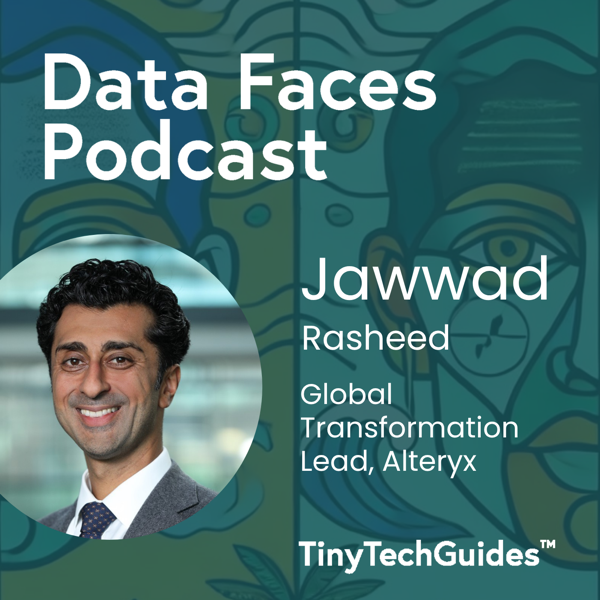
Jawwad Rasheed is the Finance and Financial Services Transformation Lead at Alteryx, with extensive experience guiding organizations through technology-driven change. Previously at EY, he specializes in helping financial operations bridge the gap between traditional finance and modern data-driven approaches.
In this episode
- Finance’s evolution from controller to cognitive agent
- Overcoming data perfectionism
- The rise of self-service analytics in finance
- Why continuous accounting will replace traditional finance cycles
- How AI and automation reshape the finance function
→ Read the full article: The AI-powered CFO: why finance must shift from control to cognition
Full transcript
Jawwad Rasheed 0:00 David,
David Sweenor 0:05 welcome back to data faces, the podcast that explores human stories behind data analytics and AI, I’m your host. David Sweenor, founder of TinyTechGuides, today I am super excited to be joined with Jawad Rashid, he’s Finance, Financial Service transportation at Alteryx. Jawad, welcome to the show.
Jawwad Rasheed 0:25 Thank you, David. Great to be here. Jawad brings you know so much experience of
David Sweenor 0:30 transforming financial operations through analytics and AI, he helps organization, organizations really bridge the gap in traditional finance and modern, data driven approaches. So today we’re going to explore how analytics and AI are really reshaping the finance function. We’re going to discuss some of the challenges that JOA seen, and maybe some insights about the future of this and the finance function. So Joao, can you tell us a little bit about yourself, your background, and you know what you’re up to over at Alteryx,
Jawwad Rasheed 0:59 absolutely. So my background, so I’ve spent my life predominantly in financial services. And within that spectrum, there’s lots of things that many fin serves would like to do, and more often than not, in recent years, a lot of that has been down to driving some level of change with technology, at the forefront of how people and resources can best come together to move finance forward. My life is very much work cross functional, though I focus predominantly, let’s say, within the finance spectrum. So the tags finance transformation are things that I’ve brought with me at altrix, and my role at altrix is to help shape our proposition within that domain of the Office of Finance. But unsurprisingly, it’s not a single sided domain. We work very much cross functionally in all enterprises we speak to. We often find finances at the crossroads. But you think about the conversations that we have with risk, Treasury, procurement, sales, marketing, that suite really comes together quite nicely when you look at some of the technology capabilities that many are looking to strive for, been authors about three years and, you know, very keen to share some of the things I’m seeing in the in the market and
David Sweenor 2:08 and the way forward as well. I appreciate that, Joanie, I mean, you have a wealth of experience. I think you’re formerly at EY was a can’t recall, but you know, finance function, historically, they’ve had so much data. You know, some people, they say they’ve been insights for so really, two questions, why is this? There seem to be prime to be data driven. And, you know, how are sort of modern analytics, and AI, perhaps, you know, changing this dynamic?
Jawwad Rasheed 2:35 Sure, yeah, I think there’s probably two dimensions to answer that. Well, one is, where has finance come from as a function, and the second is, what has technology done along that journey to also help act as a catalyst and help shape what finance could do. So let’s go back 2530, years, if any of us on the call can remember what that was like, but let’s imagine that we can.
Jawwad Rasheed 2:59 I can. Juan, you see the gray beard here? I certainly can. I can,
Jawwad Rasheed 3:03 I can remember it just about as well. But let me, let me, kind of paint a picture of what that, that path may look like. So finance historically has been the controller, consolidator, compliance led function one that manages cost, that does all the things to get the numbers right, keeps books and records in order. That’s been a stereotype that finance has had to bear and continues to bear as it moves on into into the decades to come. The question really is, well, what’s changed, and how has finance changed in the last 1520, years, and Where then is it going? So the big change has been not just the need to be a control room consolidator and manager of cost suppliers and those things, but really become a cognitive agent, and that’s an additional C that you can add along to that list. And what does that actually mean in practice? It means having the right capabilities, the resources, the tech and everything else, to be able to look at data sets, to be able to look at complex data set and improve the analytical capability for business and strategic decision making. The reason that’s come about, the reason why finance has moved in that direction is, unsurprisingly, the competitive environment that we’re in means is much harder to find an edge, and it’s much harder to think about how businesses can play a much active role alongside finance to do that best. So the role that’s really grown is the role of the finance business partner, the finance representative that sits in the business or works alongside the business to drive revenue growth, not just look at the cost and the control elements, which is equally important, but really be at the forefront of how can we grow the enterprise in the business. So we’ve seen that shift, that kind of growth, we wouldn’t call it that in capabilities, not just for financial accounting and financial operations, but much more management, reporting, giving information to people to be able to make decisions. That’s happened because we’ve had a huge dispersion data information is vastly available, and that responsibility is kind of each. Shifted a lot to the finance professions the other side, to that, other than what’s happened in the world of analytics and AI and automation. So again, let’s go back 1520, years. What we’ve seen is the traditional model where a finance professional would raise a request to it to a data engineering architect to define pipelines, curate the data, prepare the data, send the request back into finance. That model has been disrupted by the rise of hyper automation, by internal automation solutions, where those capabilities are now sitting within finance. So finance analysts are becoming data analysts in their own realm, and what that means is it can manage more intricate data pipelines and more complex requests. That adoption of those low code solutions is great. It means that, you know, there’s more things that finance professionals can do themselves. But it also means that the need for data scientists, and this hasn’t gone away. They just do much more complex stuff. When you bring those together, that opportunity is still huge. Like, what can we do with the vast amount of information that we have to remain competitive, to be more forward looking, to be far more predictive in terms of what we can do and where we can take the business, not just being the number checker on itself.
David Sweenor 6:14 Okay, that’s quite interesting. You said a couple really, really fascinating things. This, this notion of cognitive agent. So I’m hearing that finance leaders are, you know, maybe moving from historically sitting on the bench to really, maybe coaching, coaching the game, to use a poor sports analogy. And then the other thing I’m hearing is this rise of self service analytics. Does that introduce more risk to a company? You know, I spend a lot of time thinking and discussing AI, and specifically generative AI, which makes up things all the time. But now, if you have finance professionals that maybe used to talk to it, people that would send them a report, get data, what have you, and maybe they’re operating in spreadsheets. Does it change the risk profile? Or do you think it’s the same? They’re just they’re getting to it faster. They don’t the weight on somebody else
Jawwad Rasheed 7:04 as ever. It’s a balancing act, and I think this is an organizational decision on where does that balance lie in terms of freedom that they give in this instance, finance professionals to information and the government’s control that you need to manage that assessment so you’re never going to have a situation where you would open up all the information to all people and all parties, right? And the concept that there is certain information that certain people can own will still be maintained, and certain controls and checks still need to be in order, so that at any point in time, the position and performance of a company can be assessed easily, though, you’ve got to balance that with Well, if you don’t provide that level of access, and you don’t provide that level of assurance to people that know the information the best, what are you missing out on? And typically, the one you’re using out on is huge opportunity. That means that those requests, as mentioned previously, get clogged up more in the IT button now. The pace in which the industry all introduced and moved in the last 1015, years has far surpassed the rate at which change can be managed in organizations. So unless you have some concept of being more self serve, you are going to be further left behind if you end up with a much more waterfall approach to managing requests. So that’s the real model that’s shifted. That’s the change in the operating model. Is not to have this send request and come back and give me a response. It’s we need to work in a more agile manner. We’re finding that it sometimes actually sits within finance. So we have, you know, it domains as part of finance rather than Excel. So we can morph those, those those boundaries. We can morph those, those management lines as well. Okay,
David Sweenor 8:49 alright, so we need a governance framework. And I love that you said, you know, don’t be left behind if you have this ticket system. You know, you’re never, you’re never going to catch up. So maybe let’s talk a little bit about the role of leadership. Jawad, I mean, you’ve led countless transformation initiatives. What are the biggest sort of misconceptions that finance leaders have about implementing analytics in the function?
Jawwad Rasheed 9:15 Yeah, I think there’s, there’s many. The ones that resonate and come to mind the most are statements like, we need to get the data in a very good state before we think about analytics. And if we go again to the go back to where we’re coming from and kind of what the future holds, there will never be a perfect state where information is perfect for us to then consider the analytics that we can derive from it, the imperfect state will have to exist, and that shouldn’t be a blocker to be able to do more with the information that’s currently available. The reason that is is the notion of finance doesn’t have to always go down to the single dollar value to. Drive certain decisions. If you think about a group function, what they need is assurance on the direction that they’re taking, so you can have a margin of plus minus three 4% to be able to still make the right decision in the course of action. That doesn’t mean that therefore you need everything down to the nth degree perfect in order to make unidirectional views. So there is this old adage that we need to get everything right in order before we can do analytics, if anything, having the right initiatives to have a cultural shift where people understand the important analytics, and that’s very much aligned to corporate strategies, hierarchy of KPIs, because we’ll talk a little bit more about that later. If they understand that importance, then they’ll surface the issues with the data. In the process, they’ll surface what’s wrong with it. When they say, Hang on, this outcome doesn’t make sense. So use that as a catalyst. Don’t use it as a blocker. I think the other things are thinking that there is there will naturally be more advanced understanding if we get deeper analytics. So granularity Analytics doesn’t always lead to something that improves or advances the organ. It doesn’t always do that. It very much depends on what the organization believes are its most important set of metrics and KPIs, and almost like a driver trio set of hierarchies that define those KPIs with the rest of the organization. So an organization might say the three most important things to me are revenue growth, managing my cost income ratio, and minimizing PML sensitivity, volatility, and beneath that, you might have a number of other metrics and drivers associated. So if an organization is serious about that strategy, you’ll say, Well, what are the analytics that I need to give me information that I’m managing that against my corporate strategy and what’s the next level below? What’s the next level? That’s how driver trees work. So it doesn’t always mean that you have to have everything down to a very minute level of granularity to move forward. It really depends on how you’re defining your corporate strategy, your consider metrics and what the hierarchy looks like. I think the two other things become really important are the belief that somehow there is a one off fix that’s going to fix everything. And once we have that in place, then we’re good to go and we’re good for the future. The real secret source is to define a mechanism by which your reality is continually evolving, so that as your business changes, you have a method internally to adapt to that change with a varying degree of information analytics support. So any level of change or implementing analytics need to be thought of as a continually evolving mechanism and process in the organization, because businesses are never static, and your direction changes and your metrics change and your targets change. So you need something internally, an operating model to adapt, and a lot of that comes down to the cultural shift in acknowledging what the finance team needs to do, and what’s important to them to make that happen. So analytics are all good, but unless there’s a fundamental shift in the notion that our organization is incentivized to let our people come back to us with some interesting information that might help us, then you’re not going to lead to that level of change of continually evolving and growing this organization. So the cultural limit becomes hugely important. Joel, so lots of different things, I think, in that bag, but those are some of the things that I often see as stumbling blocks. Yeah, that’s super
David Sweenor 13:31 fascinating to me in that, you know, you met this, this notion of having a directional view, you know, you don’t have it. Have it down to the exact scent, you know, if you’re, you know, in some cases, you do for sure, but you know, you’re trying to help the business achieve its objectives. And so just having having that directional view, I think, is a wise advice for folks out there. So let’s talk about how we get there. You know, there’s this notion of the last mile of analytics, and we have analytics and turning insights into action. So how, how do you bridge this gap? For CFOs,
Jawwad Rasheed 14:12 yeah, that gap of I’ve got some information, or what do I actually do with it? Right? So, right? I think it comes going to the previous question and talk about the pitfalls, and I think the pitfalls lie in trying to work left to right. The left to right is saying, I’ve got some information, I’m going to drive some insights, and I work out what to do with it. So the better course of action is to think the right to left saying, what are the 10 decisions that I need to make? What are the 10 questions I’m looking to answer? How does that start at the top of the top of the house, and how does that extend across the organization? Knowing what those are, knowing what those actions are, will help define those KPIs and metric and then help confirm, do I have the data or the data gaps against those particular requirements. Assessing that availability of data, and then the process and technology to support also means it may uncover some of the organizational and efficient. Agencies, are you set up correctly? Do you have the right people to deliver against those metrics? So working the right to left is usually the answer here, in terms of, how do you turn insight into action? It’s not the last mile. It’s the first thing you need to consider saying, Give me the 1015, 20 things that I want to answer, and how do I make sure I’ve got everything set up in order for me to do that effectively, I did this exactly so work actually, for I can’t mention the bank, but let’s say it’s one of the global banks. Works across region and border. They do everything you know, corporate lending, Wholesale Banking, retail wealth management and the rest and their group finance team had this exact ask to a, define a series of metrics, B, produce them in some form of visualization, but also have the capability to drill into the information more and define further insight. So you’ve got the almost the 8020 concept here. You’ve got the, I’ve got, you know, 1520 things I need to absolutely know. I need some information. And there’s also a bunch of stuff that we probably don’t know at this point in time, but will uncover, having drilled a little bit more into the 80% the things that we really want to drive that will lead into a number of other threads, and we’re happy to explore that. That’s the notion that you need. Doesn’t need to be completely structured, saying we’re only going to want to answer 20 things. It needs to have the flexibility and the threat to do more. And that’s, you know, I talked about the evolving model, trying having analytics continually on. That’s the kind of internal operating model that’s needed to maintain that.
David Sweenor 16:30 Yeah, it’s really interesting. I always, you know, you don’t want to do analytics. I think, for the sake of doing analytics, I love that notion of, what are the business decisions that we need to make, and then work backwards there, from there. Do you think businesses have a handle on what decisions they want to make? Like, what’s the state of planning and leadership? Sometimes I see it all over the map. What about dear your perspective on that?
Jawwad Rasheed 16:54 I think the tension here lies between, how do the businesses align to enterprise strategy and group strategy. So if you’re a business, typically, you have your own targets around growth and P and L and how you maintain costs, etc. And that can conflict sometimes with how this stitches together with the overall enterprise strategy. And business sometimes run in their own direction and become almost too powerful within organizations. And we find that a lot and those leaders have a path to grow and may go into leadership positions the organization themselves in order to maintain that you do need a strong leadership at the top. And I think this comes down to saying, Well, what are the guardrails that we’re going to put on the business in order for them to have enough room to grow successfully? But in the I guess, with the right checks and balances, so they’re aligned to our corporate strategy, number one, the second is to probably maintain some healthy internal competition to do so. So I find that the the the model of incentivizing the businesses to be the pioneer to do something is hugely powerful. When you give the information a hand and saying, Hey, there’s a lot more that you can surface. Come back to me with the ideas I’m going to empower you to do so the self serve nature, what we’re talking about earlier, obviously helps do that. Strong leadership is required at the top. This is probably the starting point. But I think the the right boundaries and parameters need to set the business to work in, and the right incentive models need to be built in for those business leaders and finance leader support to help them along that. And I think that’s a healthy balance just maintaining that kind of internal competition and wanting to be, you know, the pioneer to show to everyone else have wonderful things you can do with information? Sure,
David Sweenor 18:42 yeah, I think there’s a definitely a lot of potential there. So we can’t have a podcast without talking about AI, at least, I can’t. So how do you see, you know, AI impacting, really, the role of, you know, the finance function, the analyst and involved, you know, over the next was going to say three years, but I don’t think we can see past next week right now with the state of the rate of change. So I just How do you see this unfolding? Sorry, that’s
Jawwad Rasheed 19:10 always the million dollar question. How is it going to unfold? I think to answer that question, we have to look at, well, where is finance going again, and then how does that impact the kind of talent of roles that exist within finance. So let’s imagine a more Nirvana state. The Nirvana state of finance may be something on the lines of, we don’t need cyclical nature of processes. And what do I mean by that organizations and public organizations, for example, disclose their numbers, monthly, quarterly, annually, and there’s a lot of effort that goes into that, you know, actuals and forecasts produce take a lot of time to assemble. There will come a point, and I’m confident that then there will come a point where things like your actuals and your forecasts can be produced instantly on demand, and therefore traditional cycles don’t become relevant. You. Kind of distinction between operational and analytical data begins to disappear, and finance organizations are currently meeting, trying to meet the demands of cyclical information. But really, the speed in which that information is needed by investors, by stakeholders, is going to speed up too. But if honest day is there is no concept of closing your books. You’re just always live and at any only time you can get a finger on the pulse on where the organization is. Imagine that is the direction that we’re moving in. It’s almost like, I guess, the term continuous accounting is, you know, comes to mind when you when you think about that, the talent that you need in finance doesn’t become the people that bring crunch and assemble all of that to produce some output. It becomes almost like the the human interface between machines and the owner of, let’s say, models, that may be responsible to produce some level of outcome. In order to do that, you still need to be a specialist in your domain. There’s no way that you’re going to be a review on a checker unless you understand what the output is and how it’s actually got there. So having transparency of information that’s passed through machines and sources and reach leads to an outcome. There is a role for the finance analyst to be a specialist in the machine, the model, or anything else that’s been used in intermediary to gain assurance on the output, because I mean the crunching of sales. It means they become almost the an owner of a system or a model or an application. And that continuous, continuous accounting concept, I think, emphasizes that role, because at any point in time, a direction may come in from investors or stakeholders, saying, I want to know X, Y and Z, you need to be instantly on point to be able to respond to those external requests, regular progress, investment requests. I think that, combined with premium placed on data scientists and adolescent storytellers into finance, will also very much come to life so the continued morphing of the data scientist roles within finance, and the blending of those roles to bring in finance SMEs with data science knowledge will become huge, huge demand and premium placed on that. Why? Because, again, as you increase the level of self serve, there’s more that finance can do, even now to double down on that use of hyper automation territory, automation to bring that, you know, Advanced Data Science capabilities back into the finance domain. And then you kind of think about, where else, where else could the finance roles go? I think, I think that tag of data officer alongside finance officer will become a lot more prevalent. So we might find, for example, the CFO has become cfdos, for example, Chief finance and data officer. In the same way that data officers and information officers are sitting a lot closer together, that whole realm of the C suite might suddenly morph into something that’s far more hands on, you know, joined at the hip, etc, even more than it is today, more to the point where some of those C suite roles become more into one. Technical literacy will be high as ever, as I think, as I think we know, and I think we will definitely be considering a leaner organization. But that leaner organization will lend itself, I think, more to the advancements that you have in becoming far more prescriptive and predictive in terms of where the organization could go, which lends itself to the analytic capabilities that need to be doubled down on finance,
David Sweenor 23:32 you know, I love this concept. You know, you mentioned this, this human, human in the loop, essentially, you know, in the finance function. Now, if we play the sport, you know, you’re obviously, there’s gonna be more automation to be more AI, more generative. Ai, doing things. So when we’re doing these things at scale, and we have, you know, millions of things going on in these large enterprises, how does the human know what to focus on? How do they know if there’s one hallucination that they don’t catch. It ruins the all the downstream activities from that. How is? How is the one to handle that? He was a big concern of mine, but loved your perspective on
Jawwad Rasheed 24:10 that. Yeah. So this is a question that comes up a lot, particularly in the financial services spectrum, for reasons that have existed in that world for decades. And let me kind of explain a little bit further. So a lot of the ask that you would need to provide assurance on particular, let’s say, if you’re a bank, is getting comfort on a model that’s used to, let’s say, produce a credit score or produce some kind of significant weighting to a particular portfolio that you’re managing. Now all these exposures that you are that you are running, for example, in your machine. Means need to have some level of assurance around the model that’s been built, and these are subject to external scrutiny by regulators. Are happy for years, the level of scrutiny that you face is very extreme, where you need to explain all the algorithms and the mechanism by which a number is being produced. If you consider what that means in the realm today around model governance and model ownership. What we’re asking is for finance specialists to also have domain knowledge in how you build a model, what that model is, and it could be a very complex model, for example, an LLM, or a fine tuned model that’s specific to the domain. Know how it works to gain assurance on the outcome, so that if there is an potential error around what that outcome is, they can investigate through a chain of thought to understand, well, what’s led to that point. The only way you’re going to do that is if you are part of the notion to help build and train that model in the first place, you can’t suddenly become a owner without having the mechanics at hand to know what’s gone into the construct of that so point of values have essentially become owners of important AI models and other models that help produce some outcomes and will face a huge level of scrutiny if they want to go down that road on being able to explain how an input with some complex algorithm it’ll lead to An output, and knowing where the potential errors may lie, that concept is a fundamental shift in where we are today that moves the finite analyst much more into the data scientist realm, and that’s where I think those data science capabilities become hugely valuable for final leaders. It’s the morphing of the two which becomes a powerful concept, and that’s where a lot of the talent demands, I think, will lie, you know, it’s interesting,
David Sweenor 26:43 though, Joel, just to push on that a little bit, you know, I think it’s fairly straightforward. If we have an algorithm that deals with with numbers, you know, it could be a forecast model, it could be regret, whatever it is, it can be very complex. But when we talk about, you know, an LLM, which is, you know, sensibly trained on the world’s data. You don’t, you’re never going to really know what’s in there. And let only maybe the largest organizations, they might build their own, and know exactly what’s in there. But for the rest of the world, you know, there’s very they’re going to grab one from somewhere, uh, provider, open source, whatever. So like, can you ever truly know so this just raise the amount of governance we need to have within these things.
Jawwad Rasheed 27:29 Can you ever know? The answer to that is it depends on the transparency you have around the chain of thought that’s led to an outcome and whether that can be explained with the model, you’re always going to be susceptible unless you, let’s say, build your own internal model with your own training data sets and the rest, you’re always going to have some level of risk for a, let’s say, open source model that is freely available in the market that you don’t truly understand the full complexities around all the tokenization that’s gone into produce, let’s say transformation with input to an output absolutely and the multiple parameters that used to do so. The only way that that you can think about improving that level of certainty is to think about smaller domain models that you can have in potentially larger volume, that are managed locally within the organization, with key model owners, that are built bottom up with trained data that’s used by the organization, where you go through that learning of testing the model, doing all the regression tests, improving the outcomes, to improve the level of certainty. I think we’re seeing that shift already in the market, already where more organizations are investing in developing their own domain specific models for very specific tasks which are cheaper to run. Don’t invest in ICOs and all those kind of things. But in order to do that successfully, I think you need to think about this completely bottoms up, and the low code solutions, I think, play a role in this. I mean, we can talk about the actual open source platforms, like your tensorflows that are usually critical to do model development, but also you just kind of get the training data right in the first place. So this same question, though, is posed by very simple models as well, as you said. You know, regression models get huge scrutiny in the market, right? Because they’re saying, Well, how do you prove to me that the linearity that you’re proposing here is is what it says it is for the next three to five years, right? That scrutiny won’t go away. I think the scrutiny will then be doubled down on those people that are developing and owning those models. I think that’s where the burden lies for the
David Sweenor 29:39 future of finance. Okay, all right, so maybe we have time for one last question. So you know, are there other technologies or trends that you think will have a significant impact on finance analytics over the next, I don’t know, few years, five years.
Jawwad Rasheed 29:58 I think if we talk about finance as a whole. Or not just analytics, then let’s look at where finance is going. So the concept of touchless transactions, I think, as I mentioned, will definitely continue and double down. One of the things that we’re probably going to see more of is more competition with major players to provide ERP solutions, and obviously they’re moving much more to hyperscalers through cloud based ERP automation, we’re seeing a lot more microservices and applications that sit on top of that, that offer some level of not competition, but let’s say, add ons which many companies are going down. So I think the need to be flexible with cloud based ERP solutions. The extension of microservices will definitely be a trend that continues. I think we haven’t seen enough of real, practical applications of distributed ledger technology and what that means of decentralized ledgers. Okay, the blockchain kind of revolution, we haven’t really seen that come into life enough, and there’s much more that can be done still, to get the certainty of transactions that are validated and verified through distributed ledgers decentralized systems. So hopefully that’s something that will really come into fruition now, particularly with the hyperscalers that we have, and I still don’t think we’ve done enough, even with the existing kind of hyper automation, Intelligent Automation application that we have in it, you get every organizations that I’m sure we both speak to have only really kind of scratched the surface here right, are still struggling to be able to really take a lot of the rule based commoditized and standardized processes in finance, automate them in a way that is as touchless as possible. There’s so much more that can be done just in that realm. So yeah, there’s the what does the future look like? We haven’t done enough of what we said we were going to do in the next 10 years, right? There’s a number of big ticket items out there that haven’t really come into full play and fruition that again, we need to explore and make practical use of. And as we do so, we’re getting a lot of natural kind of hype and interest and excitement around what the future holds with AI agents and chat bots and the rest and everything else in that hole. So the bag is full of goodies. Prioritization is important, and need to start bottoms up here.
David Sweenor 32:27 Yeah, and so Jawad, you know, for the finance professionals that are listening to this, you know, just final thoughts and advice, they’re looking at this. They’re looking at this technology landscape. They might be having difficulty understanding where to start. You know, what advice would you offer them, and how can they get a hold of
Jawwad Rasheed 32:45 you? So what advice we’re seeing curriculums change in finance. And back in my day, when you went through your accounting qualifications, or CFAs and seams and the rest, the path was kind of quite clear. You become accountant. You’ve got childhood accountant. You think about the different roles that you could play in finance, and it was almost quite a defined career. And now that kind of defined career is, I think, very positively, being challenged by doing more exciting things within the finance domain. And we’re seeing much more of the the data led skills and system led skills morph with the finance specialism. So I think the one, the one advice, really is don’t lose the need if there is that, that kind of fear that your knowledge is going to be eradicated. In order to become the finance specialist, you will also need to think about how you become that middle, middle person, almost the human middleware to technology, right and and that’s hugely important if the direction that we’re moving in is something that’s far more seamless and touchless when it comes to finance, it’s almost finance it’s almost finance as a service as opposed to finance as a function, right? That’s an important notary. So, yeah, I think, I think be be completely aware of the changes around you. Important to have the the foundational skills and qualifications. Still, it’s really wonderful that we can accelerate the way that we get those foundational skills these days, with all of the resources and meetings available to us, but understand the role that you have to be more of a an agent of change and an ambassador for finance services, rather than sitting in a functional language and finance
David Sweenor 34:35 Okay? Well, Joao, as always, this has been an enlightening and informative, delightful conversation. I appreciate you coming on the show, and I hope our listeners enjoy it. So thank you. Great
Jawwad Rasheed 34:49 to be on Thank you. David. Cheers. You.